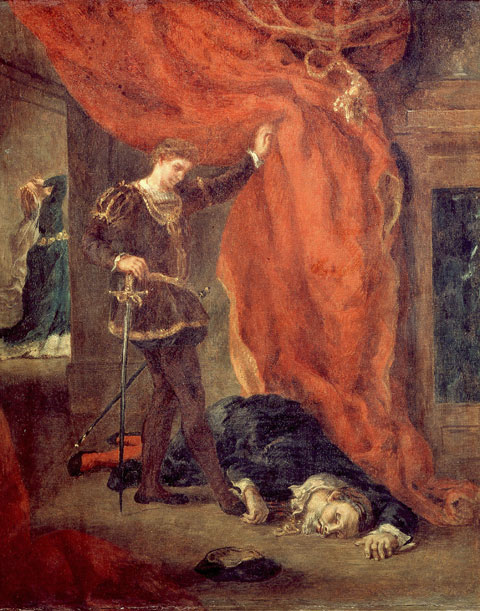
Hamlet Limerick

Hamlet Stands Over Polonius;
Eugène Delacroix (1855)
There once was a wavering Prince of Denmark
whose uncle replaced his dad as monarch.
The ghost of his dad
said, "Kill 'em, my lad!"
Too bad he took that stab in the dark.

BOOK REVIEW: Rilke: The Last Inward Man by Lesley Chamberlain

Rilke: The Last Inward ManRilke: The Last Inward Man by Lesley Chamberlain
My rating: 5 of 5 stars

Amazon.in Page

This book surveys the influences on Rainer Maria Rilke’s poetry, and makes the argument that Rilke was the last vestige of a mystically spiritual [Romantic or Romantic-esque] poetic line. Poetry was becoming more political and more influenced by nihilistic philosophies that eschewed inward investigations of meaning and self-realization, constructs that were seen as artificial and empty. Rilke bucked the trend, and while he did become an important poet, Chamberlain believes he paid a price.

The book discusses the influence of sexuality, spirituality, and artistic obsessions on Rilke’s poetry in great detail. It also talks about his life as an influence, both his family life (or lack, thereof) and the key years he spent in Paris. The last couple chapters tie the story together by clarifying what Rilke achieved and how it contrasted with prevailing trends.

If you’re interested in understanding more about the philosophical and spiritual forces impacting Rilke’s work, this is an interesting read. It’s not a biography, strictly speaking, but does unavoidably discuss Rilke’s life in some detail (though always through a literary / philosophical lens.)


View all my reviews

ESSAY REVIEW: The Kentucky Derby is Decadent and Depraved by Hunter S. Thompson

The Kentucky Derby Is Decadent and DepravedThe Kentucky Derby Is Decadent and Depraved by Hunter S. Thompson
My rating: 5 of 5 stars

Online Available Free: Grantland

Available within the collection: The Great Shark Hunt

This story is cited as the first work of gonzo journalism, a highly entertaining style of immersion journalism which takes liberties with objectivity and factual detail for comedic effect or heightened narrative impact. The Kentucky Derby is more setting than subject of the story. It’s Thompson attempting to throw together coverage of the horse race at the last minute for Scanlan’s Monthly, a magazine that existed less than a year. So, the story is as much Thompson racing around trying to con his way into some press passes as he and the graphic artist sent by the magazine go on a booze-fueled junket on and around the race track grounds.

The story is laugh-out-loud funny in places, and features Thompson’s irreverent and fast-paced style throughout. It really was something new. Thompson, apparently, thought he’d failed completely when he sent in the story, but the response indicated that – rather – he’d invented something new, something for which there would be a huge market.

It’s definitely worth reading this story, just don’t expect deep insight into the horse racing tradition of Kentucky.

View all my reviews

BOOK REVIEW: Cotton Candy by Ted Kooser

Cotton Candy: Poems Dipped Out of the AirCotton Candy: Poems Dipped Out of the Air by Ted Kooser
My rating: 5 of 5 stars

Amazon.in Page

Release date: September 1, 2022

The new collection by Ted Kooser is vibrant and playful. While imagery is front and center in these poems, it’s not the imagery of still life, but rather conveys the constant motion of all things. It’s that dynamism that makes for an uplifting read. Most of the entries are nature-centric, but a few – like the titular poem – delve into the world of man.

It’s a brief collection, consisting of about seventy short-form poems.

With so many mopey poetry collections out there, it was a pleasure to read one that enlivens and energizes. I’d highly recommend it for poetry readers.


View all my reviews

Prospero’s Limerick

There once was a bookish Duke from Milan
who, while distracted, was played for a pawn.
They thought him a twerp
his Dukedom was usurped…
Eventually, brains won out over brawn.

BOOK REVIEW: Borges: An Introduction by Julio Premat

Borges: An IntroductionBorges: An Introduction by Julio Premat
My rating: 5 of 5 stars

Amazon.in Page

Jorge Luis Borges was a thinking person’s writer, his works are both global and local (of Argentina or, specifically, of Buenos Aires focus,) are philosophical and literary and cut across scholarly domains, and they can also be arcane and fragmented. It’s because of this — combined with the fact that Borges work remains well worth reading — that a volume like this is beneficial. While the book does -in part – simplify and elucidate Borges’ work, it also expands on the Borges canon as a way to present the reader food-for-thought about ways in which one might approach the thoughts of Borges, oneself. The book is divided into two parts, one on the man and the other on his writings.

While this book is subtitled, “An Introduction,” I would suggest it’d be beneficial if one has read some of Borges’ major works (e.g. A Personal Anthology, “Ficciones,” The Aleph and Other Stories, “Selected Non-fictions,” etc.) Premat does offer some relevant background information when he references texts in order to help clarify his points, but not always enough to get the full understanding and less and less as the book progresses – so as to avoid redundancy. Borges’ work (tending toward short [even micro-] writings across fiction, nonfiction, and poetry) is challenging enough for this kind of study. As opposed to a novelist who would have a few major works to discuss, Borges has a vast body of writings that are no more than a few pages each.

As a reader of Jorge Luis Borges, I found this book to be beneficial and thought-provoking, and would recommend it for others who want to expand the depths of their understanding of this Argentinian writer and his ideas.

View all my reviews

BOOK REVIEW: Dwellers by Eliza Victoria

Dwellers: A Novel: Winner of the Philippine National Book AwardDwellers: A Novel: Winner of the Philippine National Book Award by Eliza Victoria
My rating: 5 of 5 stars

Amazon.in Page

Release Date: August 16, 2022

This well-crafted tragedy features a form of magic handed down within a family that allows one to shift one’s consciousness into to the body of another, though this bodily colonization kills the original owner. While it might seem like just another sci-fi / fantasy plot device designed to make for an interesting adventure, the book conveys lessons about the discontentment and the inability to escape oneself. It’s also worth noting that despite its speculative fiction / fantasy gimmickry, the story is also a taut drama of family dysfunction.

The narrative isn’t linear, and this allows the story to begin in medias res, with the protagonist / narrator finding himself in the fire after having leapt from the proverbial frying pan. Two crucial mysteries are solved over the course of the book. The first mystery is why two young men would jump into new bodies, apparently with such urgency as to not realize the bodies they were taking possession of belonged to people whose lives were a horrifying mess. The other mystery is why those lives were such a mess in the first place.

I found this story intriguing and it kept me reading with an interest in discovering the base truth. The book’s beginning is a bit disorienting because all one knows is that the two characters living in the house aren’t it’s rightful owners, but rather mental settlers of unknown identity who’ve taken possession of the occupants’ bodies, and — speaking of bodies – there’s a mystery corpse in the basement freezer. The body in the freezer is both an excellent hook, and also the means to create a pause in any reader who might tend to think, “if I could, I’d definitely change bodies.” Despite the nonlinearity and the snarl of characters within the bodies of other characters, the book is readable; i.e. it’s not as challenging to follow the thread of plot as it often is in books with such narrative complications.

If you enjoy philosophical speculative fiction, this book is well worth looking into.

View all my reviews

A Midsummer Night’s Limerick

Four Athenian youths fled out to the trees,
lacking the love geometry to put hearts at ease.
It might've been tragic,
but Puck worked his magic.
They returned by twos, not ones or threes.

BOOK REVIEW: Border Zone by John Agard

Border ZoneBorder Zone by John Agard
My rating: 5 of 5 stars

Amazon.in Page

This amusing collection of poems combines autobiography with biography. It’s autobiographical in that it shines light on the poet’s experience growing up in the Caribbean and then living as an expat in the United Kingdom. It’s biographical in that it reflects the author’s interests in people and history, interests that are most boldly combined in the book’s final poem, “Casanova the Philosopher,” a long poem (though broken in to forty bite-sized chunks) that riffs on the life and legend of Casanova. The poems draw on literature, historical events, and mythology, and also include a few elegies.

The lighthearted tone — even when dealing with evocative subjects such as racism, censorship, and death – makes for a read that is at once pleasant and thought-provoking. A couple of my favorites were “The Migration of Coconut Water,” which plays with the panacea-like qualities that people attribute to their local favorite consumables, and “We Mosquitoes” which is from the perspective of the annoying little malaria-vectors.

Much of the collection is rhymed verse, often featuring the lyrical qualities that come of short lines. If you enjoy poetry with and international flavor and no shortage of humor, this collection is well worth checking out.


View all my reviews

BOOK REVIEW: God Bless You, Mr. Rosewater by Kurt Vonnegut

God Bless You, Mr. RosewaterGod Bless You, Mr. Rosewater by Kurt Vonnegut Jr.
My rating: 5 of 5 stars

Amazon.in Page

This novel presents a satire of American socio-economic existence. It spends much of its time poking fun at old money folk (trust fund kids, as they’d be called today,) but the book has plenty of barbs to go around. The story centers on Eliot Rosewater, the head of the Rosewater Foundation, the charitable arm of an old money robber-baron kind of family corporation. Eliot is cut from different cloth, however. He’s in love with the work-a-day blue collar American, and does everything in his power to eliminate his separation from such people, including obsessively working with volunteer fire departments, setting up his foundation in his hometown (Rosewater, Indiana,) and making the Foundation an extremely personal organization that gives what would today be called micro-grants to ordinary citizens for ordinary uses.

Opposing Eliot Rosewater is a lawyer named Norman Mushari who’s made it his mission in life to have Eliot proven insane so that he can have the Rosewater Foundation fortune shifted to Fred Rosewater (of the middle-class Rhode Island Rosewaters.) The challenge is knowing whether Eliot is truly insane or not, even Eliot, himself, doesn’t always seem clear on the matter. For many, such as Mushari, just the fact that Eliot is acting in opposition to the societal norm (e.g. setting up in Rosewater, Indiana v. New York or Chicago and not making big grants to corporations and colossal NGO’s but rather giving a few hundred dollars at a time to residents of Rosewater) is proof enough. And, if Eliot is crazy, is it because there’s something wrong with him, or that there’s something wrong with the world.

This book is hilarious, and the last chapter leaves the reader with a great deal to mull over. I’d highly recommend this book for all fiction readers.


View all my reviews