
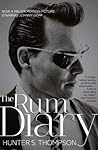
BOOK: “The Rum Diary” by Hunter S. Thompson

The Rum DiaryThe Rum Diary by Hunter S. Thompson
My rating: 5 of 5 stars

Publisher Site – Simon & Schuster

Thompson wrote this novel in the early 60’s but did nothing with it until the late 90’s when — apparently — he needed the money. That doesn’t sound like it would bode well for a work of literature, but it grew on me. The story follows a roughly six-month period from the time a journalist, Paul Kemp, arrives in Puerto Rico to start work at an English language newspaper in San Juan to the time he departs in the wake of the paper’s demise.

The plot is loose and late — by that I mean the most emotionally resonant events are clustered toward the book’s end. This doesn’t mean that it’s a slow-burn through the beginning and middle, per se. There is a lot of decadence and merriment going on among the protagonist and his colleagues that makes for an amusing read. Also, there is a bit of sexual tension as Kemp arrives on the island on the same plane as a pretty blonde who turns out to be the girlfriend of one of his co-workers (and thus verboten,) a girl who’s bad news, yet still the object of simmering obsession.

I found this to be a fun read and would recommend it for those curious about the hedonistic lifestyles of tropically based journalists in the 1950’s. Thompson apparently did spend some time in San Juan in 1960’s and the book is said to be loosely influenced by journalists he met and events that happened there.

Note: There is a movie. I have not seen it. Judging by the trailer, however, I would say it’s a quite loose adaptation beyond the setting and some of the characters in broad strokes.

View all my reviews

BOOK: “Tell My Horse” by Zora Neale Hurston

Tell My Horse: Voodoo and Life in Haiti and JamaicaTell My Horse: Voodoo and Life in Haiti and Jamaica by Zora Neale Hurston
My rating: 5 of 5 stars

Author’s Book Site — Zora Neale Hurston Trust

This is a beautifully written and fascinating look at Jamaica, Haiti, Voodoo, Zombies, and the sinews that run between them. The first half of the book reads largely like a travelogue of, and introduction to, Jamaica and Haiti, respectively. In this half, Voodoo is only mentioned here and there as an aside. There is much more discussion of culture, race, and politics, notably the disheartening politics of Haiti. (I should point out for those unfamiliar with Harlem Renaissance figures, this book dates to the 1930’s — so current affairs are not addressed, but — unfortunately — Haiti has a long history of troubles.) The second half of the book delves much more intensely into Voodoo and the supernormal happenings broadly connected to it. Hurston’s exploration is neither as a tried-and-true believer, nor as a hardcore sceptic; rather she takes a more journalistic objectivity.

The language of this book is splendid, and Hurston produces many a quotable line. It is true that the subject matter, Voodoo, is extremely compelling, but this book is more than just a collection of tales of magic, superstition, and the weird. It also offers depth of insight into the cultures of these countries and their peoples. Hurston frequently mentions the differences between classes on the matter of Voodoo, the upper-class rejecting it as mere superstition and the lower classes often engaging with it as a way of life.

I’d highly recommend this book, not only for those interested in learning more about Caribbean Voodoo practices, but also for travelers with an intense curiosity about culture.

View all my reviews

BOOK REVIEW: Border Zone by John Agard

Border ZoneBorder Zone by John Agard
My rating: 5 of 5 stars

Amazon.in Page

This amusing collection of poems combines autobiography with biography. It’s autobiographical in that it shines light on the poet’s experience growing up in the Caribbean and then living as an expat in the United Kingdom. It’s biographical in that it reflects the author’s interests in people and history, interests that are most boldly combined in the book’s final poem, “Casanova the Philosopher,” a long poem (though broken in to forty bite-sized chunks) that riffs on the life and legend of Casanova. The poems draw on literature, historical events, and mythology, and also include a few elegies.

The lighthearted tone — even when dealing with evocative subjects such as racism, censorship, and death – makes for a read that is at once pleasant and thought-provoking. A couple of my favorites were “The Migration of Coconut Water,” which plays with the panacea-like qualities that people attribute to their local favorite consumables, and “We Mosquitoes” which is from the perspective of the annoying little malaria-vectors.

Much of the collection is rhymed verse, often featuring the lyrical qualities that come of short lines. If you enjoy poetry with and international flavor and no shortage of humor, this collection is well worth checking out.


View all my reviews