BOOK REVIEW: The Simpsons and Their Mathematical Secrets by Simon Singh

The Simpsons and Their Mathematical SecretsThe Simpsons and Their Mathematical Secrets by Simon Singh

My rating: 4 of 5 stars

Amazon page

It will come as no surprise that television comedy writers are disproportionately Ivy League educated individuals. What may come as a surprise is that a number of comedies—particularly animated series—have a large number of technically and mathematically educated individuals on their writing staffs. Mathematicians, computer scientists, engineers, and physicists regularly work in hidden humor that only a math geek could love—or get—into episodes of The Simpsons and Futurama. Singh’s book explores the subtle mathematical references and humor that swoosh over the heads of most viewers.

While the title doesn’t mention Futurama, it should be noted that there are four chapters devoted to that series. (This in contrast to the 14 chapters dedicated to the much older show, The Simpsons.)

Let’s assume that nerds can be categorized into three sets: nerds, super-nerds, and mega-nerds. This book takes as its core demographic the largest of these groups, run-of-the-mill nerds. How does one define these three apparently arbitrary designations? A mega-nerd would see the humor in the equation scrawled on a blackboard in the background as he (or she) watched an episode of The Simpsons. (All Hail, King of the Nerds!) A super-nerd wouldn’t get many of these jokes as he (or she) watched, but he would freeze-frame the scene, and would have enough mathematical skill to decipher the cryptic jokes. A regular nerd misses the joke altogether, but is interested enough to take the time to read an explanation of these obscure references. (These categories are contrasted with the typical TV viewer, who doesn’t get the joke, but is blissful in his ignorance.)

While much of the book is devoted to these series’ mathematical gags—which range from the elementary to the arcane—Singh offers interesting insight into the writing process on shows with a team that mixes traditional writers (English and Literature majors) with mathematical types. One of the most interesting behind-the-scenes questions is why mathematical writers work so well for the The Simpsons? Futurama, being a science fiction series–and thus aimed at the geek/nerd nexus, isn’t so much a surprise, but Homer and his family don’t have any motive to be particularly mathematical—with the possible exception of the occasional reference by brainy Lisa. The chapters are arranged by various mathematical themes, such as prime numbers, pi, statistics, topology, etc.

There are some ancillary sections that deserve mention. First, there are a series of “quizzes” that consist of jokes with the set ups written as the question and the punchline serving as the answer. These jokes get progressively more complicated—starting with crude elementary school jokes (e.g. “Why did 5 eat 6?”) and ranging to the truly obscure (e.g. “What’s big, grey, and proves the uncountability of the decimal numbers?” The answer, if you’re wondering, is “Cantor’s Diagonal Elephant.”) Second, there are five appendices that are used to go into more mathematical depth on some of the topics under discussion. This is written as a book for the masses, and so attempts are made to minimize and simplify equations. There are equations and graphic representations, but they’re kept at a relatively elementary level of mathematics.

I enjoyed reading this book and would recommend it for anyone who—like me–kind of likes mathematics, but finds it more palatable with a spoonful of sugar. In this case, the sugar is the discussion of the humorous scenes of these two comedies.


View all my reviews

TODAY’S RANDOM THOUGHT: Blind Dog

IMG_0606

This dog followed us around during our tea plantation walk in Munnar. It was a fine-looking dog with a warm disposition. It seemed quite healthy, except for the fact that it was missing its left eye.

This made me think. If you take in a blind dog, does that make you its seeing eye human?

TODAY’S RANDOM THOUGHT: Hitler’s Final Victory

Source: German Federal Archives

Source: German Federal Archives

Hitler killed the short-stache (a.k.a. the “toothbrush mustache.”) Imagine that, almost 70 years after his death, he still holds power over people’s decisions about facial hair.

This is a misplaced take-away lesson. It’s the unbridled narcissism, the icy hatred, and the irrational exuberance in the power of evil of Hitler that should be abandoned (yet, somehow, those intangibles still quietly exist.) It’s not the superficial aspects of Hitler that should be shunned, but the ones at the bastard’s core.

I’m not saying the toothbrush-stache was a good look. On the contrary–as one who has had a mustache his entire adult life and has worn a beard now for several years–I’m a little offended by the lack of commitment to one’s choice of facial hair that the toothbrush-stache represents. (Incidentally, I feel the same about the sole patch and mutton chops.) In my mind, one should go full-stache or go home to shave.

Still, there being no accounting for taste, I think those individuals who would otherwise find the short-stache appealing (i.e. you know, indecisive types who wear culottes and eat with sporks) should revive the toothbrush mustache as a big fuck-you to Hitler–don’t let tyrants boss you around from the grave.

Toothbrush mustache admirers of world, unite!  (No, I won’t be joining you.)

DAILY PHOTO: Creepy Flagpole Holder?

Taken in March of 2014 in Madikeri

Taken in March of 2014 in Madikeri

We decided that the “socket” in this equine’s anatomical correctness–so to speak–was for insertion of a flag pole. Which seems mildly inappropriate and–given the horse’s sly stare and broad grin–more than a little creepy. Perhaps that was not the intention at all, but one has to assume there’s a reason he wasn’t given “the Ken doll.”

The Prostate Exam

Before moving to India, I got a stem to stern medical checkup. This included the dreaded  first prostate exam (emphasis on “prostate exam” not on “first” as I don’t suspect the process gets any more pleasant.) When my wife and I had both been on my work insurance, we had a HMO that said they didn’t do prostate exams for white males until they were 65 and older (or postmortem, if they died of prostate cancer, whichever came first.) That should’ve been a clue that they were a bunch of bean-counting quacks, but as I was less than eager to get said exam I took their word for it.


Anyhow, the area where I lived was fairly close to Emory University, and my new doctor’s office was even closer. (For those of you unfamiliar with Atlanta or Georgia–Emory has one of the preeminent medical schools in the Southeast and for some specialties the country) When I got my physical, after the preliminaries conducted by the nurse, I was next seen by what–for lack of a better term–I’ll call a junior doctor (ER went off the air too long ago for me to remember the proper terminology). This was a poised and professional young woman–I know not whether a medical student or recent graduate from Emory medical school.


She reviewed my medical history and did a few rudimentary “stick out your tongue and say ‘ahh'” kinds of things.   Then she told me that my doctor–a man I’d never met before–would be into look me over and write the prescriptions for the meds that I needed for coming to an area prone to malaria and other plagues.


She then asked, “If you’d prefer, your doctor can do your prostate exam. Otherwise, I’ll do it. Do you have a preference?”


I said, “Having never met the man, and at the risk of sounding sexist, I’m going to assume that you’ve got daintier hands. Ergo, you’ve got the job.”   To which she replied, “Yeeeah, me,” in the feeblest monotone voice, her tone suggesting that she might not be as thrilled by the prospect as her words would have indicated.


I had the exam. It was quick, painless, but–I’ll not lie–not without the inevitable awkwardness associated with one person having a hand–or part thereof–lodged in another person.


For those of you who know me, it goes without saying that my doctor turned out to be the most petite homuculus of a man. (You know what they say about what happens when you ASS-U-ME, U get the hand of  a bigger ME in your ASS.) However, you pays your money and you takes your choice. I wouldn’t have felt comfortable asking the doctor and intern to place their palms together to see who had bigger digits.

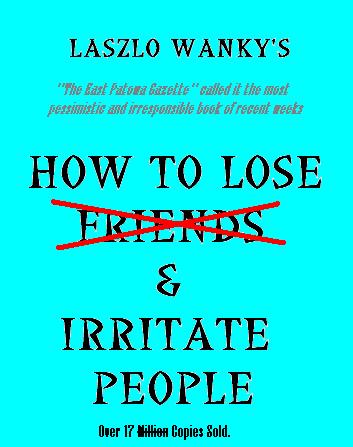
BOOK REVIEW: How to Lose Friends & Irritate People by Laszlo Wanky

Cover_How_to_Lose_Friends


How to Lose Friends and Irritate People by Laszlo Wanky

My Rating: 5 out of 5 Stars

Amazon Page


Wanky pays an homage to Dale Carnegie’s seminal self-help book by calling it, “a book for its time–that time being one in which people were lonely, pathetic, and didn’t understand social networking.” The author’s central premise is that we live in very different times, and today people are inundated by Facebook friends they neither like nor find interesting. Furthermore, Wanky goes on to argue, gone are the days when likable people are  liked. We live in an era in which douche-bags and drug-addled celebrities are gods among men. The book offers many headline examples, such as how Miley Cyrus’s career crashed as the sweet and admirable Hannah Montana, but then she caught her second wind by adopting the persona of a meth-addicted prostitute.


Roughly half of the book is dedicated to how to find success in defriending unwanted virtual amigos. Wanky suggests that the usual tactic of subtly “un-adding” people almost always fails because people are too “wussified” to make it stick. The only effective strategy, according to the author, is to trick others into removing you from their list of pseudo-friends. Be forewarned, however, being uninteresting and annoying is not enough–one must be spectacularly despicable. This is hard for most people–whom Wanky calls “the sychophantic masses”–because they slobber over being liked. Wanky devotes three chapters to helping people get over their love of being liked. The most cogent of these chapters is, “Kim Jong Un or Gandhi: Who Ya Wanna Party With?


The aforementioned chapters also help set up Part II of the book, which explains how one can put a skyrocket on one’s career by borrowing the techniques of the likes of Howard Stern, Rush Limbaugh, and Piers Morgan. Wanky shows how, like these individuals, one can be thoroughly unlikable while having people hang on your every word.  Again, three chapters form the core of this part of the book. They are: “Loud = True”, “Bombastic Fact Picking for Beginners”, and “Your Hairstyle Makes You Sound Stupid.”


I’m not going to pretend that Mr. Wanky’s language is fluid or graceful.  The author’s prose is colloquial… at best. A typical sentence–seen in chapter 8–is, “If ya wanna get with the boom-chiggy-booms, you gotta shout those fart-monkeys down, cause if they hear ’em they’ll all be like, ‘who’s the fart-monkey now, bitch, who’s the fart-monkey now?'”


The book’s strengths include its incredible brevity. Weighing in at only 26 pages, four chapters consist entirely of 27-syllable haiku. It also features fine graphics such as a picture of a “fart-monkey” that any grandmother would be proud to stick on their refrigerator. (The color choices were bit odd, but Wanky was clearly limited to the 16-color box of Crayolas.)


I’d recommend this book for anyone who doesn’t like friends and who really despises people’s indifference toward them. I have no doubt that by following Mr. Wanky’s recommendations, one can become a thoroughly loathsome individual in a matter of days.


Lastly, Happy April Fool’s Day.


Two Things To Keep On You In India

20140316_160803If you though I was going to say “Passport and FRRO Registration”– WRONG! First of all, that would make the most boring blog post ever–not a distinction for which I have aimed (but I wouldn’t turn down the award for it, if it comes with a cash prize.) Second, I’d keep those items some place safe–like a hollowed out Ganesh (but that’s not where I keep mine, so don’t get any ideas.)

1.) Tiny pictures of yourself: After about the ninth time I went someplace random and was matter-of-factly asked for a “passport size” print or a “stamp-size” print, I asked whether it was common for Indians to carry a bunch of photos of themselves around on their person–because there seemed to be such a presumption that I would have a stack of selfies on hand at any random moment.  The answer was “Yes, yes we do keep photos on hand.” Not only is it common to carry a small pack of passport pics–some keep a stock in various sizes. Long story-short, a lot of places will want a photo besides government offices–more than you might expect.

Americans just take a billion pictures of themselves and post them to Facebook, and would be self-conscious about the apparent narcissism of carrying around physical pictures of oneself. The only Americans who carry physical pictures of anybody are grandmothers who haven’t figured out how to use their phones (admittedly, a large but shrinking demographic) and they carry pics of munchkins–not themselves.

2.) Change: That’s “change” as in coins and small bills–I’m not getting abstract on you. India has a crisis of change–still not being abstract. I’m not just talking about the auto-rickshaw driver who negotiates a fare that is merely twice the metered rate, and then when you get to your destination they inform you that they have no change for a 100 rupee note (and because only someone who values “the principal of the matter”  at more than 30 cents will argue, you end up paying too much.) I’ve gotten the evil eye at such places as restaurants, stores, and even the Metro counter (who should have coins in stock if not the metro counter?) In India, there isn’t a strong expectation that the business will be the one who makes change in a commercial transation–like it is in …well, every other place in the world that I’ve visited.

I’m not sure if this change crisis is created by an inability of the Central Bank to calculate how much small currency to release into the economy, or whether the vast number of beggars are bogarting all the coin.

At any rate, if you are a nice guy and always make change for every business you deal with, you will inevitably end up in a situation in which you desperately need a pay toilet and the smallest money you have on you is a 1000 rupee note.  As paying 1000 rupee to visit the most disgusting place on Earth (a third-world public toilet) is demoralizing, I suggest you horde change like everybody else.

Yoga Instructor / Lotto Girl–A Most Dispicable Combination

A Product of Non-linearity.

A Product of Non-linearity.

Today, I did Power and Hatha Yoga classes back to back. The instructor for both these classes was highly-skilled, knowledgeable, and challenging–which is to say, somewhere between a Marine Corps Drill Sergeant and the Marquis de Sade in terms of capacity to bring the pain. If there’s not something that threatens to collapse  me into a disheveled  heap of limbs in each class, I risk getting bored. So when I say this yoga instructor is sadistic, I mean it in the most appreciative way imaginable.  And not appreciative  in that “Thank you, Sir. May I have another?” Animal House sort of way, but genuinely.

All that being said, there’s one particular piece of Sadism that stands above the rest, and that is a predilection for non-linear counting.

Imagine you’re in a pose, say a back bridge with one leg up in the air. The teacher has been counting down in the usual fashion taught to school children. You are quaking and your muscles are burning, but, from the integers being rattled off, you suspect you’re near being able to release and seek the momentary solace of some other unforgiving act of contortionism that will eventually have a different part trembling. However, sensing she needs more time to make a circuit of corrections, the teacher abandons our much-beloved linearity and begins rattling off numbers like the weather-girl who makes the nightly lotto drawing. (e.g. “and 4…3…37… 19…”)

Wait, what?   I can’t cry–at least not first. I’m the only man in room. Besides, sobbing might dislocate something.

Now, I’m aware that a true yogi wouldn’t give a whit what random numbers were being “counted” off. Said yogi would find his bliss in the asana and melt into oneness with the universe. However, being closer to the type of Yogi who likes to steal pic-i-nic baskets than the kind whose “Kundalini is awakened” (I’m not even sure what that means; I hope it’s not dirty), I still find it presents a challenge.

DAILY PHOTO: Fruity Flower Sculptures

Taken January 26, 2014 at Lal Bagh Gardens

Taken January 26, 2014 at Lal Bagh Gardens.

So, I spent an hour Googling what the correct term was for a “sculpture” made out of flower blossoms. I’m sure there’s some lingo used amongst the Flower & Garden Show crowd (but you must need to know the secret handshake.)

However, after viewing the websites for many flower shows around the world from Philadelphia to Hong Kong, all I was able to learn is that–whatever they are–these examples from the Bangalore Republic Day 2014 Flower Show… well, they aren’t good. I hesitate to say this because someone may come back and say, “You monster, those [whatever they are] were constructed by children with Down Syndrome.”

If that is the case, I  stand corrected and must say that those are the finest examples of [whatever they are] that I have ever seen made by children with Down Syndrome.  I may also be showing my ignorance of Down Syndrome because perhaps children with Down Syndrome do ikebana like Rain Man counted match sticks–which is to say freakishly well.

The [whatever they are]  just seem a little misshapen compared to those from, for example, the Hong Kong Flower Show.  If the Hong Kong arrangements are the X-Box 360 version, these are clearly the mid-1980s Atari Pong version–not that there is anything wrong with that.

First World Problems Are So Adorable


How deep is it? No one knows.

How deep is it? No one knows.

In the interest of enhancing global understanding and camaraderie, I’ve built a translator of common first world (FW) problems–putting them in terms of their Rest of the World (RoW) equivalents.

FW: This food needs salt.
RoW: This food needs food.

FW: My health insurance premiums went up $20 per month.
RoW: My right foot, which recently turned from purple to black, just fell off.

FW: My car is in the shop again.
RoW: My right foot, which recently turned from purple to black, just fell off.

FW: It’s raining again today.
RoW: My house was washed off its foundations and is currently floating down the Brahmaputra River.

FW: Looks like those devils from the other party got a majority in the legislature.
RoW: This coup was particularly bloody.

FW: Squirrels are getting into my bird feeder.
RoW: A tiger ate my family.

FW: A traffic jam made me late for Pilates class.
RoW: While limping through the Kyber Pass to get antibiotics for my right stump, I was socked in by an unanticipated blizzard.

FW: My GPS says this road cuts under the interstate, but now I’ve got to go around.
RoW: What’s GPS?