POEM: The Missing Link

cafe_cellphone

I called you on the telephone.

It turned out weren’t at home.

“How can this work, if you won’t pick up.”

I messaged, sipping coffee from my cup.

“I’m right here,” a voice did say.

A hallucination as clear as day.

This was no time to go insane.

Hitting redial, I tried her in vain.

No answer. I feared I’d become unstable.

“Hey, lunkhead, I’m right across the table.”

The voice matched by a pounding sound.

The angry poltergeist had me spellbound.

Then a splash of water hit my face.

Lashing out, angered at the disgrace.

“Oh, hey, how long have you been there?”

Rolling her eyes in a dumbfounded stare.

5 Hyphenated Yogas That Miss the Point of Yoga

The laissez-faire and easy-going yoga community has spawned some phenomenally ridiculous mergers. I have “yoga” as a term on Google News, and almost every week I get fed a new example. I’m not saying every new approach to yoga is bad, but there’s one disturbing trend–i.e. the distraction yoga.


In the title, I refer to “hyphenated yogas,” but what I’m really ranting about is “distraction yogas.” A distraction yoga is one in which an element is brought into the practice so that one doesn’t have to keep one’s mind on one’s breath, alignment, and / or mental state. (Because who wants to think about that shit when one can be thinking “Wow, that kitten sure is cute.” or–believe it or not–“This beer has hoppy undertones.”)


Now before I get accused of hating puppies or beer, let me point out that nothing could be further from the truth. What I’m ranting against is the notion that you can marry any two good things and make a great thing. If you don’t believe me, please allow me to dip my nachos in your banana split. See, there are plenty of things that are awesome independently that make abominations when forced together.


I’ll include links as I go, lest you think I made this stuff up for hilarity’s sake.


5.) Beer Yoga: This is one of the most recent and intriguing distraction yogas. I’m not saying that one needs to follow a strict Vedic approach to life to practice yoga, but–come on–could you stop drinking for a couple hours to pretend your body is a temple (or at least that it’s not sitting in a trailer park with the windows busted out.) Unless “calf slaughter-yoga” catches on, it’s hard to imagine a less yoga-like practice than consuming intoxicants during the practice of yoga. By the way, there’s also a marijuana yoga, but I’ll lump these together as intoxicant yogas.

beermug


4.) Goat Yoga: This is one of many “animal yogas.” Like the others, the point is to have cute creatures around. How it’s supposed to help one’s yoga, I can’t fathom. Actually, I can fathom the suggested logic, probably something to do with calming and engendering feelings of compassion and well-being. But, ultimately it’s distraction by cuteness. Note: you can also do yoga with cats, dogs, horses, and probably river otters.

goatyoga-461x346


3.) Karaoke Yoga: Talk about distraction–nothing better than pounding music and reading a prompter to keep one’s mind off that ache in one’s hamstring.

karaoke_yoga


2.) Rave Yoga / Club Yoga: This might be a cheat because it’s similar to the previous one on the list, and I’m trying to lump these together so as to not be too repetitive. However, it’s not exactly the same, and is the perfect example of a distraction yoga. (There’s also Harmonica yoga and other musical yogas, but I won’t double-dip anymore.)

bombay_yoga-2e16d0ba-fill-735x490


1.) Tantrum Yoga: It wasn’t easy to determine whether I’d include this one or not. On the one hand, it’s not a distraction yoga in the sense that the others are. On the other hand, it takes the award for being least yoga like on the grounds that it’s not about dispassionately witnessing one’s emotional state but rather feeding one’s negative emotions. Note that I don’t group laughter yoga into the same class. I’m not sure whether laughter yoga is beneficial (or to what degree it’s a yoga), but I know that many people benefit from it because it bolsters positive emotional states.

tantrum


Now, one may have noticed that there are many seemingly strange (hyphenated) yogas that I haven’t mentioned. I haven’t said a thing about surf board-yoga, stripper pole-yoga, or acro-yoga–and I specifically excluded Laughter Yoga from the wrath of my rant. That’s because this isn’t a rant about people being innovative or non-traditional, it’s about people missing the point of what yoga is supposed to be (i.e. a means to quiet the mind.) I don’t know whether I can see myself doing yoga on a surf board or a stripper pole, but I’m certain that one has to give it one’s full attention–it’s not about finding a distraction to make yoga more palatable to hipsters.

5 Ways to Flummox Your Adversary

5.) Acknowledge that there is a universe in which his or her point is valid: However, tell your adversary that this is contingent upon theoretical physicists being correct that there are an infinite number of universes, each governed by a different set of laws–at least a some of which would have to be stupid. This is called the bubble-verse flummox.

bubbleuniverses


4.) Challenge him or her to a duel: This will require that you carry a well-worn leather glove wherever you go. For it’s not so much the words that produce an effect as the slap across the cheek. You are going for decibels. You can’t pull this off with a cotton glove, a rusty metal gauntlet, or a stiff leather work-glove. You need the glove to have some weight and to be able to put some whip into it. This is called the Aaron Burr.

gloves


3.) Talk to your adversary as if that person were a beloved household pet. This will involve both head tousling and inquiries as to, “Who’s a good boy?” It’s called the canine gambit.

dog


2.) Ask your adversary whether he or she is trying to seduce you. It doesn’t matter how mundane or technical the subject is (trade pacts, non-proliferation agreement, etc.), this one is almost guaranteed to shut down opposition. It’s called the Mrs. Robinson.

seduction


1.) Say, “The game is afoot!” and then just walk off. It’s very important that you don’t respond to any question about what this means or whether you’re insane. Furthermore, one must break off all contact with the adversary for several days there after. Stew time is necessary. I call this one, The Sherlock.sherlock

A Tongue-in-Cheek Poem

I know you feel my sex appeal

despite the lack of earnest squeals.

You should know, despite my glow,

the fans rarely stop to say, “Hello.”

Am I not a rockstar, superhero

because my visibility ranks near zero?

In this hour of superpowers

I think I’ll stop to sniff the flowers.

BOOK REVIEW: The Devil’s Dictionary by Ambrose Bierce

The Devil's DictionaryThe Devil’s Dictionary by Ambrose Bierce
My rating: 5 of 5 stars

Amazon page


Like all dictionaries, it’s a collection of words and meanings, but this one is much more fun to read. Before it was compiled into a book, these entries were serialized in newspapers from 1881 to 1906. As might be expected, some of the definitions / jokes didn’t age well. However, a great many of them are as amusing as ever. In fact, because so many of the definitions revolve around people’s narcissism and self-serving biases, they may be more accurate and apropos than ever. (And lawyers and politicians continue to be fair game as the butt of a joke.)


Let me give a few examples of the aforementioned narcissism:

ABSURDITY, n. A statement or belief manifestly inconsistent with one’s own opinion.

ACQUAINTANCE, n. A person whom one knows well enough to borrow from , but not well enough to lend to…

ADMIRATION, n. Our polite recognition of another’s resemblance to ourselves.


Not all of the definitions revolve around humanity’s narcissistic worldview. While subjects like politics, economics, and religion are widespread, the entries cover the wide range of subjects one might see in your regular dictionary. e.g.:

CLARIONET, n. An instrument of torture operated by a person with cotton in his ears. There are two instruments that are worse than a clarionet—two clarionets.

CORPORATION, n. An ingenious device for obtaining individual profit without individual responsibility.

ECONOMY, n. Purchasing the barrel of whiskey that you do not need for the price of the cow that you cannot afford.

EDUCATION, n. That which discloses to the wise and disguises from the foolish their lack of understanding.

LOVE, n. A temporary insanity curable by marriage…

TELEPHONE, n. An invention of the devil which abrogates some of the advantages of making a disagreeable person keep his distance.


Despite being a work of the 19th century, Bierce held a more rational and scientific outlook than typical, and this can be seen in many definitions–some of which were probably considered outlandishly irreverent in the day. This helps to keep “The Devil’s Dictionary” relevant. e.g.:

FAITH, n. Belief without evidence in what is told by one who speaks without knowledge, of things without parallel.

FEAST, n. A festival. A religious celebration usually signalized by gluttony and drunkenness, frequently in honor of some holy person distinguished for abstemiousness.

GHOST, n. The outward and visible sign of an inward fear.

MIND, n. A mysterious form of matter secreted by the brain. Its chief activity consists in the endeavor to ascertain its own nature…

MONKEY, n. An arboreal animal which makes itself at home in genealogical trees.

MULATTO, n. A child of two races, ashamed of both.

OCEAN, n. A body of water occupying two-thirds of a world made for man—who has no gills.

PRAY, n. To ask that the laws of the universe be annulled in behalf of a single petitioner confessedly unworthy.


In addition to the definitions, there are many segments of verse or prose used to elaborate on the definitions. These excerpts are usually clever, humorous, or both. There are no graphics and so these snippets are the only use of examples and clarification provided. e.g.:

re: EPIGRAM: “In each human are a tiger, a pig, an ass, and a nightingale. Diversity of character is due to their unequal activity.”

I would highly recommend this book for those who like humor with language.

View all my reviews

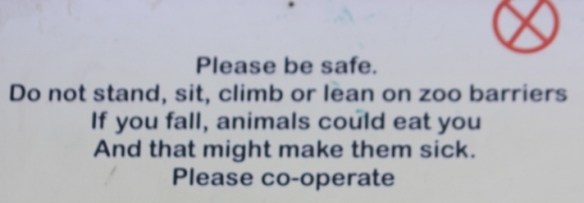
DAILY PHOTO: Best. Zoo. Signage. Ever.

Taken in Mysore in October of 2013

Taken at the  Mysore Zoo in October of 2013

Sri Chamarajendra Zoological Gardens (i.e. the Mysore Zoo) wins the award for the most clever (and most gruesome) signage at a zoo.


img_1431 img_1325 img_1323

POEM: Man’s Best [and Faster] Friend

img_2586

Once there was a dog and a man.
The dog chased and the human ran.
The dog got leaner, the man fitter.
But sometimes got bit, and being bit got bitter.


Chased, one day, a bone in hand.
The man devised a clever plan.
Raising the club, he flung it aside.
The dog caught its meal in mid-stride.


From that day on man carried meat.
To offer dog a tasty treat.
Dog, it seems, had trained its master.
No more racing to get faster.


Thirty thousand years then past.
Pavlov trained at dog at last.
Humans are slow, but can learn.
As the world, in due time, turns.


BOOK REVIEW: Inside Jokes by Matthew M. Hurley, et. al.

Inside Jokes: Using Humor to Reverse-Engineer the MindInside Jokes: Using Humor to Reverse-Engineer the Mind by Matthew M. Hurley
My rating: 4 of 5 stars

Amazon page


This book examines the science of why we find funny what we find funny. Most people probably feel about this as did E.B. White who said, “Analyzing humor is like dissecting a frog. Few people are interested and the frog dies of it.” Still, while analyzing humor may not be as fun as reveling in it, it’s fascinating to scientifically inquiring minds.

Humor is universal (not the humor of a specific joke, but the experience of somethings being humorous.) A skilled science fiction writer might conjure up an alien race that is credibly humorless. But it defies credulity that even the remotest of aboriginal Earthling wouldn’t giggle or guffaw at the sight of an off-course ball careening into an unsuspecting man’s crotch. Humor’s universality begs certain questions. First and foremost, one expects there to be some evolutionary advantage to a sense of humor. That evolutionary mechanism is precisely what Hurley, Dennett, and Adams attempt to demonstrate in this book. The authors suggest that the pleasure associated with humor is a reward for recognizing an incongruity, and they go into great deal to fill in the details needed to explain the panoply of things people find funny, while suggesting why alternate explanations are inferior.

While there’s a lot of frog-killing academic analytics and needlessly messy scholarly language, this book does offer a vast collection of examples of humor to support and clarify the authors’ points. So, unlike many books on evolutionary and cognitive science, this book does have a built-in light side. WARNING: there’s also a discussion of why some attempts at humor fail. This means one is also subjected to a number of puns, elementary school jokes, and comedic misfires that show the reader why sometimes humor implodes.

The book starts by building a common understanding of what humor is. It turns out that this isn’t simple because people find many different kinds of things funny–from caricatures to wordplay. (And, whatever the initial evolutionary purpose of humor, our species has run with that reward system to places that couldn’t have been readily anticipated.) Next, the authors discuss the many varieties of theories of humor that have been raised. This subject has been studied for some time, and thinkers have suggested that humor’s pleasure derives from a number of different causes from feeling superior to recognizing surprise–just to name a couple. After considering the competition, Hurley et. al. start laying out the basis of a cognitive / evolutionary explanation. In chapter five they describe 20 questions they think must be dealt with, and–in the last chapter (13)–they give their responses as a summation of the book’s main points. Along the way, the authors take on important related questions such as why humor sometimes fails, what others will see as the weakness of their argument, whether a robot could be humorous, and why we laugh. The last point opens another can of worms. Even if one concludes–as the authors have–that humor is a reward system for recognizing incongruities, the question of why there is an advantage to spontaneously announcing that recognition still arises.

There’re are a few graphics in the book, mostly these are cartoons and humorous photos that serve as examples. The book is published by MIT Press, so all the usual scholarly features of notes and citations apply.

I found this book to be thought-provoking, and the plentiful examples of jokes made it enjoyable to read as well. I’d recommend it for those interested in the science of the mind. It’s a bit dry in places for readers looking for light reading about humor.

View all my reviews

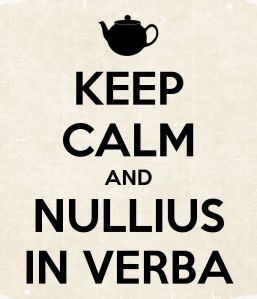
POEM: Nullius in Verba

nulliusinverba1

Said Socrates, “Oh, those poor bastards, for they think they know.

“I may be an ignorant slut, but I know I know not.”

[I paraphrase.]

My point, if I have one, is that “know” is an overused word.

Stinking up the discourse, like a bloated, floating pig turd.

[Remember Jim Carey, in the movie “Liar, Liar”]

“I object, Your Honor”… “Because, it’s devastating to my case.”

It’s a refrain seldom stated, but oft implied.

It works quite well, if you only talk to one side.

Fault us not for we’re wired to be certain.

If the cave wall shadow might be a tiger,

you don’t wait to see whether it’s a mouse.

That said, we’ve evolved these huge honking brains.

Our prefrontal cortexes might withstand the strain–

of asking:

How do I know this?

What if I’m wrong?

Might my mind deceive?

Facts: cherry-picked or  strong?

POEM: Elusive Lunatic

img_4320

he’s not your run-of-the-mill maniac

thrice escaped and twice hauled back

steely-eyed with a devil’s grin

he invented seven new deadly sins


he watches the “can haz cheezburger” cats

and will stop to fix an old lady’s flat

he’s got two souffles baking in the oven

and is cooking meth on the stove above ‘em