POEM: An Exercise in Everyday Absurdity [Prose Poem]

At an optician’s office, I was being sold a scratch-proof coating for my new eyeglasses. I usually summarily reject last-minute add-ons designed to squeeze additional profit out of the consumer, assuming they are all like rust-proofing, extended warranties, and muffler-nut re-torqueing plans — which is to say, needlessly complicated ways to toss away money.

But this guy was compelling. Well, in part he was compelling, and in part I tend to drop things [phones, glasses, remote-controls, toaster pastries, etc.] with great regularity. So, when I was offered this space-age scratch-proof coating, a coating that I was promised could survive being tumbled around in a cement mixer, I was sold.

Then, as this salesman was packing up my glasses, he said, “Here is your special cleaning cloth. Make sure you use this cloth — and ONLY this cloth — when cleaning your glasses.”

To which I replied, “Uh, why…, exactly?”

“Because you’ll scratch the coating,” he said patronizingly, as one might to a child or an adult one suspected a court of law had deemed mentally incompetent to dress himself.

“So this ‘scratch-proof’ coating, the one that’s supposed to survive a five-story fall and sidewalk bounce, the one that nearly doubles the cost of the glasses, that coating can’t survive whatever grit might remain lodged in a freshly-laundered cotton T-shirt?”

“Exactly! Now you’re getting it. So, just make sure you only use the special cloth, okay?” he said in a manner that I feared would end in the tousling of my hair.

Do you know why I believe this salesman was so good at his job? Most people would get severe cognitive dissonance-induced headaches from trying to maintain this matrix of logically-inconsistent information in one brain. This individual was unplagued by such difficulties. That allowed him to not only maintain a straight face while being challenged on the issue, but to truly believe that it is those who have trouble reconciling these conflicting pieces of information that are defective.

This might sound like a rant, but it’s not. I’m convinced that it is people such as he who will inherit the earth, and I’m in awe of their special gift.

POEM: Hyperqueryitis

When I was a young boy, earlier than I can remember, I caught hyperqueryitis — a permanent affliction denoted by a propensity to ask “too many damned questions” — or so it was explained to me.

The condition can become exacerbated by certain common treatments — all of which are popular replies of the adult human being, such as:

-“… because it just is, that’s why!”

-“… because it’s always been that way!”

-“… we’ll get there when we get there and not a moment sooner!”

Side-effects may include: the use of words such as: propensity, affliction, and exacerbate; as well as a marked tendency to make up one’s own words.

BOOK REVIEW: What the Hell Did I Just Read by David Wong

What the Hell Did I Just Read (John Dies at the End, #3)What the Hell Did I Just Read by David Wong
My rating: 4 of 5 stars

Amazon.in page


This is the third installment in a trilogy that began with “John Dies at the End.” The series takes place in an undisclosed and rundown Midwestern town that is prone to various catastrophic supernatural shenanigans. It’s a humor-horror cross-genre work that is heavier on the former than the latter by virtue of the fact that the tone is consistently lightened by the duo of doofuses’ jokes and unreliable narration – often in the face of apparently calamitous events.

In the first book, the narrator, David, and the titular character, John, consume a drug (street-named “Soy Sauce”) that gives them the ability to see supernatural phenomena to which the general citizenry are blind. This book continues with that idea, but — given their experience with supernatural happenings, limited as it may be – they’ve become paranormal investigators of sorts (usually unpaid and sometimes without anyone asking for their services.) Also, Amy becomes not only a more firmly established love interest to David, but also a full-fledged member of the team – albeit the one that plays straight-[wo]man to the buffoonery of the other two.

The central event in this story is a child abduction that turns into a chain of abductions, but soon it becomes in doubt whether the children ever existed in the first place – or whether they are mass delusions implanted by a monstrous source. The book unfolds as the story of the trio trying to find the “children,” to find out what their true nature is, and then to figure out what to do about them. The villain’s henchman is capable of shape-shifting and takes several forms throughout the book – including that of David, thus casting suspicion upon him.

The author takes an interesting approach to perspective. The perspective shifts between David, John, and Amy, but only the David parts are written in first person (John and Amy are allotted sections from their perspective, but they are written in third-person limited perspective.) There are section headings to clarify whose perspective is being used and so it’s not hard to follow (even context would provide a great clue.) The shifting perspectives serves three purposes. First, one can see points in time during which David is not present, allowing the team to divide and conquer and for humorous confusion to be exploited. Second, it allows one to see the difference between the various accounts of the same event, which is helpful in building confidence about what actually happened — given the unreliable narration. Third, it allows for unreliable narration to be used for comedic effect. John, in particular, is famous for being especially unreliable among the unreliable narrators, though most of his embellishment is along sexual lines. [Amy is the most reliable in that she isn’t prone to flights of fancy. However, she has no ability to see through the shapeshifters and implanted hallucinations, and so she might – in fact — be the least reliable.]

There is not a strong and satisfying conclusion to the story. In part, this is because it’s not entirely clear what really transpired. We know at the end that there is another version of events out there, an account written by a scholar of the paranormal who is a secondary character in the latter half of the book. However, it also seems that the author tries to end one the lesson that sometimes the best thing to do is to wait and see, and not create problems by one’s need to be active. That is a fine lesson, but it doesn’t make for a satisfying conclusion to the story. There is also a muddled motivation of the “missing children.” I don’t think this lack of a definitive ending is about setting up a fourth entry in the series because the author states only vague intentions to (possibly) continue the series at some undefined point in the future. I also don’t think it’s a matter of having painted himself into a corner, but it maybe that he’s trying to say something about what really happened that I didn’t actually get. That’s a risk with so much going on in a multi-perspective, unreliably-narrated book.

There is a humorous attempt to engage with the challenge of mental illness, with John and Amy encouraging David to get help toward the end of the book. [This is also addressed in the epilogue.]

This is certainly a fun read. It’s humorous throughout. The story isn’t the strongest (or perhaps isn’t the clearest.) If you’ve read the other books, or at least the first one, and enjoyed it, I’d recommend you give this one a look.

View all my reviews

Literally: the Dumbest Poem Ever

He held half-baked ideas in
his twice-baked brain.

He’d grab his umbrella when they
shouted, “Make it rain!”

–the umbrella he should have left for a
friend stuck home under the weather.

But his glasses were bent out of shape, and
he was hell-bent for leather

So, he couldn’t find his coat, nor gloves,
nor ass-less chaps.

And, thus, was running better late
than never — perhaps.

He couldn’t afford to miss the boat
that had sailed, my friend.

He needed his job, ’cause a penny
earned was one he’d spend.

When told he was skating on thin ice,
he maxxed out the AC.

All his blessings were disguised too
well for him to see.

He’d thought he was okay when told
he had stiff competition.

–the nuns taught him to fix that with six
Hail Marys and an Act of Contrition.

But they said his co-workers were
really on the ball.

He’d have gotten a Pilates chair,
but was afraid to fall.

When he heard the new guy was up-and-coming,
he got up and left.

He wanted to be thick as thieves so he
went out for a supply closet theft.

POEM: Rubber Ducky [Day 21 NaPoMo: Lai]

[There isn’t as much agreement about the form of this French style — compared to other styles I’ve done so far (e.g. sonnets, haiku, sestinas, etc.) Adding to the complication, there are similarly named styles with much different forms. Suffice it to say here, the version of Lai that I’m doing is a 9-lined poem with a rhyme scheme of aabaabaab, a meter of 2.5 / 2.5 / 1 feet (i.e. 5 syllables – 5 syllables – 2 syllables,) and a narrative element.]


Mister Rubber Duck,
They say you have luck.
It’s true!
Though you may show pluck,
you taste rubber, Yuck!
So you
won’t be hung up plucked
like that Peking schmuck.
Adieu.

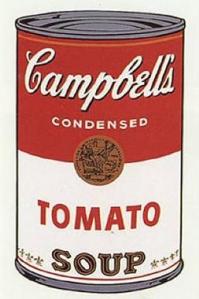
POEM: All Hail, Warhol! [Day 17 NaPoMo: Doggerel]

[With doggerel the only way to be “good” is to be ironically bad.]


Being a true genius must be hard work.
Is there a less laborious path to the perks?

I’m so glad you asked:
Just convince the right person you’re a genius,
and you’ll be in like porn star penis.

Just stack some boxes of Brillo pads,
reprint some old burger joint ads,
slather color on portraits — Tammy Faye Bakker-style —
(just make sure to showcase the subject’s creepiest smile.)

Lest you think I’m just being snarky,
I say this without a trace of malarkey,
if you can buy mansions off a soup can label you didn’t design,
genius is too meek of a word, you stink of the divine.
[Like Odysseus being dropped in the lap of goddesses
who were ready & eager to pop open their bodices.]
Do you think the Campbell’s marketing artist has a mansion?
He probably retired with a meager pansion.

I say this without derision,
to be great artist you don’t need to show in galleries, Parisian
you simply need to showcase your vision
of some poor shmuck’s labors
to the person who can get you a better class of neighbors.

POEM: Calypso Facto

For seven years,
Ulysses was hostage to Calypso.

He was like, “Wife is waiting, gotta go!”

“You know, by Neptune, you are still cursed?”

“Being stranded with you was fun at first…”

“Out there’s the ever-present threat of Death.”

“Worth it, to not wake to your morning breath.”

COVID-19, you are my Calypso!


[Anyone got Zeus’s number?]

A Post-Journalistic Limerick

I asked an online reporter,

“How do you live post-bricks-n-mortar?”

“I’ve tricks up my sleeve:

tell ’em what they believe,

and if facts remain cut it shorter.”

POEM: The Revolution of Donald Duck & the Anchormen

Oh! Cast off these khaki shackles!

Like Don Duck, pants raise my hackles.

I’d chuck my slacks in the river Styx,

show all Hades my bag of tricks.

No more this prison for my loins,

and hear these words that I enjoin:

DOWN WITH PANTS!

DOWN WITH PANTS!

DOWN WITH PANTS!

POEM: Kool-Aid Gets A Bad Rap

I’m told The Kool-Aid Man was seen busting through this wall moments before my arrival, but I can neither confirm nor deny it.

They say, “Don’t drink the Kool-Aid!”

It’s because the 919 people at Jonestown who did so died of cyanide poisoning.

Except they didn’t.

Well, they definitely died, but they didn’t drink Kool-Aid.

They drank “Flavor Aid.”

You see, Jim Jones has been accused of many things,

but not being frugal in the conduct of mass murder isn’t one of them.

Why use the name-brand when everyone is going to keel over by cup’s end?

Now, Ken Kesey did use genuine Kool-Aid in his acid tests —

dubbed “The Electric Kool-Aid Acid Tests” by Tom Wolfe —

because he knew the people he was feeding LSD would live,

if, perhaps, zoinked out of their ever-loving Fahrvergnügen,

and he wanted them to have a quality simulated fruit flavor experience.

I’ve been told many times not to drink the Kool-Aid,

but I can’t say that I’ve been given Kool-Aid with anything in it —

well, other than water, a crap-ton of sugar, and whatever Kool-Aid is made of —

which I assume is similar to the non-liquid ingredients in spray paint.

[And no fatalities have ever been proven in building collapses involving The Kool-Aid Man.]