MICRO-FICTION: Julia Doesn’t Know How Lucky She Is

IMG_2555“Have you completed your mission? The Council grows impatient,” The thought occurred in Safrom’s mind as if he had a split personality rather than an angry disembodied consciousness in his head.

“No, we were very close to planting it last night, but the cat came in squawking and making racket. It woke her up just before we could get it set. Those damn cats will be the death of me.  The preceding night we managed to keep one out all night, but the other slept on the subject maintaining constant vigilance,”  Safrom said aloud as he paced around the sterile white space of his station.

“The subject travels, why don’t you just do it then?” The thought formed.

“Believe me, I would love to, and we make great efforts to do so. But it is not as easy to track a person through thought-space as it is in the physical world. If we can ever get the damn implant installed, that will, of course, change immediately. Most of the time she is not gone long enough for us to find her, and on the few occasions she has been, or we’ve been lucky, she hasn’t slept deeply.”


“RRRrrrarr-eeeow …  RRRARRrrr-eeeow… RRArrra-eeeow,” the noise came from floor level.

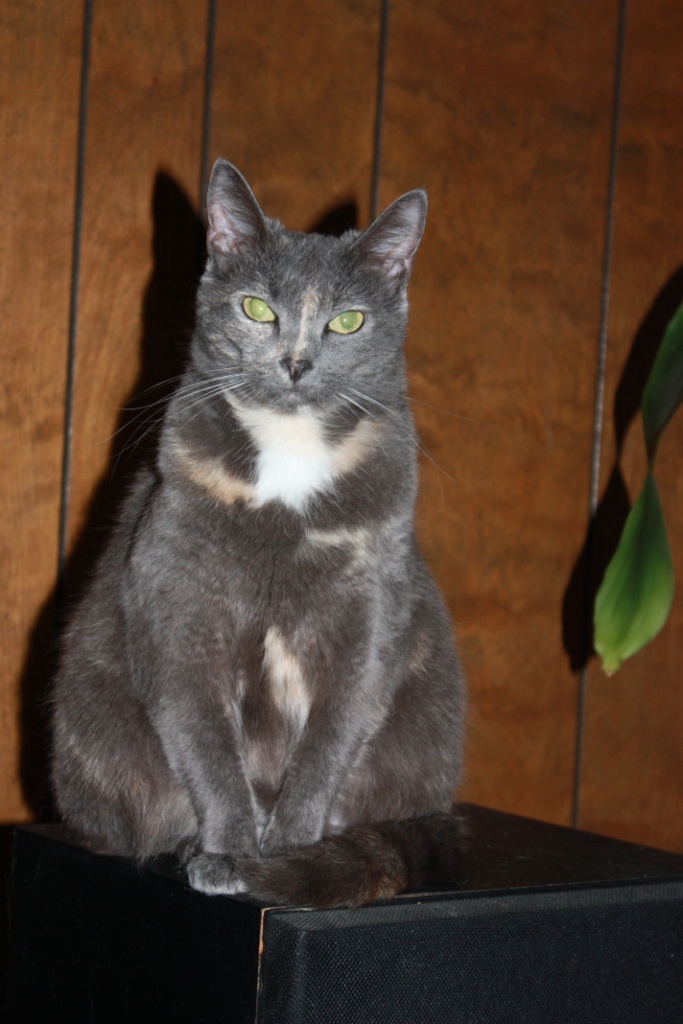
Julia pushed herself upright groggily and swept a shock of black hair out of her face. She stared at the gray cat illuminated by a shaft of streetlamp glow that slanted in through her bedroom window, and said, “Really! You’re really waking me up from a sound sleep in the middle of the night?”

The cat stopped its bellowing and sat back on its haunches, looking at Julia indifferently. Then the shorthair trotted out of the room and down the hall.

Julia lay back down melting into a down pillow and drifted back to sleep while wondering what made her cat do that. What makes a cat that has been fed and is never let out at night, repetitively caterwaul until its owner wakes up, and then it just goes back to its indifferent self?


Julia yawned aloud. “Excuse me. My cat woke me up in the middle of the night three times for no apparent reason.”

“Does it do that a lot?” Erma asked.

“It comes in waves, but, it seems to have it down to a science. It always seems to do it when I’m in the deepest sleep, usually in the middle of a weird dream.” Julia elaborated.

“What was your dream about?” Erma asked.

“Ah, you know, it was a dream. It didn’t make much sense. I was being chased?

“Being chased by whom?”

“I don’t know. I never see them, but it always feels as though they are just about to catch me.”

“Maybe the cat is doing you a favor.”  Erma said in a completely somber tone.

“Yeah, right, maybe.” Julia replied with a grin. She assumed Erma was joking, although there was nothing in the older woman’s expression to indicate that she might be.

Erma changed the subject, “So how is your research coming?”

Julia shrugged and said, “I don’t know. I’m feeling a little overwhelmed as of late. I keep pulling up new material, but, as I do analysis, I don’t seem to be converging on an explanation.”

“It’ll come, you’ve just got to keep at it, and never up. If you never give up, a solution will always present itself.” Erma said with a smile.

“I suppose.”

“You know the thing about cats is…” Erma began.

“What’s that?” Julia inquired.

“Aww, never mind.” Erma said.

Evangelists Meet Max Their Match

BING-BONG.

Without even looking up from his computer, Max knew it was church people. They came around trying to sell him a religion now and again. No one sold aluminum siding, encyclopedias, or ice cream door-to-door anymore. Evangelic proselytizers were the last bastion of door-to-door salesmanship. The sect varied; the approach did not. They were the only ones who ever disturbed his peace.  Well, the only ones who didn’t use the phone.

He went to the door. It was a zaftig woman and a clean-cut young man–both dressed in funeral-like attire.

“Hello!” the pair said with practiced exuberance.

“Hello,” Max parroted with a decided lack of exuberance. Then he added, “May I help you?”

Max didn’t feel like being helpful, but there was the off-chance that it was  a couple of his neighbors who were just looking to borrow a cup of sugar so they could bake cookies for whatever wake they were attending. If so, he’d help them out, but as far as he knew such a request hadn’t happened since 1955. Then he saw their name tags, and not the paper kind. These were black plastic bordered in gold with white letters.

“We’d like to talk to ya ‘bout the Bible,” the woman said.

“Unless it’s the racy bits, I don’t think you’ll hold my interest,” Max said.

“Excuse me?”

“Never mind.”

“Have you ‘cepted Jesus as your personal Lord and Savior?” the woman asked. The young man was silent, apparently just there in case the woman knocked on the door of a Jeffery Dahmer-type.

Max was distracted by the words “personal lord”, and how odd the phrase seemed. Can I get my Messiah in Mocha with a burgundy robe?

After an awkward pause, he said,  “No, I’m an atheologist.”

They gave a coordinated grimace as if he’d dropped a deuce at their feet. “You’re an atheist?”

“No. I said atheologist. An atheist is one who does not believe in God. I believe in God. I just don’t believe in religion.”

“You cain’t have Gawd without religion.” The woman said.

“I beg to differ.”

“How’d ya know Gawd, elsewise?” The woman continued.

Max swept his hand outward in a gesture meant to draw the pair’s attention to the flowering dogwood in his front yard and the sky beyond. Their forehead creases indicated that they were both perplexed. The meaning of his gesture was lost on them.

“You cain’t know Gawd without religion,” the woman repeated, as if Max just hadn’t heard her the first time and if she said it more emphatically he would get it.

“You can repeat a gratuitous assertion ad infinitum, and it will remain an assertion,” Max said.

Neither evangelist gave any indication that they understood what Max was saying.

He sighed, stepped out onto the porch with them, and said, “Look. First, let’s ask what God gives us.” He leaned out under the eaves to look at an azure sky feathered by white wisps of cirrus clouds. This time they followed his gesturing arm and looked out with him at the bounty of nature. “Now, let’s consider what religion offers us. May I?”  He said as he reached for the thin little magazine that they had prepared to leave with him.

Max was taking a risk. He couldn’t know exactly what it the magazine would contain, but he’d seen enough of them to make an educated guess. There it was, right on the cover. He didn’t even have to flip through in search of it. The cover artwork was a dark sketch of a treeless city with brooding clouds drifting at the tops of buildings. The buildings were in ruins, and there were human-shaped lumps on the ground –meant to be either corpses or homeless people. It was a story about the fall of man or the coming apocalypse or some doom upon whose cusp humanity sits.

“Here we have it. Religion doesn’t show us beauty. It wants me to be afraid. It wants to scare me. It wants carnage and chaos to be my lodestar. It shows me horrors so that it can be my life-preserver. It wants to be my life-preserver so that I’ll substitute its will and wisdom for my own. It wants me to believe its leaders are infallible so that I’ll feel good about giving up control. It wants me to behave as its people behave. Most insidiously, it wants me to hate the people who it hates… This is why I don’t believe in religion. Thank you for your time,” Max said as he handed the Doomsday Gazette back to the woman and walked back into his house, leaving the two slack-jawed proselytizers in his wake.

Sharing Stories of the Plaguepocalypse

[I’m recycling this from a Figment competition that I once entered–and lost.]
Day 100, Post-Apocalypse

Day 100, Post-Apocalypse

JB and I worked tediously to find and repair damaged insulation on the main from the solar farm down to our bunker. Breaks or cracks in the insulation meant lost energy that we could not afford, but we had to bury the cheap cable available to us because the Mojave sun degraded it too rapidly otherwise. Burying the line invited a whole new problem because burrowing critters then began to gnaw on it. Whenever there was a power drop, two of our trio had to come out and do line maintenance.  Output should have been at its maximum given it was mid-day during the hottest time of year, but, instead, we were experiencing a sixty percent drop in power.

We wore white from head to toe except for a slit in our ninja-like masks where sunglasses covered the unclothed region and protected our eyes from the harsh rays and glints.  This had always been a harsh land, but changes experienced in recent decades made it far hotter.  I sucked a mouthful of water from the bladder that lay next to my body under my baggy white clothes. The water was hot, like a freshly brewed cup of tea—sans the tea.

“Son-of-a…, sweat is stinging my eyes,”  JB said as he removed his sunglasses, and blotted his eyes with his sleeve.

“Put the shades back on. We can’t have you getting burned retinas,” I said.

“Yeah, yeah, if I go blind who’ll come out here with you to dig up line?” JB’s reply dripped sarcasm.

“Exactly, now you’re getting it,” I said.

JB wiped his eyes once more, and then put the glasses back on. Without the shades, the surroundings looked like the Mars of old movies – cast in a reddish hue.

“I think I’ve got it,” JB called out.

“Looks like it,” I replied, leaning over to look in JB’s newly-excavated hole.

A mole rat skeleton had its teeth buried in the insulation.

After removing the rodent, patching the insulation, and putting the sand back, JB and I walked back to the hatch of our bunker.

JB crouched over the opening. He touched the metal lip of the hatch and immediately yanked his hand away while screaming an expletive. The gloves were not thick; they were for keeping the sun off the skin while holding in as little heat as possible.

JB called down the shaft, “Brit!”

“What ‘cha want,”  Brittany replied.

“How’s our power level, we pulled a fried mole rat off the line,” I asked.

“Yum!…,  The power is back to normal,”  She called back.

I followed JB down the long ladder into the bunker. I pulled the hot hatch closed behind me and secured it against some unlikely foe.

“We need to protect that line somehow,” I said

“I’m just glad we didn’t have to hump out to the transmitter. The last time it broke down I was loopy with dehydration by the time I got back. You sure this is the only place for us to live?” JB said.

Brit came in with two cups of water and handed them to JB and myself.  She said, “I’ve got the loop broadcasting again and the receivers are turned up loud.”

“If you can come up with someplace else where we can tap into the energy necessary to keep broadcasting, I’m all ears,” I responded.

“That’s just it. We’ve been broadcasting all this time, and we’re not getting any reply,”  JB said.

“We also don’t know whether this climate is responsible for our good fortune,” I said.

JB had no response.

“Good fortune? Oh, my, I feel like such a princess.” Brit said curtseying with her fingertips bunched up and wrists kinked as if she were holding up a skirt.

“I mean being alive,” I clarified.

There was a silence.

Brit spoke up, “Remember people?… I love you guys, but I’d give anything to meet a stranger. Remember the last time you saw a crowd of strangers.”


I did, indeed, remember.

I was planning on going to Union Station to get out the Los Angeles. Before I left my apartment, I saw a news story showing the train station among all the other avenues of disembarkation that were thronged with people.  The streets outside the station were flooded with a throbbing, undulating mass of humanity. As in the mosh-pit of a rock concert, there were two primary classes of people: those who were screaming and those who were suffocating. Mixed in among these were glassy-eyed souls who had the good sense to realize they were the walking dead, and to behave accordingly.  There were images from packed train-less platforms, and the grandiose cavernous waiting area.

I packed my gear and donned boots so as to be prepared to hike out of town if necessary. It proved to be a wise move, because I when I arrived at the train station the wall of humanity was impenetrable.

I hated crowds. Crowds were noisy, hot, and chaotic.  My hatred of crowds saved my life. Nature has its weird ways. I had once read about ants that could take down a fully grown cow. They did this by covering the animal benignly, and then, upon a release of a pheromone from the ants on the creature’s head, they all stung at once. This malady, a hemorrhagic fever of some sort, was similarly impossibly intelligent and geared toward wiping out the entire species. It seemed to know when its victims were within a crowd, by what mechanism I cannot imagine, and it would then send them into sneezing and coughing fits that propelled droplets of virulent blood in a fine mist to those all around.

Now I missed crowds, because they were a sign that one’s species wouldn’t die with oneself.

JB and Brit had taken to telling each other their own last crowd stories, which we’d heard before. We’d heard all of each other’s stories.

Well there was one story that I kept for myself. It was the story of the day before I met up with Brit and JB. It was my nadir.

I had been hiking east from the city. My path merged with the I-40 corridor, and it was the most horrific day of my life. I’d always been an avid hiker and had spent long periods on my own before, but these times of solitude were without signs of humanity. As I came upon I-40, there were people all around -in cars and on the ground, but they were all stiff and had rivulets of brown or red running from their noses, mouths, ears, eyes, and presumably the unseen orifices.

When I saw a monastery on a hillside, I thought I was saved.  Surely the isolated monks or nuns were safe and would help out a weary uninfected traveler? I found an old stone church that was post and beam on the inside. Anyway, my hope faded when I found the pews had been used as hospital beds, and all, patient and caretaker alike, were bled out. The only signs of life were rats on the floor, weeds in the mortar joints, and birds in the rafters. That was my moment of greatest loneliness, for if God had abandoned his own house, what hope was there for me.

Your Life is Hard? Try Working with Ninjas,Pirates, and Smugglers!

Ninjas, pirates, and smugglers aren’t exactly chatty. They burn, or shred, their correspondence. They sow seeds of disinformation to confuse the authorities. They lurk in the inkiest of shadow worlds behind doors we don’t even know exist. Still, who wants to do a hatchet job on a pirate? Right?

Did I mention that these are characters in the novel that I’m currently revising (or did I let you believe I was talking about in-the-flesh smugglers so that you’d keep reading.) Sorry, no one ever accused me of NOT being a deceitful bastard. Well, my friend, you’re now more than Tweet deep in this post; that’s quite an investment; it’s the modern-day equivalent of having read The Iliad, so you might as well keep reading.

Kiss the Cobra (my third working title) features a cast of characters of not only the aforementioned occupations but also monks  (both the scholarly and  kick-ass kung fu varieties), an Emperor, a muay Thai master, and a secret society that makes ninjas look like chatty Cathys. Like all good lies, this novel begins with a seed of truth. That seed is the rescue of Emperor Go-Daigo from imprisonment by an evil (ok, quasi-evil) shogun in 1337.  From that seed, it’s my wild imagination run amok… or is it? The Emperor assigns the loyalist ninja who rescued him, Korando, to travel to Southeast Asia to acquire an artifact that legend has it will help him re-consolidate power.

Cut to the present day, a linguistically-talented young man, Matsuo (a.k.a. “Matt”), comes into possession of a scroll. The scroll is Korando’s journal, written and hidden as a confessional. Matt investigates Korando’s journal on an electronic bulletin board only to find himself being chased by nefarious characters. Matt discovers that there are still people willing to kidnap, kill, or commit treason for the secrets that Korando’s journal may possess.

The novel weaves the 14th century journal with this present-day cat and mouse game between the forces of good and evil. There’s murder and mayhem, love and betrayal, victory and defeat, virtue and vice; in short everything you love in a novel is densely crammed into this book.  There’s even one character who may or may not be a Zombie–I’ll let you be the judge.

Now let me just add this screenshot of me to show you ho

Do you ever get a chill on the back of your neck?

Did you ever get an inexplicable chill on the back of your neck?

BOOK REVIEW: Solaris by Stanislaw Lem

SolarisSolaris by Stanisław Lem

My rating: 4 of 5 stars

Solaris is the  best known work of the Polish sci-fi writer Stanislaw Lem. It’s the story of the planet Solaris’s super-intelligent ocean and the humans that are observing it from an orbiting space station. Scientists discover that the ocean is intelligent because the planet orbits two stars, and the ocean must redistribute itself as ballast to keep Solaris from flying off out of its star systems.

Having had no luck in learning about this ocean, the scientists begin more invasive operations–bombarding the ocean with electromagnetic radiation. The ocean then begins to project human beings into the space station, using blueprints in the minds of the scientists. Each of the scientists begins to see, and eventually interact with, someone from his past. Each “guest” is physically indistinguishable from the person in the respective scientist’s past, but the simulacra are “off.”  These simulacra stir up bad memories.

The most extensive interaction we see between a crew member and one of these manifestations is that of the protagonist, Dr. Kris Kelvin, and his ex-wife. Dr. Kelvin is a psychologist and is the most recent crew edition. (The novel actually starts with him as a new arrival, we learn of the earlier incidents as he does.) His “visitor” is the spitting image of his wife, a woman who committed suicide after the couple broke up.

The novel plays with an intriguing question. What if a person you loved and lost came back from the dead, but you would only be able to experience them as they existed in your mind? In some sense, they’d be more real to you than the actual person. But you’d know they were just a fabrication, and you could never learn anything new about them. At first Kelvin rejects, even banishes, his wife’s doppelgänger, but when she inexplicably returns he finds it hard to maintain his distance.

I enjoyed this book. The translation seemed skilled to me (though I don’t read Polish, and hence didn’t read the original.) I’d recommend it.

View all my reviews

There have been three film adaptations of this novel. I haven’t seen any of the movies, but this is the trailer for the most recent one. The trailer emphasizes the love relationship more and the sentient ocean less than the novel (though the interaction of the protagonist with his imagined wife is central to the work.)

BOOK REVIEW: Steel and Other Stories by Richard Matheson

Steel: And Other StoriesSteel: And Other Stories by Richard Matheson

My rating: 4 of 5 stars

Amazon page

Steel and Other Stories is a collection of 15 short stories from the author of I am Legend. Thirteen of the fifteen stories are from the 50’s, and motifs of that time are common (e.g. Cold War phobia, the Western, etc.)

1.)The title story, Steel, is about android boxers. Viewers of the movie Real Steel, which was loosely based on this story, will find the story not much like the film. In the film the boxers are robots, but in the story they are androids. For those readers who aren’t sci-fi geeks, the difference is that androids look and move like humans. There is more on the line in the final fight in the story than in the film.

2.) Fit the Crime is about a cantankerous old poet on his deathbed. It’s a humorous story and will be enjoyed by those who love language play.

3.) The Wedding is about a superstitious groom who gets on his bride’s last nerve.

4.) The Conqueror is the sole Western in the collection. It features gunfights and a final line revelation.

5.) Dear Diary is a very short sci-fi piece that is written in the form of three diary entries: one in 1954, one in 3954, and one at an undesignated date presumed to be later than the second entry. In typical Mathesonian style, the third entry, only a partial sentence, turns expectations on end.

6.) In Descent two couples are preparing to move underground to survive nuclear holocaust. Confronted with the decision of dying above ground or living a subterranean life, one of the men opts for the former. This creates a dilemma for the man’s wife.

7.) In The Doll That Does Everything two parents of a horrid child contemplate whether the lifelike doll they buy their child really can do everything.

8.) The Traveler is about scholars who go back in time, cloaked, to observe biblical history first hand.

9.) When Day is Dun is about the last man alive, but, unlike I am Legend, the apocalypse is of nuclear annihilation.

10.) Splendid Source is one of the most famous stories in the collection. It’s about a search for the point of origin of ribald jokes. Viewers of Family Guy will recognize its depiction in an episode of that series.

11.) Lemmings is one of the shortest pieces in the collection. It imagines humanity walking one after another into the sea.

12.) In The Edge a man finds that people he doesn’t know know him. This begs the question of whether he has a doppelgänger or he’s lost his mind.

13.) In A Visit to Santa Claus a man reconsiders a contract on his wife’s life that is to be executed on a visit to the mall to see Santa.

14.) In Dr. Morton’s Folly a dentist gets an after-hours emergency case.

15.) In The Window of Time A man travels back in time 68 years by mysterious circumstance, walking familiar territory in transformed in time.

Matheson is a master story craftsman, and this collection is an interesting mix of stories from various genres–some humorous and some dark.

View all my reviews

BOOK REVIEW: Life, the Universe, and Everything by Douglas Adams

Life, the Universe and Everything (Hitchhiker's Guide, #3)Life, the Universe and Everything by Douglas Adams

My rating: 4 of 5 stars

Amazon page

My review of: Hitchhiker’s Guide to the Galaxy

My review of: Restaurant at the End of the Universe

Arthur Dent and company are back for a third volume, and this time they must save the universe. This installment in the Hitchhiker’s Guide to the Galaxy (H2G2) series leaves off where the second stopped.

Readers will recall that at the end of the second volume,Restaurant at the End of the Universe, Arthur and Ford Prefect were marooned on the Earth two million years before their time (i.e. before the Earth was destroyed for a hyperspace bypass.) The two are reunited after Ford spent some time in solitude experimenting with being insane. They catch a ride forward in time on a piece of couch-shaped jetsam caught in an eddy in the space-time continuum.

Arthur and Ford are then picked by Slartibartfast, designer of fjords, who convinces them that they must go on a mission to save the universe from the inhabitants of the planet Krikkit. Actually, he can’t convince Ford of that, but he does convince him to go to the longest running party in the universe. Unknown to Ford, Slartibartfast wants to prevent the Krikkiters from attaining a requisite part that happens to be located at the party.

Arthur plays a particularly important part in this volume. After a run-in with a creature that he has killed numerous times in various bodies, the H2G2 straight man develops the knack for not hitting the ground after throwing himself downward (i.e. he can fly.) This new skill plays an important role in ultimately winning the day.

Arriving at Krikkit, the group finds that the locals aren’t much interested in destroying the universe anymore.This leads the band them to uncover a plot of intrigue and hilarity.

Given that there are two more books, you probably believe that the universe wasn’t destroyed, but I’ll avoid spoilers.

As always, Adams is the master of absurdist science fiction. Sure he gets his characters out of jams by flukes of the infinite impossibility drive or, in this book’s case, randomly appearing and disappearing couches, but it’s the wackiness that we enjoy and not the tautness or logical consistency of the tale.

View all my reviews

BOOK REVIEW: Story of O by Pauline Réage

Story of OStory of O by Pauline Réage

My rating: 3 of 5 stars

Amazon page: See Here

I haven’t read 50 Shades of Grey, but was surprised to hear that it began as Twilight fan fiction. From the descriptions that I’d seen, it seemed much more like a relatively softcore, commercial-fiction version of Story of O. I don’t whether the Story of O fits into this recent genre development called “mommy porn,” because the book predates that terminology.

In Story of O a successful fashion photographer named “O” is in love with a man whose tastes run to the extreme. Her lover, René, asks her to come into this lifestyle, and she willingly submits to his wishes. Submission involves some harsh tests of her willingness to endure.

I expect the initiated will point out that one major difference exists between the two works. 50 Shades seems to involve a monogamous relationship, whereas– in the Story of O— O is handed off from René to a more senior dominant for her “training.” O then begins to fall for her new master. Moreover, there is no monogamy in Story of O–whatsoever. (i.e. O is passed around like a doobie at a Greatful Dead concert.) I’m not saying they are the same books, just that they seem similar. They are both books about women who willingly surrendering to men with exotic (re: freaky) desires.

There also seems to be a difference in endings between the two story lines (vis-á-vis who walks), but I will not go into that.

Actually, one major fault of Story of O is that there is not a proper ending (completion of a narrative arc.) The version I have has a brief annotation that says the ending was suppressed. It goes on to give a description of two alternate versions of a similar ending. I suspect the drafts of those endings were lost to the ages because I have a copy of the 1973 edition (the book came out in the 50’s) and to my knowledge there is no subsequent edition.

Those who are freaked out by kinkiness will find Story of O hard to stomach. In terms of language, I’ve read that it’s calmer than 50 Shades…, but in terms of the actions carried out I suspect it runs a bit more toward the exotic. Another group that will find this book to not be their cup of tea are those who have strong feelings about women’s empowerment. If that’s you, you will likely find it hard to relate to a woman who has power in her life, but who willingly–nay, eagerly– relinquishes it. Moreover, O seems to thrive on being dominated. That is, she falls hardest for the man who will most forcefully enslave her.

View all my reviews

BOOK REVIEW: Eclipse of the Crescent Moon by Géza Gárdonyi

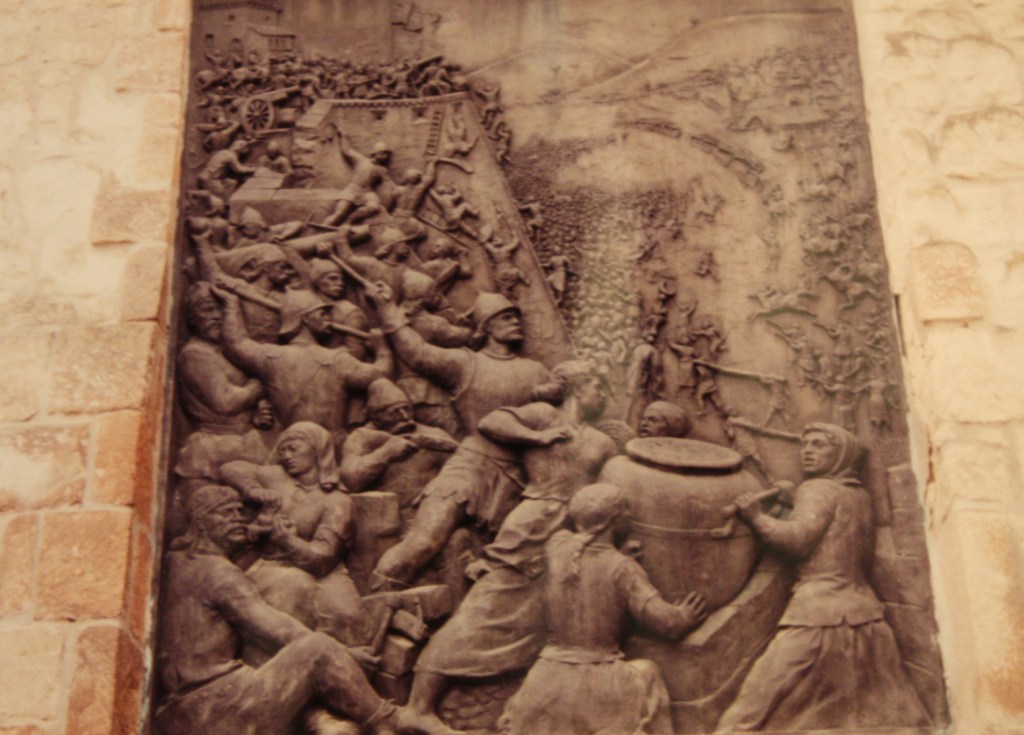
Bas relief of Siege of Eger

Bas relief of Siege of Eger

Eclipse Of The Crescent MoonEclipse Of The Crescent Moon by Géza Gárdonyi

My rating: 4 of 5 stars

This book is the English translation of a volume originally written in Hungarian and titled Egri Csillagok, i.e. “Stars of Eger.”

Historical fiction works best when the event it’s built around requires no fictitious embellishment to fascinate the reader. Eclipse of the Crescent Moon takes place during the 1552 siege of Eger. During this siege, 2,000 Hungarians held off at least 40,000 Turkish invaders for over one month. (In the book the Turks have a two order of magnitude advantage.) The Turks retreated despite having had superior armaments as well as a massive numeric advantage. It’s the perfect underdog story.

Reading a purely historic account would be interesting enough, but Géza Gárdonyi creates value-added by imbuing his characters with depth, particularly his lead Gergely Bornemissza. There wasn’t much known about Bornemissza. He was a minor character in history compared to Eger’s commander, István Dobó. However, his expertise in explosives did play a role in this Hungarian success story.

The book begins when Bornemissza is a young boy. He and a girl named Éva are captured by a Turk. The couple escapes and manages to free others. They later elope to avert Éva’s arranged marriage. They have a child who is later captured by the same Turk who had captured them.

A major subplot is a trip made to Istanbul in the heart of enemy territory to attempt to aid in the escape of Bornemissza’s  adoptive father.

The book is well translated and an engaging read.

View all my reviews

BOOK REVIEW: The Journeys of Socrates by Dan Millman

The Journeys of SocratesThe Journeys of Socrates by Dan Millman

My rating: 4 of 5 stars

The Journeys of Socrates shines the spotlight on Dan Millman’s mysterious teacher from The Way of the Peaceful Warrior. We discover that Socrates was born Sergei in Russia to a Cossack father and a Jewish mother.

His youth is scarred by tragedy. His mother died in labor with him and his father died of alcohol poisoning while Sergei was away at military school. His only remaining relative that we know of, his grandfather, dies. He flees military school to avoid having to harass Jews as a soldier, and in the process he has to battle his arch-rival. He marries into a family, but that brings its own tragedy. His family by marriage are Jews living under false identities at a time when it is very dangerous to be a Russian Jew.

It is after this tragedy that Socrates’ search for warrior skills and revenge drive the narrative. In injecting so much tragedy into his life, Millman makes the main character’s transformation all the more impressive. At every turn, Socrates is faced with events that should fill him with bitterness and hatred, but he must keep going and learn to control his emotions to become the warrior that he wants to be.

He proceeds to train under a warrior trained in the way of Japanese swordsmanship, a man named Razin. Razin only reluctantly accepts him as a student. He then lives at a hermitage, learning to reign in his mind and to respond freely and appropriately to attacks. His teacher at the hermitage, Father Serafim, teaches him to fight, while encouraging him to give up his vendetta. Finally, he travels abroad to train with a convened collection of sages from various traditions (Taoism, Buddhism, Judaism, Christianity,etc.)

Socrates narrative arc is well developed. He is pitted against a powerful enemy named Zakolyev, aka Gregor Stakkos, a military school rival who became an antisemitic Cossack gang leader. Socrates is reluctantly drawn into a final decisive battle with this nemesis, but there is a twist at the end to further complicate that event.

I’ll admit I’ve had mixed feelings about Millman’s work. I was a big fan of the original books Way of the Peaceful Warrior and to a lesser extent Sacred Journey of the Peaceful Warrior. Those books provided great insight into mind-body development in a readable narrative form. However, I later picked up one of his subsequent books and found it to be some sort of numerology/astrology drivel. That was disconcerting not only because it offended my sensibilities as a Cartesian skeptic, but even more so because it seemed to fly in the face of the Peaceful Warrior message– which was one of self-empowerment, not passive acceptance of some randomly bestowed fate.

So I picked The Journeys of Socrates reluctantly. However, I found this book to be the most readable of all. It is written like a novel or the memoir of someone who led the rare novel-shaped life.

View all my reviews