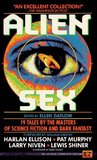
BOOK REVIEW: Alien Sex Ed. Ellen Datlow

Alien Sex: 19 Tales by the Masters of Science Fiction and Dark FantasyAlien Sex: 19 Tales by the Masters of Science Fiction and Dark Fantasy by Ellen Datlow

My rating: 4 of 5 stars

Amazon page

Alien Sex is an anthology of 19 works of short fiction that revolve around sex, attempted sex, or sex-like behavior with non-human entities. While the title leads one to believe the book is specifically about sex with aliens from outer space, that’s not the case in all these stories. There are also stories where the object of affection is a lesser primate, an incubus, a new species, and a biologically-modeled robot. As one would expect with life forms from other worlds, the “sexual” act is not always what we would recognize as sex. (e.g. One planet’s whoopee might be another’s mundane act.) As a last warning about what the book is not, it’s not—on the whole—a collection of sci-fi erotica. A number of the stories probably wouldn’t be arousing to the freakiest of super-freak, and I can only assume weren’t meant to be.

While there’s a unifying theme, the works included cover a lot of ground in terms of style and format. It’s not even true to say it’s 19 short stories because there’s one poem and one chapter that reads more like an essay (i.e. lacks a narrative structure.) Some of the works are written in the language, tone, and style of erotica, but others aren’t. A few of them read like thinly veiled commentary on problems in the author’s own love life—i.e. cheating spouses, feeling a lack of attentiveness, or porn addiction. (Each work has a brief author commentary at the end, and a couple of the authors suggest that what was going on in their own life or those close to them shaped the idea.)

While the appeal of the works varied significantly, overall this was a fun and intriguing read. The works included are as follows:

1.) Her Furry Face by Leigh Kennedy
A primate handler who is in a waning marriage falls for one of his super-intelligent orangutan students.

2.) War Bride by Rick Wilbur
The world is going to end tomorrow unless you’ve been taken as a pet by one of the aliens.

3.) How’s the Night Life on Cissalda by Harlan Ellison
A man sent to investigate an alien race becomes inextricably sexually entangled with one of the aliens. Eventually, he’s forcibly separated from the alien—of a race that are apparently thin-skinned—and lives to see the descent of mankind.

4.) The Jamesburg Incubus by Scott Baker
A teacher in a Catholic school finds that he can make out-of-body nocturnal visits to some of his more attractive female students.

5.) Man of Steel, Woman of Kleenex by Larry Niven
This reads more like an essay than a short story. The work delves into the physics of why sex with Superman would be fatal for Lois Lane.

6.) The First Time by K.W. Jeter
This is a variation on the old coming of age story in which a young man is taken to a brothel for his first sexual encounter. It’s just that this encounter is of the 3rd kind.

7.) The Jungle Rot Kid on the Nod by Philip José Farmer
The premise behind the story is what if William S. Burroughs (author of Naked Lunch) had written the Tarzan stories instead of Edgar Rice Burroughs. In essence, it’s a risqué take on Tarzan.

8.) Husbands by Lisa Tuttle
After the extinction of husbands, a woman develops a new species to serve the companion role.

9.) When the Fathers Go by Bruce McAllister
A husband confesses to his wife that while she was in stasis waiting for him to come back from interplanetary travel, he sired a child with an alien. Furthermore, the child is coming to live with them. But wait there’s more…

10.) Dancing Chickens by Edward Bryant
This story reads more like an overly elaborate joke than a short story. It begins with the question, “What do aliens want?” and ends with a pun punch line. That being said, the lead is an unappealing but intriguing character.

11.) Roadside Rescue by Pat Cadigan
A stranded motorist is made an indecent proposal by a chauffeur on behalf of his alien employer.

12.) Omnisexual by Geoff Ryman
This is about an intergalactic brothel, but it’s the story in the collection that reads most like literary fiction—meant in both the best and worst possible ways.

13.) All My Darling Daughters by Connie Willis
While there are several really good works in this anthology, I’d have to rank this as my favorite—if only by a narrow victory. A sassy, sexually-liberated co-ed has her sex life torn asunder when all the young men come back from break with little, furry creatures in their possession and no interest in the female student body. Besides a neat concept for a story (though it may be implying that men are overwhelmingly rapey), the author does a great job of character development making the lead character both interesting and likable, while juxtaposing her with her apparently goodie two-shoes roommate.

14.) Arousal by Richard Christian Matheson
A woman who cheats on her husband with a stranger is cursed with permanent post-coital euphoria that swamps all interest in her family and life in general.

15.) Scales by Lewis Shiner
A woman’s husband is having an affair with what she thinks is a student assistant, but who turns out to be a soul-sucking seductress from the netherworld.

16.) Saving the World at the New Moon Hotel by Roberta Lannes
A woman waiting for her spouse to meet her at a bar to apologize for his infidelities decides to get a little herself. The man she hooks up with turns out not to be a man at all.

17.) And I Awoke and Found Me Here on the Cold Hill’s Side James Tiptree, Jr.
An experienced man offers advice to a newbie to get away before he ends up seduced by the aliens. This story talks about sex, but is about something much broader.

18.) Picture Planes Michaela Roessner
This one is a poem about alien sex, rather than a story. It stands alone as the only non-prose entry.

19.) Love and Sex Among the Invertebrates Pat Murphy
In a post-apocalyptic world, a dying scientist–who no longer believes in science–creates robots capable of engaging in the act. The creatures she makes are based on a range of real animals which are written about interspersed with the story-line.

I’d recommend this book for those who enjoy science fiction. One need not be into erotica to enjoy the stories and, the more one is seeking erotica, the less appeal the book may have. It’s a collection of big name writers in science-fiction, and the anthology’s diversity makes it particularly interesting.

View all my reviews

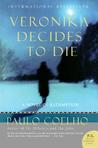
BOOK REVIEW: Veronika Decides to Die by Paulo Coelho

Veronika Decides to DieVeronika Decides to Die by Paulo Coelho

My rating: 4 of 5 stars

Amazon page

Veronika Decides to Die is about a young Slovenian woman, Veronika, who attempts suicide, fails, is institutionalized, and is informed that her attempted suicide damaged her heart and she has only five days to live. In the hospital she has to come to grips with what it means to be dying, but also what it means to be insane.

The book deals with the effect of Veronika’s death sentence diagnosis on her as well as on other patients with whom she interacts. The first patient Veronika comes in contact with is a depressive named Zedka who offers Veronika advice and insight. Then there is Maria, a woman who withdrew from her professional and family life to be institutionalized because she was having inexplicable panic attacks. Finally, there is Eduardo, a schizophrenic who is virtually non-functional when he meets Veronika, but who ends up in a relationship with the young woman nonetheless. These patients come to realize that they are hiding out at the hospital. They stay in the hospital because they are free to defy norms without judgment. When Veronika decides she doesn’t want to die hiding out, it has a profound impact on the others.

The book borrows heavily upon Coelho’s personal experience. He was institutionalized as a young man by parents who were disturbed when he went artsy and began hanging out with undesirables. Interestingly, Coelho has a cameo role in the book as himself. In the book he writes an article that playfully asks the question, “Where is Slovenia?” When Veronika is waiting to die from her overdose, she reads the article and decides to write a letter to the editor claiming that she killed herself because of the depressing effect of Coelho’s suggestion that nobody who’s anybody knows or cares where Slovenia is located.

In the end Veronika finds that she is truly free. Veronika seems to have everything at the beginning of the story: a job, boyfriends, and popularity. However, it’s those things that she comes to feel enslave her, and that’s what leads to the attempted suicide. In a way, Veronika is doubly freed. She is free because she is dying, and what can one do to a dying person. Second, she has been labeled crazy, and, having such a label, people expect her to act oddly. She has the freedom to do those things she has been too frightened to do all her life.

I’d recommend this book. It’s short, readable, and offers clear food for thought.

View all my reviews

BOOK REVIEW: Dawn by Octavia Butler

Dawn (Xenogenesis, #1)Dawn by Octavia E. Butler

My rating: 5 of 5 stars

Amazon page

Dawn is the story of a woman, Lilith, who awakens in the custody of aliens. This is no run-of-the-mill alien abduction. Lilith is one of a small number of human survivors of nuclear holocaust. The aliens are akin to a merchant ship that comes upon the survivor-baring life rafts of a sunken cruise ship—or at least they appear to be. They offer rescue, the hope of survival, and a promise to allow human survivors to rebuild their society in a low-radiation area of Earth when they are sufficiently trained in the necessary survival skills.

However, for Lilith the situation is not akin to shipwreck rescue because there’s a stark in-group / out-group conflict to get over. And it features the most challenging and terrifying out-group imaginable—an intelligent alien race. Lilith instinctively fears and distrusts the aliens. She discovers that she’s been awakened and put back in stasis on more than one occasion. While Lilith’s fear turns out to be unfounded, her distrust proves sound. The aliens genuinely want to help the humans and mean them no harm, but they do have their own plans and see a means to benefit from their interaction with humanity. While the aliens don’t lie, they do withhold information, only gradually doling it out as they see fit. As Lilith’s fear subsides and her trust–at least in a limited sense–grows, this restricted information is a constant source of tension between Lilith and her alien handlers.

While Lilith is initially terrified and completely incapable of interacting with the aliens, she does by gradual turns accept the truth of the situation and begins to interact with the aliens, trying to discover their end-game. Her (relatively) calm and open-minded nature was—in part–why she was chosen. She’s to be a liaison between other newly awakened human survivors and the aliens. She and the humans she has already awakened will be the only beings that the newly awakened humans will see until they are deemed ready by the aliens. Of course, this makes Lilith distrusted among her fellow humans. Most of them are frozen in a Cold War mindset and think they are under the control of the Russians, refusing to believe the “nonsense” about aliens.

The heart of this novel is about Lilith being unwillingly cast as both Uncle Tom and Judas Goat to her fellow survivors. She has powers, albeit limited, granted to her by the aliens, and these only make her more suspect. These include the ability to awaken humans from stasis and to reconfigure the area in which they live, but it also includes rapid healing and enhanced physical capacities. These are given her so she can hold her own against the hostile newly awakened. The aliens know there will be physically violent individuals because they experienced it firsthand. In fact, they are hoping that using Lilith as an intermediary will ease this proclivity. However, it does nothing of the kind, and instead makes Lilith and those who are close to her targets for the rest.

This book is sci-fi because it’s futuristic, speculates about alien life, and proposes a world in which amazing technological advances have been made. However, if there was a genre called psych-fi (psychological fiction), it might be more apropos. The heart of this story is about fear and trust, and how people treat in-group and out-group people and those seen as crossing over. It also addresses the issue of the dissolution of in-group characteristics and the innate fear that creates. What if humanity does not survive, but rather some race that is in large part human, but also inhuman?

Warning to the squeamish, there’s a recurring theme of attempted rape in the book. In the first case, this is visceral and believable. However, there’s a straining of credulity when people later are coming straight out of stasis and succumbing to their most base prurient urges. Sex is a powerful driver, but in such a situation it would seem that more immediate survival drivers would dominate. In other words, it has to be the rare horn-dog who wakes up from a 300 year stasis aboard an alien vessel, and the first thing he thinks of is getting his freak on.

I enjoyed this book and found it quite thought-provoking. The concept hooked me from the start. Butler’s use of language can be beautiful, but she doesn’t go overboard with elaborate language that distracts or bogs down the story.

This book could be enjoyed not only by fans of science fiction, but by those who like a good story in general and, in particular, those who like to think about what makes people tick.

It should be mentioned that this is the first book of a trilogy. The other books are Adulthood Rites and Imago, respectively. The entire trilogy, often called the Xenogenesis trilogy, can be purchased in one volume entitled Lilith’s Brood.

View all my reviews

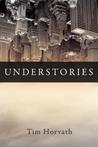
BOOK REVIEW: Understories by Tim Horvath

UnderstoriesUnderstories by Tim Horvath

My rating: 4 of 5 stars

Amazon page

Two traits of Tim Horvath are rapidly revealed in reading the collection of stories entitled, Understories. First, he’s an academic to the core. Second, he loves words and the way they can be jigged around to create not only meaning but feeling. Combined, these characteristics yield both positive and negative outcomes.

On the positive side, Horvath writes what he knows, and this can be seen in tales like: The Understory, The Discipline of Shadows, Tilkez, and even Circulation. Horvath paints a vivid picture of life in academia with The Understory and The Discipline of Shadows in particular, replete with scholarly rivalry and interdepartmental politics. While that may make the book sound stunningly boring, those two stories are among the strongest–in part because the author knows how to build tension and character in this domain. His bookish characters are constructed with wit and depth.

On the other hand, this book is for the ones who love language more than they love story. The readability isn’t high. Horvath peppers the text with words that many of us memorized to take our GRE test but never used after receipt of our acceptance letter. Many avid readers never learned such words in the first place. This is where the Kindle edition, and its capability for instantaneous word lookup, comes in handy. (Though, the author does manage to stymie Kindle’s internal dictionary on a number of cases.) The shorter pieces tended to leave me wondering if Horvath had a point other than to dazzle with verbiage. To be fair, it’s not just monosyllabic and pretentious words that Horvath loves. He has a taste for all sorts of words that are evocative and powerful, be they whimsical, sexual, or emotional.

Understories consists of 21 short stories, but I use the term “story” loosely. Some of the chapters are stories in a conventional sense. That is, they have a beginning, a middle, and an end, and a character who takes some sort of personal journey. Other pieces are the literary equivalent of the masturbatory orgasm; they’re pleasant to experience but beg the question of what the objective is. The contents of the book are below. I’ll restrict my commentary to the more substantial pieces, and leave the reader to figure out what Horvath was trying to get at with the others.

1. The Lobby: This is really an artistic introduction and rules for reading the book.

2. Urban Planning: Case Study #1: This is the first of 8 such “case studies.” With the exception of one, they’re all flash pieces.

3. Circulation: If I had to pick a best story of the anthology, it would be this one. It’s about a man whose eccentric father is in the hospital with mind and body that aren’t what they used to be. The man is Director of Circulation for his hometown library, and the father has one published book and spent much of his life working on an unfinished Atlas of the Voyages of Things. The sub-story about the books as a reflection of the man is what gives this something extra beyond the usual “Cats in the Cradle” (Harry Chapin reference) narrative.

4. Urban Planning: Case Study #2: Another brief piece.

5. The Understory: This is one of the full length stories, and is one of the best pieces. It’s about the bringing together and falling apart of a platonic relationship between two scholars. Set in pre-war Germany, the story opens with a scholarly rivalry between two professors who become good friends. However, one of the men is a Jew and the other is promoted to a Deanship because he has appeal with the Nazis.

6. Urban Planning: Case Study #3

7. The Discipline of Shadows: This is the story of a professor in the Department of Umbrology. What’s Umbrology? It’s the study of shadows. An interdisciplinary department with a unifying theme of shadows provides and intriguing background for a story that’s not so out of the ordinary. The story delves into scholastic politics and a sordid intradepartmental love triangle.

8. Urban Planning: Case Study #4

9. Planetarium: This is story proper. It’s about the reunion of two high school buddies, and their differing recollections of a seminal event of their youth involving shenanigans at a planetarium. The story is an odd sort of confession.

10. The Gendarmes: This story will appeal to lovers of the surreal. It’s about a man who discovers that a team of scientists are playing baseball on his roof.

11. A Box of One’s Own: An eloquent tale of the curiosity inspired by boxes.

12. Internodium: This is another short piece.

13. Urban Planning: Case Study #5: This one probably ties for my favorite flash piece. It’s about a city that evolves into all restaurants.

14. Runaroundandscreamalot!: There’s a lot of humor sprinkled throughout this book, but this is the one story one might put in the humor genre. It’s funny from the title onward, which is the protagonist’s pet name for a generic Chuck-E-Cheese-esque place called “Playalot”—which is a medieval-themed kid’s play palace. The protagonist, a divorced man, takes his daughter there and meets a woman that he proceeds to try to get to know better despite only knowing her as “Hanh’s Mom” for most of the story.

15. Urban Planning: Case Study #6: This is the other tie-holder for best flash piece. It’s about a city in denial.

16. Pocket: A flash piece on, well… pockets.

17. Altered Narrative: A short and experimental piece.

18. Urban Planning: Case Study #7: This is the only one of these “Urban Planning Case Studies” that is a short story in the usual sense. It’s about a [grown man] film projectionist who abandons his post after seeing his wife with another man.

19. The Conversations: There’s a fair amount of surrealism sown throughout this book, but this is one of the more speculative pieces. That said, it’s really just about the death and resurrection of the conversation—along with “mint.” The sci-fi component revolves around speculation about precisely caused it and what the difference is between a “Conversation” and a “conversation.” The latter being what we normally think of (i.e. and informal discussion), and the former being the subject of the story.

20. Tilkez: The protagonist is a creepy little man who writes down everything and the story is about his relationship with both a female and language (I think. The female might be symbolic.)

21. Urban Planning: Case Study #8: One last flash piece.

View all my reviews

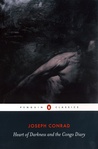
BOOK REVIEW: Heart of Darkness by Joseph Conrad

Heart of Darkness Heart of Darkness by Joseph Conrad

My rating: 4 of 5 stars

Amazon page

Heart of Darkness is a story within a story (i.e. a frame narrative) in which the protagonist, Marlow, tells a group of men on a ship on the Thames about his adventures captaining a boat on the Congo River. The use of a frame narrative both gives this novella/ novel a confessional feel, but also imagines Marlow’s audience feeling his tale particularly viscerally as some of them might be caught up in similar intrigues themselves.

Marlow’s job in the Congo is transporting ivory. However, the core of the story revolves around a trip to extract an agent of the ivory trade named Kurtz, and to transport the ill man to medical care. Kurtz is an intriguing character. This isn’t a man one can feel indifferently towards. Some love his intellect, charisma, or even his ruthlessness. Others despise him as the face of villainy. Kurtz represents imperialism at its most vile. Some natives are at war with him. Others respect and fear him. However, he’s willing to destroy them all on a whim to make the flow of ivory come more swiftly.

Marlow isn’t a member of Kurtz’s fan club initially and thinks the agent is completely insane, but he becomes intrigued with him as their journey progresses. In a way, Marlow is the moderate face of Imperialism. He doesn’t like the way the natives are treated, or the power plays and bureaucracy of the trade. However, he’s an active and willing participant, and, ultimately, when given a choice to work against the system or in support of it he chooses the latter. He hands over Kurtz’s report on the “Suppression of Savage Customs.” He also shows his sympathy towards Kurtz through his interaction with the dead man’s fiance.

This is definitely 19th century literature. While the book is very short, it’s readability isn’t high by today’s standards. It’s organized into just three parts or chapters, and the prose isn’t built for speed. Also, while it turns out to be a gripping tale, it’s slow off the blocks. It must also be put in the context of 19th century literature because the themes of imperialism and suppression of “savagery” have long since been settled. Viewed through today’s lens, the story might not ring true. Though I suppose there’s still a heart of darkness in urban environments today, behind walls rather than across seas.

What are the book’s strengths? While it may seem silly, the title is pure-D awesomeness. Also, while it’s not organized or written for readability by today’s standards, by 19th century standards it’s a page-turner. It’s certainly a compact tale. As I indicated, I’m not sure whether to call it a novel or a novella. Reading this book isn’t a major time investment, and it does pay off. Conrad’s use of descriptive language is often beautiful. Conrad’s characters all ring true and serve to sit one in a world of darkness beyond the imaginings of the London elite, where sad and terrible things happen to make their world possible.

Lastly, the book makes one think. Like Kurtz, one is likely to love it or hate it.

View all my reviews

BOOK REVIEW: Rashōmon and Other Stories by Ryūnosuke Akutagawa

Rashomon and Other Stories (Tuttle Classics)Rashomon and Other Stories by Ryūnosuke Akutagawa

My rating: 5 of 5 stars

Amazon page

Six stories make up this brief collection. All six are intriguing, well-written, and shine a light onto the dark side of mankind. The works of Akutagawa collected herein are all morality tales, but aren’t written in a moralistic tone. In fact, it’s not clear that the author wishes to convey lessons on virtue and vice as he’s intrigued with the instant at which an ordinary person turns bad. That instant, and the inflamed passions that often inspire it, is a prevailing theme throughout most of this small anthology. Akutagawa beats AMC by the better part of a century in showing us how bad breaks.

The first story is entitled In a Grove. This is a murder mystery in which we are given conflicting accounts of a man’s murder through the process of the investigation of the act. The final account that we are offered is that of the victim himself–as presented by a psychic medium. [Only two of these stories contain supernatural elements–this one and the last. Most of the collection involves realist premises. One must remember that Akutagawa was writing in the early part of the 20th century, and scientific rationality hadn’t yet gotten as strong a hold as it does today.] In this case, the use of a psychic is really just a plot device to give the reader insight into a truth which couldn’t otherwise be revealed. Having heard the perspectives of the murder and the dead man’s wife, one is left with questions owing to the self-serving nature of those statements. Of course, the final section reveals a twist–that I won’t spoil.

The second story is the title story, Rashōmon. The title is the name of a gate in Kyōto, the largest gate of Kyōto, in fact. However, Kyōto has fallen on hard times, and our protagonist is a newly masterless samurai who has sought the gate’s shelter from the rain. There, he contemplates whether he should take up a life of crime, which seems to be his only means of survival in the current economy given his skill set. The gate has become a repository for the corpses that are amassing as victims of the hard times accumulate. Within the gate, he finds an old hag who loots bodies for a living. His interaction with the old woman helps him to decide his own destiny.

The third story is called Yam Gruel. While “yam gruel” (or anything with the word gruel in it) might not sound appealing given today’s usage, a fact one must know is that during the time of the story it was a highly-prized and rare dish. The story follows a milquetoast administrator who leads a rather pathetic life in which he has but one ambition, to eat his fill of yam gruel. As a member of the samurai class, he’s invited to an Imperial banquet each year. However, because of his low status and the high-value of yam gruel, he never gets more than a taste. One year he openly bemoans the fact that he never gets his fill. A powerful samurai overhears this complaint, and it puts a seed of mischief in his mind. While this tale isn’t about breaking bad, it is about inflamed passions.

The fourth story sticks out as different from the others. While the bulk of the stories center on that moment at which a more-or-less good person goes bad, The Martyr tells us about a protagonist that never goes bad, despite having every right to. This might seem like a sea change in theme, but in reality it’s just another way of shining a light on the dark seed that resides in people. Only this time it does it by way of contrast. All of the other characters are deeply flawed, and we see that most vividly when contrasted against the one who always behaves virtuously. In this case, that virtuous character is Lorenzo, a novice monk who is accused of a severe breach of good conduct. Lorenzo becomes an outcast and a vagrant due to these allegations. Yet, despite all this, he acts heroically–even to assist those who’ve betrayed him.

In the fifth story we revisit the theme of breaking bad. In Kesa and Morito we are presented with two regret-filled accounts of the instant at which an adulterous couple decides to kill the husband of the woman involved in the affair. Each member of the cheating couple thinks that the other desperately wants the killing to go forward. In reality, both consider it a foolish decision driven by a brief moment of passion. This is another tale about letting one’s passions get out of control.

The final work is a retelling of the story of a monk named Hanazō who decides to prank his fellow monks because they chide him about his huge nose. Hanazō sets up a sign that says a dragon will appear from the local lake at a certain time and day to fly up into the heavens. The joke doesn’t turn out at all as the monk intended. I won’t go into the moral of the story to avoid giving too much away, but suffice it to say there is a moral.

I highly recommend this collection. As I’ve suggested, the collection isn’t just a disparate collection of tales, but has an integrating theme. Akutagawa was truly one of the masters of the short story. He wrote 150 stories before dying at the age of 35 in a suicidal drug overdose.

For those who like to see how literature is portrayed in, below one can watch the film version of Rashōmon.

View all my reviews

BOOK REVIEW: The Color of Magic by Terry Prachett

The Color of Magic (Discworld, #1)The Color of Magic by Terry Pratchett

My rating: 3 of 5 stars

Amazon page
The Color of Magic is a hero’s journey tale done in comedic fashion. It’s the first book in Prachett’s disc world series. An incompetent wizard, Rincewind, becomes the guide to a goofy but wealthy tourist named Twoflower. However, as it happens the events that confront these two on their journey are part of a game being played between gods. I loved the humor, liked the story, but wasn’t a fan of the organization of the book.

I should admit up front that fantasy is–hands down–my least favorite genre, and I can’t say that view didn’t jaundice my perception of this book. However, it’s a testament to Pratchett’s humor and readability that I continued reading it.

What is my beef with fantasy in general? First, once one introduces magic, how does one maintain tension in an environment in which anything can happen effortlessly? Obviously, fantasy fans find plenty of tension to keep them reading, but I just don’t get it personally. I know that one retort is that the same could be said of other speculative fiction genres. To the degree that is true, I also don’t care for those other genres so much either. However, sci-fi (for example) has a basis for constraints that can be widely agreed upon. Second, the appeal of feudal society for setting perplexes me. I guess there is a certain romance to these periods for fans (perhaps because they imagine themselves in the statistically-unlikely role of king or knight as opposed to the much more likely position of serfdom, but whatever), but I see this type of society as backward and unsustainable (a ten millennia old kingdom maybe possible in a world of magic, but not in a world as we know it.)

I know fantasy fans will be able to come up with examples of how their favorite authors avoid both of the pet peeves mentioned. In truth, Pratchett does a good job of negating these pitfalls. With respect to the magic problem, he makes the protagonist wizard really inept and, therefore, easily in situations over his head. Simply put, he makes his lead weak relative to those confronting him. With respect to the setting issue, Pratchett creates an entirely different kind of world, the disc world. This is not Charlemagne’s Europe with wizards.

Prachett is often compared to Douglas Adams. In fact, if you Google “the Douglas Adams of fantasy,” you are sure to pull sites pertaining to Pratchett. One can see the same type of absurdist humor in Prachett’s work. Here’s a compilation of a few of my favorite lines:

“Being Ymor’s right-hand man was like being gently flogged to death with scented bootlaces.”

“No, what he didn’t like about heroes was that they were usually suicidally gloomy when sober and homicidally insane when drunk.”

“Yah. I outnumber you one to two.”

“He wondered what kind of life it would be, having to keep swimming all the time to stay exactly in the same place. Pretty similar to his own, he decided.”

“But the captain had long ago decided that he would, on the whole, prefer to achieve immortality by not dying.”

“Your affected air of craven cowardness does not fool me.”

Pratchett appeals to the downtrodden in all of us. This can best be gleaned from the tale of Goldeneyes Silverhand Dactylos. Dactylos is a superb craftsman who is blinded, has his hand cut off, and suffers ever greater indignities because the Emir wants him to never again produce anything as lovely. It’s like the myth about Shah Jahan having the hands cut off Taj Mahal craftsman, except Pratchett’s Emir keeps asking the same man of increasing handicaps back to construct ever greater marvels of engineering.

The book is arranged in just four chapters. This is a bit of an oddity for commercial fiction, and I don’t really care for the sparse employment of breaking points in this book. Again, if I was enough of a fan of fantasy to read this in a single sitting (or even a few sittings) I would likely not find this to be an issue. However, I read it over time and interspersed with many other books (a lot of which were more captivating to me personally.) This might seem like a ridiculously nit-picky point, but for those of us who have a lot of reading up in the air at once, being able to readily put a book down and pick it up seamlessly later without losing the story is of great benefit.

If you like humor, this book will appeal to you. If you like fantasy, I suspect you’ll doubly like it–as long as you have a sense of humor. If you don’t like either, this book will not be for you.

View all my reviews

BOOK REVIEW: Justice League Vol. 1: Origin by Geoff Johns

Justice League, Vol. 1: OriginJustice League, Vol. 1: Origin by Geoff Johns

My rating: 2 of 5 stars

Amazon Page

Amazon had the Kindle edition of this graphic novel on sale recently. With all the talk of a Justice League movie, and whether it can ever get off the ground, my curiosity in these characters was piqued.

This volume was released in August of 2011 as the leading edge of a reboot of the entire DC comics line called “the New 52.” This is the origin story for the Justice League as a team, though all but one of the individual characters–Cyborg–is an existing hero at the time the story begins. The other characters, i.e. Batman, Green Lantern, Superman, Flash, Wonder Woman and Aquaman are familiar to the world but are not well liked. (and are introduced into the story arc in that order.)The volume consists of Issues #1 – 6 of the Justice League [New 52] reboot.

In the beginning, there’s only one dyad among this group who knows each other personally, the Green Lantern and the Flash–we don’t really know how they know each other. Most of the other characters are aware of each other’s existence (or myth), but have never met. Of course, Cyborg doesn’t exist at the beginning of the story, and his individual origin story is woven in throughout the book as a subplot so that he can be introduced into the arc at the climax. The characters are assumed to each operate in his (or her) own domains, i.e. Gotham City, Metropolis, Coast City, Central City, etc.

As the story opens, Batman is chasing down a stocky, non-human creature on the roof tops of Gotham in order to try to figure out what the nefarious character is up to. Green Lantern is inexplicably introduced into the middle of this chase scene. Batman and Green Lantern viscerally despise each other from the get go. This isn’t surprising as Green Lantern is an arrogant ass throughout the entire story. Perhaps the highlight of the book (which is sad as it happens so early) is when Lantern is busy mocking Batman, and the Dark Knight steals his ring–the source of his power–right off his finger.

The Green Lantern and Batman witness the inhuman creature planting a piece of alien-looking technology (later revealed to be a “mother box”), and Green Lantern’s ring confirms it to be otherworldly. The pair decide to pay a visit to the Earth’s resident alien, a.k.a. Superman. Green Lantern immediately runs afoul of Superman, arrogantly thinking he can subdue the Man of Steel, and has to call his old friend the Flash. The quartet finally stop fighting and begrudgingly agree to put their heads together.

After seeing a piece of the Cyborg origin story, we are introduced to Wonder Woman. She is probably the character that we get the greatest sense of. (Besides Lantern, who is unlikable throughout.] The Amazonian seems more alien than Superman. She’s never had ice cream but loves it, but not quite as much as a good fight. She’s not emotional about fighting, neither fearful nor angry, but is at her most happy when fighting. She’s the character most out of touch with the world she is occupies. She joins up with the four in the chase for the winged, alien monsters, forming a quintet and instilling some gender equity.

The Cyborg origin story comes to a head when Silas Stone, a brilliant defense industry scientist, turns his dying son, Victor, into the Cyborg, thinking it the only way to save the young man after he suffered severe burns from a mother box explosion. The former star football player is now a kind of Frankenstein’s monster, part himself and part autonomous machine. There’s a cacophony in his head as he can now pick up various radio signals.

It’s shortly thereafter that Aquaman is introduced. Considerable artistic effort was put into manning up Aguaman, who always seemed the weak link in this team. The group happens to be standing around near the water when Aquaman and his fish minions chase some of the evil army to the surface

The enemy is Darkseid, a juggernaut warlord from another world (or a parallel universe), whose army of evil minions have been the ones that the newly formed League have been fighting both individually and as a group. When Cyborg goes running away from his father–and his creator as a machine-man, he runs into the six superheroes, and the team of seven is fully assembled. Darkseid’s power is so great that he relatively easily captures and subdues Superman.

Batman goes to rescue Superman as the rest of the team regroups. The Dark Knight’s tactic is letting one of the evil, winged, juggernaut minions capture him–as they have been capturing others.

I won’t spoil the ending, but will say that it was pretty weak, and a large part of the reason I gave this work such a low rating.

A two star rating may seem a little harsh. The dialogue in this work is better than most comic books. There’s relatively less “As you know, Bob,…” style exposition. There is some, as when Green Lantern feels the need to explain to Batman about how there are other Green Lanterns and this is his space sector. However, there are also clever uses of action to present background, as when Lantern begins to admit that he’s a show-off and it turns out he’s brushing up against Wonder Woman’s truth lasso. (This is a much better way to do it than Wonder Woman saying, “And now my lasso is around you and you’ll have to tell the truth, for whosoever the lasso touches cannot bear false witness.” Which would be the typical comic book way of revealing the lasso’s power.)

There are two problems with this work that are too serious to overlook. First is the deus ex machina ending. The authors make a bold choice as to who will save the day, perhaps to create surprise and perhaps to highlight the character. But the whole resolution strains credulity. Second, there is no good explanation for why these characters keep piling into each other (except for the Xenophobic thought processes of Batman and the Green Lantern that Superman must know about anything alien.) These evil minions are supposedly everywhere, and yet the individual superheroes keep running into each other–and continuing to stay together despite the fact that most of them clearly don’t like the others. I think the author takes this “we hate each other, but are begrudgingly working together” trope a little too far. It feels as if this Wizard of Oz cast hadn’t come together by commonly following the yellow brick road, but rather that seven separate and randomly moving tornadoes picked up one each and just happened to stack them in a neat pile.

Besides Green Lantern being arrogant and unlikable and Wonder Woman being endearingly alien, we get very little sense of individual characters. Batman and the Flash are the voices of reason of two differing type, but Superman and Aquaman are just muscle.

I have a black and white Kindle, but the art looked good to me–but that’s not my forte. I applaud the artists for getting rid of Superman’s red tighty-whities and making Aquaman look more manly. At the end there’s some alternative artwork and info on costume development for those who geek out on such things.

If there’s any hope for a Justice League movie, it’s not to be found in this story line. If you’re a DC fan, you’ve already read this–like it or not. If you’re wondering whether to become a DC fan, I wouldn’t start here.

View all my reviews

BOOK REVIEW: Ender’s Game by Orson Scott Card

Ender's Game (Ender's Saga, #1)Ender’s Game by Orson Scott Card

My rating: 4 of 5 stars

Amazon page

Ender’s Game is the story of a boy, Ender Wiggin, whose intelligence and capacity for ruthlessness lead the military establishment to believe that he’s the last hope for mankind. The book is set in a future after the Earth has been invaded twice by an alien species called the buggers, and now the Earth is planning its own “preemptive” invasion to end the bugger threat once and for all.

The novel follows Ender’s life from his short home life as a “third”—a rare third child for which special permission must be granted—through his post-war life. (This entire timeline transpires before adulthood.) The bulk of the novel takes place in Battle School, where Ender receives his training in military tactics and strategy and spends much of his time in zero gravity war games. He rises up through the ranks quickly, as expected, but not without stirring some animus in the process. He learns strategy both through war games and through the mind-field of real world animosity by others who are jealous or feel insulted by his brilliance.

As Commander material, Ender is considered to be in the Goldilocks zone. His older brother, Peter, is too cruel; his sister, Valentine, is just too kind. (All three Wiggin children are geniuses.) Ender has the right mix to fight the buggers. His problem is that the world forces him to be ruthless and his compassionate side makes it hard to cope.
While Ender leaves home young and early in the novel, there is a subplot involving the older Wiggin children that is revealed over the course of the book—showing the reader more of the tormenting brother and the loving sister who shaped his worldview. Ender does interact with Valentine in person on a couple of occasions, but his only interaction with Peter is a brief mention of correspondence at the end of the book.

Ender is an intriguing character. He is always the outsider, by birth as a third and then through isolation in Battle School that is facilitated by the conflicted head of the Battle School, Col. Graff.

I won’t get into the ending except to say that there is a twist at the novel’s climax. I will say that the reveal of this twist felt a little anti-climactic to me. However, as the real story isn’t about fighting the buggers, but Ender’s internal struggle, this isn’t as dismaying as it might otherwise be.

One can tell that this is a series book because it climaxes and resolves relatively early, leaving a fair amount of space to set up the next book. This actually helps the twist offer some surprise because the reader sees that there are so many pages left for the novel to resolve itself.

Card does an interesting thing in making the central character stronger than everyone around him–at least until he’s introduced to his new guru, Mazer Rackham–the Commander who won the key battle of the second bugger invasion and who is alive by virtue of a relativistic trip. Ender’s superiority seems like a recipe for boredom, but it works because what we don’t know is whether Ender is stronger than everyone else pitted against him combined, and, moreover, we don’t know whether he is strong enough inside to withstand all the horridness to which he is subjected. A lot of the tension of the novel is really internal to Ender. Unlike Peter, who would revel in ruthlessness, Ender is tormented by all of the violence he must perpetrate.

I’d recommend this novel. It has its flaws, but it is quite readable and Ender’s character is intriguing from start to finish.

The movie version is coming out tomorrow. I haven’t seen it, but here is the trailer.

View all my reviews

BOOK REVIEW: American Gods by Neil Gaiman

American Gods (American Gods, #1)American Gods by Neil Gaiman

My rating: 5 of 5 stars

Amazon page

American Gods is the story of a hapless and gentle brute who goes by the nickname “Shadow.” We meet Shadow as he is being released from prison a few days early because the wife that he loved dearly has passed away. While the description of Shadow’s imposing size and criminal activity might lead us to believe he’s an unsavory character, we find him sympathetic from the outset–though we don’t learn that it was virtue more than vice that landed him in prison until late in the book.

Given that the name of the book is American Gods others who’ve read it may wonder why I say it’s about Shadow instead of being about a war between America’s old gods and its new ones (e.g. technology and mass media.)The latter statement is more likely what one will read on the dust jacket. However, for me it was the character of Shadow that kept me reading. As with any great novel’s main character, Shadow is put in predicament after predicament, and one must see how he’ll handle them. Eventually, we suspect that enough will be enough and he will have to choose to act in his own best interest rather than in the moral manner.

The importance of character in this novel doesn’t mean that it’s lacking a plot. Early on we are given a great hook when Shadow is introduced to the character of “Wednesday.” The hook is that Wednesday seems to know things about Shadow that no one could, and he makes a proposal to Shadow. The reader is thus drawn in and wants to know how Wednesday knows the impossible and whether Shadow will agree to the vague offer. While we don’t know what agreeing will mean for Shadow, we suspect that it’s tailor-made to land him back in hot water.

While Shadow seems to be always ending up with the short end of the stick, what makes things interesting is that he’s not dumb. He doesn’t stumble into these traps unwittingly. Rather, Shadow defies convention and, by some measures, is really quite a sharp man. Often, he sees the folly of his decisions but is compelled by virtue to act in ways that put him at risk.

Shadow is on a journey of self-discovery throughout the book, and what he ultimately discovers about himself is spectacular.

In a way American Gods is Neil Gaiman’s commentary on America, and Shadow represents America at its most virtuous. We see plenty of America’s faults and failings in the process, its vainglory and hunger for power. But in Shadow we see a character who is honor bound to do what he thinks is the right thing–even when it comes at great personal cost and even when he knows he is being manipulated.

I found this novel to be highly readable and would recommend it. It has Gaiman’s characteristic humor, darkness, and dark humor.

View all my reviews