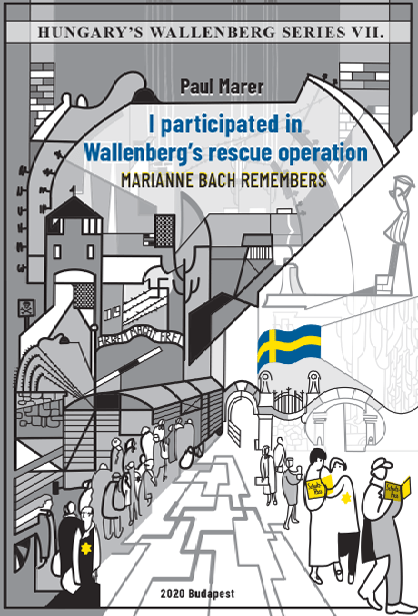
BOOK REVIEW: I Participated in Wallenberg’s Rescue Operation by Paul Marer

I Participated in Wallenberg's Rescue OperationsI Participated in Wallenberg’s Rescue Operations by Paul Marer
My rating: 5 of 5 stars

Inquiries about purchasing the book can be made here.


In 1944, the Nazis were working to eradicate the European Jews. Among the last major Jewish populations accessible to Hitler that had yet to be shipped to the death camps were those from Budapest. Among the most effective forces arrayed against the Nazis and the Arrow Cross Militia (the Hungarian fascists) in the days before the Red Army arrived were neutral nation diplomats who issued protective documentation, offering at least a thin shield of legal protection that saved thousands of lives.

Perhaps the most intriguing story of such diplomats is that of the Swedish envoy, Raoul Wallenberg – not because his operation was bigger or riskier than those of the others, but because his story didn’t end with the war. Wallenberg was captured by the Soviets at the end of the Siege of Budapest for reasons that remain speculative, and he died in a Soviet prison. This book draws on the experience of Marianne Bach, a young member of Wallenberg’s team. Given the loss of Wallenberg, and the fact that the other members of his operation are now deceased, Bach’s story is an important last chance to learn more detail about what happened in Budapest during those dark days.

The book is chronologically arranged. The first two and the last three chapters discuss Marianne Bach’s life before and after, respectively, her days working as part of Wallenberg’s team. A reader might dismiss such chapters as humdrum, if necessary, background information, and starkly contrast them with the more high-octane, life-and-death, fascist-fighting core of the book. However, Marer fixes his sights on an intriguing focal point throughout these chapters, identity (and crises, thereof.) Both before and after the war, Bach was challenged by questions of identity – religious, cultural, and national identity. Living abroad, she was a foreigner, but at “home” in Hungary there’d been a great effort to eliminate her people. It was smart to focus on events and questions at the crux of identity. It makes these chapters engaging to a degree that a broad biographical sketch would be hard-pressed to achieve.

The core of the book (ch. 3 – 8) doesn’t just tell Bach’s story – in fact, it doesn’t just tell the Wallenberg story, it delves into the broader question of the fate of the Budapest Jews and all those who intervened to save whomever they could. This isn’t to say that the closeup story is absent. Readers get a detailed view of the operations that Bach was involved in and an overview of the Wallenberg story – including discussion of his fate as a secret Soviet prisoner. It’s just that those closeup stories are embedded within a broader context that includes activities like Carl Lutz’s Glass House operation, Hitler’s order to take over of Hungary before it could defect from the Axis, and the Danube executions by Arrow Cross Militiamen that followed that takeover.

This book provides a gripping examination of a disturbing time, and I’d highly recommend it.

View all my reviews

BOOK REVIEW: The Two Noble Kinsmen by William Shakespeare

The Two Noble Kinsmen (Folger Shakespeare Library)The Two Noble Kinsmen by William Shakespeare
My rating: 5 of 5 stars

Amazon.in page


King Creon of Thebes is a jerk. The play opens with three Queens petitioning the Duke of Athens, Theseus, to avenge the kingly husbands that Creon had executed. Theseus ultimately agrees. We know that Creon is really a jerk [and not that the Queens are being spoilsports (or duplicitous)] because Creon’s own nephews – Palamon and Arcite, the titular two noble kinsmen – are about to high-tail it out of Thebes to get away from Creon’s reign when they learn Theseus has attacked. These two aren’t the kind to shy away from a fight, and so – instead of leaving – they fight for Thebes, despite its jackwagon of a King. The two fight with valor, but are no match for Theseus’s forces and are captured, becoming prisoners of Athens.

Palamon and Arcite are paragons of manliness, the kind of men who other men want to be and that ladies want to be with. They are handsome, virtuous, athletic, and likeable. The two share a bond that one might think unbreakable, until the beautiful Emilia enters the picture. Through the window of the jail, Palamon spots Emilia in the garden and is stricken by love at first sight. When Arcite says he, too, has the hots for Emilia (who they both only know by sight and from a distance,) Palamon is suddenly ready to kill his kinsman and brother in arms. Palamon is over-the-top in his anger, especially as it seems unlikely at that moment that either of them is likely to meet Emilia. [I suspect Arcite really likes Emilia, too, but one can’t eliminate the possibility that the elaborate antics to follow are all for the principle of the matter because Palamon is so insistent that Arcite has no right to pursue Emilia. As if Palamon had called “shotgun” and Arcite had tried to jump up front.]

However, soon Arcite is summoned to the palace, and he ends up being banished from Athens. He’s told that he doesn’t have to go home, but he can’t stay in Athens. Arcite starts to head back to Thebes, but then he finds out that Athens is having a field day (by that I mean a day of sports and competition, not in the colloquial sense of the word) he decides to disguise himself and compete in the hopes of winning Emilia’s heart (and / or getting Palamon’s goat.) (Winning Emilia is no small feat given Emilia’s high standards and – given her adoring talk of her relationship with a friend named Flavina – a likely lesbian inclination.) But we’ve established that Arcite is a man among men, and he trounces the competition, and – in doing so — does get to meet Emilia.

Meanwhile, back in the jail, Palamon is no slouch himself. By way of a combination of charisma and machismo, the jailer’s daughter has fallen as fast and stupid for him as he did for Emilia. The daughter ends up breaking Palamon out of jail. Shortly after that, the she goes coo-coo for coco puffs insane when she realizes: a.) being a commoner, Palamon could never fall for her, and b.) in all probability her father will be hanged when Theseus realizes Palamon is no longer in the prison, and her father’s blood will be on her hands.

Palamon and Arcite meet. Palamon has not cooled down, and is more ready than ever to kill his kinsman — but in a duel, because he’s a gentleman, not a heathen. Arcite provides food and medicine, and tells Palamon he’ll back in a week with two swords and two suits of armor so they can hold their deathmatch in a style befitting gentlemen. I don’t know how much it was intended, but the absurdist humor of these two men alternatingly assisting and threatening to gut one another is hilarious. One could build a Monty Python sketch on it with some tweaking and exaggeration.

Palamon is good to his word, and (after helping each other on with the other’s armor) the two commence their duel, but are interrupted by a deus ex machina hunting trip featuring Theseus, Hippolyta (his wife), Emilia, and Pirithous (a gentleman friend of Theseus’s.) Theseus is angry and is ready to have the two men hauled off for execution. The kinsmen genteelly request that they be allowed to finish out the duel so that one of them will die a little ahead of the other by the other’s hand. Theseus denies this request, but everyone loves these dudes (even Pirithous seems to have a bro-crush on them) and they all intercede.

Theseus has a change of heart. He offers Emilia the option of picking which one she’ll marry, and the other will be executed. Emilia says thanks for the offer of god-like powers, but that she’ll pass. She says she’ll marry whichever one comes out alive, but she’s not going to be judge, jury, and executioner. Then Theseus tells the two kinsmen to leave for one month, during which time they are to be civil to each other. When they come back, they’ll bring three knights with them. (BTW, bad deal for the knights who also die if their boy doesn’t win the competition, but they are all knightly stoic about it.) Then they’ll have a competition in which whichever man can force the other man to touch a pillar will win Emilia’s hand and the other one will be executed.

I’ll leave the reader to read how it plays out. I believe I read that this play was called a comedy on its playbill, but its one of the plays that there is no consensus in categorizing. Unlike “Macbeth,” which is always called a tragedy, or “Taming of the Shrew” which is uniformly labeled comedy, there is significant difference of opinion on this one.

All the while the two noble kinsmen’s stories are playing out, a subplot is afoot in which the jailer’s daughter has gone mad, and efforts are being made to snap her out of it. It turns out that her father, the jailer, was not in danger because Palamon didn’t rat her out, and probably because Theseus assumed Palamon burned through the locks with a smoldering look.

This is a straightforward and entertaining tale. Yes, it has its share of deus ex machina happenings (the fortuitous fox hunt is neither the first nor last), but that’s the nature of theater. Furthermore, I found parts of it hilarious, particularly when the kinsmen are getting armored up for their duel.

This was amongst Shakespeare’s final plays, and it’s said that he had a co-author on it. So, it’s got a little bit different feel. It’s not categorized as a problem play, but as I mentioned some call it a comedy and others a tragedy. Either way, you should definitely read it.

View all my reviews

BOOK REVIEW: Introducing Literary Criticism by Owen Holland

Introducing Literary Criticism: A Graphic GuideIntroducing Literary Criticism: A Graphic Guide by Owen Holland
My rating: 3 of 5 stars

Amazon.in page


As the title and subtitle suggest, this book is an overview of the field of literary criticism that uses graphics (mostly cartoon drawings) to assist in conveying the information. This is one volume in a large series (Introducing Graphic Guides) that covers a range of subjects, mostly in the humanities (at least as far as the titles I’ve seen.) I picked up this book because it’s a topic I’ve developed a curiosity about, I knew almost nothing about, and it – like many titles in the series – was available to borrow via Amazon Prime.

As far as I can tell, the book covers all the major schools of criticism. Having looked around a little bit out of curiosity, I found the same headings are widespread. I do feel that the book would have benefited from being less personality-driven and more conceptually driven. By that I mean to say, it felt like the author thought his primary task was to list all of history’s most major literary critics. There’s a large number of individuals mentioned, but with little insight into how these critics engaged a piece of literature. I know that this is supposed to be a concise introduction, but I was dismayed by how little I felt I understood of the topic at the end compared to books that I’ve read of a similar nature (e.g. Oxford University Press’s “A Very Short Introduction” series.) In short, while I understand there’s limited space to cover a vast discipline, I don’t think the space available was used well.

I must admit that part of my confusion stems from the fact that literary criticism seems to be very different from what I thought it to be – and has been becoming increasingly so. So, I assumed that literary criticism had something to do with questions of how effectively elements such as language, narrative arc, metaphor, metrical form (or formlessness), character development, etc. are used in creating a resonance between writer and reader. [When I do reviews, these are the types of questions that inform my commentary. i.e. Is the story intriguing? Are the characters believable? Is the language skillful / beautiful? Is meaning conveyed in as approachable a manner as the subject allows (or if it’s more complicated, does that complication serve a reasonable end? etc.] To the degree these questions were ever of interest to literary critics, they seem have been replaced by another question: “Does this writing make ____________-ists feel warm and fuzzy, or mean and prickly?” [Where the “-ist” in question might be a feminist, a Marxist, or an environmentalist – just to name a few.] I may be misinterpreting what modern literary criticism is and does, but the fact that I’m doing so after having read this introductory guide supports my argument that maybe there was better use of space than having such a great number of critics cursorily mentioned – not to mention the cartoons (which seemed to serve little purpose.) The one thing the personality-driven approach does is give one plenty of examples of works to read to learn how various schools of literary criticism take on their appointed task, but I’d have rather had a clue about that from just reading the book.

I suspect that there are titles in this series that are able to use graphics to greater benefit – given their subject matter. In this work, the graphics are mostly cartoons that restate key points from the text in speech bubbles – so the art essentially fulfills the role that text-boxes do in some magazines and books, but in a more space-intensive way. If there were no graphics in this text, I don’t think I would have felt that I missed out on anything.

This book will show you how the field of literary criticism progressed and who the major players were, but doesn’t offer much insight into how critics engage with works of literature. Early in the book, this doesn’t make much difference, but — given the direction the field went in — it raises a lot of questions. There is discussion of whether art should be judged on its artistic merits or whether it rises and falls by its morality and social merit. I guess the answer the field collectively came to is the latter. [i.e. What matters is how happy or unhappy a work makes the segment of society the critic represents – I guess?] However, this makes it much more difficult to conclude how critics evaluate works. Do feminist critics dismiss all of Shakespeare as garbage because it disregards the agency of female characters in the way of that time? Do ecocritics toss “Moby Dick” in the trash because its about whaling? Or do these critics not engage with such texts because they are irrelevant to them? It would have been nice to have some insight into these questions, because it matters as to whether the field has anything worthwhile to say if you are a reader as opposed to an ideologue.

If you want a who’s who of literary criticism combined with some vocabulary building, this book has you covered. However, to see how critics engages with texts to produce criticism, you’ll probably need to go elsewhere.

View all my reviews

BOOK REVIEW: Temporary People by Deepak Unnikrishan

Temporary PeopleTemporary People by Deepak Unnikrishnan
My rating: 5 of 5 stars

Amazon.in page


This book gathers twenty-eight pieces of short fiction, poetry, and creative writing – some surreal and others realistic – all with the overarching theme of the life of a guest worker in the United Arab Emirates (UAE.)

I picked up this book as my literature selection for the UAE (I’m working on reading at least one work of literature from each nation I’ve visited. I find it informs my experience with each country in a way that greatly complements the visit.) I wasn’t sure how useful this book would be for my purposes (which is in large part to gain insight into a culture that might pass me by as a traveler.) I wasn’t concerned about the fact that this book is about non-citizens who are temporarily located in the UAE, and thus the cultures I would be seeing would largely be from abroad. [The predominant ethnic group presented in these stories is Malayali, from Kerala in India, but one reads of Filipinos, Bangladeshis, Sri Lankans, and many others.] For many countries I’ve visited this dislocation might be an issue, but the UAE and other Gulf States (e.g. Qatar) present a unique situation in that most of the work gets done by workers from South Asia, Southeast Asia, and – to some degree – other places such as Africa and even Europe. Seeing how this melting pot works was definitely more interesting to me than reading about the lifestyles of rich and unknown Emirati’s who live off their petro-welfare checks. My concern, early in the book, was that there’s a lot of surrealism (including the opening story) that would offer some level of metaphorical insight but little direct insight. However, by the end I felt that I did gain a taste of life in the UAE from reading this book.

While the bio-blurb suggests there are “twenty-eight linked stories,” this isn’t really an accurate statement. There are twenty-eight “chapters,” divided into three parts, but many of these chapters wouldn’t be considered “stories” in any conventional sense of that word. [To elaborate with an example, one “story” is just a three-page list of different careers / states of being of foreigners in the UAE. Some of the works are poems and others are micro-writings.] Issue might also be taken with the term “linked” as well, there are a couple tales linked by characters or events, but mostly they are only linked by the theme of being a stranger in a strange land. This isn’t to say that there are no stories. There are, and several of them are excellent. Personally, I got the most out of the longer pieces of short fiction. These are the works that really stuck with me. The short, experimental works will surely find a readership that loves them, but for me they were mostly just a kind of palate cleaner.

The stories that most gripped me were:

-The tale of a woman who rides around fixing [and sometimes finding] construction workers who fell off a building. This one effectively presents the idea of the foreign laborer being treated as a disposable commodity.

-The man who destroys a phone belonging to a small business owner when he goes into a jealous rage. This is one of the stories that really hammers home the trauma of familial separation and long-distance relationships.

-The story of children molested by an elevator. [I warned you that some of the stories are wildly surreal and / or symbolist. The book’s blurb relates the work to Salman Rushdie, and one can definitely see shades of that author’s influence.] What struck me about this story was the idea of growing up too fast in this life as a guest worker’s dependent.

-A boy whose bicycle is stolen undergoes a series of traumas. This one has a lot to do with being ground down and then lashing out to save face. The boy whose bicycle was stolen didn’t speak Arabic and thus stood out to the police as someone they could treat as they wished, and this spurs him to want to pay the unkindness forward.

-The man who takes a job selling laundry detergent, literally dressed as a clown. This story is about the humiliation suffered by one who has to take whatever job he can get, and – once in the job – he’s seen as someone who can be tread upon by others, having lost all dignity.

-The Malayali man who returns home to India rumors that he’d been to jail for something that his neighbors find unconscionable. Another on-going sub-theme of the book is life in a highly moralistic society, and the troubles that that creates for the common man – particularly when there are extremely few available women of a status that one can approach.

This is by no means a complete list. There are other good stories as well. These are just the one’s that I found particularly resonated with me. The idea that the guest worker is not only temporarily a person but partially one as well runs through the book.

I’d highly recommend this book if you enjoy short fiction, and / or you are interested in life in the UAE.

View all my reviews

BOOK REVIEW: How To Make a Zombie by Frank Swain

How to Make a Zombie: The Real Life (and Death) Science of Reanimation and Mind ControlHow to Make a Zombie: The Real Life (and Death) Science of Reanimation and Mind Control by Frank Swain
My rating: 5 of 5 stars

Amazon.in page


The title of this book might lead you to believe that it’s either frivolous or that it’s an examination of a successful sci-fi subgenre. In fact, the book presents some serious (if disturbing, and often unsuccessful) science on two concepts that are disparate except by way of analogy of the Zombie – the brain-obsessed walking undead popularized in film and fiction. Those two ideas are: 1.) how definitive of a state is death, can people be brought back from it, and – if so – under what conditions and at what costs? 2.) is it possible to completely usurp an individual’s will, and – if so – by what means?

The book consists of seven chapters that are topically organized. The first chapter introduces the idea of Zombies, discussing early reporting on them from interested parties visiting the cane fields of the Caribbean. But it also delves into the idea of how drugs and freezing might create temporary death (or the appearance of death) from which individuals can be [partially or fully] successfully roused.

Chapter two explores the history of research about how to bring a deceased person back from the dead. Squeamish readers should be forewarned there is discussion of such things as partial dogs (i.e. the head end) being temporarily revived. The book touches on various ideas related to resuscitation. There is a discussion of one researcher’s study of katsu, techniques used in judo and jujutsu to revive an individual who has lost consciousness [or worse.] Near Death Experiences [NDE] and Out-of-Body [OoB] are also covered. These strange phenomena reported by revived individuals are too common to ignore, but — while they are often presented as evidence of an afterlife and /or the divine, there’s little reason to believe that they aren’t perfectly natural phenomena. [e.g. Neuroscientists are able to induce an OoB with a carefully placed electrode.]

Chapter three shifts gears from the question of death and resuscitation to the one of mind control. While the bulk of the chapter is devoted to pharmaceutical approaches to mind control, it also examines mind control by other means – e.g. authority as an agent of mind control as seen in the famous Milgram experiments, as well as hypnosis. Most of the drug related sections deal with psychedelics (and their naturally occurring precursors.) Swain describes the CIA’s varied shenanigans with LSD in MK-Ultra, Operation Midnight Climax, and the Frank Olsen death. [Long story short, you can’t control someone’s mind with psychedelics, but you can still achieve some despicable ends.]

Chapter four continues the exploration of mind control, but focuses on more invasive approaches — from lobotomies to electro-stimulation. Of course, even as these procedures got more sophisticated, they could still only reliably make vegetables.

If you think the history of lobotomies from chapter four was as scary as it can get, I’ve got news for you. Chapters five and [particularly] six are the ones that I found both the most fascinating and by far the most terrifying. These chapters, together, uncover how mind control is achieved in the natural world by parasitic creatures. Clearly, if there is any risk of successfully taking over a human will, it will not be with doses of Acid or icepicks stuck in the brain, it will be from figuring out how some of nature’s parasitic masters of mind control do it and copying from their playbooks.

Chapter five discusses wasps and fungi that successful take over their [fortunately non-human] hosts. I wasn’t familiar with how many mind-controlling wasps there are, but I had heard of the fungus, Ophiocordyceps unilateralis. Said fungus infects an ant, steers it up into a tree, forces it to secure itself by locking in its mandibles onto a branch, and then the fruiting body blooms out of the ant’s frickin’ scull. It’s chapter six, however, where things really get creepy. There’s an extended discussion of rabies, but the wildest part was a discussion of Toxoplasma gondi. T. gondi likes to infect cats, but if it can’t find a cat, it’ll infect a rodent and selectively (not only turn off the rat’s fear of cats but also) make the rat attracted to cats. What’s fascinating is that all of the rat’s other usual fears remain intact (bright lights, sharp noises, etc.)

The last chapter is on the various intriguing things that happen after a person dies — from cannibalism to organ harvesting. I think the most interesting discussion to me, however, was one about keeping a brain-dead accident victim alive long enough that her baby could live to term within her. (There was also an intriguing – if unnerving – case of a mother who wanted her deceased son’s sperm harvested.)

The book’s only graphics are black and white photos at the head of each chapter, but it is footnoted and has a chapter-by-chapter bibliography.

I found this book riveting. I learned a lot from it. The cases are presented in amusing and enthralling ways. If you are interested in the questions of what it means to be dead and how safe your free will is, this is an engrossing look at those subjects. I highly recommend it.

View all my reviews

BOOK REVIEW: American Vampire, Vol. 1 by Scott Snyder and Stephen King

American Vampire, Vol. 1American Vampire, Vol. 1 by Scott Snyder
My rating: 5 of 5 stars

Amazon.in page


This graphic novel includes two distinct, but interconnected, stories presented in an interspersed fashion (i.e. each chapter presents a piece of each story.) The first story, written by Scott Snyder, is set in flapper era Hollywood, and revolves around a hardworking aspiring actress, Pearl, who is lured into a den of vampires by a big-name actor who she has a celebrity crush on.

The second story, by Stephen King, is set in the wild west and tells the story of a violent bandit named Skinner Sweet. Sweet is also turned vampire when he is “killed” by a vampire whose business activities are disrupted by Skinner’s rogue ways. The connective tissue between the two stories is the character of Sweet, who is a background character in Snyder’s story – playing a sort of mentor / guide who Pearl is only reluctantly and skeptically willing to accept.

Like Blade, character from Marvel Comics and the movies of the same name, Pearl and Sweet have enhanced capabilities in comparison to the old “European” vampires. These enhancements are similar to Blade’s, as well. The American Vampires don’t instantaneously fry in sunlight, and they are stronger and faster than their old-world counterparts. I suspect that in both cases, these enhancements are meant to make things interesting, given that – in both cases — these characters are at a disadvantage in every other way (i.e. they are outnumbered, they have many fewer resources, and they are far less experienced.) Unlike Blade, the “American Vampires” morph into nastier and more monster-like versions of themselves when they go on the attack.

The stories are straightforward, though skillfully crafted. In the first, Pearl is turned and then goes out for some payback, her best friend getting caught up in the action as well. In the second, Sweet plays out his vendetta against a lawman who was his nemesis. We get additional insight from a man who wrote up Skinner’s story as a work of fiction, but then came out as having really been writing the truth – much to the amusement of a skeptical audience. Flashbacks throughout this author’s talk layout the Skinner Sweet story. One does get the sense that immortality has had a tempering effect on Sweet, who doesn’t seem so prone to be mean for meanness sake. Although, this might be deceptive as we don’t see much action by him in the Snyder story.

I found the artwork to be well-done. While I don’t have expertise on the subject, I could follow the panels with no problem, and that’s about all I need out of them.

I was engrossed by this book. It can’t be claimed to being original, but it is an adept execution. If you are interested in vampire stories, this is an interesting take on them.

View all my reviews

BOOK REVIEW: The Winter’s Tale by William Shakespeare

The Winter's TaleThe Winter’s Tale by William Shakespeare
My rating: 5 of 5 stars

Amazon.in page


The moral of this story is that great power combined with human frailties like jealousy, vanity, and pettiness is a recipe for misery – even [perhaps, especially,] for the all-powerful individual. Stated another way, all humans get a little crazy from time to time, but if one has power over life and death the craziness isn’t just a passing fancy.

Leontes, the Sicilian King, has enjoyed an extended visit from his old friend King Polixenes of Bohemia. As Polixenes intends to leave the next day, Leontes is politely trying to talk his friend into staying longer. Leontes then asks his Queen, Hermoine, to take on the task of nagging Polixenes while Leontes steps out to take care of some business. When Leontes returns, he finds the Queen has succeeded in talking Polixenes into staying. At this point, Leontes is driven into a jealous madness, assuming his wife must be sleeping with Polixenes because she was able to talk the Bohemian King into something Leontes couldn’t. Leontes immediately becomes certain of this infidelity, despite the fact that he has no evidence for it and – it will turn out – no one believes the Queen has been unfaithful. While Leontes keeps his rage to himself, he orders one of his trusted Lords, Camillo, to murder Polixenes.

While neither Camillo nor Paulina (the Queen’s closest friend) would be considered marquee characters, they are the MVP’s of the play. Both characters take actions that put themselves at great risk when confronted with the dilemma of whether to do the right thing or to comply with the dictates of the King. Camillo first does this by refusing the assassinate Polixenes and then fleeing to Bohemia (which is necessary given Leontes’s madness.) [In an intriguing turn, Camillo will again have to do the right thing, this time, in the face of Polixenes’s wishes – i.e. when Polixenes wants to punish his son for sneaking out to apparently court a commoner. This incident with the — previously reasonable — monarch reinforces the aforementioned story moral, and perhaps establishes a few hundred years before Baron Acton’s dictum that “absolute power corrupts absolutely.”] Paulina is vocally (and, later, in other ways) supportive of the Queen, even when it is clear she is raising the hackles of King Leontes.

The madness of Leontes is fascinating. He not only concludes with certainty that the Queen cheated on him, he also makes the leap that his current son, Florizel, and the child that Queen is due with when she is arrested were both sired by Polixenes. The fact that all his Lords and Paulina (wife of a Lord) politely suggest to him he is in error does not sway him. As an attempted concession toward reason, he consults an Oracle. Even when the Oracle’s sealed response comes back telling him that he is wrong, that his wife and Camillo are both right, and he is going to end up without an heir unless he can find the child that he sent away (the infant delivered in the gaol) he is unswayed – until moments later when he learns his once beloved son, Florizel, is dead. Despite the fact that he’d concluded Florizel was a bastard, he is moved by the death of the boy – at least in combination with the swooning of the Queen — which appears to be her death as well.

The rest of the story plays out the fate of the child that was sent away by the King. The child was taken by Antigonus (another of Leontes’s Lords and husband to Paulina) who doesn’t survive the trip but does leave the child where a shepherd ends up finding her.

This is an intense take on the jealousy and insanity. The story is gripping throughout. There are plenty of intriguing twists and turns. It’s fascinating how many ways Shakespeare can play the simple plot of unfounded jealousy. Needless to say, this play is highly recommended reading.

View all my reviews

BOOK REVIEW: Pride of Baghdad by Brian K. Vaughan

Pride of BaghdadPride of Baghdad by Brian K. Vaughan
My rating: 5 of 5 stars

Amazon.in page


I generally dislike books for adults which anthropomorphize wildlife. Except for “Watership Down” and “Animal Farm” I can’t — off the top of my head — think of another book oriented towards adults that I liked that did so. However, Vaughan’s book tells a stirring story that could pretty much only be told by anthropomorphizing its wildlife characters – because those characters are the only characters through most of the story and the intensity of the story revolves around their internal experience.

It’s the story of a pride of lions that escaped from the Baghdad Zoo during the Gulf War. The four lions were – for a time – roaming the streets of war-torn Baghdad looking for food. The story blends fiction with way-points of fact established from the accounts of soldiers.

Vaughan does inject some of the harsh reality of the natural world into the book, and so it doesn’t fall completely into the pit of anthropomorphization, and — by doing so — he creates a more visceral experience in the story.

It’s a short but gripping story. Vaughan succeeds in facilitation of the reader’s consideration of what it must be like to be an uncomprehending creature placed in humanity’s most incomprehensible condition – warfare.

An appendix to the book includes the proposal and notes, which clarifies some of what was actually known to have happened as opposed to what is either speculated or fiction.

I found this book intriguing and would highly recommend it.

View all my reviews

BOOK REVIEW: The Nightgown & Other Poems by Taisia Kitaiskaia

The Nightgown & Other PoemsThe Nightgown & Other Poems by Taisia Kitaiskaia
My rating: 5 of 5 stars

Amazon.in page


This playful poetry collection takes fairy tales and folklore as a theme, but — as in those tales — it makes magical leaps, refusing to be restrained. Amid poems that meander in a fun but stream-of-conscious way, denying the reader literal meaning, there are lines that — like Zen koan — slap the reader in the face for trying to rationally calculate a meaning. (An example that stuck with me is, “candles are dying to see me naked.”)

The poetess is clearly a word-lover, and occasionally makes bold choices of verbiage, sending me to the dictionary for words like “oubliette.” Though I must say there was always a nice pay-off. These weren’t words chosen solely for sound quality, they invariably represented evocative or profound ideas. (e.g. The aforementioned example, “oubliette” is “a secret dungeon with access only via a trapdoor in the ceiling.”)

Lest I make the collection sound impenetrable (if fun,) I’d say it just requires a certain surrender to whatever it kindles in the reader.

I immensely enjoyed reading this collection. It’s fun. Even when it’s taking on serious topics, which it does, it doesn’t take itself too seriously and it’s all the more effective fore it.

I’d highly recommend poetry readers give this one a try.

View all my reviews

BOOK REVIEW: World War Hulk by Greg Pak

World War HulkWorld War Hulk by Greg Pak
My rating: 5 of 5 stars

Amazon.in page


This collection [World War Hulk (2007) #1-5] picks up where “The Incredible Hulk: Planet Hulk” left off. “Planet Hulk” sees Hulk arriving on the harsh planet of Sakaar where he engages in a series of adventures that take him from enslaved gladiator to king. I reviewed that work recently, and enjoyed it more than this one, though both are from the same author and each tells an intriguing story. The “Planet Hulk” story was just more intricate and thought-provoking — we see a change in the Hulk and the events that bring those changes about.

In “World War Hulk,” the Hulk returns to Earth, seeking revenge upon the “Illuminati” group who jettisoned him into space (i.e. Tony Stark / Ironman, Doctor Strange, Reed Richards / Mr. Fantastic, and Black Bolt.) Said revenge isn’t so much for shooting him into space, but because the craft that they sent him to space in blew up leveling Sakaar’s capital city and killing (among many others) his brand new Queen. So, the story is just the Hulk trying to put a beating on the four superheroes who shot him into space as they try to not get beaten (and to keep a [mostly] evacuated New York City from being leveled.] The Illuminati quartet face a number of problems, however. First, while they might have had the combined ability to defeat the Hulk before (at least teamed with the many other heroes at their disposal — and many are present from street-level vigilantes to big leaguers like the Fantastic Four,) the Hulk is madder than ever, and thus stronger than ever (but also wiser / more experienced.) Second, the Hulk now has his own monster-level “Warbound” entourage (i.e. Korg, Miek, Hiroim, Brood, and Elloe Kaifi.) Finally, the one hero who, without a question, has the power to stop Hulk and his Warbound, i.e. The Sentry, is severely agoraphobic and schizophrenic. So, it’s a great challenge to get him out the door and once you do, he’s at risk of schizoid behavior. On top of all that, he contains enough power to destroy the world – accidentally or because of distorted perceptions.

I did like the touch about The Sentry being a basket case. I’m not a big fan of hugely overpowered heroes, but if they have enough weaknesses they can redeem what would otherwise be terminally boring storylines. This is certainly the case with the Hulk who is at his most powerful when he is out of control and who is also, generally, at his least intelligent at those times. The Sentry takes it a step beyond because he’s barely functional. One may be doubtful about someone so powerful being scared to go outside, but it is the nature of mental illness that one doesn’t always see oneself as one is seen and there need not be a sound logic to one’s perceptions of the world.

I’d recommend reading “Planet Hulk” first and – if you enjoy it, which I suspect you might – you’ll probably find following it up with “World War Hulk” worthwhile.

View all my reviews