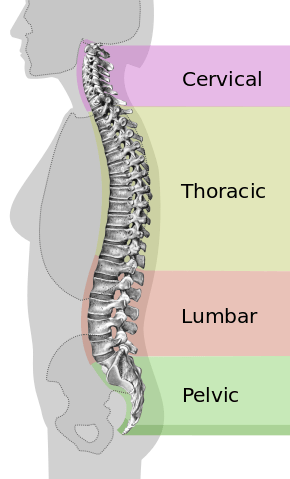
Hyperkyphosis (a.k.a. Excessive Thoracic Kyphosis, “Dowager’s Hump”, or often just called Kyphosis) is an excessive outward curve of the thoracic (chest) region of the spine. There are many causes and contributors to this problem, but–for the purposes of this post–I’ll be focusing on postural kyphosis. There is a natural curvature in this part of the spine that is healthy. However, as is also true of the lumbar spine, the amount of curvature can become excessive, leading to a number of health conditions.
5.) Hyperkyphosis increases the risk of injurious falls in older people. Having one’s head forward, when combined with a lack of capacity to respond quickly to loss of balance, makes it more likely one will fall and hurt oneself.
Source: Kado, D.M., et. al. 2007. Hyperkyphotic posture and risk of injurious falls in older persons: the Rancho Bernardo Study.J Gerontol A Bio Sci Med Sci. Vol. 62: 652-657.
4.) As far as the muscles of your upper back and neck are concerned, an 11 pound head can weigh 40 to 50 pounds when it’s forward positioned. Hyperkyphosis and forward head position tend to go hand in hand. If you purposely slump your back you’ll see why.
Source: Hansraj, K.K. 2014. Assessment of stresses in the cervical spine caused by posture and position of head. Surg Technol Int. Vol. 25(Nov): 277-279.
3.) There is reason to believe the young are becoming more prone to hyperkyphosis in conjunction with “text neck” from spending lots of time slumped over their phones.
Source: in addition to the Hansraj journal article above, see also: Ward, Victoria.2015. Children ‘becoming hunchbacks’ due to addiction to smart phones. The Telegraph. October 16. Online edition; last accessed Nov. 7, 2017.
2.) Yoga can help reduce hyperkyphosis. A test group who practiced hour-long sessions of yoga three days a week for 24 weeks showed an improvement in the flexicurve angle of kyphosis.
Source: Greendale, G.A., et. al. 2013. Yoga decreases kyphosis in senior women and men with adult onset hyperkyphosis: results of a randomized controlled trial. J Am Geriatr Soc. 57(9): 1569-1579
1.) Older individuals may be at risk for fractures, particularly when doing spine flexing movements, but careful use of spinal extensions (e.g. hands free cobra or superman shalabasana [locust]) can build strength and reduce fracture risk.
Source: Katzman, W.B., et. al. 2010. Age-related hyperkyphosis: its causes, consequences, and management. J Orthop Sports Ther. 40(6): 352-360
This book’s paradoxical title is perfect for its paradoxical subject matter, which is famously expressed in such quotes as, “When nothing is done, nothing is left undone” [ver. 48 of the Tao Te Ching.] Slingerland lays down the ancient Chinese wisdom of wu-wei and de, but provides something novel by putting it in the context of the positive psychology and neuroscience of today. Wu-wei literally means “no doing,” but can be more meaningfully defined as “effortless action.” De (pronounced “duh”) is a charisma seen in people who have mastered the effortlessness and spontaneity of wu-wei.
While the book is built around the varied approaches of four Chinese philosophers—two Confucians (i.e. Confucius and Mencius) and two Taoists (i.e. Laozi and Zhuangzi)—the author relates this philosophy to the present-day thinking found in Daniel Kahneman’s “Thinking, Fast and Slow,” Mihaly Csikszentmihalyi’s conception of Flow, and the neuroscience of the subconscious.
The book consists of eight chapters. The introduction and the first two chapters outline the concepts of wu-wei and de using both Chinese and Western stories and examples to help clarify these arcane ideas and put them in the context of the social and spiritual spheres. Chapter 1 offers an extensive discussion of the operation of the brain as it relates to the discussion of effortlessness and spontaneity.
Chapters three through six make up the core of the book, and present the approach and thinking of Confucius, Laozi, Mencius, and Zhuangzi, respectively. This “boy-girl-boy-girl” Confucian-Taoist organization offers the reader sound insight into the varied approaches and allows one to see the evolution of thinking. Confucius gets the first cut, but his approach to effortlessness and spontaneity involves a great deal of effort and planning. It might seem that Laozi’s approach–which does away with effort and planning–might be more apropos, but it’s hard to imagine anything of benefit actually being spawned by such a loosy-goosy approach. The more nuanced approaches of Mencius and Zhuangzi offer additional insight, but do not eliminate the paradox. It’s this paradox that’s the subject of chapter seven.
The final chapter examines what the reader can take away–given that the paradox of wu-wei seems inescapable. The author proposes that, paradox or not, there is value in pursuit of effortlessness and spontaneity, and progress can be made by understanding and accepting said paradox.
The book has no graphics, but is annotated and has a bibliography–as well as an appendix table that summarizes the various approaches to wu-wei.
I enjoyed this book and found it fascinating. It’s highly readable, having humor and a wide range of examples from ancient myths to pop culture. The book offers a great value-added by considering the relevance of modern science and psychology to this ancient concept. I’d highly recommend this for individuals interested in Chinese / Eastern philosophy, as well as anyone hoping to bring a little more effortlessness and spontaneity into his or her life.
Balance is one of those qualities that one takes for granted until it fails. Actually, given our bipedal stance, it’s extraordinary that we aren’t falling down all the time. Achieving a stable upright posture takes a lot of complex anatomy and physiology operating flawlessly. I picked up this book because I believe a yoga teacher should be cognizant of the range of capacities for balance that might be seen while teaching. If one teaches students in their 20’s to their 40’s, the need for balance modifications and capacity building might not come up much. It’s when one deals with the very young as well as older students that one sees flawed balance in large measure. [And—let’s face it—the very young can fall down 30 times, pop right back up each time, and be all the stronger for it, and so mature students are the major concern.]
This isn’t the first book in this series of Harvard Medical School Guides that I’ve read and reviewed, and probably won’t be the last. (see: “Your Brain on Yoga,” “Guide to Tai Chi,” and “Low Back Pain.”) I’ve found the series to be beneficial because it presents scientifically sound information, but isn’t afraid to give alternative approaches—such as yoga and tai chi—their due when the studies show that said activities are of benefit. This book is no exception. At several points the authors mention tai chi as being beneficial, and the book includes a yoga balance workout as one of the six that it contains.
The book is organized into 13 sections (i.e. chapters.) The first chapter describes how our vestibular (inner ear), visual, and proprioceptive (the nervous system elements that track where one’s body parts are) systems interact to keep us upright.
Chapter 2 presents an overview of a range of conditions that affect balance. Some of these influence balance specifically and exclusively, but many are conditions that one might not associate with balance problems though they’ve been shown to increase the risk of imbalance. There are sections about which medications have side-effects adversely affecting balance as well as what your doctor may be able to do about balance problems.
Chapter 3 is a “Special Bonus Section” and is of particular importance to mature readers or those who care for said individuals. The topic is preventing falls, and this section describes common causes of falls and offers checklists of considerations for setting up the environments in which those with balance problems will be active.
Chapter 4 introduces various types of activities that improve balance, and chapter 5 is a brief guide to considerations relevant to beginning a balance workout such as whether to consult one’s doctor and what safety precautions should be considered.
In chapter 6, the authors propose how balance workouts can be merged into one’s overall fitness plan. A lot of this chapter is an introduction to exercise—e.g. how much is needed, and what the benefits are. Then there are some tips about how to smoothly merge balance with other exercises.
Chapter 7 presents more specific considerations for beginning balance workouts. Unlike chapter 5, this section provides information about equipment, warm-ups, and how to interpret the instructions for the workouts. The latter is beneficial because the workouts are in a one page per exercise format, and this section negates the need to be needlessly repetitive.
The next six sections (chapters 8 through 13) are various balance workouts that are organized in an easiest to hardest format. The first is a beginner’s workout, which is performed with a chair—used for sitting in some exercises and as a prop in others. The second is a standing balance workout that features simple static balance maneuvers. The level of challenge is similar to that of the first workout, except that one is without a chair prop. The third workout adds in movement to help maintain balance through steps and motion. The next workout is similar but utilizes another prop, a 360 step (a circular step of similar height to the more common Reebok rectangular step, but circular.) The penultimate workout uses a pseudo-balance beam. The author’s mention a product put out by Beamfit, but other manufacturers produce a similar product. It’s a low, dense foam beam that sits on the floor. The last workout utilizes classic Hatha Yoga poses, and features both expected poses like tree pose (vrksasana) and others such as down dog (adho mukha svanasana) that might come as a surprise.
There’s a resources section and glossary at the end. The book presents many graphics, most notably photos of each of the exercises in the six workouts.
I’d recommend this book for anyone who needs an overview of the problems of balance and what can be done about them. It’s short, readable, and user-friendly.
5.) Take a class / Join a group: While I’m partial to yoga and the martial arts, the class could be in any area that presents a challenge. However, there are a couple of advantages to the aforementioned two (to which I would add dance.)
First, these disciplines train one to be expressive with one’s body and to move more freely. This can do wonders for confidence. People store tension in their bodies without even realizing it. Many have postural problems that effect confidence and self-perception. A 2014 New Zealand study found that posture can have a strong effect on emotional state.
Second, no matter who one is, one will be challenged by new approaches to movement. The average person has great difficulty learning to use their body in new ways. One needs to drill in movements conscientiously to achieve competency. Our conscious mind, frequently gets in the way. Even the most athletic and coordinated people will need to work it, failing repeatedly until they succeed.
Why is the challenge so important? Many people go through life afraid to fail, but far too few fear never failing. Sounds idiotic. Nobody wants to fail. I have some hard news. If you’ve never failed, it’s not because you are unmitigatedly awesome in all things. It’s because you’re living in a box and cherry-picking life experiences that feel unthreatening.
If, like me, you’re an introvert, this approach offers the additional benefit of social interaction that is of a predictable / schedulable nature. One needs the interaction, but the problem comes when one has social interactions and / or sensory stimulation that go on too long and in an unpredictable fashion. Therefore, being able to schedule such time is a good way to go about being a more productive introvert.
4.) Writing / Visualization: These two approaches to mentally rehearsing allow one to keep one’s inner critic in check. The problem with simply day-dreaming it is that critic can chirp in without being that cognizant of it.
In visualization, one quiets the mind and can then non-judgmentally acknowledge and dismiss the negative thoughts. In writing–be it as a journal entry, poem, or a story–we may not notice the nagging voice of the inner critic on the first draft, but you can take note of it and undo it in rewrites.
3.) Travel / Living abroad: I should point out that not just any old travel will have the desired effect. Many people plan their travel with the objective of being comfortable at the fore. They eat at places that serve the same kind of food as at home. They stay in hotels with virtually all of the comforts of home, and sometimes many more. This is understandable because the traveler might just be seeking rest. However, if one is seeking the epiphany or enlightenment experiences talked of by backpackers and ashram-dwellers, that’s not something that comes from staying in resorts or eating at American fast food joint. Those kinds of brain changing experiences come when one is stripped from the familiar and has to surrender one’s attachments to the way one thinks the world should be. One’s perception of culture and worldview changes radically when immersed in a foreign environment.
2.) Game it / Roleplay: There’s a big movement to gamify all manner of everyday activities. In her book, “Reality is Broken,” scholar of game design Jane McGonigal describes a game called “Chore Wars” that incentivizes the doing of mundane household chores.
What is it about games that help one move beyond one’s limits? First of all, it incentivizes actions. And if you’ve ever noticed people playing games on their phone or FB for hours on end, you’ll note that it doesn’t take much reward to keep people plugging away—as long as the game is structured well.
Second, good games provide a built-in process of “leveling up.” This means that the challenge keeps being intensified as our skill level advances. Those familiar with Csikszentmihalyi’s conception of “Flow” will recognize that matching skill level to challenge level is one of the most crucial elements in facilitating flow-state.
Roleplaying is a bit like the previously mentioned tools of visualization and gaming in that it’s a way to have a low-cost rehearsal. If one has someone with whom one can engage in such a roleplay, than one also has someone to help make you aware of your inner critic and its deleterious effects. And that brings us to the final tool:
1.) Have a spouse, partner, and or confidant: In “Why Zebras Don’t Get Ulcers” Robert Sapolsky tells a story of being interviewed by a magazine. He was asked what the number one thing that they could tell their readers about reducing stress. To which he replied that the most well-established factor in stress reduction is to have a spouse / life partner with whom to share one’s challenges. Unfortunately, this was a magazine for women business leaders, a significant portion of whom had given up on permanent relationships and families. They, therefore, asked him what else he had. Still it’s hard to overlook the anxiety-fighting effects of having someone around with whom to share one’s dread.
5.) Adopt a power posture: There’s been a lot of research in recent years suggesting that posture isn’t a one-way street–i.e. body doesn’t necessarily have to follow our mental state. One can reverse the flow, improving one’s mental state by adopting a strong and confident posture.
One of the most thorough discussions of this phenomena is in Amy Cuddy’s book Presence, which famously mentions the “Wonder Woman” pose. However, another widespread example is using the up-and-outward fist pumping posture that is widely seen among humans and even other primates (i.e. with arms outstretched as Usain Bolt is seen above.)
I got my eye on you
4.) Master eye contact: This is dreadfully difficult for an introverts such as myself. We tend to look anywhere but the eyes.
If one is traveling in risky places, it’s important to have a grasp of the fine art of eye contact. If one doesn’t make any eye contact, then one risks looking zoned out–potentially inviting aggression. If one rapidly looks away, offering too short an eye contact period, one appears intimidated–potentially inviting aggression. However, if one’s eye contact is too long, it may trigger some primal fight impulse, or–at a minimum–suggest you have taken more interest in the individual–which may invite aggression. This means one has to balance a fine line that says, “I see you, you know I saw you. Now I’m going to do me and let you do you.”
3.) Adopt the opposing viewpoint: Say you find yourself obsessing about some perceived slight or wrong. While you want to address this issue, you want to be calm enough to avoid saying or doing something you’ll regret. You want to be seen as a sensible individual while being persuasive. The key is seeing both sides, and taking a moment to realize that your opposition is probably not the black-hearted villain of his own story. He likely has some reason for his behavior. Maybe it’s even a reason you can empathize with, given your own experience–i.e. being overworked and distracted, facing a decision that only allows for a best worst option, etc.
2.) Visualize it: It may seem as though anything that occurs solely in the mind can’t have that much force, but–in fact–it can. Visualizing can help one get over one’s anxieties. By systematically considering how events will unfold, one can break the cycle of worst-case scenario creation that the brain readily falls into. This will make an activity seem less intimidating and more manageable.
1.) Start small: Often when a person would like to be more kind or compassionate, she’s flummoxed or overwhelmed by the scale of the problem. She sees problems that she can’t make a dent in. So schedule one small act of kindness in a week or maybe a bigger one monthly, or as is possible. Do it, see its value, and be content.
One also sees a need for starting small with advanced physical practices. If you can’t do a yogasana or martial arts move, figure out what capacity building or modifications one needs to get to the end goal. Then take it on bit-by-bit. There are many videos on how to systematically build up to challenging maneuvers like the press handstand or planche, moves that almost no one can do with out a great deal of prep work.
This book examines the role of the nervous system in movement and bodily activity. It describes how one’s body is able to perform extraordinarily complex maneuvers that we often take for granted because they feel effortless. It investigates some of the ways in which the interface between body and brain go awry, as well as the various effects this can have. It also offers insight into how we can be deceived because we are experiencing the world less directly and more through the shaping activities of the brain than we feel is true.
The book contains ten chapters, plus a little forward and back matter. The first chapter is entitled “the body mandala” and it provides an overview of how the nervous system can be thought of as a series of maps layered upon maps that routes various input from outlying areas to the brain and commands from the brain to the outlying areas. A “mandala” is a symbolic representation of the universe [from Hindu and Buddhist traditions], and this notion is repeatedly revisited throughout the book.
Chapter 2 explores the mapping of the homunculus and its ramifications. If you’ve ever seen a 2-D or 3-D image /model of a human being that has gigantic lips and hands and disproportionately small torso and thighs, you’ve seen said homunculus (as the term is used in neuroscience.) The reason it’s scaled this way is that body part size is reflective of space in the nervous system dedicated to said parts and not their actual size. If you’ve ever seen one of those maps–called cartograms–in which the size of a country reflects a statistic, say, population (thus India, China, and Singapore are much larger than their physical size, but Canada is much smaller than its), you get the drift. This chapter also answers the question everyone wants to ask (and many do) which is “why–if the lips are so large because of their dedicated territory in the brain—are the genitals unexpectedly small in the homunculus?
Chapter 3 describes how body maps can be in conflict and what effect this can have. It talks about why people who lose weight often still feel fat and move in ways that are not reflective of their actual figure. It also gets into anorexia (and the lesser known bigorexia) which reflect mismatches between perceived body image and actual body schema.
Chapter 4 investigates a fascinating phenomenon in which visualization can often result in strength and performance gains. Said gains aren’t on the same scale as among those who actually exercise or practice, but the fact that one can make gains without moving a muscle is certainly intriguing. Of course, the takeaway is that one can get the best of both worlds by augmenting physical conditioning and practice with visualization—one has a more finite number of feasible physical training hours in a day (i.e. there are diminishing returns on physical training at some point.)
Chapter 5 is the first of two chapters that deal with problems related to improper interaction between the nervous system and the body. Here we learn about “the yips” that plague golfers and other occupational dystonias. When one begins practicing any physical activity, the objective is to build up muscle memory so that the movements can be completed purely unconsciously. This works through neuroplasticity—the fact that sequences of neurons that frequently fire together become more strongly linked—but neuroplasticity can have a dark side at the extremes.
Chapter 6 considers the way in which the system of maps can fail such that one fails to recognize one’s own limbs, one recognizes extra ones, or the like. Chapter 7 is about peripersonal space—i.e. the physical bubble of space that one needs to feel comfortable, and which varies both culturally and individually.
Chapter 8 delves into the role that upcoming technology may have in changing how we look at the body-brain connection. Mirror neurons are the subject of the penultimate chapter. You’ve probably heard of these neurons which fire when we see someone else perform an action. Usually there is an inhibitory signal to keep our body from actual mimicry, but sometimes you may find yourself unconsciously mimicking the position or body language of another person when one is engaged in an engrossing conversation. (Yawning contagiousness is a featured example.) Mirror neurons play a role in how we learn so quickly, how we sometimes anticipate the behavior or emotions of others, and deficient activity in these cells has been speculated to be responsible for autism.
Chapter 10 describes the role of the insula in human activities. The insula has been found to be involved in emotion and rewards system by which humans are motivated to engage in a number of bodily activities.
The book has many graphics to clarify technical points, many of these being line drawings of the brain and other physiological structures. There is also a glossary of key scientific terms.
I found this book to be fascinating. It was highly readable despite its technical subject matter, and it described these systems and the research about them in a clear manner. I’d highly recommend it—particularly if one is interested in movement, fitness, and optimal human performance.
5.) FACT: People who lose weight often still feel heavy and commonly maintain the body language and movement characteristic of an overweight person.
REASON: A conflict exists between the body schema (which is largely up-to-date on the current state of the body, but is largely unconscious) and body image (which relates to how we feel about our bodies, can lag behind the state of the body, and of which we are conscious.)
RELEVANCE: It may take unconventional activities to help a student realign his or her body schema and body image. e.g. Wobble boards have been shown to be effective.
4.) FACT: The busiest skeletal muscles in the body are the extraocular muscles (i.e. more than 100,000 moves per day.)
REASON: We don’t see over a broad area as clearly as we think we do. The illusion that we can is created by rapid saccades by which the eye is constantly moving to take in sights from the point at which our sight is best. You can prove this to yourself by fixing your gaze forward, and then–from the side–draw a playing card at random so the face is towards your cheek while holding the card out to one’s side at shoulder height, and then–eyes still fixed forward–gradually move it in an arc at arm’s length towards one’s center-line until you can make out which card it is. You might think you’d be able to make it out at say a 30-degree angle from center-line, but you’ll find it’s almost directly in front of your eye when you can make it out. If if isn’t: a.) your eyes made a cheating saccade so quickly you didn’t notice it or, b.) you are an android and have eyes (and nervous system interface) that aren’t constructed on the same principles as the human system of vision.
RELEVANCE: One may want to brush up on eye yoga. Yes, there is such a thing.
REFERENCE: There’s a section on exercises for the eyes in Swami Saraswati’s “Asana Pranayama Mudra Bandha” (commonly called APMB.)
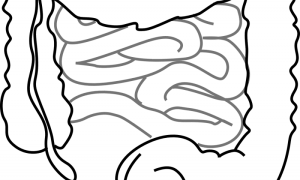
3.) FACT: The gut has its own nervous system (i.e. the enteric nervous system) that can interact with our body’s nervous system, and increasing evidence suggests that it’s not always mental stress that causes stomach aches, but sometimes problems in the gut result in mental / emotional turmoil.
REASON: There’s a lot that remains unknown at the moment, but a lot of research is going on in this area. It seems reasonable to guess that there’s probably an evolutionary advantage for the digestive tract to be able to express its dissatisfaction in a way that changes behavior (and emotions are all about behavior change.)
RELEVANCE: Unexplained depression or emotional outbursts may have unexpected origins.
REFERENCE: I can highly recommend “Gut” by Giulia Enders, but I’ve also heard great things about the more recent “I Contain Multitudes” by Ed Young, though I haven’t gotten around to reading it yet myself.
2.) FACT: The problems that can arise due to hyperventilation aren’t about oxygen levels, they are about too little carbon dioxide.
REASON: Lack of carbon dioxide can cause arteries and arterioles of the brain and spinal cord to constrict.
RELEVANCE: Introduce kapalbhati and bhastrika with caution.
REFERENCE: H. David Coulter’s “Anatomy of Hatha Yoga” chapter on breathing (Ch. 2) deals with the physiology of breathing in an excellent fashion.
1.) There are oh-so-many more than five senses in the human body. Within the realm of “felt sensation” alone there’s not only touch (one of the five senses we usually think of), but also: thermoception (sense of temperature), nociception (sensation of pain), proprioception (sense of the location and motion of our various body parts, and balance (which relies on vision and proprioception but also vestibular sensation.)
REASON: Without these sensations we couldn’t function as we do. I don’t have to tell experienced meditators how difficult it can be to simply stand up or walk when proprioception is dampened by the pins-and-needles from sitting cross-legged such that one doesn’t notice one’s drooping foot.
RELEVANCE: At some point one should begin to practice relying on proprioception more and visual confirmation less. (Proper drishti–focal points–rarely allow one to visually confirm one’s position.)
REFERENCE: Besides the book mentioned in #5, check out David J. Linden’s “Touch.” I’ve also begun reading a Harvard Medical School Guide entitled “Better Balance” that gives insight into how to improve the sense of balance–particularly if one serves senior citizen students.
This guide is one in a series put out by Harvard Medical School. It’s the second one that I’ve read, and I found them both to be beneficial reads. The first was on the health benefits of tai chi chuan (a Chinese martial art / system of health exercise [qi gong.])
Harvard Medical School’s willingness to report findings about unconventional approaches and self-care was part of the appeal of this book. When I first developed lower back problems, I went to the doctor, was diagnosed with arthritis via x-ray, and all I got was an offer for pain killers. To me this was much like going to the mechanic because the check engine light came on, only to be told that all they could do for me is unplug the pesky indicator light. At any rate, that’s why this kind of book can be useful, because one can’t always expect a given doctor within the modern medical establishment to be on top of treatments not involving drugs or surgery. This isn’t to denigrate those options, often times they are the best or only option, and they are covered in this guide as well. However, back pain is one of those rare areas in which sometimes the best option is outside medical norms. Much as many doctors hate having information thrust in front of them by patients, at least Harvard Medical School may garner more respect than a WikiMD post. There’s even a box talking about the mind-body connection, and options in that domain.
Low back pain is both extremely common and often still poorly understood. That’s because there are so many problems that can cause similar symptoms. [I guess this shouldn’t be a surprise because our pelvis had to rotate through evolutionary changes to take us from quadrupedal to bipedal. It makes sense that our nerves and blood vessels might be routed in such a manner as to cause troubles.]
While this guide is short, it does take on a range of issues, including: who’s most at risk, how the spine works [and doesn’t], what the basic categories of back injury are, how one’s specific ailment may be diagnosed, how to evaluate treatment options, what one can do on one’s own to help heal a problem back while preventing future injury, what medicines may be prescribed, what surgical options may be offered, and advice on facilitating a recovery.
As far as ancillary features are concerned, there are a number of line drawings. This artwork is generally either anatomical drawings used to show how the spine works or is injured, or show exercises that one can use to strengthen the back. There are a few pages each of resources and glossary. The resources are not so much printed resources (there’s only one of book, and that one is authored by the editor of this guide,) but rather organizations and even websites.
I found this guide to be informative and helpful. I would recommend it for anyone who has low back problems, or who might benefit from learning more about them (e.g. yoga teachers.)
“Touch” is a neuroscientist’s perspective on the human sense of touch, and the profound impact it has on life in our species.
It’s a short book, only about 200 pages of substantive text, arranged into eight chapters. The first chapter considers the role that our sense of touch plays in our lives as social animals. There are a number of studies described in this chapter, but I’ll cite only two that I think give an idea of what the chapter is all about. The first considers why a person holding a cold coffee is likely to be viewed more negatively than if that same person was holding a hot coffee after a handshake. The second reports that survey takers in a mall were more likely to gain compliance if they engaged in gentle, casual, and non-creepy touch—e.g. fingers to forearm.
The second chapter explores the combination of sensors we have in our skin—particularly in our fingers–that allow us to conduct feats of dexterity that (while we take them for granted) are phenomenally difficult. For all the billions put into robotics research, robots are nowhere close to being able to complete tasks that any five-year old can do. The third chapter examines how humans are uniquely geared to be able to give and recognize a particular type of touch sensation, the caress. Throughout the book there are a number of interesting stories, some of them are scientific case studies and others… not so much. This chapter begins with the story of a man on trial for flying into a rage because his girlfriend couldn’t get the pressure right when engaging in manual stimulation. (The author was actually on the jury.)
The fourth chapter delves more deeply and explicitly into sexual contact. Whereas chapter 3, dealt largely with hand against random skin, this chapter deals in genitals and erogenous zones more specifically. There are also a number of fascinating cases / stories herein. A lot of the chapter deals in how we experience and interpret pleasure.
Chapter five explains a specific type of sensation, that of temperature. It considers why crushed chili feels hot but crushed mint feels cool to the skin. While the focus of the book is on human anatomy, physiology, and social interaction, there are many cases from other species throughout the book. This chapter offers a prime example. It explains how Vampire Bats have a unique ability to sense infrared. This is of benefit to them, since they only take blood meals and, therefore, need to be able to sense where the blood is flowing and has the least insulation (fur) over it.
Continuing the examination of specific kinds of sensation, chapter six is about pain. This is where the neuroscientific perspective offers some interesting insight. In particular, because it considers why soldiers who had multiple gun wounds could do their job on the battlefield with nary a peep of complaint, but then would raise holy hell about a bad blood stick a few days later in the hospital. The case of a medic who was badly shot up but not cognizant of it until later is discussed in some detail.
Chapter 7 deals in the itchy, and asks and answers the question of whether or not itchiness is a particular case of low-intensity pain. By low intensity, I’m not speaking of the compulsive behavior sometimes spurred by such sensations.
Chapter 8 is also highly neuroscience influenced. It deals with various illusions of sensation, and how these illusions come about through the interaction of sense and the brain. While the most famous example of such an illusion is phantom limb pain experienced by amputees, Linden addresses less traumatic and more work-a-day tactile illusions for most of the chapter. (This may be because there are a number of popular works of neuroscience that deal in phantom limbs—most notably V.S. Ramachandran’s books.)
I enjoyed this book. It conveys significant technical detail, but does so in a fashion that is easy for a non-expert to follow both because of readable writing and the use of stories. The author uses frequent graphics to help clarify points, and the graphics (mostly line drawings and graphs) do their job by being easy to follow and interpret.
In short, the book was highly readable, concise, and informative. I’d recommend it for anyone interested in the sense of touch.
This is a book about body awareness. It explores the subject by presenting tidbits from a range of movement and posture systems.
The book is divided into three parts. The first is a brief overview of the subject of bodily awareness. This section discusses what it means to be aware of the body, how body and mind / emotion are connected, and it sets up the need for the practices described throughout the rest of the book. The second part deals with a series of solitary activities that one can do to improve one’s quality of posture and movement. It forms the bulk of the book. The nine chapters of this portion of the book can themselves be divided in two. Three of them deal in aspects of bodily awareness: breathing / voice-work, grounding, and sensation. These sections borrow and adapt from established systems in a generic sense (e.g. the section on grounding uses a number of techniques drawn from yoga.) The other six chapters each deal with a system of bodywork, including: self-massage, African dance, Tai Chi, Eutony, Kum Nye, and running.
I’ll describe two of these specifically because they aren’t household names. I suspect most readers can imagine what the following look like: self-massage, African dance (even if it’s from a Paul Simon video), Tai Chi (from old folks in the park), and running. However, it’s probably reasonable to assume that some readers will have no idea what Eutony or Kum Nye are. Eutony is a system developed by a Danish teacher, Gerda Alexander, during the 20th century to use explorative movement to work toward more efficient movement. As far as I can discern, the founder is no relation to F. Matthias Alexander who developed–the more famous–Alexander Technique (AT is mostly well-known among actors, actresses, and would-be entertainers.) However, Eutony might be put in the class of techniques like the Alexander Technique and Feldenkrais that were developed last century and work toward improved use of the human body. However, the approach seems much different from Feldenkrais, which is highly structured, while Eutony is apparently not.
Kum Nye isn’t well-known either, but not because it’s a johnny-come-lately, rather because it’s ancient and obscure. Kum Nye is a Tibetan system of yoga. A lot of the techniques shown seem to be designed to help one gain the suppleness needed for extended sitting in meditation, but there are also “flying” techniques and other standing techniques that will help loosen one up, perhaps to free one up for more meditation.
The third part is shorter: three chapters presenting systems of partner-work. The first chapter is on Aikidō. For those unfamiliar, this is a Japanese martial art founded by Morihei Ueshiba that emphasizes harmony and flow. The chapter features a few basic drills from that martial art. The next chapter is on relating to others in a general sort of way, e.g. body language, emotion, etc. The last chapter is about massage.
Graphics are utilized heavily throughout the book. These include color photographs and drawings. Given what the book tries to do–showing these various approaches to movement–the graphics are essential. In the unlikely event that there are any prudes who read my reviews, you may want to make a note that there is a fair amount of nudity throughout the book. It’s not gratuitous or raunchy, but if you’re one of those people freaked out by nudity, this is probably not the book for you (nor the subject to be studying, for that matter.)
The book’s strengths are its valuable subject, its organization, and its use of graphics. Its weakness is in the number of approaches that it examines. There are too many for one to get any great insight into any particular system, but it’s too few if the goal is to give the reader a menu of movement and bodywork systems from which to find on right for them. I guess I wasn’t really clear what the objective was. If it is to show the reader a variety of paths so they can find the one best for them, the menu is too small. However, if it’s to show the reader one path consisting of all these elements, then it’s muddled. Among Western health and fitness purveyors there’s a tendency to think that if you take anything that’s good and ram it together with anything else that’s good, you’ll get something great. This is clearly not true; sometimes you get a pudding sandwich. This book feels a lot like a pudding sandwich.
If you are looking for a limited survey of movement and body awareness systems, and are okay with the list mentioned, you should check this book out. It also has some good general information about body awareness, though it’s a bit pedestrian for experienced practitioners.