Unknown's avatar

About B Gourley

Bernie Gourley is a writer living in Bangalore, India. His poetry collection, Poems of the Introverted Yogi is now available on Amazon. He teaches yoga, with a specialization in pranayama, and holds a RYT500 certification. For most of his adult life, he practiced martial arts, including: Kobudo, Muay Thai, Kalaripayattu, and Taiji. He is a world traveler, having visited more than 40 countries around the globe.

POEM: Fog Monster

fog followed us down the valley
in a relentless glacial flow
ahead lea, aft a soft white wall
lost, the mountainous tableau


who is chased by a dragging cloud
pulled over the land like a cover?
it’s not mustard gas creeping in
just water drops caught mid hover


well, i can’t speak for one and all
but i found my pace did quicken
when sound roams free, but sight ‘s restrained
the old nerves tend to kick in

DAILY PHOTO: Cape Buffalo with Egret, Amboseli NP

Taken in May of 2017 in Amboseli National Park, Kenya

Egret, in white

Cape Buffalo

DAILY PHOTO: Memorial Crowns of the Auspice

Taken in March of 2017 in Bangkok

5 Travel Tips for the Introvert in India

Most of these tips apply to an introvert’s travels anywhere in the world — at least the densely populated parts of the world. That said, India — particularly urban India — presents a daunting degree of challenge.

This is because Indians, to generalize a bit, love sensory stimulation, and are used to a vibrant environment full of colors, sounds, and scents. There’s an old story about an Indian man clinging to a cliff. At the cliff’s edge and within reach of the rock to which the man clings, there are two things. One is a sturdy loop of gnarly tree root, and the other is a fragrant flower. As the story goes, the man snatches away the flower and blissfully plummets to his demise while enjoying the flower’s scent the entire way down.  It’s probably not a true story, but hopefully it illustrates that it’s not just my opinion that Indian tolerance for sensory stimulation is above average, and that means it can be an especially draining place for introverts.


5.) Pace yourself / build quiet time into the itinerary: Spending a full day among the bustling masses of an Indian city can be exhausting for an introvert.

For the longest time, I was under the impression that I had a disproportionately high likelihood of going hypoglycemic (i.e. using up my glucose and getting cranky.) And maybe there’s some truth to it, but I know I’m a lot easier to get along with on a nature trek having skipped lunch than I am if I skip lunch touring a city. While I need to recharge my calories periodically, I think I need to sit down in a relatively quiet place even more.

One may want to keep an eye open for restaurants and cafes that look like good refuges as one tours, because it’s not always easy to find suitable places on the internet. One may find that the cafe one planned to rest up at, the one with fantastic ratings, also has no seating and / or is a beehive of mad activity.


4.) Be aware of the locations that will bring an over-abundance of random visitors: One will find, at certain times and places, that random people will come up to: a.) take a picture with you; b.) have their child’s picture taken with you; or, c.) to practice their English (or relevant language.) It’s fantastic the first few times in a day.

This phenomena is by no means unique to India. China is legendary for having parents who want their child’s picture taken with a foreigner — and the more foreign you look (e.g. if you are a six-foot tall blonde woman) the more of these visits one is likely to experience.

As I said, even as a hardcore introvert, I enjoy these interactions in regulated doses. That’s part of what one seeks from travel, interacting with locals who aren’t in the tourism trade. For example, in Phnom Penh, Cambodia, I found these chats ( a few times a day, max) endearing and insightful.

It’s a matter of scale. The shear density of people in India can result in the situation getting out of hand. I’ve actually had lines form as though I was some sort of visiting dignitary. As in most countries, the average person isn’t super comfortable approaching strangers. However, once people see that some bold individual succeeded, they become emboldened. Eventually, all these interactions can become too much to maintain an energy level conducive to sightseeing.

Unlike sensory bombardment, this is one issue that is actually lessened in the heart of a big city. In Mumbai, Kolkata, and Bangalore, one doesn’t experience this as much. (Delhi, too. Though in Delhi one will frequently be approached, but by professional con artists. Sorry, Delhi is my least favorite part of India by a large margin.) These big cities see foreigners constantly. One will still be approached on occasion: a.) if one is in a neighborhood distant from the heart of the city where the people don’t see many foreigners, or b.) during festivals / holidays when many people come in from the villages. Villagers hit some of the same tourist spots as do foreigners.

I’ve found that the largest numbers of strangers approach in smaller cities like Aurangabad, where they don’t have a ton of expats and foreign companies compared to Bangalore or Mumbai, nor do many of the small to medium-sized cities attract massive numbers of foreign tourists in the way that a few small cities like Rishikesh and McLeod Ganj do.

Ultimately, one just has to have a polite exit strategy, which may feel a bit rude. Which brings me to…


3.) Avoiding being overwhelmed by touts: Unlike the pleasant, but potentially draining, interaction with locals, touts are just annoying. Like other places I’ve visited that have high rates of poverty and thus high rates of desperation, including parts of Latin America and China, the touts in India can be downright clingy, and will follow one for miles buzzing in one’s ear if one doesn’t handle the situation properly.

Introverts are often self-conscious of the fact that they can seem rude when they are turned inward in the presence of others. So, one may be tempted to keep saying “No thanks” to the tout who has followed you for two blocks. However, as long as one continues to acknowledge a tout, one gives hope — no matter how explicitly your words may be saying no. This thread of hope is what leads to the relentless behavior. After I discovered this, I began to say “no thank you” only once, and then to ignore the tout like he didn’t exist. It saved us both wasted effort and traveling got much easier. Two or three steps of completely ignoring a tout will achieve more than two miles of trying to explain why you neither want or need what he’s selling.


2.) Be careful where your vision goes if you zone out into your own head: The subject of eye contact comes up in almost every post I do on introversion. Probably because I’ve just recently become aware of the degree to which I under employ eye contact, and also because India has an unusual norm for eye contact. In most countries, there’s something like a one-second rule. One makes eye contact with strangers for around a second before averting one’s eyes. One may look back, but one doesn’t sustain eye contact endlessly. I don’t want  to make one think that most Indians will stare at you ceaselessly, but a few will — particularly those who don’t see or interact with foreigners often.

My point with this item is that when one zones out and stares off into the distance, one can create a number of problems for oneself, including: a.) convincing touts you are interested in a product that you aren’t, because it looks like you are staring right at it; b.) females may gain undesired attention from males, c.) males may gain unwanted attention from boyfriends or husbands.


1.) Beware of the importance of eye contact, but don’t try to keep pace with those who lock eyes.  Like traveling anywhere else, it’s important to make brief eye contact for both sociability and security. However, if you try to keep up with those who can stare the paint off a pump-handle, your energy is going to drain quickly.


I should conclude by saying that traveling is nothing one should be anxious about as an introvert, and, furthermore, introversion can have its advantages. (Not the least of which is the fact that if one has acclimatized to feeling oneself the odd man out, one is well placed to plop down in different culture.)

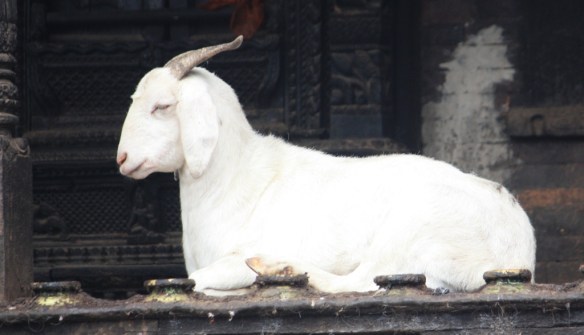
DAILY PHOTO: Puppies and Goats of Bhaktapur

Rubble Puppy


Temple goat


Dog disappointed with a package


Goat resting on a plinth; Taken in May of 2018 in Bhaktapur, Nepal

BOOK REVIEW: Murderous Minds by Dean A. Haycock

Murderous Minds: Exploring the Criminal Psychopathic Brain: Neurological Imaging and the Manifestation of EvilMurderous Minds: Exploring the Criminal Psychopathic Brain: Neurological Imaging and the Manifestation of Evil by Dean A. Haycock
My rating: 4 of 5 stars

Amazon page


This book examines what neuroscience can tell us about the psychopathic mind, and how that compares to what other disciplines – such as psychology and genetics – have been telling us. This is no simple task because there remains a great deal of disagreement about what psychopathy is and how it relates to other behavioral conditions, like sociopathy.

The book begins with front matter (a Preface and an Introduction) that sets the stage for a reader who may have only a vague and Hollywood-inspired notion of what psychopathy is and who may confuse it with any number of psychiatric conditions.

Chapter 1 builds intrigue and offers a narrative introduction to psychopathy by telling the story of the architects of the Columbine shooting, Dylan Klebold and Eric Harris. The Columbine shooting gives the reader an ability to compare and contrast, because the two shooters had quite different psychological profiles. The chapter also uses the case of Jared Loughner, a Tucson shooter who killed or wounded almost twenty people – most famously Congressional Representative Gabrielle Giffords.

Chapter 2 dives into the controversial questions of what a psychopath is, how effectively can psychopathy be measured, and how it compares to conditions that have the same or similar symptoms. The obvious point of comparison is Sociopathy, about which a controversy remains as to whether it’s a distinct condition. However, the more interesting comparison is to “Kunlangeta,” which is a term from an Inuit tribe. The Kunlangeta – psychopathy comparison gets to the fact that aberrant behavior isn’t new. It’s just how these actions are viewed and responded to that has changed.

Chapter 3 describes the strengths and limitations of brain imaging as a tool for understanding the psychopath. We find that neuro-imaging has revealed tendencies – notably a reduction of gray matter in parts of the frontal and temporal cortex. However, we also discover that there remains much to be learned.

Chapter 4 is entitled “A Problem Behind the Forehead” and it continues the discussion of the neurological connection to psychopathy – particularly by considering the case of Jim Fallon (the neuroscientist who stumbled onto the fact that he had the brain of a psychopath — not to be confused with the late night talk show host.) The consideration of Fallon’s case foreshadows a discussion that is detailed in Chapter 8 about psychopaths who function just fine in society and who don’t kill people with axes.

Chapter 5 examines competing explanations for psychopathy that are more likely to be complementary to neuroscience than competitors – notably genetics and childhood abuse. This chapter highlights the fact that criminal psychopathy has complex causes and there is as of yet no single silver bullet that links to psychopathic behavior.

The idea in chapter 5 leads nicely into the next chapter (ch. 6) which considers to what degree we have enough (or will ever have enough) information to be able to predict who is likely to engage in bad behavior. Is a real world “Minority Report” scenario likely in which someday we’ll be able to know who’s going to commit violent felonies before they do (at least for some cases.)

Chapter 7 explores the most notable symptoms of psychopathic behavior, including the inability to empathize and a lack of fear.

Chapter 8, as mentioned, explores the fact that not everyone who has psychopathic traits runs afoul of the law. In fact, many lead productive lives running companies or performing surgeries.

The next two chapters reflect upon questions that may be of great interest to readers. Chapter 9 asks whether one can become a psychopath late in life. In other words, once one has lived out an abuse-free childhood, grown a fully developed brain, and reached an age where the relevant genes have or haven’t flipped on is one safe? Or, is there some way – an injury or ailment, perhaps – that one might become the victim of adult-onset psychopathy? The penultimate chapter asks whether one’s child might be a psychopath in the making.

The last chapter discusses how criminal justice works if it turns out that at least some individuals commit crimes because they got a bad brain. While there may be controversies over the death penalty, most people feel at ease with harsh sentencing and with locking convicted criminals away for life. However, if some individuals had no choice but to do what they did by virtue of a brain defect, it’s much harder to be confident one has taken a fair and reasonable course of action.

There’s a brief epilogue which presents a common fixture in science books: the scholarly rant about how the field is underfunded.

The book has a number of color and black-and-white graphics including photos, diagrams, brain scans, and brain cross-section pictures. There’s a recommended reading section in addition to the bibliographic notes. I read the Kindle version of the book, and it had excellent hyperlinks for the notes as well as in the index.

I’d recommend this book for anyone who is interested in the question of the degree to which brains determine who engages in criminally aberrant behavior. The author uses stories of famous cases of psychopathy to present a book that is very readable and doesn’t get lost in scientific minutiae. It’s a quick and fascinating read.

View all my reviews

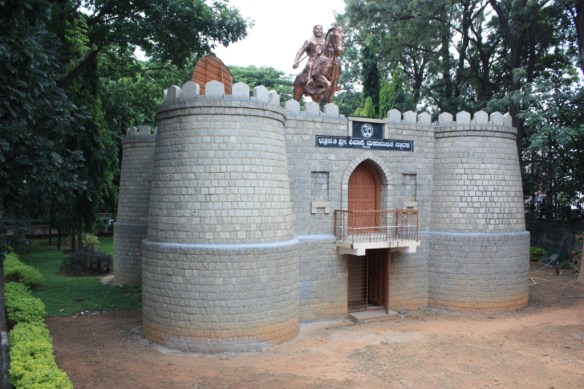
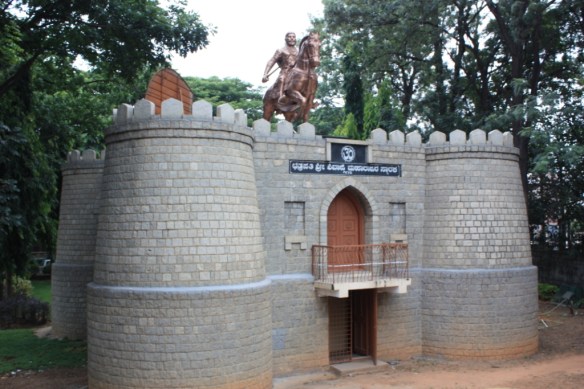
DAILY PHOTO: Tiny Castle of Sankey Tank

Taken in Bangalore in June of 2014


Properly known as:

Chatrapathi Shri Shivaji Maharaja Smaraka

BOOK REVIEW: Malabar Mind by Anita Nair

Malabar Mind PoemsMalabar Mind Poems by Anita Nair
My rating: 5 of 5 stars

Amazon page


This collection of 40 poems by Anita Nair begins with verse that is imbued with Indian-ness and has a timeless feel, and progresses into more modern and – at times — erotic territory. For those unfamiliar with Indian geography, the Malabar Coast is the southwest coast of India. It stretches from Goa down through Kerala, and as far as the southern tip of India. The author’s last name, Nair, is one used by members of a caste from the state of Kerala. The Malabar Coast is known for spice, tea, and coffee plantations inland, and coastal ports that carry those commodities to buyers around the world that date back long before the British colonized India. Because of the long history of the spice trade, this area has its own unique feel. That should give the reader some sense of the cultural elements suffused into this work.

The poems are generally free verse (though there’s a prose poem and perhaps some other forms,) and are mostly in the range of a couple of stanzas to about three pages, though the final poem, “The Cosmopolitan Crow” is a long form poem. The entire collection weighs in at around 100 pages. The author frequently uses a sparse form that presents lines of one to three words, but that isn’t the case for all the poems.

While there’s eroticism in parts, it’s relatively subtle and shouldn’t be an impediment to any but the primmest of readers. (Though I’ve been known to miscalculate the degree to which some folks get uptight about sexual and somatic content.)

I enjoyed this collection. I was sensual, evocative, and captured the feel of Kerala nicely.

View all my reviews

BOOK REVIEW: 3 Sections by Vijay Seshadri

3 Sections3 Sections by Vijay Seshadri
My rating: 5 of 5 stars

Amazon page


This collection of 34 poems by Vijay Seshadri won the 2014 Pulitzer Prize for Poetry. The book includes free verse poetry, lyric poetry, and prose poems. There are poems that reflect Seshadri’s Indian heritage, such as “Three Urdu Poems,” but like Seshadri himself – who moved from Bangalore to America at age five – the preponderance of poems reflect an American experience. Most of the poems are a single page each or less, but the prose poems at the end, such as “Pacific Fishes of Canada,” cover about a dozen pages.

The human and human society, as opposed to nature, takes center stage Seshadri’s work. Dystopian notions that have crept to the fore in the popular conscious are seen in poems such as “Secret Police.” However, this may be more indicative of a look back to the Cold War, which features prominently in the aforementioned nostalgic prose poem “Pacific Fishes of Canada.” The philosophical meditation also plays prominently in this work.

I enjoyed this little sixty-seven page collection, and found it to be evocative and thought-provoking.

View all my reviews

DAILY PHOTO: Scenes from Loktak Lake


Taken in May of 2017 in Manipur