A cold wind blew through the vestibule,
tussling the tongues of flame
on the candles powering parishioners’ prayers.
Would one ill-timed entrant extinguish all those vows and well-wishes?
The flames did a shimmy dance,
but remained lit —
save one.


A cold wind blew through the vestibule,
tussling the tongues of flame
on the candles powering parishioners’ prayers.
Would one ill-timed entrant extinguish all those vows and well-wishes?
The flames did a shimmy dance,
but remained lit —
save one.

Taken in Doha on December 31, 2019.
 The Art of the Novel by Milan Kundera
My rating: 5 of 5 stars
This is a collection of essays by the renowned Czech novelist about the literary novel, and particularly the European literary novel. That said, the pieces gather nicely into this collection without seeming disparate. Points and themes carry across the essays such that the book has a life as a whole. Also, the there is food for thought in this book even if one isn’t particularly interested in literary novels. There are ideas that could be of interest to any story crafters or writers.
There are seven parts (essays) in the book. The first and third part take specific novels as their focal point: Cervantes’ “Don Quixote” and Hermann Broch’s “Sleepwalkers,” respectively. That said, the feel isn’t greatly varied from the more general chapters of 2, 4, and 5. That is, Kundera uses critique of those novels (as well as others) to make general points about what is more or less effective, artistically speaking, in the novel. Besides those two novels, not surprisingly given Kundera’s heritage, he also repeatedly uses the novels of Franz Kafka and “The Good Soldier Svejk” by Jaroslav Hasek as examples. That said, many well-known novels come up in the discussion including those of Tolstoy, Musil, and even Faulkner (I say “even” because he’s clearly not a European novelist.)
The sixth and seventh parts are both a bit different. Part six is entitled, “Sixty-Three Words,” and it’s Kundera’s discussion of words that he believes are misconstrued. In some cases, they are words prominent in his own works, and in other cases they are of interest regarding novels more generally. Like many writers, Kundera takes a strict approach to words, arguing that synonyms don’t exist because if meanings were truly identical one of the words should die. The last piece is from an address that he made about the novel as a European artform.
While I read this with interest as a writer, I found that the discussion that most intrigued me did so on the level of a jnana yogi. That is, what interested me was his discussion of what constitutes a person – fictional or not. Kundera speaks in considerable detail about this issue. He’s writing about fictional selves, but some questions carry over. What makes a character and what is superfluous information – i.e. the illusion of a self? What is necessary and beneficial to convey to reader? Kundera criticizes the modern novel for getting bogged down in describing physical attributes and background information. On the other hand, Kundera praises novels in which one learns little about the character beyond what they do in the novel. His objection is that this denies the reader the opportunity to mentally build the character, him or herself. However, it also raises the question of whether those characteristics are really the relevant information.
I learned a few things from this book. It’s short and surprisingly readable given the topic-at-hand’s potential to become arty and pompous. If you’re a writer (particularly if you’re interested in the novel as an artform) this book is worth a read.
 The Science of Storytelling by Will Storr
My rating: 5 of 5 stars
Many books have been published on the science of story since the realization that storytelling is as fundamental to humanity as tool-making and bipedalism. The first such book that I reviewed was Lisa Cron’s 2012 “Wired for Story.” So, the question of interest isn’t whether the topic is fascinating (it is) but – instead – whether Storr’s book offers value-added. I believe it does. While Cron and Storr cover some of the same territory, the differences in approach lead to variations in the material covered and the emphasis given. Storr orders his book around his particular method of story building, which he refers to as “the sacred flaw approach.” He proposes that at the heart of a story is an erroneous assumption to which the lead character wishes to cling. This is where he tries to stake his claim among the vast number of books offering advice on story – i.e. by focusing on character flaw, rather than on the sequence of events (i.e. plotting.)
The appeal of this topic will vary according to who’s asking, but for writers there’s certainly a desire to unravel the mystery of story. Every story builder would like to venture into new and uncharted territory, but there seem to be key criteria around which stories live or die. The most glaring illumination of this can be seen when filmmakers spend tens or hundreds of millions on films that utterly flop, and when they spend that much money and flop it’s not because the CGI was hinky. It’s inevitably because the story lacked appeal. At its worst, this has led to strategies such only rebooting films that have worked in the past, and at it’s best it results in following one of the many fixed patterns (e.g. Joseph Campbell’s “the hero’s journey.”) Understanding the science of story offers the hope of being able give one’s audience what they need to find a story fulfilling without following a beat-by-beat sequencing from a manual — in the manner of a pre-flight checklist.
The book is divided into four chapters that are designed to look at story through its various levels, and within each chapter there are many subsections. The chapters are: 1.) creating a world; 2.) the flawed self; 3.) the dramatic question; and 4.) plots, endings, and meaning. Chapter 1 isn’t just advice about how to build the story environment, but rather it looks at how our brains take in and model the world as written so that one can use that knowledge to more smartly approach presenting a world. As one might guess, chapter two is a crucial one because it introduces the study of characters and their flaws, and why said flaws are critical to the appeal of a story. The author also addressed differences between Eastern and Western approaches to story and I found the discussion of culture to be an intriguing inclusion. Chapter three continues the work of the second by focusing on how the interaction of subconscious and conscious minds contribute to a protagonist’s problems. In keeping with the coverage of culture, there’s a section that looks at stories as tribal propaganda that was quite insightful. The final chapter examines how plots and good endings arise as a logical result from setting up the character.
There’s an appendix that lays out Storr’s “Sacred Flaw Approach.” This is the approach that he teaches in his writing course. The book is also annotated, though it is text-centric and doesn’t employ much in the way of graphics.
I found this book fascinating. It does rehash some of the same examples as other books on story (e.g. “The Godfather” movie,) that’s simply because those stories are widely known and thus have broad usefulness. But there were plenty of insights to keep me intrigued, even having read other books on the topic. If you’re interested in the science of storytelling, this book is worth giving a look.
 The Documentary Filmmaking Master Class: Tell Your Story from Concept to Distribution by Betsy Chasse
My rating: 4 of 5 stars
This book focuses heavily on the business aspects of making a documentary – including legal, financial, and marketing issues [as opposed to the technical and creative aspects.] I suspect that makes it the perfect guide for many would-be filmmakers who learned the art and technique of filmmaking elsewhere, but who may be lacking insight into how to raise money, manage a team, and get the film seen by the right people – or just any people. On the other hand, if you’re expecting in-depth instruction on how to shoot or edit your film, this book doesn’t discuss those topics in great detail. [And would probably need many more graphics to do so. The author presents concepts like narrative arc and discusses interview questions, but that’s all conveyed readily by text.]
The book consists of 19 chapters arranged into seven sections. Section I is, quite logically, about what questions one should ask and answer before putting significant resources into a film. These are questions that one would logically expect a filmmaker to consider, but that could be overlooked in the heat of passion. For example, are there many films on the same subject (and, if so, did most of them flop?)
Section II discusses the business plan. Once one has preliminarily concluded it’s worth pursuing the project, the business plan involves outlining the project soup to nuts so that one isn’t making it up as one goes along, and running into the problems that improvising creates.
Section III explores various approaches to financing one’s project and what is required of each. There are chapters that compare and contrast investor funding, crowd funding, and grants and alternative funding, and which discuss what is needed for each. There is also a chapter about whether a sizzle reel is likely to be worthwhile. [A sizzle reel is somewhat similar to trailer, but cobbled together from existing footage.]
Section IV is about production. While I said this book is light on creative and technical material, it does address how to go about interviewing, and how to obtain b-roll, music, and other necessary material. Still, a lot of space is devoted to legal and human resources type issues. Section V is about post-production and is also a mix of technical and creative material related to assembling one’s film.
Like Section III, Section VI is one of the cornerstones of the book. It explains how to market one’s film and how to get it distributed. The pros and cons of being shown in a theater versus other platforms (e.g. streaming services, internet sites, etc.) is considered in detail. There is a lot of discussion of legalities and whether it is better to hire someone to handle these tasks or be involved with them oneself. The final section the conclusion.
There isn’t much in the way of ancillary matter in this book, though there are sample contracts and agreements where relevant, that – again – I imagine could be quite beneficial for those entering the field.
As a complete neophyte to the subject, I didn’t know what to expect. I did learn a lot of interesting information about the business and legal considerations involved in filmmaking. Chasse offers a great deal of insider insights. I don’t know how many surprises there would be for someone who’d gone to film school — or even for a dedicated autodidact, but there were certainly a lot of interesting tidbits for an outsider.
I’d highly recommend this book for someone who is interested in making a documentary, though if you haven’t spent a lot of time studying the technical and creative aspects (or at least making iPhone videos,) you’ll probably need to supplement this book with other information sources.
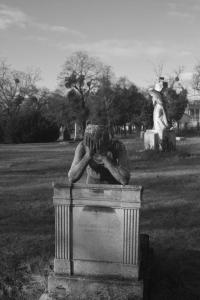 In the graveyard kneel so many mourning, wailing widows and widowers — weak-kneed and hanging off tombstones.
Carved of marble or cast of bronze, and meant to last an eon.
How odd to imagine a permanent mourner.
In the time marble can be carved, I’d prefer any subject on my gravestone to be captured leaning back in a boisterous belly-laugh with a beer can in hand.
 Menekülés egy tökéletes világból by Sándor Szélesi
My rating: 4 of 5 stars
This short sci-fi novel revolves around the mystery of a man who wakes up with autobiographical amnesia (i.e. he can’t remember anything about his life, though he is familiar with the world in general.) It should be noted that I read the English translation, and can’t speak to the original Hungarian edition (i.e. Menekülés egy tökéletes világból.) At least one minor criticism leveled may not apply to the Hungarian edition (e.g. there are a couple minor typos of the kind spellcheck wouldn’t necessarily catch.)
The story is set in a futuristic Budapest. Most of the description goes into detailing the futuristic technologies — such as virtual reality — that are important to the story and intriguing, but there is minimal description of setting or characters. Some will find this works fine – particularly those who are familiar with Budapest. (It’s accurately described as a beautiful city and locations are given that will be familiar to those who’ve spent time there, but others will be left completely to their imagination.) Other readers will find the writing a bit sparse. The technologies involved are believable progressions of what is under development currently, though implementing some of them would take working through intense controversy (though that is set up to some degree by mentioning a dystopian background event.)
The story is intriguing from the opening premise of a man wondering who he is (not to mention the woman he woke up next to) through the discovery of why it is he can’t remember his life. Along the way, a couple possibilities pop up as false flags to tug readers’ anticipation in the wrong direction. That the protagonist tries to not let on that he doesn’t know who he is also creates an interesting wrinkle.
There is a nonfiction appendix that discusses the future of technology that is presented by the corporate sponsor of the work (i.e. WaveMaker.)
I enjoyed this story. It’s a quick and entertaining read and raised some questions about the future of technology that aren’t yet clichéd.