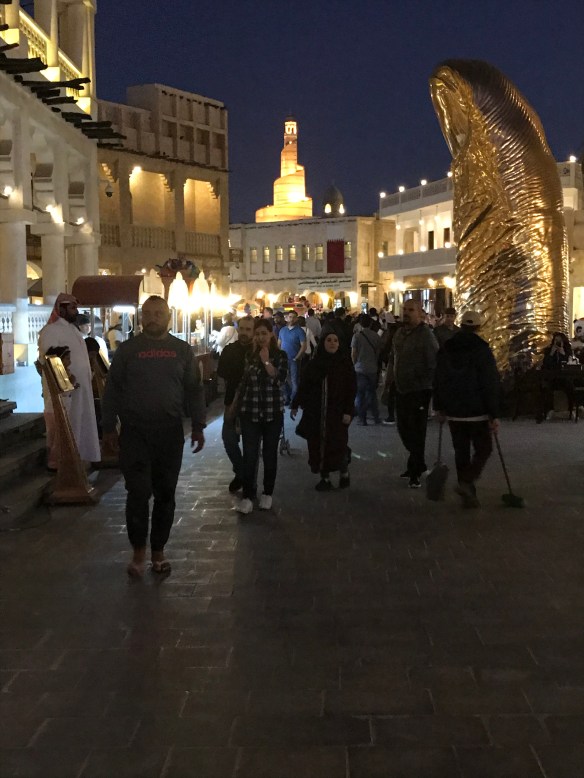
Taken in Doha on January 1, 2020.



 Sound Medicine: How to Harness the Power of Sound to Heal the Mind and Body by Kulreet Chaudhary
My rating: 4 of 5 stars
The Longfellow poem “There Was a Little Girl” has a line that says, “…When she was good, She was very good indeed, But when she was bad she was horrid.” That’s kind of how I felt about this book. At its best, it reports findings about how practices involving sound (i.e. mantra chanting) effect health and well-being, and lends insight into why sound sooths. At its worst, it tries to sledgehammer the square peg religious / spiritual practices into the round hole of quantum physics and foundational physics, often engaging in leaps that are at best wildly speculative, while presenting them as though they are as likely as not.
My favorite professor from undergraduate studies was a folksy Religious Studies Professor who cautioned against two opposing fallacies. The first he called “the outhouse fallacy.” This is assuming that because people of the past didn’t have indoor plumbing that they were complete idiots. Let me first say that, until recently, yoga (and other complementary health practices) suffered its fair share from this fallacy among doctors and the scientific community who felt that it couldn’t possibly help with health and well-being because it wasn’t rooted in the latest scientific findings. However, there is an opposing fallacy that my teacher called the “firstest-is-bestest” fallacy, which assumes the ancients figured it all out and we are just bumbling around in the dark hoping to stumble back into what they once knew. Scientists are prone to the first fallacy and the second is rife among religious folk. As a medical doctor who turned to siddha yoga (a form that puts a great deal of belief in superpowers and magic), Chaudhary had a rough road to not fall into one of these fallacies and, in my opinion, she falls more into the second — sounding at times like the ancient yogis knew more about the subatomic world and consciousness than science ever will. Most of the time, she words statements so that a careful reader can recognize what is well-supported and what is speculative, but she’s rarely explicit about the degree to which speculations are such, and I don’t remember an instance in which she presented an alternative that would undermine her argument. (i.e. The unstated argument seems to be that mantra is special among practices, that its usefulness is embedded in the fundamental physical laws of the universe, and, therefore, that it works by mechanisms unlike other meditative / complementary health practices [i.e. by engaging the parasympathetic nervous system so the body can make repairs using established biological mechanisms.])
In a nutshell, there is a “god in the gaps” approach to the book that says, look we don’t understand consciousness or all the “whys” of quantum mechanics, ergo there must be supernatural explanations. I don’t think that because we’ve used EEG since the 1920’s and fMRIs since the 1990’s and still haven’t yet unraveled the hard problem of consciousness that we need to say that god / supernatural forces are where we must look for explanation. The gap is ever closing, slowly but surely, and there’s no reason to believe it’s reasonable or useful to cram commentary from Vedas (or any other scriptures) to fill the gap.
It’s not only the science where Chaudhary presents a belief as though it is established truth without alternative explanations. Early on, she states that colonization is the reason for the decline of meditation in India. Don’t get me wrong, I’m as accepting that colonization resulted in a great number of evils as anyone, but it’s a leap to say that – therefore – every negative a society faces is because of its colonizer. I would point to Thailand, a society that was never colonized (except a brief period by the Burmese) and which is primarily made up of Theravadan Buddhists (a system for which meditative practice is considered central,) most of whom also do not meditate regularly today. I suspect a more logical explanation for the fact that most Indians don’t meditate today is that: a.) it’s hard work and time consuming (as a productive endeavor it’s not bread-winning and as a leisure time activity it’s laborious,) and b.) the majority of Indians (like the majority of Thais) probably never mediated. (When we look back in time, we often want to create this wholesome and uniform image that what we have writings about was how everyone lived, and that probably never reflects the truth.)
So now that my rant is over, I should say that I didn’t think this book was horrible, by any means. It has a lot of good information, and some of the speculative bits offer interesting food for thought. As long as one reads it carefully and with a healthy dose of skepticism, it’s a beneficial consideration of sound and vibration in health and well-being. It’s just that when I compare it to, say, Davidson and Goleman’s “The Science of Meditation” (which I reviewed recently) this book is far less careful about presenting the science, eliminating pseudo-science, and letting the reader know what is controversial and speculative versus what is well-supported by sound and rigorous investigation.
 This is the belated final posted of my 2019 project on altered states of consciousness. I was traveling during the latter half of December and, hence, my tardiness.
During 2019, each month I gave special attention to studying some state of consciousness that exists outside of the normal waking state. (Of course, the folly of believing that there is one “normal waking state of consciousness” is one of the major lessons learned from this exercise.) My investigations included: meditation, hypnosis, lucid dreaming, sensory deprivation, psilocybin consumption, and various others — a number of which were variations on inducing a Flow state.
In December, because I was traveling so much I was reading even more than usual, and it occurred to me that there is a kind of reading in which the mind behaves differently from the norm. I’m not talking about all reading, but — specifically — when one gets lost in story. There’s run-of-the-mill reading, and then there’s the reading in which a hundred pages seem to fly by in minutes, but you realize you’ve lost a lot more time than that. This topic might seem like a dull ending to this project. Being absorbed in story might not appear as enthralling or “sexy” as mushroom tripping or floating in sensory deprivation tank, but the experience can be just as profound.
As I was looking into this, I discovered that there is a term that addresses what I’m talking about, “narrative transportation.” Narrative transportation relates to absorption, which I learned is a factor in hypnosis. That is, how easily does one become completely mentally occupied with an object of contemplation such that one loses awareness of the passage of time and external stimuli. In this type of reading, one is mentally reconstructing the world and events of a story, and that process is demanding of one’s attention. Furthermore, there is an intense emotional experience that one is feeling simultaneous to this mental construction. This doesn’t leave much room for the mind to wander — if the story is intriguing enough to hold one’s attention.
As a reader, one facilitates narrative transportation largely by picking stories that are appealing to one, and by finding extended time periods to read without distraction. However, what’s really interesting is how a writer can facilitate this state through his or her style and method. The most commonly discussed aspects of this facilitation are: the story arc (i.e. arranging events to create and maintain excitement) and building lovable or loathsome characters (either way, just as long as they aren’t tedious or boring.)
But there is another aspect that I think of as readability. How easy does the storyteller make it for the reader to create their own mental story-world? In large part, this has to do with the art of finding the Goldilocks Zone of description. If one describes too little one creates “floating head syndrome” in which the reader (if they continue reading at all) may imagine floating heads conversing in a blank white room. On the other hand, if one spends twelve pages describing the drapes or the weather, one is unlikely to keep readers engaged. Coincidentally, one of the books that I read in December that was educational (though not transportational) was Milan Kundera’s “The Art of the Novel.” In it, Kundera bemoans the tendency to over-describe characters such that one interferes in the reader’s imaginings. He points out that readers learn almost nothing about the physical description and background of some of the most important characters in literature.
And so concludes my year of altered states as I look forward to new adventures in 2020.
 Troilus and Cressida by William Shakespeare
My rating: 5 of 5 stars
This play combines a piece of the story of “The Iliad” with a love story that wasn’t part of the Iliad, but which is based on minor characters from the Iliad. [For those unacquainted, “The Iliad” tells the tale of the siege of Troy after a prince from Troy, Paris, returns home with Helen, the wife of the Spartan king Menelaus, and the Greeks launch “a thousand ships” to try to get her back.] Even the romance isn’t original to Shakespeare as the Troilus and Cressida tale had already been told and retold, and Shakespeare’s telling is said to have been influenced by Chaucer’s.
While most of Shakespeare’s plays are readily categorized as comedy or tragedy, this is one of the few that defies such characterization. In terms of how the story resolves itself, one might call it a tragedy, but the tone throughout is often more comedic.
The part of the Iliad that is told is largely about the Greek generals trying to get Achilles back in the fight because he is the best match for Hector, the mightiest of the Trojan princes. The love story pivots on Cressida being given to the Greeks as part of a prisoner exchange, and – as is often the case – features a heaping dose of jealousy that sours this great love affair.
This is definitely a worthwhile read, despite criticism that it feels muddled. One doesn’t need to have read the Iliad, though it may help to make it more entertaining.
 The Valiant by Jeff Lemire
My rating: 4 of 5 stars
This book gathers four comic books into a full story arc. It tells a simple story of good versus evil involving a team of superheroes versus an extremely powerful opponent called “The Immortal Enemy.” The Immortal Enemy takes many forms over the course of its life, and in this case (as always) it chooses a form designed to unnerve the Geomancer who opposes it. It’s an allegorical tale of environmental protection versus degradation that blends fantasy and sci-fi with a touch of the weird.
At the heart of the story there is a blossoming relationship of an unlikely pairing. The first is an inexperienced Geomancer. She is just learning the ropes and is a very human and emotionally-oriented character. He is a Wolverine-esque character named “Bloodshot.” He’s stoic and rocksteady. The gist is that she becomes more confident through her exposure to him, and he regains some humanity through exposure to her.
The story’s resolution felt a bit deus ex machina to me, involving an artifact whose role and function aren’t clear until it proves instrumental, but overall it was an entertaining read.
I found the artwork to be well done. I don’t have any particular expertise in such matters, but it looked good too me.
If you enjoy graphic novels, this one is worth picking up.
 Dare Eat That: A Guide to Bizarre Foods from Around the World by Divya Anand
My rating: 4 of 5 stars
This book takes one on a journey, sampling exotic foods of the world. The author describes experiences eating bizarre dishes in nine countries: the US, India, the UK, Luxembourg, Thailand, Australia, Cambodia, Vietnam, and Singapore. The foods include insects, balut, reptiles, game animals and fowl, and a wide range of seafood (including blowfish, a type of sushi prepared with surgical precision to avoid tainting the meat with a lethal poison.)
The book is organized by country in the order listed above. Some countries have many sub-chapters and others have as few as one depending upon how extensive the travels and how much unusual food was on offer. The book presents tables for each dining location, showing the cost, taste, and “fear factor” for each of the exotic dishes. Of course, the taste and fear ratings are inherently subjective. I know, among the items I’ve eaten, my subjective ratings would often be a little different. However, there is an inescapable cultural — as well as individual — bias to such ratings. By cultural bias I don’t just mean at a country level, but if you grew up in a coastal region versus a landlocked one, your ratings would probably vary considerably. That said, I thought it was a nice way to give the reader a quick insight into the experience of each food.
The biggest disadvantage of this book is that the experience is once removed. That is, the author is mostly reporting her spouse’s experience. As a vegetarian who shifted to eating chicken, she tried very few of the foods first hand (though, among those she did try was durian melon – proving she’s not a coward, because durian is nastier than much of the insect, seafood, and game food.) Still, because of this distance from the experience, the description could probably be more vivid in places. On the other hand, there is an amusing tension created between the husband who is an intense bizarre food foodie and the author who is squeamish about meat markets that adds to the entertainment value of the book.
Besides the aforementioned tables, the book is loaded with pictures — including a section of color plates — and has maps and diagrams as well.
I found this book interesting, readable, and – as a traveler – a potential reference source. If you’re a traveler and / or interested in exotic cuisine, you should check it out.
Taken on January 1, 2020 in Doha.

Taken on December 31, 2019 in Doha.

Taken December 30, 2019 in Doha.