Unknown's avatar

About B Gourley

Bernie Gourley is a writer living in Bangalore, India. His poetry collection, Poems of the Introverted Yogi is now available on Amazon. He teaches yoga, with a specialization in pranayama, and holds a RYT500 certification. For most of his adult life, he practiced martial arts, including: Kobudo, Muay Thai, Kalaripayattu, and Taiji. He is a world traveler, having visited more than 40 countries around the globe.

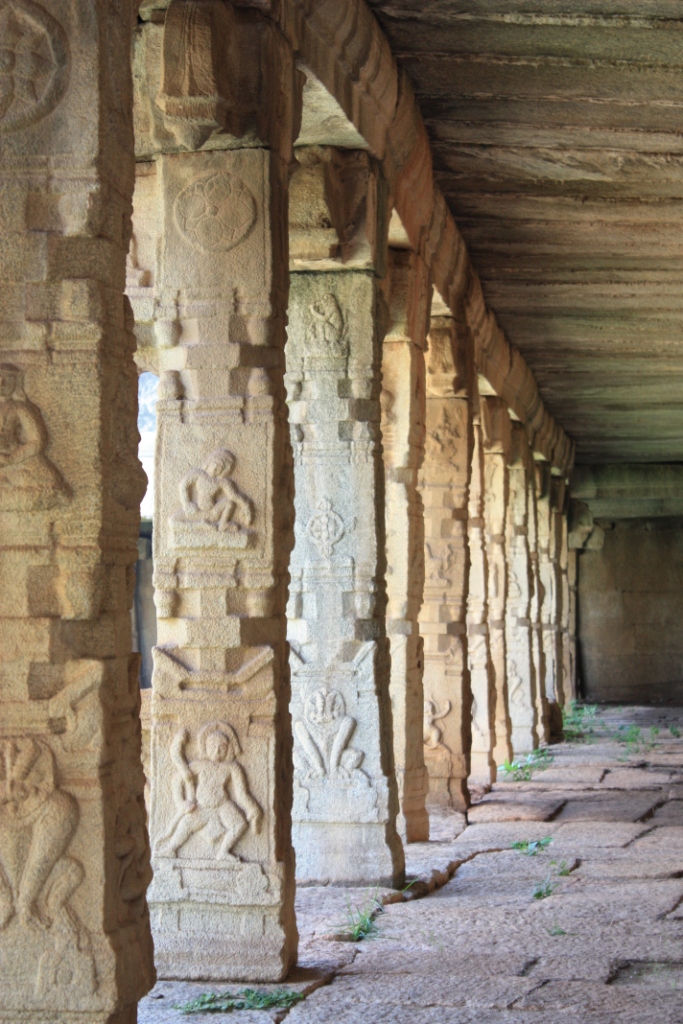
DAILY PHOTO: Columns at Achyutaraya Temple

Taken November 2, 2013 at Hampi

Taken November 2, 2013 at Hampi

I thought the varying colors and designs of these columns made an interesting photo. This is taken at Achyutaraya Temple, which is one of the more extensive standing structures at Hampi, though not necessarily the most well-preserved/restored.

If one is on the Hampi Bazaar, walk away from Virupaksha Temple and toward the police station. Follow the steps that lie past the large bull sculpture, and when one gets to the top of the hill, just past the little Hanuman (the Hindu monkey-god) shrine, follow the fork to the right. One will soon see Achyutaraya temple down below. After visiting Achyutaraya, one can follow the flat land toward the Vittala Temple, which is sort of the crown jewel of Hampi.

BOOK REVIEW: The Book of Massage by Lucinda Lidell

The Book of Massage: The Complete Step-By-Step Guide to Eastern and Western TechniquesThe Book of Massage: The Complete Step-By-Step Guide to Eastern and Western Techniques by Lucy Lidell

My rating: 4 of 5 stars

Amazon page

I picked up this book because I recently began studying Thai Yoga Bodywork (TYB.) While The Book of Massage doesn’t specifically deal with Thai massage, as a neophyte, I figured some general reading was in order, and there aren’t a lot of widely available books that deal with Thai massage specifically (at least not where I currently reside.)My first testimonial of this book is that I looked through over a dozen books on massage at my local bookstore, and this is the one with which I walked home.

I found Lidell’s book to be a valuable resource. The book covers three approaches to massage: oil massage, shiatsu, and reflexology. As the subtitle suggests, this book addresses both Eastern and Western approaches to massage. The section labeled simply “Massage” is one that deals largely in the Western approach, as it’s suggestive of the Swedish style of massage. This involves oil, no / few clothes on the recipient, and a variety of strokes that are delivered over relatively broad areas (as opposed to the deeper acupressure approach of the latter methods.) The oil massage chapter begins with an overview including what type of oil to use and the basic strokes, and then provides a sequence before delving into specific techniques for various body parts or groups of body parts.

Shiatsu is a Japanese form of massage that is based on the concepts of Traditional Chinese Medicine (TCM.) I found this style to be much closer to what I’ve learned in TYB. Like TYB, both patient and recipient are clothed, there is no oil, acupressure is the norm, it requires no table, and there is a match up between what are called “energy lines” in TYB and “meridians” in Shiatsu. Shiatsu even employs similar stretching techniques to those that are the hallmark of TYB. I can imagine these systems having a common ancestral art.

The order of the shiatsu chapter is basically the same as the chapter on Massage. First, there’s necessary background information. This consists of a couple of pages on the basic Taoist concepts on which TCM is based (e.g. Chi, Yin & Yang, and the five elements) and related vocabulary like “tsubo” (pressure points) and meridians. The section then goes on to address basics of posture and bodily tools (palms, thumbs, elbows, knees, etc.), the sequence of the massage, and then the specifics of various body parts.

Reflexology massages only the feet and hands in the belief that points on these appendages map to other parts of the body. In other words, practitioners believe one can increase wellness throughout the body by working points on only the feet or hands. It’s said that the roots of reflexology may be ancient and that it may have been practiced in Egypt in 2300BC, but the modern school was developed by an American physician in the early 20th century. TYB does borrow from reflexology (though not necessarily the modern form of it), so some of this was also similar to what I learned in TYB. Again, the order of this section went from the generic information one needs toward the specifics of how to apply a given technique on a particular part of the foot or hand.

In addition to the three core sections, there were chapters before and after that provide the reader with useful information. Some of this was banal but obligatory (e.g. a brief history of massage and a discussion of the importance of touch among the human species), but some of it was essential practical information such as how to create the proper environment and how to center oneself before delivering a massage. There was also information that will be useful for some about massages involving babies, expectant mothers, the elderly, athletes, and oneself.

Perhaps the most beneficial of the “supplementary” chapters was one that dealt with the subject of how to read bodies. This may seem like an odd topic. However, it’s useful to be able to recognize where an individual holds his tension or where her posture is off–a problem that can create many muscular difficulties. There’s a short overview of anatomy, which I found useful, and a shorter overview of “chakras and auras,” which I personally didn’t find useful but can see where others might.

There are several strengths and relatively few weaknesses to this book. I found the organization to be logical. The graphics are a combination of photos and line drawings, and they work well together. I thought it was great that the author explained that Shiatsu is to be done in comfortable, loose-fitting clothing and that the only reason the graphics display the masseuse in a skin-tight body suit was so that the baggy clothing wouldn’t inhibit the reader’s view. Also, I found the written descriptions worked well with the graphics. One often needs a written cue as to where to find a certain point or line, and just showing it in a picture can be misleading given the wide variety of body types as well as the granularity of the graphic in contrast to the specificity of a point one may need to hit.

I suppose I should warn the easily mortified and / or very religious that there are full and partial frontal nude photographs in the section on oil massage. [I doubt such people are a major demographic for giving or receiving massage, but one never knows.]

I don’t have a lot of complaints. As it’s set up like a workbook, a spiral binding might have been nice, but I recognize the huge challenges of that. Plus, I’m not certain that one can or should learn massage from a book. Rather one should look at it as information to support study with a skilled teacher–or to experiment with once one has already developed some skill. The sections early and late in the book that talk about the importance of human touch didn’t add much, but they were also brief.

If you’re looking for a book on massage that covers a broad set of bases, but yet gives adequate detail for learning, I think this book is a good choice. I’d say it piqued my interest in learning Shiatsu.

View all my reviews

Hae Kum Gang: Korean Food in Bangalore

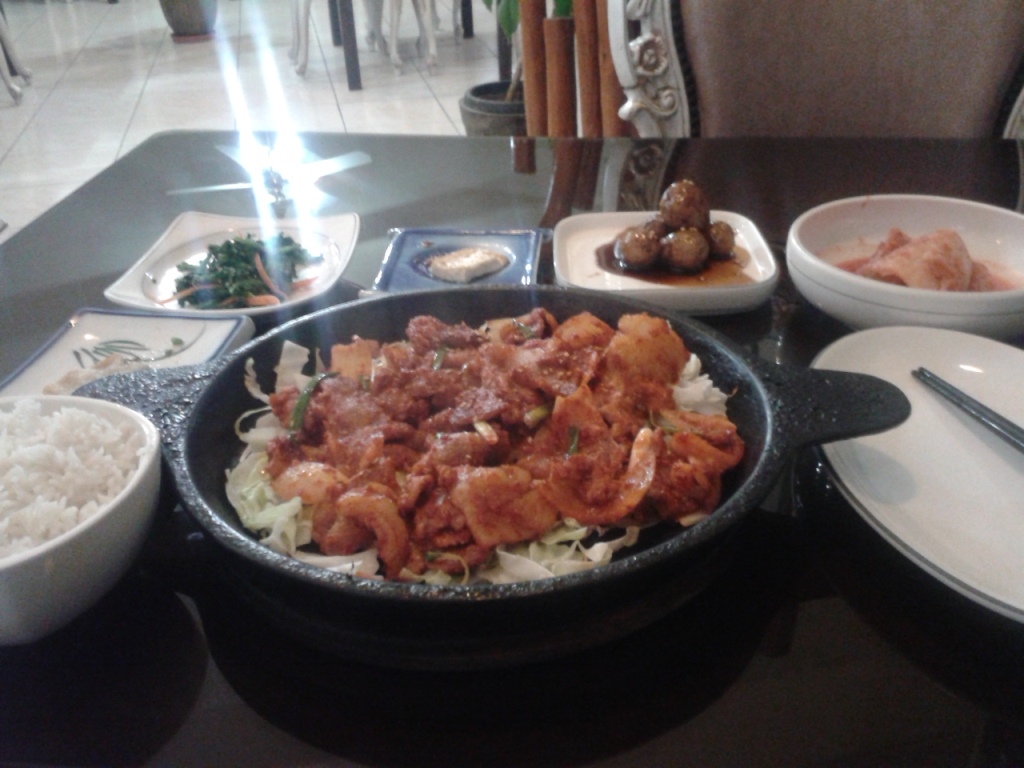
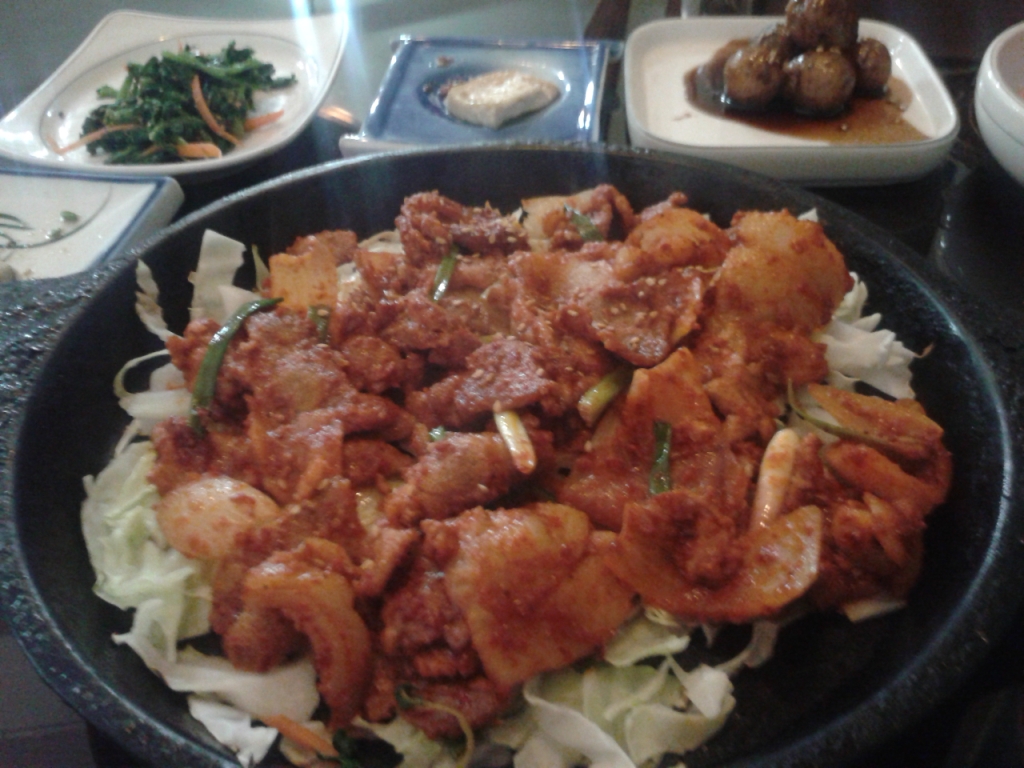
Jeyuk-Chulpan with assorted sides.

Jeyuk-Chulpan with assorted sides.

I’ve been eating a lot at restaurants since we moved to Bangalore, both because it’s (usually) cheap and for the experience of it. I’ve eaten at enough places to have developed some favorites, but I try to keep broadening my experience by eating at as many new places as  I can.

Today, I had a lunch experience that was new on two fronts. For one thing, it was a restaurant that’s new to me, but–for another–it was my first experience with Korean food as prepared in India. I’ve eaten at several Chinese restaurants in India, and, while the places I’ve tried were all pretty good, they were all distinctively Indo-Chinese. In other words, the dishes didn’t taste like they did in other places at which I’ve had Chinese food, e.g. China. On the other hand, the Bangalorean Thai restaurant, Lan Thai, seems pretty authentic to me, except perhaps the diminished use of fish sauce (which is incredibly popular in Thailand and almost non-existent in India.) I was, therefore, uncertain what to expect from Hae Kum Gang–other than that it had a pretty high rating on Zomato and so it likely had decent food.

I can’t say what Korean food tastes like in Korea, as I’ve not yet gotten outside of Inchon airport, but Atlanta had a pretty huge Koreatown and I ate at a variety of Korean restaurants there. (A Korean man once told me that Korean food in Korea tasted very different because of the taste of the vegetables–given the spice palette of Korean food, I wasn’t sure whether to dismiss this as nostalgia–e.g. tasting the difference between American cabbage and Korean cabbage through the kim chi chili seasoning and fermentation seems a bit of a challenge.)

At any rate, what I found at Hae Kum Gang was on par with what I’ve had in Duluth, Georgia.  This was a pleasant surprise because their menu states Korean, Chinese, and Japanese cuisine. While these cuisines have some overlap–particularly with Korea in the middle–they are each distinct. My concern was based on bad experience with “multi-cuisine” restaurants in India that try to do everything and end up doing everything in a mediocre fashion.  (Hampi was loaded with such places.) What I ordered was pretty typically Korean, I imagine if you had a Chinese or Japanese dish off the menu you might not find it authentic, but rather like a Korean interpretation of the dish. (Although, Duluth has some fine sushi places with Japanese names and advertising themselves as Japanese food, but clearly owned, run, and staffed by Koreans.)  

I ordered the Jeyuk-Chulpan, which was described as: “Stir-fried pork with vegetables, served in spicy chili sauce on a sizzler plate.” The description was spot on. The platter sizzled for about 15 minutes after it got to the table. The dish had a pleasant level of heat (spice) and was tasty.  This isn’t a dish for those watching their cholesterol. The pork was quite fatty, which, of course, made it sumptuous and delicious but higher in fat content than many might desire. For lunch it suited me. It’s not something that I would eat for dinner, both because I don’t sleep well if I have red meat immediately before bedtime and because one needs some active time to burn off some of those calories  before going to bed. 

I was told a bowl of steamed rice came with this dish, but was pleasantly surprised to find seven other sides were brought out as well. Getting a load of side dishes along with your main is not uncommon with Korean food and I’ve had similar experiences elsewhere. The first small plate to arrive was Yukhoe,–a spicy Korean answer to steak tartare. I was a little reluctant about eating a raw beef dish in India, but I forged ahead and found it delectable. It was spicy, and warmed through–though not enough to cook the meat. While it was tasty and I’m none the worse for wear, I don’t know if I’d recommend you partake of this dish unless you know your constitution to be caste-iron and you like to live a little on the wild side. In the US, where there are all sorts of regulations and health inspections in restaurants, there is still invariably a warning to consume at your own risk. The same could be said of Japan, where 4 people died (35 hospitalized) in 2011 from eating a batch of the Japanese version of this dish that was tainted with E. Coli.  The standard for raw beef dishes is less than a day between slaughter and freezing and less than a day between thawing and use. I can’t say what this restaurant’s practice is. It tasted clean and fresh, but exercise care.

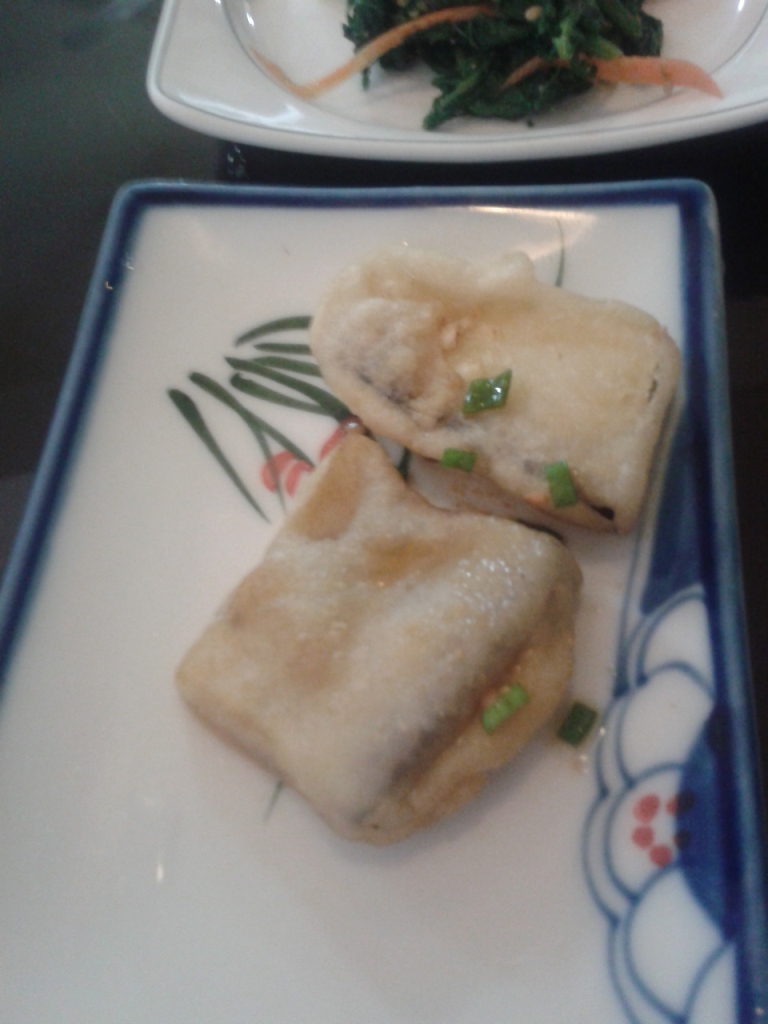
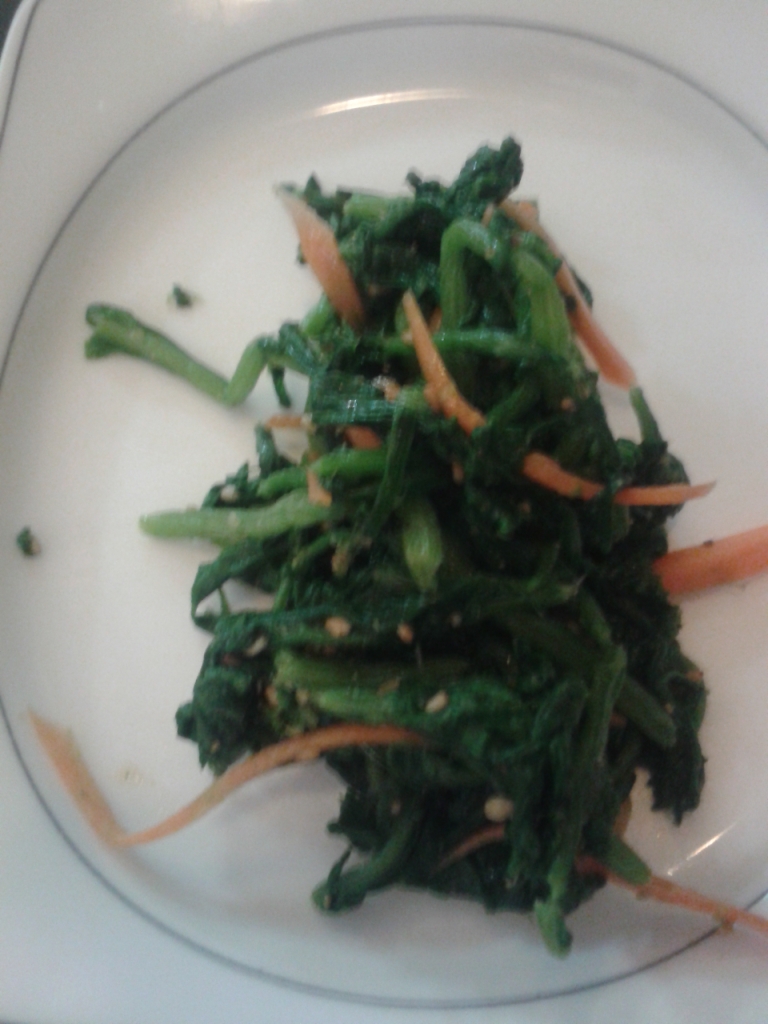
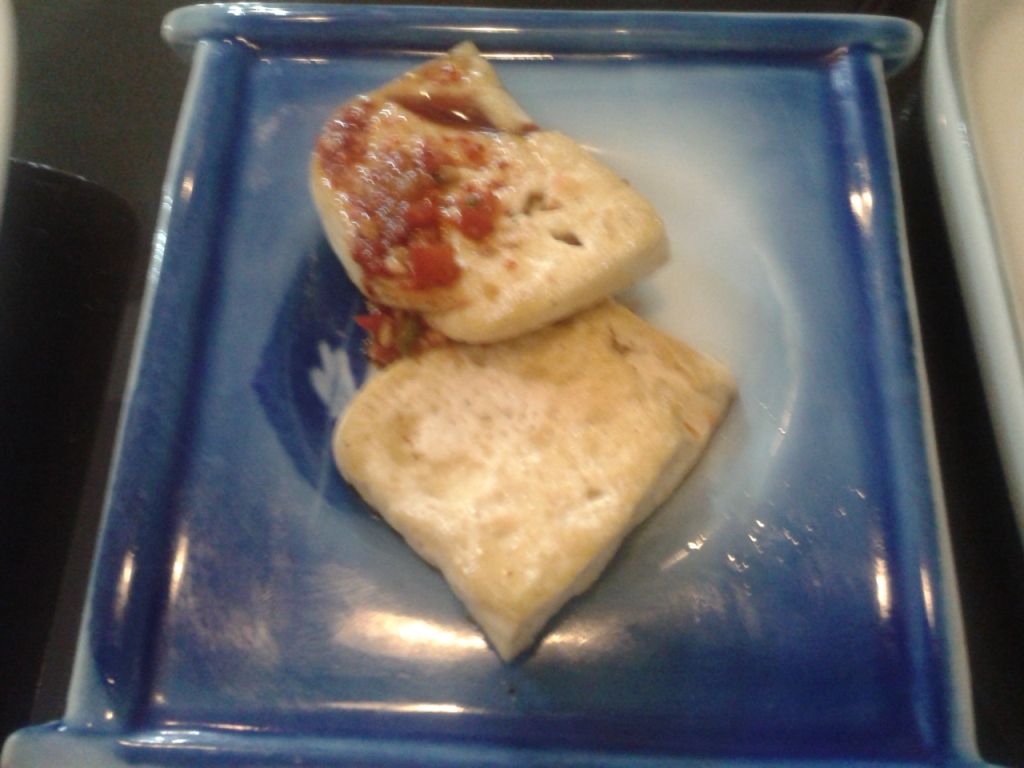
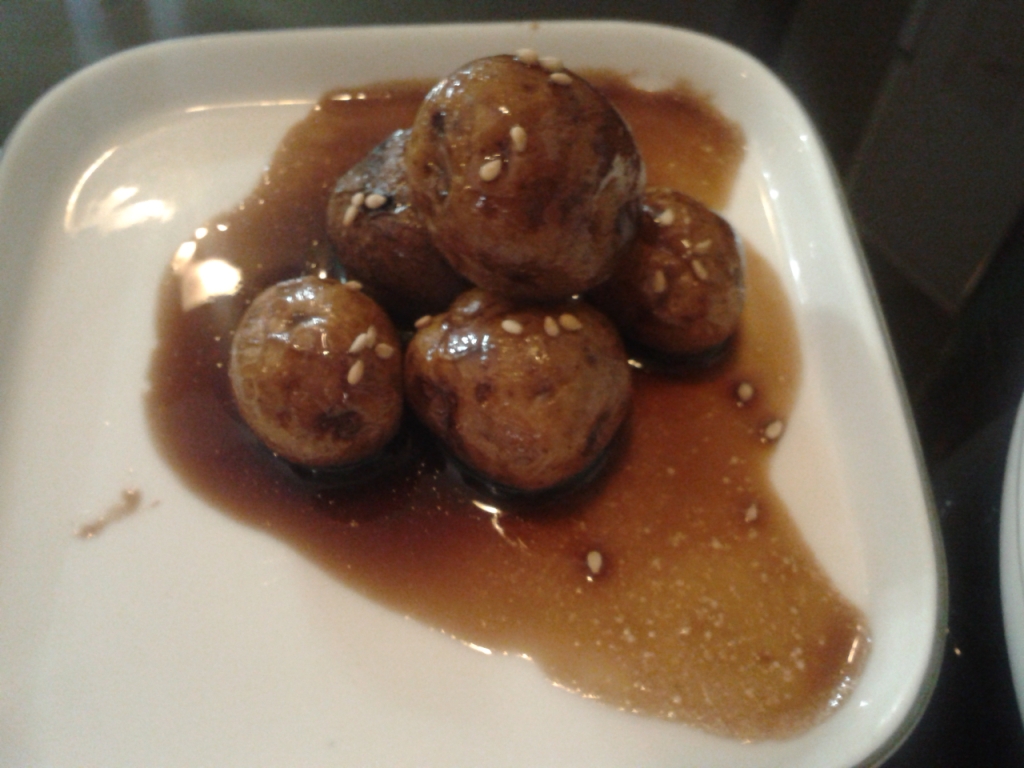
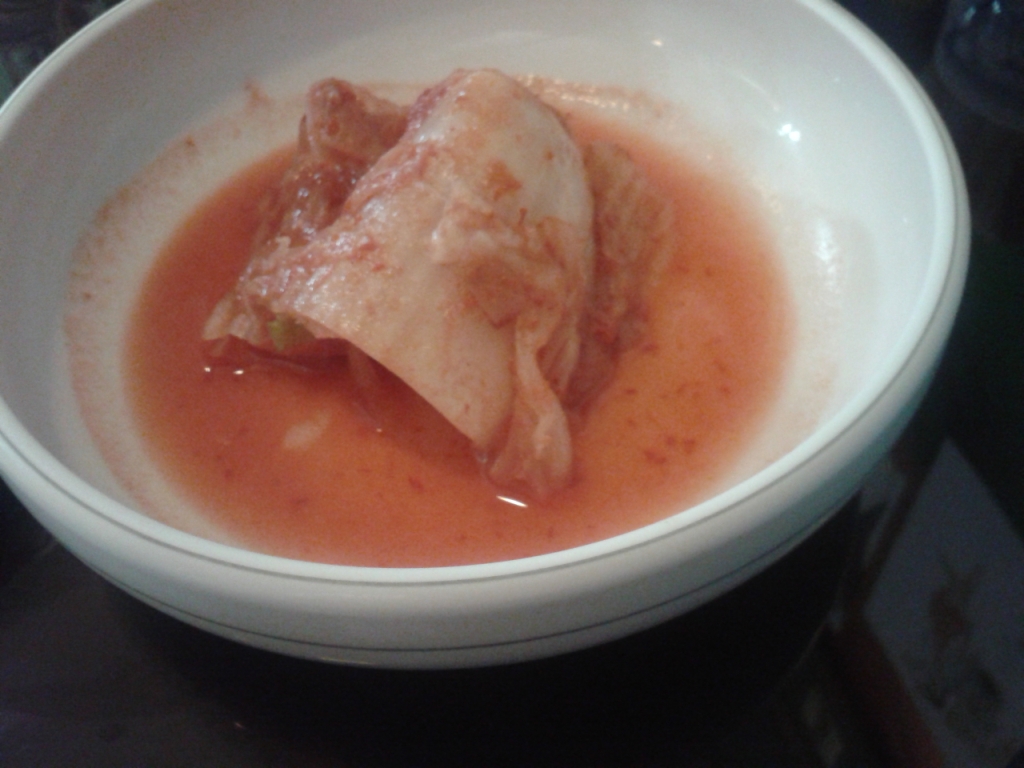
There was also a soup and a salad. The soup actually tasted more like something I’ve had on occasion in India than anything I’ve had in a Korean restaurant, except the vegetables were typically Korean. I believe the salad was a seaweed. There was also braised tofu, boiled baby potatoes in a teriyaki-esque sauce, and the Korean mainstay kim chi.  If you eat the Yukhoe, I’d recommend you eat your kim chi. Kim chi isn’t a personal favorite of mine, but its fermentation may offer you some assistance in digestion.

I’d recommend Hae Kum Gang.  My food was 480 Rs. (plus tax, tip, and a mineral water), which is pricey by Indian standards–but, as I always say, sushi and brain surgery are two things you don’t want a great deal on.

No, I don’t know if the name is supposed to register as “Hey, Come Gang!”

HaeKumGang2 HaeKumGang3 HaeKumGang4 HaeKumGang5 HaeKumGang6 HaeKumGang7

DAILY PHOTO: Reservoir Goat

Taken November 2, 2013 at Hampi.

Taken November 2, 2013 at Hampi.

This goat was strutting along in slow motion like he was in the opening scene of Reservoir Dogs.

Have no idea what I’m talking about? See below.

Indonesian Snake Massage

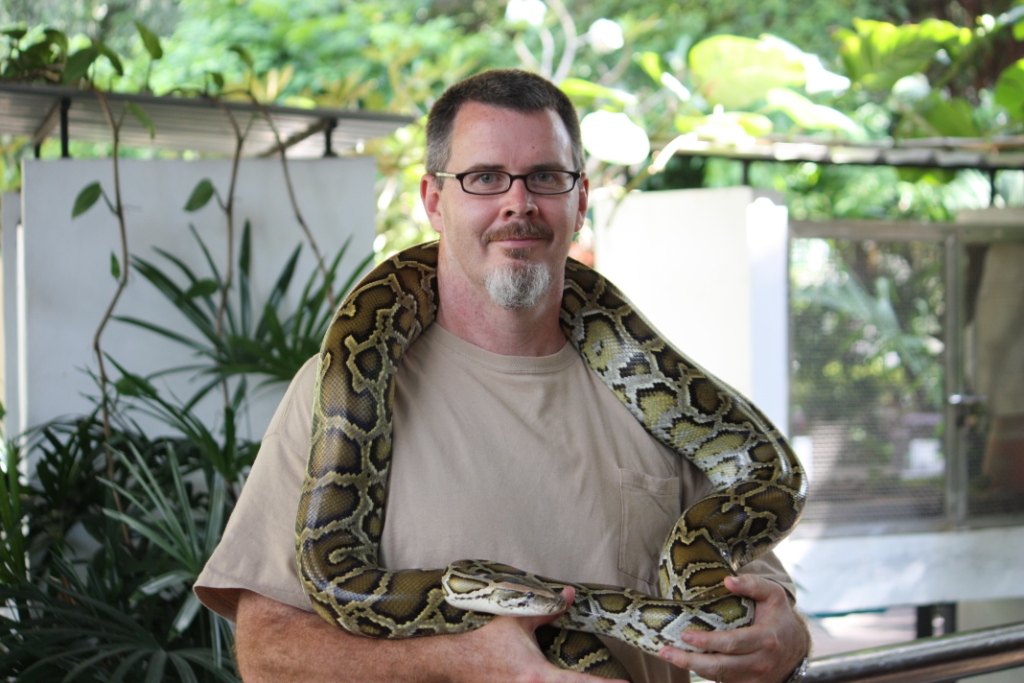
A Python, but no massage

A Python, but no massage

What could be more relaxing and luxuriating than laying on a massage table and having pythons heaped upon one to slither and writhe their way around one’s body? Many people might answer that question with replies like, “being set on fire”, “a prostate exam”, or “a pop math quiz.” Yet, some people dig this unusual form of therapy, and are willing to pay big bucks for it.

If you’ve traveled in the third world, you know that there are ever new and innovative attempts to bilk tourists out of cash. However, there has to be something to a weird idea for it to really take hold. Consider the ubiquitous Southeast Asian “fish massage.” I’ve tried it. It isn’t really a massage, but it does involve fish–namely little fish that eat away one’s dead skin cells to exfoliate and tickle at the same time. I don’t know if the fish massage does much good, but it feels weird, has some novelty to it, and is a good way to both get off one’s feet and experience ten minutes without someone trying to sell one something else odd and questionable.

Will the python massage (no, that is not a euphemism, innuendo, or a phrase from bad erotica) survive? I believe it will. Why? Because behind every insane idea there are drunk backpackers with Type-A personalities challenging one another to “go for it.”

In [Atheological] Praise of Grace & Fasting

IMG_1214Those who’ve read my posts, or who know me, probably know me to be areligious, which–contrary to popular belief–isn’t necessarily the same as being atheist. Personally, and on the whole, I’ve never found enough virtue in religion to outweigh what I believe to be its vices. That being said, I do find behaviors to applaud among the faithful.

First and foremost among these commendable activities is the practice of saying grace before each meal. Of course, what appeals to me isn’t the notion of saying, “Hey, God, you are really groovy for laying this food upon my plate, and it’s my most heartfelt wish that you’ll keep up the good work. Thank you ever-so-much,  and YEEAAAH, God!” [Though if a less borderline-sacrilegious version of this kind of grace is your bag, more power to you.]

What I commend is the taking of a moment to be still and introspective before eating, of taking time to recognize the importance of our food. Of course, one can do this same sort of thing without invoking a God or gods–and some people do so.

One can take a moment to remind oneself to be mindful of how one eats, to not eat too quickly, and to recognize when one is full. (Bodily full not mentally satiated, the two are often not the same and the former will usually arrive first.)

One can take a moment to remember a time in one’s life when one was hungry or thirsty and concerned about whether one would have enough calories or safe drinking water to get through.  In our modern age, I suspect many have never been in a situation to experience such a thought, and are the poorer for it.

One can recollect the image of some hungry soul,  scraping to gather enough food to survive.

One may simply say, hara hachi bu, as Okinawan people do to remind themselves to eat only until they are 80% full.

Whatever you think or say, the goal is to keep eating from being a mindless activity, done on automatic pilot. Failure to be cognizant of what one puts in one’s mouth is the number one killer among human beings–and not just the obese. OK, I admit that I made that statistic up. But of how many statements can it be said that one is better off behaving as if it’s true–regardless of whether it is or not.

On a related note, I also applaud the act of periodic and/or partial fasting as carried out by many religions, as long as the safety of the individual is put before religious dogma, which–to my knowledge–it usually is. One shouldn’t be what my father called a Red Lobster Catholic, the kind who went to Red Lobster on Fridays during Lent and ordered the most sumptuous seafood feast they could afford–missing the point entirely by treating themselves. One also shouldn’t fast to the point that one feels starvation, and then binge and gorge.  One should cut one’s intake in a safe and reasonable manner in order to observe what it’s like to feel biological hunger (as opposed to cravings of the mind,  or boredom hunger.) Then take advantage of the fact that one’s stomach capacity shrinks surprisingly rapidly, allowing one to control one’s intake much more easily.

One needn’t believe that one has to make oneself suffer as a sacrifice to a higher being to see the value of fasting. Fasting done mindfully, and not dogmatically, increases one’s bodily awareness, one’s thankfulness, and one’s pleasure in eating.


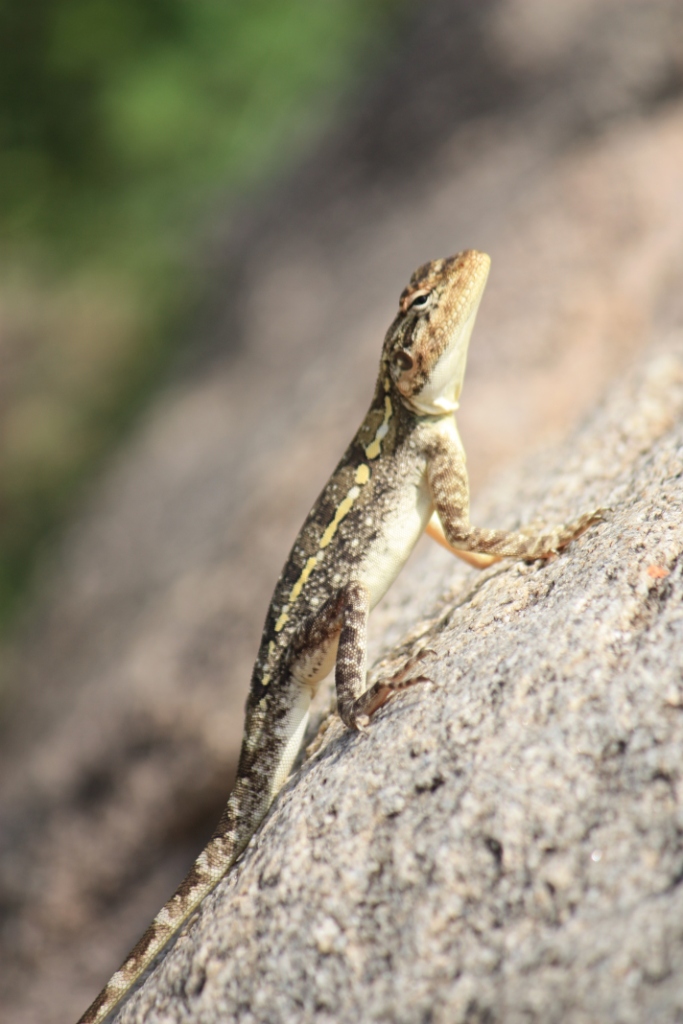
DAILY PHOTO: Climbing Lizard

Taken November 2, 2013 at Hampi.

Taken November 2, 2013 at Hampi.

These little lizards were one of the most common animal lifeforms at Hampi.  They blend into the rock quite well despite the broken white or yellow line of dots on their backs, which itself blends into the splotched pattern of the creature.

I believe they are called Psammaphilus Dorsalis, Peninsular Rock Agamas, or South Indian Rock Agamas. [However, I know nothing about lizards and am open to correction by a herpetologist.]

DAILY PHOTO: Precarious Rock

Taken November 3, 2012

Taken November 3, 2012

Part of what makes Hampi so surreal is all of the precariously balanced boulders. This shot is oriented straight up and down, i.e. the camera is not tilted, and so one wonder’s “How is that rock not falling?”

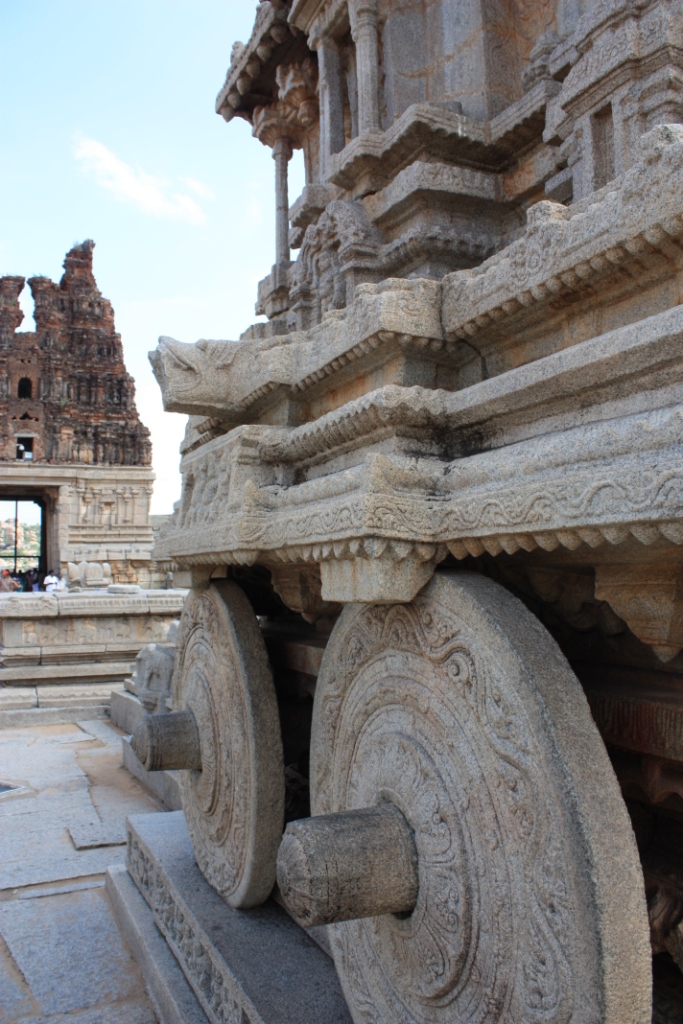
DAILY PHOTO: Stone Chariot

Taken November 2, 2013 at Hampi

Taken November 2, 2013 at Hampi

This stone chariot is one of the most iconic scenes of Hampi. The wheels on the chariot were once capable of moving, but no more. It remains an amazing sculpture. It’s in the Vittala temple complex, and is one of the first things that draws the eye when one enters through the gate that one can see in the background.

BOOK REVIEW: Justice League Vol. 1: Origin by Geoff Johns

Justice League, Vol. 1: OriginJustice League, Vol. 1: Origin by Geoff Johns

My rating: 2 of 5 stars

Amazon Page

Amazon had the Kindle edition of this graphic novel on sale recently. With all the talk of a Justice League movie, and whether it can ever get off the ground, my curiosity in these characters was piqued.

This volume was released in August of 2011 as the leading edge of a reboot of the entire DC comics line called “the New 52.” This is the origin story for the Justice League as a team, though all but one of the individual characters–Cyborg–is an existing hero at the time the story begins. The other characters, i.e. Batman, Green Lantern, Superman, Flash, Wonder Woman and Aquaman are familiar to the world but are not well liked. (and are introduced into the story arc in that order.)The volume consists of Issues #1 – 6 of the Justice League [New 52] reboot.

In the beginning, there’s only one dyad among this group who knows each other personally, the Green Lantern and the Flash–we don’t really know how they know each other. Most of the other characters are aware of each other’s existence (or myth), but have never met. Of course, Cyborg doesn’t exist at the beginning of the story, and his individual origin story is woven in throughout the book as a subplot so that he can be introduced into the arc at the climax. The characters are assumed to each operate in his (or her) own domains, i.e. Gotham City, Metropolis, Coast City, Central City, etc.

As the story opens, Batman is chasing down a stocky, non-human creature on the roof tops of Gotham in order to try to figure out what the nefarious character is up to. Green Lantern is inexplicably introduced into the middle of this chase scene. Batman and Green Lantern viscerally despise each other from the get go. This isn’t surprising as Green Lantern is an arrogant ass throughout the entire story. Perhaps the highlight of the book (which is sad as it happens so early) is when Lantern is busy mocking Batman, and the Dark Knight steals his ring–the source of his power–right off his finger.

The Green Lantern and Batman witness the inhuman creature planting a piece of alien-looking technology (later revealed to be a “mother box”), and Green Lantern’s ring confirms it to be otherworldly. The pair decide to pay a visit to the Earth’s resident alien, a.k.a. Superman. Green Lantern immediately runs afoul of Superman, arrogantly thinking he can subdue the Man of Steel, and has to call his old friend the Flash. The quartet finally stop fighting and begrudgingly agree to put their heads together.

After seeing a piece of the Cyborg origin story, we are introduced to Wonder Woman. She is probably the character that we get the greatest sense of. (Besides Lantern, who is unlikable throughout.] The Amazonian seems more alien than Superman. She’s never had ice cream but loves it, but not quite as much as a good fight. She’s not emotional about fighting, neither fearful nor angry, but is at her most happy when fighting. She’s the character most out of touch with the world she is occupies. She joins up with the four in the chase for the winged, alien monsters, forming a quintet and instilling some gender equity.

The Cyborg origin story comes to a head when Silas Stone, a brilliant defense industry scientist, turns his dying son, Victor, into the Cyborg, thinking it the only way to save the young man after he suffered severe burns from a mother box explosion. The former star football player is now a kind of Frankenstein’s monster, part himself and part autonomous machine. There’s a cacophony in his head as he can now pick up various radio signals.

It’s shortly thereafter that Aquaman is introduced. Considerable artistic effort was put into manning up Aguaman, who always seemed the weak link in this team. The group happens to be standing around near the water when Aquaman and his fish minions chase some of the evil army to the surface

The enemy is Darkseid, a juggernaut warlord from another world (or a parallel universe), whose army of evil minions have been the ones that the newly formed League have been fighting both individually and as a group. When Cyborg goes running away from his father–and his creator as a machine-man, he runs into the six superheroes, and the team of seven is fully assembled. Darkseid’s power is so great that he relatively easily captures and subdues Superman.

Batman goes to rescue Superman as the rest of the team regroups. The Dark Knight’s tactic is letting one of the evil, winged, juggernaut minions capture him–as they have been capturing others.

I won’t spoil the ending, but will say that it was pretty weak, and a large part of the reason I gave this work such a low rating.

A two star rating may seem a little harsh. The dialogue in this work is better than most comic books. There’s relatively less “As you know, Bob,…” style exposition. There is some, as when Green Lantern feels the need to explain to Batman about how there are other Green Lanterns and this is his space sector. However, there are also clever uses of action to present background, as when Lantern begins to admit that he’s a show-off and it turns out he’s brushing up against Wonder Woman’s truth lasso. (This is a much better way to do it than Wonder Woman saying, “And now my lasso is around you and you’ll have to tell the truth, for whosoever the lasso touches cannot bear false witness.” Which would be the typical comic book way of revealing the lasso’s power.)

There are two problems with this work that are too serious to overlook. First is the deus ex machina ending. The authors make a bold choice as to who will save the day, perhaps to create surprise and perhaps to highlight the character. But the whole resolution strains credulity. Second, there is no good explanation for why these characters keep piling into each other (except for the Xenophobic thought processes of Batman and the Green Lantern that Superman must know about anything alien.) These evil minions are supposedly everywhere, and yet the individual superheroes keep running into each other–and continuing to stay together despite the fact that most of them clearly don’t like the others. I think the author takes this “we hate each other, but are begrudgingly working together” trope a little too far. It feels as if this Wizard of Oz cast hadn’t come together by commonly following the yellow brick road, but rather that seven separate and randomly moving tornadoes picked up one each and just happened to stack them in a neat pile.

Besides Green Lantern being arrogant and unlikable and Wonder Woman being endearingly alien, we get very little sense of individual characters. Batman and the Flash are the voices of reason of two differing type, but Superman and Aquaman are just muscle.

I have a black and white Kindle, but the art looked good to me–but that’s not my forte. I applaud the artists for getting rid of Superman’s red tighty-whities and making Aquaman look more manly. At the end there’s some alternative artwork and info on costume development for those who geek out on such things.

If there’s any hope for a Justice League movie, it’s not to be found in this story line. If you’re a DC fan, you’ve already read this–like it or not. If you’re wondering whether to become a DC fan, I wouldn’t start here.

View all my reviews