Unknown's avatar

About B Gourley

Bernie Gourley is a writer living in Bangalore, India. His poetry collection, Poems of the Introverted Yogi is now available on Amazon. He teaches yoga, with a specialization in pranayama, and holds a RYT500 certification. For most of his adult life, he practiced martial arts, including: Kobudo, Muay Thai, Kalaripayattu, and Taiji. He is a world traveler, having visited more than 40 countries around the globe.

DAILY PHOTO: Terror House in Black & White

Taken in December of 2014 in Budapest

Taken in December of 2014 in Budapest

Terror Háza is a museum of the atrocities committed by the fascist and communist regimes in Hungary. It is housed in a building, Andrássy út 60, that was used by both those regimes for torture and imprisonment of dissenters.

DAILY PHOTO: Hampi Scorpion

Taken in November of 2013 at Hampi

Taken in November of 2013 at Hampi

This dead scorpion was sitting on some stonework at the Achyutaraya Temple.

BOOK REVIEW: I Have No Mouth & I Must Scream by Harlan Ellison

I Have No Mouth and I Must ScreamI Have No Mouth and I Must Scream by Harlan Ellison

My rating: 4 of 5 stars

Amazon page

This collection of short fiction by Harlan Ellison consists of only seven stories. It was originally published in the late 1960’s and a second edition was released in 1983—the latter being the edition I read. Despite a bit of Cold War zeitgeist–most notably in the title story—this collection holds up well to time.

I’ll proceed by discussing each of the seven stories.

1.) I Have No Mouth & I Must Scream: It’s after World War III, the Soviets, Americans, and Chinese had built artificial intelligences (AIs) to help prosecute the war. The AIs ganged up against humanity and exterminated all humans—excepting five individuals (4 men and 1 woman.) The AI finds a way to indefinitely extend the lives of the five so that it can keep its playthings around. The AI is kind of like a sadistic child with an ant farm. The story is told from the perspective of one of the five remaining humans.

2.) Big Sam Was My Friend: A folksy narrator tells the tale of how a fellow interstellar circus performer met his ends. The deceased, Big Sam, was capable of teleportation, like the character Nightcrawler (Kurt Wagner) in the X-men. Ellison does an excellent job of creating a unique character and tone in this story.

3.) Eyes of Dust: On a planet of beautiful people, there remains a family of uggos–and the child is the ugliest of all. However, ugliness isn’t the boy’s only unique trait. This is one of the weaker stories of the collection in my opinion, but it’s not bad.

4.) World of The Myth: The three-person crew of a spaceship crashes on an unfamiliar planet. The planet is inhabited by ant-like creatures that can form complex shapes, and through such displays the creatures can reflect the essence of who a person is back at them. This proves more than the despicable captain of the small crew can bear.

5.) Lonelyache: This story is more realism than speculative fiction—or at least I interpreted it that way. It’s about a guy who’s gone through a divorce recently, and is living alone. The story intersperses recurringly-themed dreams in which men are trying to kill the lead character, with waking sequences which revolve around the man’s troubled relationships with women.

6.) Delusion For a Dragon Slayer: In the Introduction, we are told by Theodore Sturgeon that the description in this story is very much how people on hallucinogens experience the world. I can see what Sturgeon is saying. The story begins with a series of vignettes about people who died for no logical reason and at the least likely times. The story then tells an extended tale of one such death, that of the lead character, in a way that mixes dream and reality in a way that’s hard to differentiate.

7.) Pretty Maggie Moneyeyes: A man in Las Vegas hits the jackpot on a slot machine. He feels compelled to engage in the very sucker-like behavior of playing the same machine again, but he wins again and then keeps winning. The casino obviously suspects foul play with the second jackpot, but they can’t find anything wrong with the machine or any way in which the man might be cheating. All their investigation reveals is that a woman had died playing that machine some time before.

I’d recommend this book for those who like short speculative fiction. The best of the stories are outstanding, and the worst of them are still intriguing and readable. I will say that it’s not a collection for readers with delicate sensibilities–including young readers. (e.g. Rape is a theme that repeats in a couple of stories.)

View all my reviews

READING REPORT: February 13, 2015

Welcome to a special Friday the 13th edition of the Reading Report. What’s so special about it? If you’re not deluded by superstition, then not much. If you are superstitious, reading this post may cause you to suffer a plague of locusts (or whatever plagues your particular geographic area.)


Now that we’ve gotten rid of the illiterate ninnies, we can get down to discussing books.


I finished two books this week–one nonfiction and one fiction. I’ll be posting book reviews within the next couple weeks.


The nonfiction book was called Yoga Body: The Origins of Modern Posture Practice. The author’s intriguing and controversial thesis is that yoga as it’s practiced in studios around the world today nothing to do with traditional Indian yoga, but, instead, owes it’s existence to European calisthenics and bodybuilding systems and the Indians that borrowed from them. I didn’t find the author’s argument compelling for a number of reasons that I’ll get into in my review. This isn’t to suggest that I’m certain he’s wrong. He may be right, but the way he constructed his argument left a great deal of room for doubt.


TLEG_Vol1

The fiction book was a graphic novel entitled The League of Extraordinary Gentlemen (Vol. 1). For those of you who haven’t seen the movie featuring Sean Connery, this comic book gathers together a team of protagonists from 19th century science fiction and adventure novels. The team consists of Mina Harker (of Bram Stoker’s Dracula), Allan Quatermain (of H. Rider Haggard’s King Solomon’s Mines), Captain Nemo (a Jules Verne recurring character), Dr. Jekyll/Mr. Hyde (Robert Louis Stevenson’s title characters), and Hawley Griffin (of H.G. Wells’ The Invisible Man). One needn’t have read all those classic stories to follow this book, but being a fan of 19th century tales of the fantastic definitely makes it more fun. The story depicted in this volume has nothing to do with the movie plot.


mantraSherlockHolmes

I’m more than halfway through a couple of books that I mentioned in earlier Reading Reports, they are Why Do People Get Ill? and The Mandala of Sherlock Holmes.  I read chapters 7 through 9 of the former book, which had to do with the expression of symptoms, the heart as a symbol and that symbol’s expression in illness, and the impact of mother’s experiences on infants and children. In the latter book, Holmes has arrived in Tibet, and the plot thickens. The author is Tibetan, and so has some unique insights. However, some chapters advance the story with action, and others are almost like travelogue.


I’m still early into reading two books that I’ve previously mentioned. The first is Zen and the Brain. In this book I’ve transitioned out of the part explaining Zen and the author’s experience of that tradition, and am now into the part that lays down the basic neuroscience. While the author writes in a readable style, for a neuroscientist, this is still challenging reading because of its scientific nature and the complexity of the brain. However, the chapters I read recently both raise some fascinating questions and provide useful information. The chapter I just finished dealt in part with the neurochemistry of addiction. I like that this book is divided up into short chapters. This is beneficial for taking in such complicated information. I need frequent think-breaks to ruminate on what I’ve read.


pyjamagame

The second is The Pyjama Game. After a slow start, the last two chapters have contained some fascinating information. One of these chapters dealt with the history of jujutsu, particularly as Japan transitioned from medieval to modern. The other chapter outlined Kanō Jigorō‘s development of judō.


I bought three books this week.


The first is entitled Healing Moves, and is by a married couple consisting of a fitness writer and a cardiologist. This book addresses a topic that is a prevailing theme in my nonfiction reading as of late, which is what movement, exercise, and physical activity can do to improve one’s health (not just one’s fitness.)

HealingMoves


The second book is Greatest Ever Boxing Workouts.  This book presents information about what boxers like Mike Tyson, Manny Pacquiao, and Floyd Mayweather do to prepare for fights. It’s a follow-up to an earlier book that included fighters like Muhammad Ali and Roy Jones Jr.

BoxingWorkouts


Finally, I just got a short story collection on Kindle Daily Deal the other day entitled Lovecraft’s Monsters.  This isn’t a collection of H.P. Lovecraft stories, but rather is an anthology of stories inspired by Lovecraft’s work.

LovecraftsMonsters

DAILY PHOTO: Macaque Portrait

Taken in the July of 2014 near Chamarajanagar.

Taken in the July of 2014 near Chamarajanagar.

10 Easy Pieces of Fitness Wisdom: and Why “Fitness Secrets” are Bullshit

A few weeks ago I did a post entitled, 10 Easy Pieces of Wisdom: and Why “Secret Wisdom” is Bullshit. That article’s premise was that understanding what one needs to do to be wise is simple, but the process of doing it is inescapably arduous–often to the point of seeming Sisyphean. (For those who aren’t brushed up on their Greek Mythology, Sisyphus was the guy who was punished by having to roll a rock up to the top of the hill only to let it roll back down, and the repeating the process ad infinitum.) I’m not saying that it’s a Sisyphean task, just that it can feel that way and one has to press forward through that feeling.


This post has the same premise, but applied to fitness. Fitness and wisdom have more in common than you might first think–they are both about improvement of the self. Unfortunately, the commonality that’s relevant here is that both invite crowds who will try to convince you they have an end-run around hard work. One of my past martial arts teachers, who was also in law enforcement, said that “cons only work on people with larceny in their hearts.” So it is that the con-men that are trying to sell “enhanced formula supplements” or “a 15 minute per week workout” can only sell to the people who want something for nothing. (Clue: what you get for nothing is nothing worth having.)


Without further ado, here are the 10 easy pieces:


1.) Know Thyself. This is a two-parter:

First, don’t let your ego write checks your body can’t cash. Some students want to jet right into the most advanced exercises. That’s like a third grader taking trigonometry; it’s ultimately less than productive. These are the individuals who tear ligaments, and who you don’t see again for six months–if ever. For virtually everyone, advanced exercises–be it a muscle-up or a yogasana like Urdhva Dhanurasana (A wheel pose, chakrasana, that is entered from a standing back bend)–require a lot of time spent in capacity building via fundamental exercises.


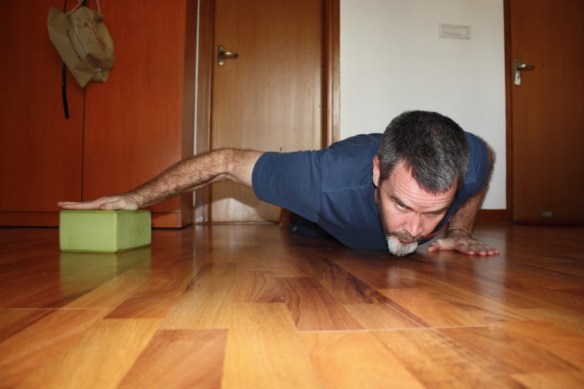
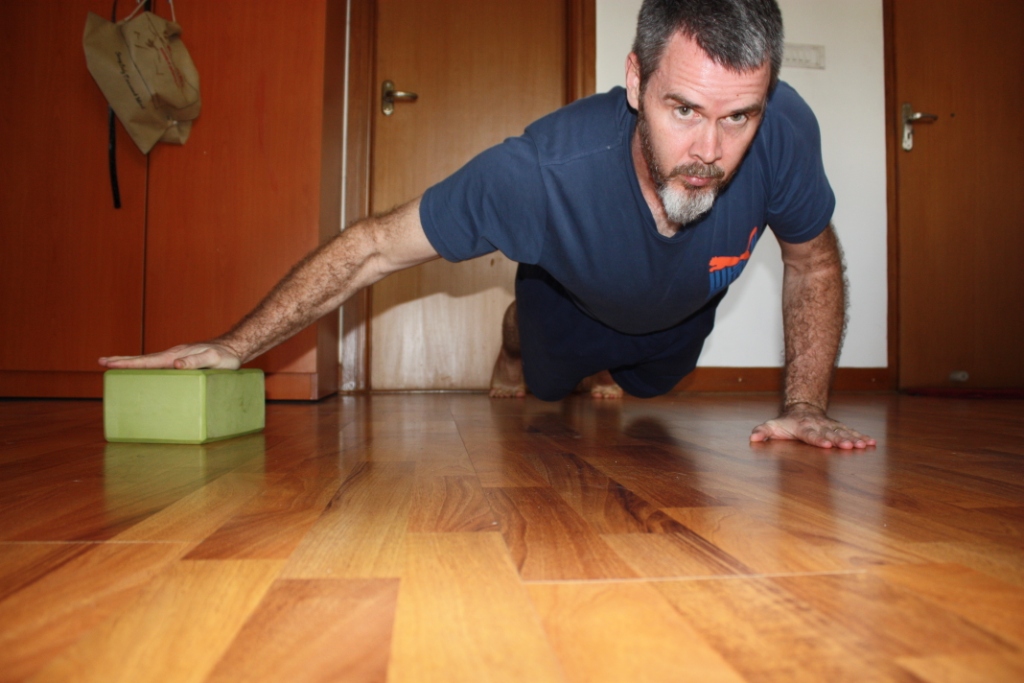
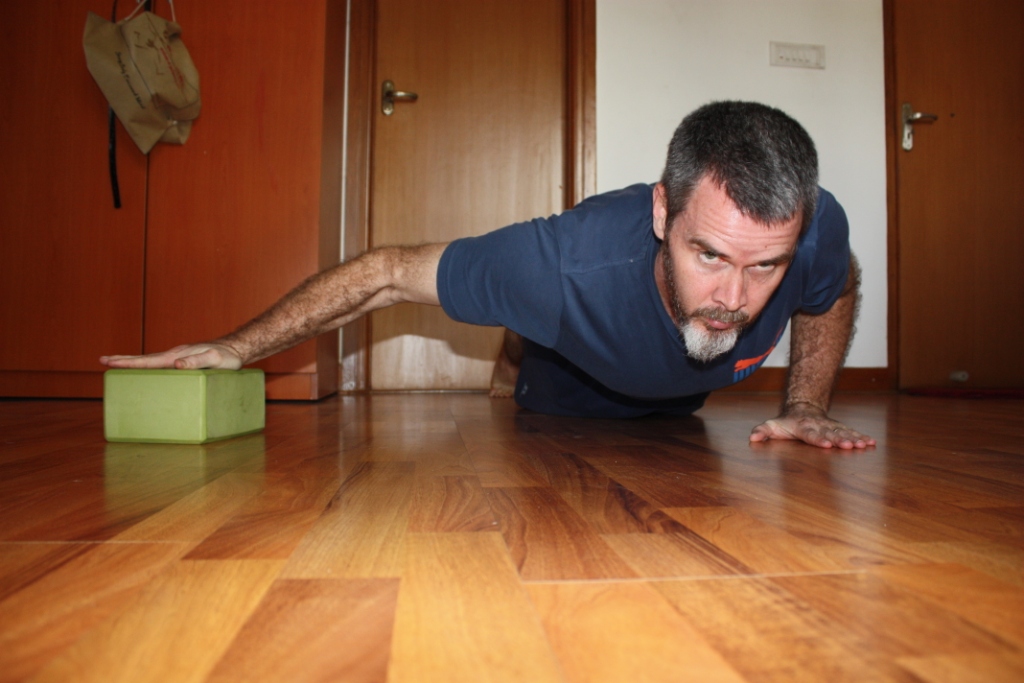
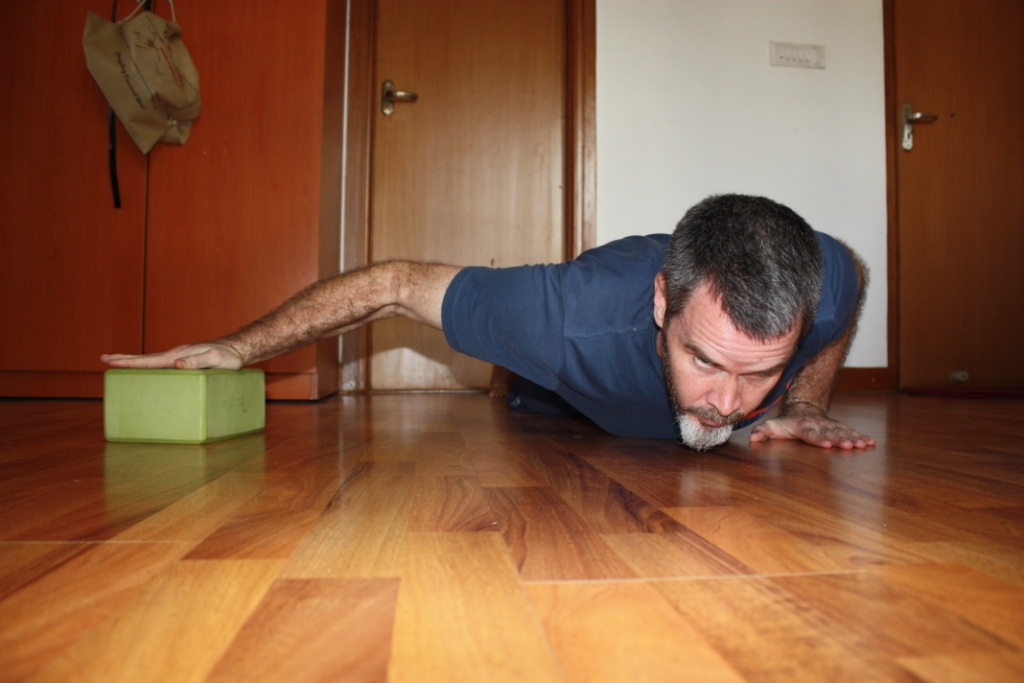
I’ll give an example, I saw someone on television yesterday doing the most horrendous single-armed push up. The only thing that kept this individual from damaging himself is that his range of motion was so tiny (he may have still injured himself.) His problem is that he heard that single-arm push-ups were cool, and he wanted to get straight to it. In reality, one needs to build into that exercise starting from a good solid standard push up, and then doing preppers (preparatory exercises) that gradually shift the load onto one arm. But maintaining form as well as one can. For example, putting one hand on a block off to the side, and gradually shifting it out to arm’s length.
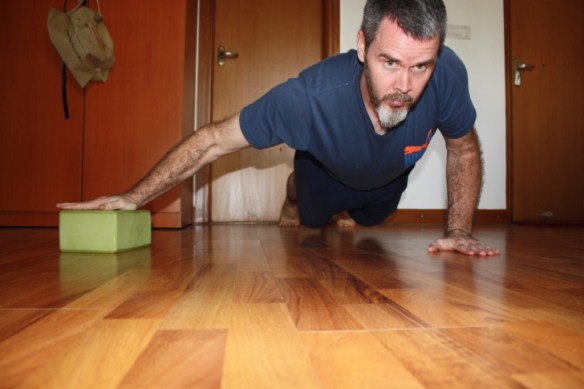
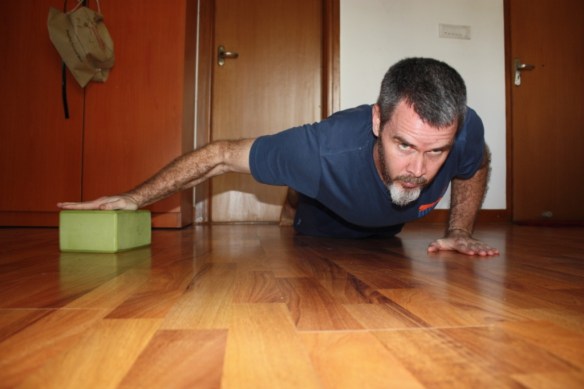
IMG_3217 IMG_3218 IMG_3219


Second, on the other hand, don’t half-ass everything because you mistake discomfort for agony. This confusion cause people to greatly underestimate their capabilities. While you may think your teacher or trainer is a Sadist (only rarely are they are, really), the fact is that they are trying to give you one of the greatest gifts you can ever receive, which is the realization that you are capable of far more than you think you are–if you’re willing to gut it out through the challenging parts.


2.) Diet is the 800 pound gorilla of cutting weight. The simplified mathematics of this that adding exercise (while critically important to fitness) only marginally adds to the calories burned part of the equation. (Believe it or not one burns a lot of one’s calories just through baseline activities–breathing, walking, sleeping, etc.) However, when you cut caloric intake that’s all reduction from the intake side of the equation. However….


3.) Don’t make your goal weight loss, but rather to have a healthy and more functional body. Weight loss tends to be about external validation. That is, one wants to appear more attractive to someone else (or everybody else.) That’s a sucker’s game. People won’t necessarily notice–depending upon how often they see you and how self-absorbed they are. If you shed pounds at a healthy rate, people around you all the time don’t necessarily notice a day-to-day change.


On the other hand, as one starts feeling healthier and develops movement capacity beyond your previous capability, that can’t be taken away by anyone.


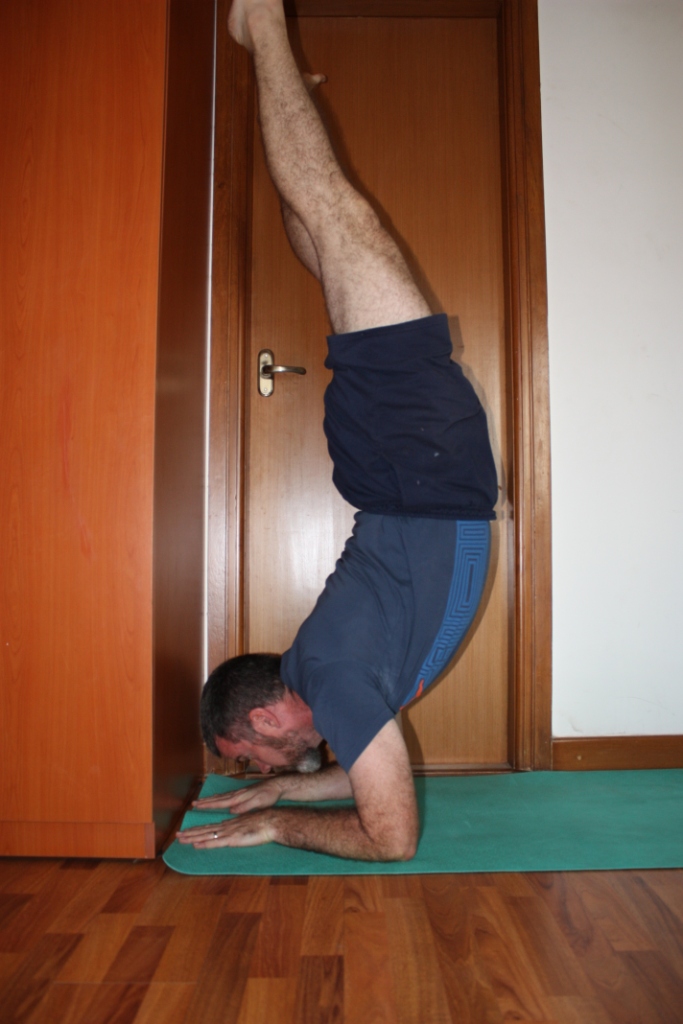
4.) When your body has been properly prepared through fundamentals, advanced maneuvers practically fall into place. I was taught a scorpion prepper  just a couple of weeks ago, and was surprised to find it was much easier than expected. I still have a lot of work to do to take it to the full pose. For example, I’m still using a wall so I don’t over-rotate in the arched back position,  but I bring my heels off the wall once I’m up. Next I’ll do away with the wall. Then it will be time to start bending my knees. My point is that  work on back stretches, core strengthening, and headstands made it relatively easy to get into the first stage.
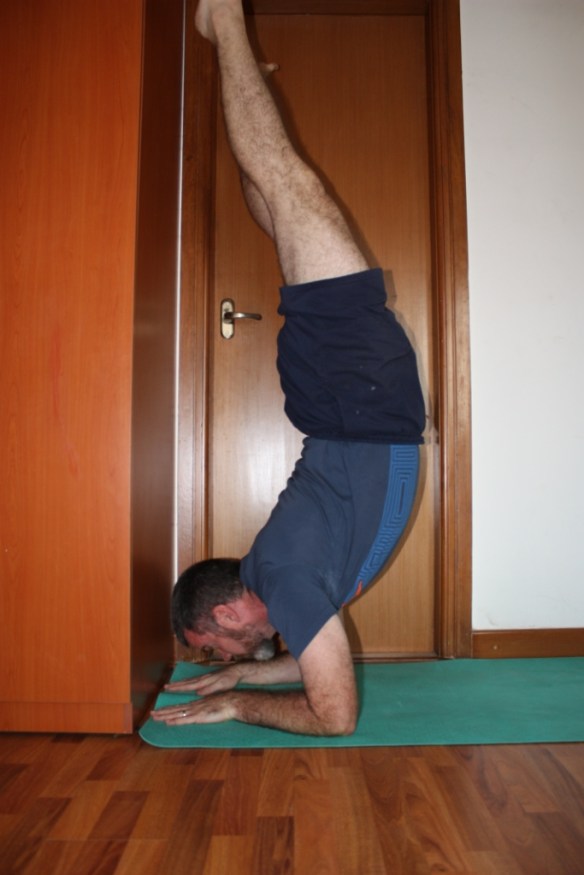
IMG_3225


5.) Reveling in small victories can kill progress. The handstand provides a classic example. In the beginning, one starts kicking up against a wall. Even this can be a challenge in the beginning. However, as soon as it becomes doable, one should start gradually taking the training wheels off. This may begin as cautiously as pulling one leg away from the wall at a time. Then do away with the wall altogether. Then the suffering begins anew as one sheds the kick up in favor of a more controlled manner of ascent into the handstand.


6.) Don’t be quantitative.  A journalist once asked Muhammad Ali how many sit-ups he did in his training regimen. Ali said, “I have no idea. I don’t start counting until they start hurting.”

I’ve heard guys pleased with themselves because they do “sets of 100 push-ups.” This is often impressive only until you see the person actually do the exercise, and then–more often than not–you notice that they haven’t actually done one push-up. Rather, they’ve done a whole lot of mild elbow bends from a roughly plank-like position. It’s better to do 10 push-ups with a full-range of motion and controlled ascent and descent than to fool yourself with weak form.


7.) Don’t mindlessly workout. Shun the distraction of headphones, television, or cellphones . If you find working out to be so mind-numbingly boring that you need a distraction, you should re-evaluate the nature of your workouts. You should be “listening” to your body throughout the process. If your goal is to have a greater command over your body and its movement, e.g. you are a martial artist, dancer, yogi, etc., then this is particularly important.


First of all, with respect to boredom, boredom is the product of a weak mind. So you might consider working the mind out as well. Secondly, if you are truly bored, you should be upping your game.


While this may be one of my least popular points in this post, if you don’t believe me, ask Al Kavadlo.


8.) Rest is part of the process. It’s not stepping away from the process. As your body rests, your mind should be alert and taking stock of the effect of the practice on your body. Rest breaks aren’t zone out time. Also, part of having a healthy body is building a healthy parasympathic nervous system and immune system. Your body requires rest to heal, and it can heal and fight off infections tremendously effectively if you provide the right conditions.


9.) Exercises that consist of the motions you will need for your particular life are the most important.  The term “functional fitness” is ubiquitous these days, but I first read this advice in Bruce Lee’s Tao of Jeet Kune Do. Lee said that actions like punching, kicking, and grappling practice should make up the core of a martial artist’s workout. That doesn’t mean one should do away with general fitness activities. (Lee certainly didn’t.) Martial arts provide a prime example of an activity that requires a well-rounded form of fitness. That is, one needs core strength, good range of motion, cardiovascular endurance, and extremity strength and speed.


10.) Don’t agonize over failures. Move onward and, carefully, upward. If you aren’t (safely) failing to achieve an occasional goal, then you need to kick your way out of that box of comfort zone you’re trapped in.


DAILY PHOTO: Lost Baby Sock Hung on a Fence Post

Taken in Szentendre in December of 2014

Taken in Szentendre in December of 2014

BOOK REVIEW: Quarantine in the Grand Hotel by Jenő Rejtő

Quarantine In The Grand HotelQuarantine In The Grand Hotel by Jenő Rejtő

My rating: 4 of 5 stars

Amazon page

[Note: This book is published by Corvina Books, which is a Hungarian publisher that—among other things—specializes in translations of Hungarian literature (into mostly English and German.) I bought the book on a recent trip to Budapest. I mention these two facts because this seems to be an expensive and / or difficult to acquire work outside of Hungary. A cursory Amazon search brought up copies only at an exorbitant rate. In Hungary I paid 2500 forint (about $9 USD at the time), which I would consider on the high side of what the book is worth. It’s a good book, but it’s a 160-page pulp-fiction paperback novel written about 80 years ago.]

Quarantine in the Grand Hotel is a murder mystery set on a fictional resort in Indonesia (or thereabouts.) However, it’s not your typical dour mystery. It’s as much of a satirical humor novel as it is a mystery. I was hooked with the first paragraph, which reads, “When Maud returned to her room, she saw a man emerge from her wardrobe. Dressed in pyjamas and wearing a bright green lampshade on his head, the stranger beamed a friendly smile at her.” From that point, I had to know who the man in the pyjamas is and how he got there, and that information doesn’t come immediately or without false leads.

The premise is that the resort is quarantined and a murder takes place there (actually two murders.) It’s not a creative premise. The hotel setting allows the author to bring together an international cast of characters (suspects) some of whom would believably have secrets or be leading double lives. Where the creativity comes in is both in the humor, and in the skilled reveals. Rejtő used cliff-hanger chapter closings to good effect. He also plants false information, e.g. in the form of false confessions designed to protect loved ones that may or may not have actually committed a crime.

Rejtő (who wrote under the nom de plume “P. Howard”) was a Hungarian journalist and author. He wrote this and most of his books in the 1930s. He died in a forced labor camp in axis-controlled Soviet territory during World War II. He’d displeased the Hungarian Arrow Cross Militia (i.e. the Hungarian fascists) and was sent to a labor camp at the front.

I’d recommend this book for those who like light, humorous novels. If you’re a hardcore mystery fan, it might seem a little silly and ham-handed. If you are looking for a novel that offers insight into Hungarian literature, I don’t think this one is for you. The setting is not Hungarian, the major characters are not Hungarian, and I would hazard to say that most people wouldn’t know that this translation wasn’t written by a British, or other English-language country, author.

View all my reviews

DAILY PHOTO: Széchenyi Tér in Pécs

Taken in December of 2014 in Pécs

Taken in December of 2014 in Pécs

The photo above and the photo below were taken at almost the same time (around dusk), but with some adjustments to the manual settings. (You can see the time continuity in the clouds above the hotel in the right half of the photo.) What a difference a few clicks make.IMG_2911

Learning Indian Cooking in Bangalore

I'm stirring the pot.

I’m stirring the pot.

The thing about Indian food–with its penchant for pureed gravies–is that I find it delectable, but often have no idea what I’m eating or how it got to me looking, tasting, and smelling like it does.


That is until recently. A couple of weeks ago I attended a cooking class at Manju’s Cooking School in RT Nagar in an attempt to rectify (or at least reduce) my ignorance. Manju’s offers a wide variety of classes (Indian and non-Indian, veg and non-Veg, cooking and baking, etc.)


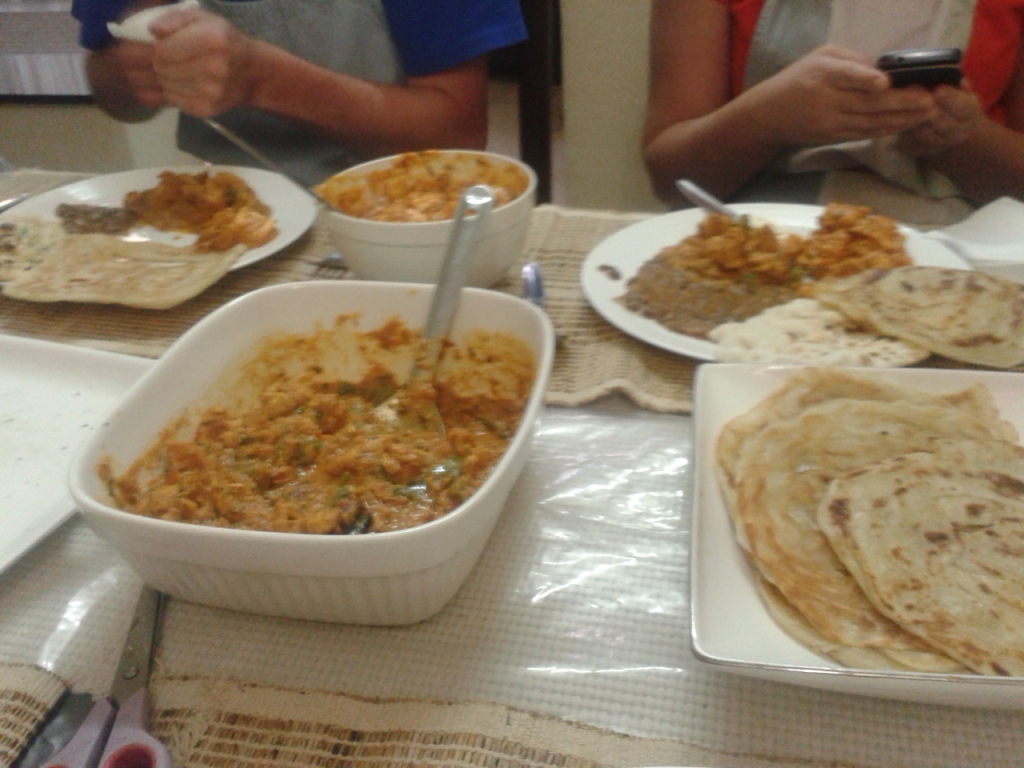
I attended with a group of friends, and we constituted a class unto ourselves. We, therefore, got a quick and dirty introduction to a number of common / typical Indian foods (veg and non-veg, and both North and South Indian.) The menu we prepared consisted of two breads (kulcha and Malabar parota), dal makhani, paneer butter masala, and kadai chicken.


The class took 2.5 or 3 hours, and ended in a banquet of the foods we hand prepared.

20150201_170142 20150201_170013


Some of the fun facts that I learned include:

-“Kadai” in the name of dish just means that it’s wok-cooked.

20150201_154859

-A Kulcha is essentially a naan of a different thickness.

-Dal makhani requires a lot of prep, even if you have access to a pressure cooker.

-There’s a lot of finely chopped onion in these gravies that often goes unnoticed.

-One can cook with the pot upside-down. This is how we cooked Kulcha. In a restaurant it would be cooked in a Tandoor oven, but at home you can cook it stuck to the bottom of a deep pot.

20150201_163717

-Lastly, the key to a the flaky goodness of a Malabar parota is lots of fat… who’d have thought?

20150201_162915

Me&Parota