Unknown's avatar

About B Gourley

Bernie Gourley is a writer living in Bangalore, India. His poetry collection, Poems of the Introverted Yogi is now available on Amazon. He teaches yoga, with a specialization in pranayama, and holds a RYT500 certification. For most of his adult life, he practiced martial arts, including: Kobudo, Muay Thai, Kalaripayattu, and Taiji. He is a world traveler, having visited more than 40 countries around the globe.

BOOK REVIEW: Piriformis Syndrome by Loren Fishman, M.D.

Piriformis Syndrome: Diagnosis, Treatment, and Yoga: Pain in the ButtPiriformis Syndrome: Diagnosis, Treatment, and Yoga: Pain in the Butt by Loren Fishman
My rating: 4 of 5 stars

Amazon page


This short book (<50pp.) describes piriformis syndrome, what causes it and how it’s diagnosed and treated. Piriformis Syndrome is a malady in which a nerve is pinched by the piriformis muscle. Because of the way pain (and other sensations) radiate, it’s not necessarily easy to differentiate this syndrome from a low back injury. However, the descriptions of the specifics of this condition, and the test used to diagnose, it may give one insight as to whether one is looking in the right direction for the cause of one’s butt and leg pain.

One nice feature of this book is that it explains how yoga can be used both as part of the treatment regimen and as a preventive measure. The yogic treatment consists of just four classical postures of Hatha Yoga: Janu Shirshasana (head to knee pose), Parivrtta Trikonasana (twisted triangle pose), Matsyendrasana (a simple twisting pose named for a sage), and Parivrtta Parsvakonasana (twisted side angle pose.) However, yoga teachers who have students who’ve been diagnosed with this condition will find it nice that the book gives modifications and clarifications pertaining to use of the postures to help such people.

There are seven chapters in the book. The first describes the condition and its cause. The second chapter explains the connection between the condition of piriformis syndrome and the symptom of sciatica. Chapter three clarifies the ways in which this condition may be misdiagnosed, and this is followed up by the chapter that shows how it is diagnosed by both physical examination and by imaging technology. Chapter five gives a basic overview of the available treatment options including injections, drugs, physical therapy, surgery, and yoga. The next chapter talks about the state of research. The last chapter explores the yoga asana that can be used to help treat or prevent piriformis syndrome. There are a few graphics. These include line drawings such as of the diagnostic physical exam, and photos of modified versions of the yoga postures.

I’d recommend this book for those who’ve been diagnosed with this ailment, who believe they might have it, but also for yoga teachers who are interested in expanding their understanding of the afflictions of which their students may suffer—so as to be prepared to help them or, at least, not hurt them.

View all my reviews

DAILY PHOTO: Nagore Dargh, Singapore

Taken on October 29, 2016 in Singapore

Taken on October 29, 2016 in Singapore


img_3563

DAILY PHOTO: Planet

Taken on November 1, 2016 at the Marina Bay Sands Gardens in Singapore

Taken on November 1, 2016 at the Gardens by the Bay in Singapore


Believe it or not, this is a seven ton bronze sculpture. It’s only painted white and only appears to be a material as light as plastic. That seven tons is cantilevered off that one arm (i.e. the back of the hand is all that touches the ground.)

It’s called “Planet” and it was sculpted by Marc Quinn in 2008.

Here is a pic from farther away that may offer more sense of scale.

img_4595

BOOK REVIEW: Subliminal by Leonard Mlodinow

Subliminal: How Your Unconscious Mind Rules Your BehaviorSubliminal: How Your Unconscious Mind Rules Your Behavior by Leonard Mlodinow
My rating: 4 of 5 stars

Amazon page


If one tries to detect lies using conscious analysis, one stinks—wrong as often as right. However, if one distracts the conscious mind so as to produce what is often called a hunch, one performs much better. This is because not only is there is another mind below one’s conscious mind, but it’s better at many tasks than is our conscious mind. This will be hard news for many readers to take because they are reading and comprehending it with their conscious minds—a conscious mind that thinks it’s better than sliced bread when it comes to things that are awesome. Mlodinow’s book is about the many aspects of this mind that we generally don’t have access to (unless one is skilled in lucid dreaming or is conscientious in the hypnagogic state [on the edge of falling into sleep]—topics the author doesn’t get into.) It’s about why humans evolved to have subliminal mental operations, how they benefit us, and how they sometimes fail us.

Ideas about what the unconscious mind is have varied over the ages, though its existence has long been recognized. Ancient traditions often attributed the unconscious to the supernatural causes like a collective consciousness. Mlodinow begins his book with a chapter entitled “The New Unconscious,” presumably to distinguish it from Freud’s conception and to emphasize the wellspring of results that have come about during the last couple decades of brain research.

The second chapter deals with our sensory experience and the role that unconscious elements play in shaping it. People tend to overestimate the extent to which they experience a high-fidelity and high-resolution display of the world, and underestimate the degree to which the brain fudges to make it seem so. Facial recognition, which is one of the most fundamental of human skills, is a centerpiece of the discussion.

The third chapter discusses memory. Again, the underlying theme is how the brain can make mistakes as it tries to cobble together a story with a combination of information we have, blank spots, and guesses. One may be surprised to discover how poorly one is able to describe the details of things that one sees—if not every day—at least thousands of times in a lifetime.

The next chapter examines how our unconscious plays into our social life. The concept of a “theory of the mind” is at the center of this discussion—and it may not be what you think. Theory of the mind is the ability to figuratively see the world through the eyes of others, to understand justifications for what others have done, and to anticipate what they will do in the future. We also learn about oxytocin and vasopressin, the so-called “love hormones,” whose presence corresponds to our fond feelings for others.

Chapter five continues the discussion of the previous chapter along a specific line of discussion—that of reading people. We are wired to make sense of the facial expressions and non-verbal behavior of other people and this chapter explores that ability as well as its limits. Chapter six describes how we draw quick and unconscious conclusions about people on the basis of how they look, feel, and smell. By way of example, I’ll offer a case from another book I read recently (I don’t believe Mlodinow refers to this particular study, but I may be mistaken) in which a mock interview was set up. Right before their interview meetings, some of the individuals were asked to hold either a hot or cold coffee (or nothing.) It turned out that whether a subject had held a beverage (and what kind) had a profound influence on the interviewers’ feelings about that subject (i.e. the degree to which an interview subject was seen as a cold or warm person had as much to do with an unconscious evaluation of a handshake as it did the conscious interpretation of the individual’s personality.)

The next couple chapters (7 and 8) explain the crucial role of the unconscious mind in categorizing things and people, how that skill has been essential to our survival, and how this sometimes gets us in trouble (e.g. racism.) Chapter 9 delves into the role of emotions, and what the author calls “emotional illusions.” Sometimes we make a decision because we have an emotional experience associated with the decision scenario, but being in an emotional state that is unrelated to the decision still affects the decision.

The last chapter is about how our attachment to self can influence decisions. You’ve probably read about studies showing 90+ percent of the population think they are better than average at something. Also, you may remember from Psychology class a discussion of the self-serving bias (attributing positive outcomes to one’s awesomeness, while blaming external forces for negative outcomes.) This chapter deals in these types of phenomena.

The book has a few relevant black-and-white graphics as well as annotations / citations.

I found this book to be interesting, but not unlike many books that are presently available. I thought it could have ventured into more novel and interesting territory. There are actually a number of books that focus on how we are wired, and the glitches that result. Sometimes our evolutionary programming served us well under hunter-gatherer conditions, and sometimes it still serves us most of the time–but fails us on occasion. There are a number of books that discuss this–often using the same or similar examples as Mlodinow (e.g. consider Eagleman’s “Incognito.”) However, the ways in which the unconscious mind can be interacted with, such as lucid dreaming, are now being scientifically studied, and so there exists a capacity to move beyond the blooper reels of the mind—though that topic is certainly a popular subject, both of scholarly study and pop science books such as this one.

If you are looking for a book on how the unconscious mind both benefits and deceives us, this is a good choice. Mlodinow has a sense of humor and writes complex subjects in an easy to comprehend fashion. However, if you’ve read up on the subject, you might not find much new here.

View all my reviews

BOOK REVIEW: Inside Jokes by Matthew M. Hurley, et. al.

Inside Jokes: Using Humor to Reverse-Engineer the MindInside Jokes: Using Humor to Reverse-Engineer the Mind by Matthew M. Hurley
My rating: 4 of 5 stars

Amazon page


This book examines the science of why we find funny what we find funny. Most people probably feel about this as did E.B. White who said, “Analyzing humor is like dissecting a frog. Few people are interested and the frog dies of it.” Still, while analyzing humor may not be as fun as reveling in it, it’s fascinating to scientifically inquiring minds.

Humor is universal (not the humor of a specific joke, but the experience of somethings being humorous.) A skilled science fiction writer might conjure up an alien race that is credibly humorless. But it defies credulity that even the remotest of aboriginal Earthling wouldn’t giggle or guffaw at the sight of an off-course ball careening into an unsuspecting man’s crotch. Humor’s universality begs certain questions. First and foremost, one expects there to be some evolutionary advantage to a sense of humor. That evolutionary mechanism is precisely what Hurley, Dennett, and Adams attempt to demonstrate in this book. The authors suggest that the pleasure associated with humor is a reward for recognizing an incongruity, and they go into great deal to fill in the details needed to explain the panoply of things people find funny, while suggesting why alternate explanations are inferior.

While there’s a lot of frog-killing academic analytics and needlessly messy scholarly language, this book does offer a vast collection of examples of humor to support and clarify the authors’ points. So, unlike many books on evolutionary and cognitive science, this book does have a built-in light side. WARNING: there’s also a discussion of why some attempts at humor fail. This means one is also subjected to a number of puns, elementary school jokes, and comedic misfires that show the reader why sometimes humor implodes.

The book starts by building a common understanding of what humor is. It turns out that this isn’t simple because people find many different kinds of things funny–from caricatures to wordplay. (And, whatever the initial evolutionary purpose of humor, our species has run with that reward system to places that couldn’t have been readily anticipated.) Next, the authors discuss the many varieties of theories of humor that have been raised. This subject has been studied for some time, and thinkers have suggested that humor’s pleasure derives from a number of different causes from feeling superior to recognizing surprise–just to name a couple. After considering the competition, Hurley et. al. start laying out the basis of a cognitive / evolutionary explanation. In chapter five they describe 20 questions they think must be dealt with, and–in the last chapter (13)–they give their responses as a summation of the book’s main points. Along the way, the authors take on important related questions such as why humor sometimes fails, what others will see as the weakness of their argument, whether a robot could be humorous, and why we laugh. The last point opens another can of worms. Even if one concludes–as the authors have–that humor is a reward system for recognizing incongruities, the question of why there is an advantage to spontaneously announcing that recognition still arises.

There’re are a few graphics in the book, mostly these are cartoons and humorous photos that serve as examples. The book is published by MIT Press, so all the usual scholarly features of notes and citations apply.

I found this book to be thought-provoking, and the plentiful examples of jokes made it enjoyable to read as well. I’d recommend it for those interested in the science of the mind. It’s a bit dry in places for readers looking for light reading about humor.

View all my reviews

DAILY PHOTO: Singapore Flyer

Taken on October 31, 2016 in Singapore

Taken on October 31, 2016 in Singapore

DAILY PHOTO: Children’s Day, Cubbon Park

Taken on November 13, 2016 in Cubbon Park, Bangalore

Taken on November 13, 2016 in Cubbon Park, Bangalore


20161113_172336


20161113_171816


20161113_171954


20161113_171749

POEM: Sounds of India

img_0016


The whisper of two hands sweeping
A pre-dawn impatient auto beeping
Early morning bicycle horn
Its character croaked, old and worn
The tout calls, raspy and rhythmic
Some birds sing, and others mimic
Relentless, the screeching squirrel
Rattling the battling cats so feral


TING-TING, spatula on kadai
The sizzled speech of things that fry
Twenty talks held in ten tongues
The bounce of distant bongo drums
Puttering auto struggles for speed
The angry whine of steel wheeled steeds
Meanwhile Ladakh’s Martian soundscapes
The silent swish of saris draped


Snapping crackers and mortar booms
The thumping of neon nightclub tunes
Clacking high heels against sidewalk
Bantering bands of drunks cross-talk
Rolling shutters and clicking locks
The beep of setting cellphone clocks
Then nothing but the croak of frogs
And howls of nighttime alpha dogs

DAILY PHOTO: Sights at the Buddha Tooth Relic Temple

Front Entrance; Taken on October 30, 2016 in Singapore

Front Entrance; Taken on October 30, 2016 in Singapore


Giant Prayer Wheel

Giant Prayer Wheel


Guardian at front entrance. Note: Even if you have 6 pack abs, you're an 18 pack shy of being on par with this guy.

Guardian: Even if you’ve got a 6 pack, you’re an 18 pack shy of this guy.


There is a wax gallery of modern Buddhists of note from across Asia

A Madame Tussaud’s of noteworthy modern-day Buddhists (Bodhisattvas)


The lantern keeper

The lantern keeper


Rooftop Garden and the Giant Prayer Wheel

Rooftop Garden and the Giant Prayer Wheel

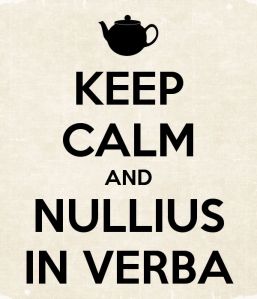
POEM: Nullius in Verba

nulliusinverba1

Said Socrates, “Oh, those poor bastards, for they think they know.

“I may be an ignorant slut, but I know I know not.”

[I paraphrase.]

My point, if I have one, is that “know” is an overused word.

Stinking up the discourse, like a bloated, floating pig turd.

[Remember Jim Carey, in the movie “Liar, Liar”]

“I object, Your Honor”… “Because, it’s devastating to my case.”

It’s a refrain seldom stated, but oft implied.

It works quite well, if you only talk to one side.

Fault us not for we’re wired to be certain.

If the cave wall shadow might be a tiger,

you don’t wait to see whether it’s a mouse.

That said, we’ve evolved these huge honking brains.

Our prefrontal cortexes might withstand the strain–

of asking:

How do I know this?

What if I’m wrong?

Might my mind deceive?

Facts: cherry-picked or  strong?