Taken near Pushkar in November of 2015


In a world free of frontiers, the subconscious mind is the final frontier.
Below are a few books that I found useful. The hyperlinks forward to my review on GoodReads or the book’s GoodReads page.
Also, I’ve included three honorable mention books that I haven’t yet reviewed, but which seem both relevant and intriguing.
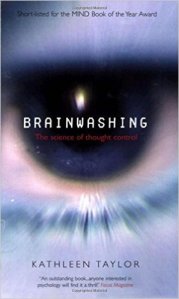
5.) Brainwashing by Kathleen Taylor: What makes some minds more malleable than others and how are minds bent to a given purpose? In learning the answers, one discovers that the bases of our beliefs are often more deep-seated than one might believe.
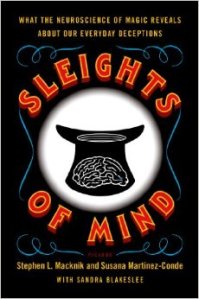
4.) Sleights of Mind by Macknik & Martinez-Conde: Magicians and mentalists are notoriously skilled at exploiting the chinks in the armor of our minds.
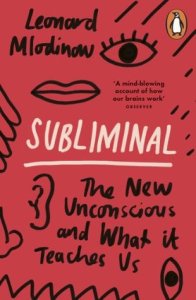
3.) Subliminal by Leonard Mlodinow: Physicist and pop science writer, Leonard Mlodinow, explores the many ways in which our behavior is more influenced from the back of the house than we feel to be the case.
2.) The Tibetan Yogas of Dream and Sleep by Tenzin Wangyal Rinpoche: This is my nod to the fact that the Western scientific community isn’t the only entity that has something useful to say on this subject. Tibetan Buddhists have a long tradition (arguably predating Buddhism and into the Bon-era) of dream yoga (lucid dreaming) and our dreams offer the greatest portal to the subconscious.

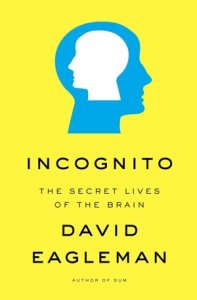
1.) Incognito by David Eagleman: Eagleman tells us that our conscious mind represents the tip of the mental iceberg, and he explores the many ways in which we are subject to the vagaries of what exists below the surface.
Here are a few others.
The Man Who Wasn’t There by Anil Ananthaswamy: I just finished this book. In it, the author investigates whether there really is such a thing as the self by studying a number of diseases and phenomena of the mind that look like negations of self. (e.g. Cotard’s Syndrome in which people insist they are dead, depersonalization disorder in which life seems a dream in a literal rather than poetic sense, out-of-body-experiences in which there is a hallucination that one is outside one’s body, etc.)
The Attention Merchants by Tim Wu: I haven’t read this one yet, but it’s said to be good and is about how our programming is exploited to keep us clicking. If you’ve ever wondered why you can’t seem to just drop social media even when it seems like a phenomenal waste of time–why it exerts such a strong pull–this book delves into what proclivities of the mind have been seized upon.
Reality is Broken by Jane McGonigal: I’m about 1/3rd of the way through this one. It has some overlap with the Wu book. In it, McGonigal asks why games have so much appeal–even to the extent of becoming addictive. As with why we keep clicking, the answer has a lot more to do with the primitive parts of our mind than the high tech subject matter might suggest.
Armored Personnel Carrier
10 tons of angry seaweed green, a weighty sight when
viewed from Dal Lake in a languidly rocking shikara
the APC’s slits, the narrowed eyes of a suspicious lover
the shikara’s school bus yellow contrasts with the drab compound
that the APC guards
an abandoned hotel, confiscated and re-purposed
makeshift sheet metal walls topped with coils of concertina wire
Beirut, bullets swapped for rocks
a ramshackle guard tower of framing timbers and plywood
is painted green and draped with a camo netting
that serves only to create shadows
&
remind the guards they are still in the Army
camouflage that doesn’t blend with a decrepit block hotel
transformed into a hive of paramilitary activity

Shikara on Dal Lake
 The Geography of Bliss: One Grump’s Search for the Happiest Places in the World by Eric Weiner
My rating: 5 of 5 stars
This book combines travel writing with pop science discussion of what makes people happy (or unhappy.) Weiner travels to ten countries in pursuit of happiness, and reflects upon the cultural components of bliss.
Some of the countries, like Switzerland and Iceland, rank among the world’s happiest in international surveys. Some of the countries, such as Qatar and America, have every reason to be happy, but aren’t necessarily as blissful as the rest of the world would expect. Some of them, like India and Thailand, have good reason to be unhappy, and yet they manage to be global exemplars of happiness [at least within certain domains.]
Then there are a few nations that have unique relationships to happiness. Bhutan has a national policy on happiness [plus it’s a Buddhist country, and Buddhism probably offers the most skillful explanation of what it takes to be happy of any world religion.] Moldova provides a counterweight as it’s one of the least happy countries in the world. Weiner visits the Netherlands in part because one of the biggest academic centers studying happiness is located in Rotterdam, but it also offers an opportunity to study whether the country’s unbridled hedonism (drugs and prostitution are legal) correlates to happiness. That leaves Great Britain, a country known for wearing the same happy face as its sad, terrified, and enraged faces.
I’ve been to half of the countries on Weiner’s itinerary, and—of the others—I’ve been to countries that share some—though not all—of the cultural constituents of happiness. (e.g. I haven’t been to Qatar, but I’ve been to the UAE. I haven’t been to Moldova, but I’ve seen somewhat less grim Eastern European states. I haven’t been to Switzerland or Iceland but I’ve been to cold countries in Western Europe. I haven’t been to Bhutan, but I’ve been in areas where Tibetan Buddhism was the dominant cultural feature.) This allowed me to compare my experiences with the author’s, as well as to learn about some of the cultural proclivities that I didn’t understand during my travels. And I did find a lot of common ground with the author, as well as learned a lot.
I found this book to be interesting, readable, and funny. Weiner has a wacky sense of humor that contributes to the light-hearted tone of the book—perfect for the subject. That said, some people may be offended because the author doesn’t pull punches in the effort to build a punchline, and this sometimes comes off as mocking cultures. However, in all cases—even that of Moldova—Weiner does try to show the silver lining within each culture.
The paperback edition I read had no graphics or ancillary matter. There are no citations or referred works (except in text), and the chapters are presented as journalistic essays. The chapters largely stand alone, and so one could read just particular countries of interest. He does refer back to events that happened in earlier chapter or research that related to another country’s cultural proclivities, but not often. The first chapter, on the Netherlands, would be a good one to read first because he describes many of the scientific findings on happiness in that one.
I would recommend this book for anyone interested in what makes some places happier (or sadder) than others.
 Maps and Legends: Reading and Writing Along the Borderlands by Michael Chabon
My rating: 5 of 5 stars
This book consists of 17 essays about reading and writing. As the book’s title–also the title of the second essay–suggests, there’s an analogy drawn between story and a map, but—more importantly– Chabon proposes that the literary domain is a realm with frontiers and hinterlands. The central theme is that there is room for great discoveries if we stray from the center of the map were all is clear and well-defined. Literary fiction is the center. The hinterlands include a range of genres and approaches to story-telling that are often maligned as low-brow—e.g. fan fiction and comic books.
The book could be split into two parts, though the aforementioned theme cuts across all essays. The first 11 essays offer insight into maligned genres and their merits, but the next five shift gears into autobiographical telling of Chabon’s transformation into a writer. (The last essay, not present in some editions, could be seen as an epilogue to the entire work.) I’ll list the essays and give a hint about what each is about:
-“Trickster in a Suit of Lights”: This essay invites us to reconsider the connection between entertainment and literature, and in particular with respect to the modern short story.
-“Maps and Legends”: Here Chabon reflects upon the nature of a map and its analogy to the domain of fiction.
-“Fan Fictions: On Sherlock Holmes”: Fan fiction is maligned, and not entirely without reason. Even when it achieves great popularity, it’s often bad (e.g. “Fifty Shades…”) However, Chabon correctly suggests that we consider fan fiction too narrowly, including only that which reinforces our notions. He offers a great example of a character, Sherlock Holmes, who launched a thousand fan fictions, some of which are masterpieces in their own right.
-“Ragnarok Boy”: Mythology often seems tired and cliché, but there are reasons such stories survive across ages. Chabon explores what it is in Norse mythology that makes it an ongoing font of inspiration for writers.
-“On Daemons & Dust”: For a while, YA was the only genre with rising sales–much to the chagrin of those who felt this might herald the rise of a real world idiocracy. In this essay, Chabon describes what it is about Philip Pullman’s “His Dark Materials” series of fantasy books that pulls readers in—including the appeal of dark elements in stories.
-“Kids Stuff”: In this essay, Chabon considers the comic book and its evolution from kids’ stuff to a vast domain meant to appeal to a broad readership.
-“The Killer Hook”: This essay continues Chabon’s look at comic books, but through a specific example: “American Flagg!” a dystopian sci-fi comic book. Chabon proposes that “American Flagg!” spawned a new approach to comic book art and tone.
-“Dark Adventure”: This is about Cormac McCarthy’s “The Road.” Some topics are revisited, such as the appeal of dark and dystopian content. [For those unfamiliar, “The Road” is the story of a father and son wandering through a post-apocalyptic wasteland in search of some sort of stable community. McCarthy is the master of sparse prose, eschewing dialogue tags and maintaining a minimalist approach to his craft.
-“The Other James”: Here Chabon discusses the ghost story, using M.R. James’ story “Oh, Whistle, and I’ll Come to You, My Lad” as an exemplar.
-“The Landsman of the Lost”: Chabon discusses the comic strip work of Ben Katchor.
-“Thoughts on the Death of Will Eisner”: Eisner was a popular cartoonist, associated with such comic books as, “The Spirit.”
-“My Back Pages”: Here the book ventures into autobiographical territory as Chabon talks about his first dalliances with writing a novel.
-“Diving into the Wreck”: This continues Chabon’s telling of how he came to be a writer, and his early troubles in structuring a novel.
-“The Recipe for Life”: Here Chabon tells us about his introduction to Golems, a concept that would play an important role in one of his most influential works—an in the rest of the book. You’ll note the connection between fantastical devices and the telling of story that carries over from the first part.
-“Imaginary Homelands”: Chabon describes the role that is played by culture in forming a writer’s experience—both the culture one is living in and the cultural heritage that we each carry with us wherever we may roam.
-“Golems I Have Known”: This is one of the longer pieces and it presents the climax of Chabon’s tale of his transformation into a novelist. Golems as fictitious creatures built to facilitate certain truths are a central feature around which Chabon’s story is told.
-“Secret Skin”: [Note: This essay didn’t appear in the initial version of the book, and so your edition might not have it.] This essay invites the reader to reconsider the role that costumes and secret identities play for superheroes and how that need resonates with readers. In the process, this last essay sums up the reason why fantastical elements are so powerful in fiction.
There are only few graphics in the book, i.e. comic panels. Other than that there’s not much by way of ancillary matter, though there are recommended readings (oddly) interspersed within the index—rather than being a separate section.
I’d recommend this book for readers and writers. The essays are well-crafted and thought-provoking.
The laissez-faire and easy-going yoga community has spawned some phenomenally ridiculous mergers. I have “yoga” as a term on Google News, and almost every week I get fed a new example. I’m not saying every new approach to yoga is bad, but there’s one disturbing trend–i.e. the distraction yoga.
In the title, I refer to “hyphenated yogas,” but what I’m really ranting about is “distraction yogas.” A distraction yoga is one in which an element is brought into the practice so that one doesn’t have to keep one’s mind on one’s breath, alignment, and / or mental state. (Because who wants to think about that shit when one can be thinking “Wow, that kitten sure is cute.” or–believe it or not–“This beer has hoppy undertones.”)
Now before I get accused of hating puppies or beer, let me point out that nothing could be further from the truth. What I’m ranting against is the notion that you can marry any two good things and make a great thing. If you don’t believe me, please allow me to dip my nachos in your banana split. See, there are plenty of things that are awesome independently that make abominations when forced together.
I’ll include links as I go, lest you think I made this stuff up for hilarity’s sake.
5.) Beer Yoga: This is one of the most recent and intriguing distraction yogas. I’m not saying that one needs to follow a strict Vedic approach to life to practice yoga, but–come on–could you stop drinking for a couple hours to pretend your body is a temple (or at least that it’s not sitting in a trailer park with the windows busted out.) Unless “calf slaughter-yoga” catches on, it’s hard to imagine a less yoga-like practice than consuming intoxicants during the practice of yoga. By the way, there’s also a marijuana yoga, but I’ll lump these together as intoxicant yogas.

4.) Goat Yoga: This is one of many “animal yogas.” Like the others, the point is to have cute creatures around. How it’s supposed to help one’s yoga, I can’t fathom. Actually, I can fathom the suggested logic, probably something to do with calming and engendering feelings of compassion and well-being. But, ultimately it’s distraction by cuteness. Note: you can also do yoga with cats, dogs, horses, and probably river otters.

3.) Karaoke Yoga: Talk about distraction–nothing better than pounding music and reading a prompter to keep one’s mind off that ache in one’s hamstring.

2.) Rave Yoga / Club Yoga: This might be a cheat because it’s similar to the previous one on the list, and I’m trying to lump these together so as to not be too repetitive. However, it’s not exactly the same, and is the perfect example of a distraction yoga. (There’s also Harmonica yoga and other musical yogas, but I won’t double-dip anymore.)

1.) Tantrum Yoga: It wasn’t easy to determine whether I’d include this one or not. On the one hand, it’s not a distraction yoga in the sense that the others are. On the other hand, it takes the award for being least yoga like on the grounds that it’s not about dispassionately witnessing one’s emotional state but rather feeding one’s negative emotions. Note that I don’t group laughter yoga into the same class. I’m not sure whether laughter yoga is beneficial (or to what degree it’s a yoga), but I know that many people benefit from it because it bolsters positive emotional states.

Now, one may have noticed that there are many seemingly strange (hyphenated) yogas that I haven’t mentioned. I haven’t said a thing about surf board-yoga, stripper pole-yoga, or acro-yoga–and I specifically excluded Laughter Yoga from the wrath of my rant. That’s because this isn’t a rant about people being innovative or non-traditional, it’s about people missing the point of what yoga is supposed to be (i.e. a means to quiet the mind.) I don’t know whether I can see myself doing yoga on a surf board or a stripper pole, but I’m certain that one has to give it one’s full attention–it’s not about finding a distraction to make yoga more palatable to hipsters.
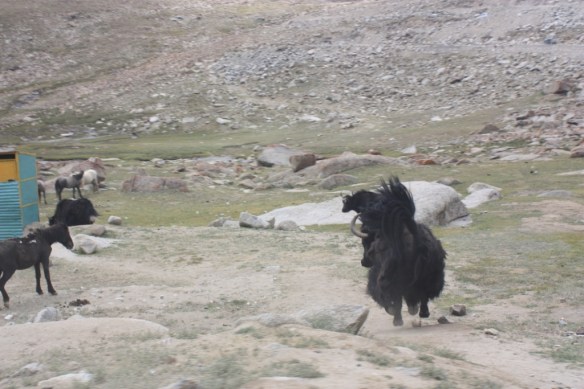
Taken in the Summer of 2016 on the road to Pangong Tso
thick-walled tomb
a slapping hand, numb and beet red
all sound absorbed
nothing passes
but a tremor
knocking loose a grain of sand
one sand grain for all the frantic panic
for all the screaming, kicking, and pounding
a grain of sand no one will miss
it’ll hit the earth without a shock wave
it’ll tumble into a pile of its kind, becoming indistinguishable
it’ll happen in the space between heartbeats
all that frenetic energy eaten by stone
the sum of a human life force in its final throes
muted by a tomb