5 Seated Meditation Postures & How to Choose the One Right for You

Sukhasana (Easy Pose)

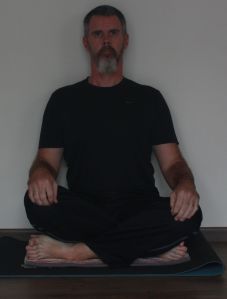
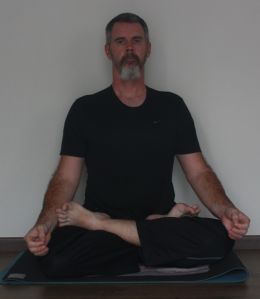
5.) Sukhasana (Easy Pose): One simply folds the legs so that each leg rests on top of the opposite foot. This is a popular crossed legged seated posture. For reasons to be explained, it’s usually not considered a meditative posture.

Pros: As the name suggests, it’s an easy seat for most people to assume. Because the leg is resting on the opposite foot, the knees don’t have to (re: can’t) lay flat on the floor, and so this is pose is more comfortable for practitioners with tight glutes or who otherwise can’t open their hips — for short time periods at least.

Cons: The downside of not putting the knees down, is that the posture is not nearly so stable as the others that will be mentioned. Instead of a big triangle running from one’s sit-bones out to the knees and between each knee, one is resting on a small triangle with the gap between the sit-bones as its base. Furthermore, there will be a pronounced tendency to slump in the back in this pose, and this makes Sukhasana not ideal for sitting more than a few minutes.

Notes: As I mentioned, this isn’t a good meditative posture because it’s unstable and prone to back pain over relatively short periods. I mention it here because many beginners can only manage to do this pose. If that is the case for you, you will probably want to look at using props to achieve a comfortable position (e.g. lifting the hips), if you intend to practice more than five minutes or so.


Swastikasana (Auspicious Pose)

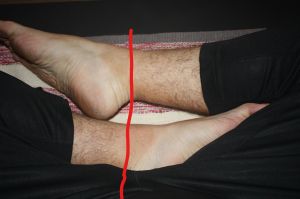
4.) Swastikasana (Auspicious Pose): Note: this pose and the next (Siddhasana – Accomplished Pose) are quite similar, and it’s hard to see the difference in photos, but I’ve added a couple pictures and some text description to try to clarify the difference. Bend the left knee and place the left sole against the inside of the right thigh. One will then bend the right leg and, squeezing the left foot into the space at the crook of the right leg, tuck the right foot into the space between the left thigh and calf muscle. Tucking the feet in is important to making the posture comfortable — particularly the bottom one, which can be compressed if not positioned properly.

The difference between this pose and Siddhasana is simply that the heels aren’t aligned on one’s center-line, but rather the left heel will be to the right side of one’s center-line and the right heel will be to the left. If one’ imagines the line below were straight and on the body’s center-line, one can see how Swastikasana has the heels / ankles offset.

Pros: The posture is much more stable than Sukhasana and, while not quite as wide a the base as Siddhasana, it avoids Siddhasana‘s disruption of circulation caused by the bottom heel being pressed against the perineum / genitals (depending upon gender.) That makes Swastikasana‘s strength its position on the middle ground. It’s stable enough for meditation but doesn’t require as much flexibility in externally rotating the thighs as does Padmasana (Lotus Pose.)

Cons: Some people (including the author) have troubles squeezing the feet into the gaps between thigh and calf — i.e. if one has thick legs, it can be problematic. Both this pose and Siddhasana are contra-indicated for those with sciatica or sacral infection (Sacroiliitis.) Some traditionalists would say that the lack of stimulation to the moola bandha / perineum is a con as well.

Notes: Both this posture and Siddhasana can be practiced with either leg folded first, and many teachers recommend alternating for those students who spend a lot of time in meditative poses, because the postures aren’t symmetrical and muscular asymmetries may develop if one always does it on the same side.


Siddhasana (Accomplished Pose)

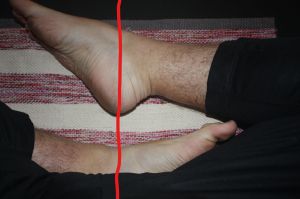
3.) Siddhasana (Accomplished Pose): As mentioned, the gist of this pose is the same as Swastikasana, except that the bottom heel will be aligned on one’s center-line, pressing into the perineum lightly, and the heel of the top foot will be in alignment with the bottom foot. (Note: Males will probably have to do some genital re-positioning to make this position comfortable.)

The picture below shows how the heels are aligned on the body’s center-line.

Pros:  While not without controversy, many teachers propose that having the heel pressing into one’s body has advantages in stimulating the moola bandha – including helping the practitioner be chaste.

Cons: The aforementioned controversy involves potential damage done by long-term disruption of blood flow in the area. It should be pointed out that there’s no reason to think that short term pressing of the heel into the groin — as is done in janu shirshasana (head-to-knee pose) — is problematic. However, meditation may involve much longer disruption in blood flow. So while some opponents of Siddhasana would agree that it helps attain chastity, they might argue that potentially causing impotence is not an ideal way to achieve that control over one’s sexuality — if control is even needed in the first place. 

Note: When practiced by women, this posture is sometimes referred to as Siddha Yoni Asana, which just reflects that contact point with the heel is a bit different owing to differences in anatomy in the region.


Ardha Padmasana (Half Lotus Pose)

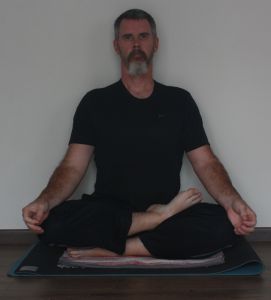
2.) Ardha Padmasana (Half Lotus Pose): The left foot will be folded in so that the left sole rests on the right inner thigh, much as in Swastikasana, and the right foot will be folded up into one’s left hip crease with the left heel as close to the navel as possible. One may need a prop (e.g. block or rolled up towel) under one’s elevated knee — especially for long term sitting. As mentioned with regards the previous two poses, this pose can be practiced on either side, giving one the opportunity to work out the asymmetries.

Pros: Half lotus offers some of Padmasana‘s (Lotus Pose) advantage in terms of stability in the lower back, without having to have quite as much flexibility in external rotation of the thigh. As a person with thick legs, but flexible hips, I find ardha padmasana and padmasana tend to be more comfortable than the preceding poses for me, personally.

Cons: The asymmetry of this pose is considerable, and failure to balance it out will be problematic. Also, if one doesn’t have sufficient hip flexibility, one may end up putting a dangerous torque onto the knee joint.


Padmasana (Lotus Pose)

1.) Padmasana (Lotus Pose): One will take the left leg and fold it so as to put the left foot into the crease of one’s right hip with the left heel as close to the navel as possible. One will then take the right foot and folding it over the top of the left so that it comes to rest at one’s left hip crease. One may want to (or need to) press both knees inward to get the legs into a stable position.

Pros: This posture is not only very stable; the lower back achieves a tension that allows one to keep one’s back upright for much longer periods of time without the back starting to slump — leading to the back pain inherent in that slump.

Cons: This takes: a.) a fairly high level of hip flexibility; b.) strong knees that will not become damaged by the torque of getting into or maintaining the pose; c.) the ability to live with discomfort, because it will be somewhat uncomfortable at first even if one has flexible hips and strong knees.

Note: For meditations of less than 30 – 40 minutes, I find padmasana to be the most comfortable and stable pose. However — at least with my thick legs — disruption of circulation of both blood and lymph becomes problematic for longer practices, and in longer meditations I tend to use poses with hips elevated and legs loosely crossed.


This is by no means a comprehensive list of seated poses used in meditation. Notably, there is the posture vajrasana (thunderbolt pose), in which one is seated back on one’s heels with the knees pointing in front of one. Since this pose puts the entire body weight onto the lower legs, circulation disruption can be substantial over long periods. Virasana is similar, but one sits down between the feet, which is challenging for the knees. While both of these postures may be hard to hold in their classic form for extended periods of meditation, variations using props — e.g. a bolster — may be the perfect solution for students who have trouble with all of the poses listed above.

5 Notes on Bending Over Backwards to be a Good Yogi

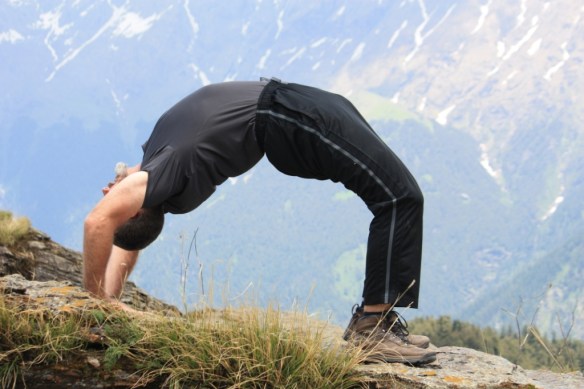
Chakrasana (Wheel Pose) in Himachal Pradesh

There are a few challenges that I observe regularly regarding back bends. Back bending poses can be difficult for a number of reasons, running from spinal processes (the bony projections on the back of a vertebrae) that simply won’t allow much range of motion to anxiety that may prevent practitioners who have the range of motion from performing these poses because of fear of falls or injury.

5.) Range of motion in the shoulders in Wheel pose (Chakrasana): The most frequent difficulty I see with wheel pose is an inability to get the hands under the shoulders when one lifts up into the pose. In the picture above, notice how one can see the face (or at least the nose and chin) forward of the arms. Often the head is well inside the arms, and this means that one is trying to hold oneself up with an unfavorable alignment. Physics isn’t on your side. Parents who’ve tried to hold a baby with a poopy diaper at arm’s length will know how heavy an otherwise light child can be when cantilevered out from the shoulders. Same idea with trying to do wheel pose with hands that aren’t under the shoulders.


Bhujangasana (Cobra Pose); note: navel on floor and arms bent

Urdhva Mukha Svanasana (Up Dog); Note: weight is all on tops of feet and palms, i.e. thighs / knees are off the ground

4.) Mixing up Cobra pose and Up Dog: This is probably the most common back bending problem that I see. Practitioners straighten out arms in Cobra pose (with thighs resting on the mat.) Why is this a problem? Because, unless the individual has the spine of a Beijing acrobat, the practitioner will have a huge kink in his or her back and one spinal process will be ramming into the spine below it. One needs to lengthen the spine as one stretches it in order to avoid kinks (all the bending coming at one point with a great deal of pressure at that spot.) One can straighten the arms in up-dog because the spine is elongating downward by virtue of the legs hanging rather than resting.

A major cause of this problem seems to be that individuals with hyper-kyphosis (excessive rounding of the chest region of the spine) have great difficulty lifting up their chest because they are working against that excessive rounding. (And increasing numbers of people have this condition.)


“Ears between the arms,” the constant refrain.

3.) Excessive neck bending: If an individual doesn’t have a large range of motion in her spine or is anxious about back bends, many times she will tilt her head back to create the impression of back bending. This can cause undue strain on the neck, not to mention delusions of spinal flexibility.


Vrischikasana (Scorpion pose)

2.) Don’t forget the psychology: I must admit, I’ve only ever taught scorpion pose in kids’ classes, but I’ve taught it in quite a few such classes. Kids love it as much as adults find it terrifying. As I’ve mentioned several times, some practitioner’s problem with back bends is rooted more in anxiety than anatomy. What I’ve come to realize is that it’s important to treat both of those causes with respect and compassion.

This may be an extension of my realization that it’s important to treat with compassion those whose weakness is strength, just as does one whose weakness is weakness. “Weakness is strength?” That doesn’t seem to make any sense. But the first “weakness” I’m referring to is yogic weakness — i.e. having a turbulent mind. Yogic weakness can result from weakness in terms of being frail and fearful of injury, but it can also result from delusions of grandeur and other mental handicaps that result from being strong.


Bactrian Camel in Nubra Valley

1.) Go to the Himalayas, and try a camel: The options abound.

Ustrasana (Camel pose)

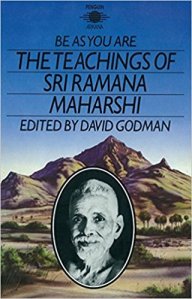
BOOK REVIEW: Be As You Are ed. by David Godman

Be As You Are: The Teachings of Sri Ramana MaharshiBe As You Are: The Teachings of Sri Ramana Maharshi by Ramana Maharshi
My rating: 4 of 5 stars

Amazon page


In the early days of yoga, before there was Power Yoga or Yin Yoga — or even Hatha Yoga or Raja Yoga, there were three approaches to yoga. Bhakti yoga was devotional yoga, the yoga of the believers who pursued the path through worship. Karma yoga was the yoga of action: practiced by doing selfless deeds. Jnana yoga, often said to the hardest, was the path of knowledge, and it involved intense study and – in particular – introspective study of the jnani’s own mind. Sri Ramana Maharshi was one of the most well-known Jnana yogis of modern times (he lived from 1879 to 1950.)

This book presents Sri Ramana’s teachings in a question and answer format. The editor, David Godman, begins each chapter with an overview of Ramana’s views on the subject at hand, and he then launches into the Q&A exchange that makes up most of each chapter. The preludes are beneficial not only because they set up the topic, but also because they help separate Ramana’s core beliefs from the way he occasionally explained matters to non-jnani’s or those who weren’t ready to grasp what he believed was the fundamental teaching. (There’s a fair amount of, “Until you realize the self, X is true, but after you achieve self-realization Y will be true.)

Sri Ramana’s central teaching is that the jnani must actively inquire about the nature of the true self (a practice called atma-vichara, or self-inquiry.) As such, the book is organized as a guide to building a practice of self-inquiry.

The book’s 21 chapters are divided among six parts. The first part investigates the self as Sri Ramana refers to it. This isn’t the individual self that one is normally referring to in common speech. Part II is entitled “Inquiry and Surrender” and three out of the four chapters, herein, discuss the process of self-inquiry. Three chapters may sound like a lot, but this practice really is the core of jnana yoga. These chapters not only explain how self-inquiry is done and what it’s supposed to achieve, they also contrast the practice with others that bear a resemblance to atma-vichara, such as reciting “Who am I?” as a mantra, as well as, neti-neti — an exercise in negation in which one considers all the things that aren’t the self (e.g. “I am not my body.” “I am not this thought,” etc.)

Part III is about Gurus and transmission of teachings. It takes on such questions as: is a Guru necessary, and what constitutes a Guru (i.e. must it be a living human? Can it be a book?) The second chapter in this part is about sat-sang, which may be literally translated as “sitting with the guru,” but refers to a kind of transference that flows from being together.

Part IV is on meditation and yoga. Sri Ramana differentiates self-inquiry from meditation, though superficially they seem to be similar activities. He discusses dharana (concentration) and mantras in these chapters as well. One inclusion that may seem unrelated to the general theme is chapter 12, which is about the four-stage model of life called the asramas (student, householder, hermit, ascetic.) The chapter on yoga is about the eight limbs of yoga described by Patanjali, and their relevance to the practice of Jnana yogi. It should be noted that Ramana downplays the importance of these practices to the jnana yogi (a.k.a. Jnani) with the exception of pranayama (breathing exercises.)

Part V discusses samadhi, siddhi (supernormal psychic powers that some yogis believe can be achieved), and other challenges and phenomena that may be experienced during one’s practice of self-inquiry. While superpowers sound cool, Sri Ramana (as well as Patanjali) warned against he pursuit of these abilities as they become distractions from obtaining self-realization.

That last five chapters are grouped under the title of “Theory.” These chapters deal in the big “meaning of life” kind of philosophical questions. Much of these chapters consist of Ramana telling the interviewer to stop over-intellectualizing about obscure philosophical matters and start asking oneself who is asking the question (in other words, get back to self-inquiry and forget about abstract navel-gazing.) At any rate, the questions include: was the universe created, and – if so – how? is reincarnation real? what is the nature of god? is karma real? is free will real? etc. They are fascinating questions, and Ramana offers a few intriguing ideas, but mostly discounts the value of philosophizing.

There are no graphics in this book, but there is a glossary, notes, and a bibliography.

I found this book to be thought-provoking. At times it can be a bit repetitive. The key point that Ramana sought to get across is (in theory, not practice) straightforward. At times it seems like the questioner is badgering the witness because he doesn’t like the answer, such as when Godman wants Sri Ramana to elaborate on the nature of suffering and the need for compassionate acts. Ramana keeps telling Godman to just go back to self-inquiry and all will take care of itself. That said, Sri Ramana offers some fascinating thoughts, and generates beautiful food-for-thought.

I’d recommend this book for anyone who wants to know more about jnana yoga or to get a different take on the philosophy of yoga in general.

View all my reviews

5 Books About the Mental Side of Yoga


5.) Be As You Are: The Teachings of Sri Ramana Maharshi: This book, which is presented in Q&A format, explores Sri Ramana’s approach to Jñāna yoga, and explains atma-vichara, the exercise of self-enquiry that Ramana proposed was the key to self-realization.


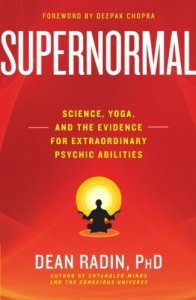
4.) Supernormal by Dean Radin: Okay, this is an unconventional choice for the list but bear with me. (I mostly included it because I like to have an under-the-radar entry in these lists, and this seems like one that could have been missed readers of works on yoga.) Radin is a paranormal researcher who, in this case, has investigated the topic of siddhi, which are the controversial powers that Patanjali discusses in the third section of The Yoga Sutras, but which many deny are real.


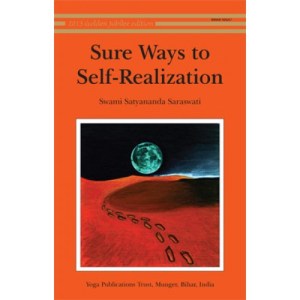
3.) Sure Ways to Self-Realization by Swami Satyananda Saraswati: This is the Bihar School of Yoga guide to meditation, and it covers both yogic meditation methods and those from other disciplines (e.g. Buddhism, Taoism, Western / scientific [e.g. biofeedback], etc.) By “meditation,” here I mean more than dhyana. This book uses the word in a broader and more colloquial sense that includes some practices that are normally considered pratyahara (withdrawal of senses) or dharana (concentration.)


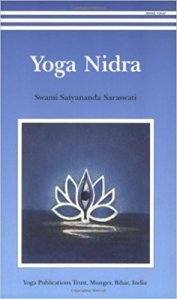
2.) Yoga Nidra by Swami Satyananda Saraswati:  Yoga Nidra (yogic sleep) is a sustained hypnogogic state — i.e. the state of mind on the edge between wakefulness and falling into sleep. It is used both as an intense relaxation exercise as well as to access the subconscious to plant seeds therein.


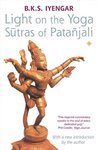
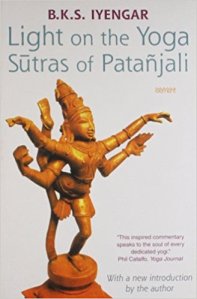
1.) Light on the Yoga Sutras of Patanjali: (Sutras by Patanjali with commentary by B.K.S. Iyengar): This isn’t — strictly speaking — only about the mental side of yoga, but, in the Sutras, Patanjali makes clear that yoga is a tool to advance mental calm and clarity. There are many translations and commentaries available. Commentaries are useful because the 196 sutras are extremely sparse. Iyengar’s book is probably one of the most approachable translation / commentaries for a modern reader.

5 Non-Yoga Video Channels that Are Great Resources for Yoga Teachers

As I’ve been expanding my pranayama (yogic breathing exercises) practice, I’ve found myself searching beyond traditional yogic sources of information at times. It turns out that there are several disciplines from which valuable tidbits of information about breath can be gleaned, including: martial arts, freediving, and physiology.

As I was on a freediving site (shown below, #5) learning some lung capacity expanding exercises, it occurred to me that it might be beneficial to do a post of some of the sources of information that I’ve found useful that wouldn’t necessarily be stumbled upon by those looking for information on yoga.

5.) Adam Freediver: This enthusiastic and whimsical Aussie freediving champion offers fascinating tips on respiration — many of which are of use out of the water as well as in.

4.) Physical Therapy Video: Bob and Brad, Physical Therapists, offer advice and exercises that may be helpful for students with hyperkyphosis (excessive back rounding), duck foot (excessive external rotation of legs), or a number of other common postural / bodily challenges.

3.) SOLPM (The Science of Learning Power Move): This site offers progressions and capacity building exercises that will help one with challenging exercises, e.g. handstands, that most people can’t do without a gradual building up. As with the Adam Freediver channel, not all of the videos are relevant, but a number of them are.

2.) Crash Course:: This witty educational channel presents excellent graphics and a light-hearted and watchable commentary by Hank Green (one of the Vlog Brothers.) The Anatomy and Physiology Series is particularly relevant, but there are select videos in other series — such as Mythology — that one may find illuminating.

1.) TED Talks: Unless you’ve been living under a rock, you’re probably familiar with TED, but you may not be aware of the breadth of topics they’ve covered, including meditation, biomechanics, yogic philosophy, breathing, and more.

Honorable Mentions:
Calisthenic Movement: Like SOLPM, this channel can help build up some of the challenging maneuvers, such as handstands, but you may also find out something useful about more rudimentary exercises, such as planks.

ASAP Science: This science channel that uses line-drawn graphics has some interesting and informative videos on topics such as meditation, hypnosis, and nutrition.

5 Fun Facts about Breathing

Annapurna, Nepal; Taken in May of 2018

5.) The Death Zone may be a myth, or — probably more accurately — everyone may have their own personal death zone:

It’s widely stated as fact that above 8,000 meters (26,000 feet) every human being is dying, no human can acclimatize, and the race is on to get back below that altitude before the body is damaged beyond its ability to repair itself. This hard-limit is widely publicized in reputable, mainstream publications such as National Geographic. There’s a certain logic to such a limit. In response to the diminished pressure of oxygen, the body produces more hemoglobin (that’s acclimatization), but the bloodstream can only take up so much hemoglobin.

Mark Horrell, in his mountaineering blog, challenges the idea of a one-size-fits-all hard limit, and provides anecdotal examples that contradict the 8,000 meter cap.

4.) Sticking one’s face in water allows one to hold one’s breath longer:

Sensory cells in the face and nostrils sense wetness and this sensation triggers a slowed heartbeat (bradycardia) and constriction of blood vessels (vasoconstriction) so as to reduce blood flow to the extremities.

A more detailed explanation can be read here.

3.) Mouth-to-mouth resuscitation works because our lungs only capture about 20% of the oxygen in each inhalation:

If we had super-efficient lungs, our exhalations wouldn’t contain enough oxygen to sustain the patient receiving cardiopulmonary resuscitation (CPR.)

This and many other fascinating respiratory facts can be found on the Crash Course videos on the subject.

2.) In two weeks time the breath you’re exhaling right now will have spread out around the globe.

Sam Kean’s book, Caesar’s Last Breath, discusses this subject in great depth. In fact, the title is a reference to the fact that in each breath it’s likely that one inhales a molecule of Caesar’s dying breath.

1.) When you lose weight, most of it (84%) is lost in exhaled carbon-dioxide:

This may not be a question that ever occurred to you, but I bet you find it fascinating once it’s brought to your attention. It’s not like when you cut 5 kg, there’s a fat pile sitting somewhere. More about this subject can be learned here.

Nadi Shodhana; Alternate Nostril Breathing

5 Challenging [Int.] Standing Balances

Vīrabhadrāsana III (Warrior III)

5.) Vīrabhadrāsana III (Warrior III):

What makes it challenging?

Substantial core strength is needed to obtain the capital “T” position. Straightening the lifted leg and getting it in line with the torso is the first challenge. Also, there is a tendency for the hip of the lifted leg to angle upward into an position in between Warrior III and Half Moon Pose (see below.) The front of the pelvis should be squared toward the floor. The drishti (focal point) at the extended hands also creates more of a challenge than looking straight down at the floor.


Ardha Chandrāsana (Half Moon Pose)

4.) Ardha Chandrāsana (Half Moon Pose):

What makes it challenging?

Largely, the same challenges that make Warrior III difficult. However, “stacking the hips,” i.e. getting the front of the pelvis squared to the wall (not the floor or at a downward angle) requires a high degree of hip flexibility. Hip openers may be necessary to be able to stack the hips without the torque of lifting the top hip up throwing one off balance.


Parivrtta Ardha Chandrāsana (Twisted Half Moon Pose)

3.) Parivrtta Ardha Chandrāsana (Twisted Half Moon Pose):

What makes it challenging?

Again, this posture shares challenges with Warrior III and Half Moon. While it’s less difficult than Half Moon in that it doesn’t require hip stacking, it makes up for it in that twisting motions tend to make staying on balance difficult. This is because one has to remain stable on the standing foot as the torso rotates and if one can’t stack one’s shoulders the weight distribution may be hard to keep balanced. Also, achieving the drishti (looking at the upper hand) without breaking balance is no easy feat.


Ardha Baddha Padmōttānāsana (Bound Half Lotus Pose) [Standing]

Ardha Baddha Padmōttānāsana (Bound Half Lotus Pose) [Folded]

2.) Ardha Baddha Padmōttānāsana (Bound Half Lotus Pose):

What makes it challenging?

The knees should be next to each other, but the knee of the folded leg wants to be forward and to the outside. Also, one must get the heel aligned on one’s centerline (below the navel) so that when one folds the foot is in a position where it can compress into the soft, fleshy tissue rather than being wedged between bones.


Ūrdhva Prasārita Ekapādasana (Standing Split)

1.) Ūrdhva Prasārita Ekapādasana (Standing Split):

What makes it challenging?

Straightening the lifted leg without throwing oneself off balance is the big challenge. It’s possible to put both hands around the support leg ankle, to make it even more challenging, but one must have an exit strategy in case one loses balance.

To What Degree Can Yoga Be Whatever One Needs It to Be?

Chennakesava Temple, Somanathapura


To what degree can yoga practice be whatever one needs it to be?


If one is expecting the definitive answer to this question, one won’t find it here. While I’ll share my views, I’d love to get some comments, because shared wisdom may help myself and others to hone in on a more coherent answer.


There is a continuum of views on this question.  On one hand, there are people who have very rigid notions of what a yoga practice can (or should) consist of. “Everyday, one should do precisely x repetitions of Surya Namaskara (Sun Salutations), y repetitions of nadi shodhana (alternate nostril breathing), z repetitions …, and every full moon one should do…, and every six months one should do… shatkarma, etc.” In some circles, this rigidity may extend to what deity one worships, the nature of one’s personal philosophy, what one should eat, how one should dress, and how vigorous one’s practice should or shouldn’t be.


Near the rigid end of the spectrum are those who rail against drawing secular and / or culturally-neutral elements from yoga, and / or engaging in a revision of yogic culture. [Cultural revision, in this case, referring to a shift from the traditional culture which is Indo-centric to a more Westernized approach (e.g. this may be seen in different modes of teaching and / or in interaction between students and teachers.) I’m afraid this may remain unclear to anyone who hasn’t spent time in both: a. a traditional yoga ashram / shala; and b. a Western-style yoga studio. To those who have, it’s likely apparent that these two places each have a culture that may share elements (especially superficial one’s like symbology, etc.), but which aren’t identical.] The recent controversy generated by a paper by a Michigan State University professor, Shreena Gandhi, who suggested that Americans practicing yoga were engaging in a kind of white supremacy is a case in point.


I find myself rejecting the aforementioned extreme for a number of reasons. First, if yoga practice should be one thing, how come there are so many different “one things” that it should be? If one set was objectively superior, one would expect it to come to dominate, but we don’t see that. Secondly, it fails to acknowledge the wide variety of varied needs. There can even be logical inconsistencies embedded in these rigidities. For example, if one says that a practitioner should do 15 rounds of Surya Namaskara per day, and, also, that they shouldn’t increase the rapidity of breathing by much, then one is limiting the base of students. Some students simply can’t do 15 rounds in a session, while for others it’s an inadequate warm-up because it doesn’t tax their system in the slightest. Thirdly, while I’m not a Sanskrit scholar, from what I’ve been taught, the early writings don’t suggest the kind of doctrinaire approaches to yoga one sees today. One can see in Patanjali’s Yoga Sutras a sparse and vague set of dictums that aren’t consistent with the idea that one needs to accept and embrace any and all of the trappings that have come along in the past few thousand years.


Now it might seem that I’m at the footloose and fancy free end of the spectrum. But  I’m afraid that I cringe too hard every time I see a story about “ice cream yoga.” (Or fill in the quote marks with whatever the mashup-du-jour consisting of an activity that some individual finds nifty, and, therefore, assumes will pair excellently with yoga.) At the far end of the spectrum are people who think one can engage in any activity (or set of activities) and label it yoga, and it is yoga. I don’t think I can quite get on that bandwagon either. While I don’t offer my support to the people who have very fixed and limited views of what yoga is, I can empathize with them at times. These include: 1. the person who has the Om symbol emblazoned over 80% of their wardrobe [or — more astoundingly — has it tattooed on his body] but who thinks it translates to “namaste,” “yoga,” or to any other mistranslation. 2. the practitioner who believes the ultimate question of the universe is which print of Lululemon captures her spirit animal, or, 3. the individual who thinks the sports bra and yoga pants she wears for practice seems like reasonable attire in which to visit a Hindu (or virtually  any other) temple.

“Om,” not “namaste” etc,


This leaves me somewhere in the middle on the issue. The single question I would ask to determine whether something is a yoga practice or not, is:

Is one working towards quelling the turbulence in one’s mind by dispassionately observing one’s body, breath, and / or mind?


This probably seems like an insane criteria because if one is doing the Gerbil Yoga version of setu bandasana (back bridge while devoting one’s attention to petting a rodent) then one isn’t actually doing yoga. However, if one is sitting at a bus stop watching the air go in and out of one’s nose and adjusting the pace of said flow, then one is doing yoga. Crazy, right? A back bridge is much more yoga-esque than sitting at a bus stop apparently doing nothing. Don’t even get me started on how one could be in a yoga studio doing a perfectly traditional yogasana like ardha chandrasana while your mind is in an internal monologue — i.e.  rant — about how miserable one is in the and how one can’t wait to hit the bar after class, and you’re not really doing yoga. On the other hand, one could be being screamed at by one’s boss in the office while watching the emotional turmoil bubble up, and one would be doing yoga. Crazy as it may sound, it’s the best I’ve been able to figure.


Let me know where you fall on the question.

BOOK REVIEW: Perfect Breathing by Al Lee and Don Campbell

Perfect Breathing: Transform Your Life One Breath at a TimePerfect Breathing: Transform Your Life One Breath at a Time by Al Lee
My rating: 4 of 5 stars

Amazon page


It’s not an exaggeration to say that there is no set of yogic practices with a greater power to transform one’s life than breathing exercises (pranayama.) With this in mind, I’m always on the look out for new sources of insight into breathing – be it from free-divers, Buddhists, sports scientists, yogis, martial artists, or else-wise. This book provides an overview from a diverse set of experts with descriptions of a number of different breathing practices (e.g. Taoist qi gong, yogic pranayama, a practice for runners, etc.,) but it takes as its central tenet a six-second breath that it recommends as the titular “perfect breath.”

Breathing practices are often underestimated. People, after all, figure that they’ve been breathing every day of their lives, so who can teach them anything on the subject. The idea of reading a book on breathing is right up there with watching the paint dry or the grass grow for excitement. Unfortunately, in parts – many densely pack up front – the authors do too little to dissuade readers of this belief. In early chapters and sprinkled throughout, the book is rife with truisms and banal comments that will leave the rankest neophyte thinking they aren’t going to learn anything of value. That said, I’m glad I kept with it, because the authors convey some powerful insights by telling the stories of people from various walks of life who’ve achieved great things by improving their breath.

The book is organized around a central structure of breathing as a tool for improvement of body, mind, emotion, and spirit. This is sound approach to covering the topic, and the discussion of breath as a means to emotional control is particularly beneficial and welcome. It could be argued that the coverage of the topic of spirituality could have been jettisoned without much loss. The authors talked around the subject in away that was vague and insubstantial. To be fair, they may have been trying to avoid running afoul of individuals who were either secular / scientific (non-spiritual) or who had strong sectarian beliefs on spiritual matters.

The book has seven parts. Part I consists of two chapters that offer an introduction into the topic. These could have been pared down without substantial loss of value. Part II (Ch. 3 – 8) is entitled “Your Perfect Breath” and it discusses developing awareness of breath, body, emotion, spirit, and introduces the fundamentals of how one should breath the “perfect breath.” Part III (Ch. 9 – 12) explores the role that breathing practices can have on improving health outcomes. It’s well established that the body puts healing / rebuilding on hold under high stress, when the sympathetic nervous system is engaged. Breathing practices can help trip parasympathetic (rest and digest) activity. Part IV (Ch. 13 – 15) is of particular interest to athletes and those who want to perform better at some physical or mental activity. In addition to discussing both physical and mental performance, the authors devote a chapter to what is sometimes called Flow (Csikszentmihaly) or The Zone, and how breath can play into quieting the mind to facilitate said state. Part V (Ch. 16 – 19) is about breathing as a means to take control of one’s emotional life. People in the throes of emotional turmoil are unlikely to notice how that turmoil influences their breath, but it has a major impact — and it’s a two-way street, i.e. one can help mitigate excessive emotional response through breath. Part VI (Ch. 20 – 21) is devoted to spirituality and the nexus of breath and prayer or meditation. The final part (Ch. 22) explores the idea of the final breath. I thought this was a valuable discussion, given the tremendous anxiety of coming to one’s last breath and its impact on people’s lives.

There are no graphics in the book. They aren’t greatly missed, but might have been useful in places. (It’s probably more accurate to say the authors could have gone into more depth if they’d used graphics and not stayed in such vague territory.) There is an appendix that lists and briefly describes the included exercises, and the e-book / Kindle version includes hyperlinks to the detailed description in the book’s interior. Having a link to the practices is a useful feature. There is also a short section of recommended readings.

While it took me a bit of time to get traction in reading this book, once I did, I learned a great deal. I would recommend it for anyone who is interested in an overview of breathing practices for health, emotional control, and increased physical performance. The authors transmit expertise from a broad range of experts from various walks of life.

View all my reviews

BOOK REVIEW: Sure Ways to Self-Realization by Swami Saraswati

Sure Ways to Self RealizationSure Ways to Self Realization by Satyananda Saraswati
My rating: 5 of 5 stars

Amazon page


This book is one-stop shopping for the yogic meditator. The first half of the book explores many of the most common yogic practices of dharana (concentration) and dhyana (meditation) in step-by-step detail. The second half of the book situates yogic meditation in a global context of meditation by introducing various techniques of meditation and mind science seen around the world. This allows the reader to compare and contrast the yogic approach to that of other systems — be they closely related systems such as Buddhism or Jainism or more remote ones such as hypnosis or moving meditations like dance or the martial arts.

I found this book to be incredibly useful. While there are mountains of books on yoga, there are relatively few that shine a light on the practices of the mind, and among those that do only very few are nonsectarian. Many books look at meditation solely as a spiritual practice and a few others present it exclusively as a secular scientifically grounded practice. This book skillfully bridges between, and does its level best to get the accounts of different systems right. That doesn’t mean that there aren’t a few oversimplifications or minor misunderstandings here and there, but the good overshadows them by far. It should be noted that even within the domain of yoga, many authors warp concepts such as jnana yoga and tantric yoga to fit their worldview or sect instead of reporting on how practitioners of those systems would see them. This book seemed to me to be much fairer than many in this regard.

The book consists of an Introduction and seven chapters. Chapters 1 and 2 discuss tools and aids used in meditation. The primary difference between the two chapters is that the first looks at traditional aids such as mantra, mandalas, and symbology, and the second discusses more modern scientific aids such as biofeedback, drugs, and sensory deprivation tanks.

Chapter 3 is one of the largest (more than a quarter of the book) and it explores the many yogic meditation techniques, including: antar mouna, japa, ajapa japa, chidakasha dharana, yoga nidra, prana vidya, trataka, nada meditation, jnana yogi meditations, kriya yoga techniques, and tantric techniques. While the later discussion of non-yogic approaches generally includes instructions for basic exercises, the descriptions in this section are much more detailed, and some include variations on the primary practice.

Chapter 4 is about the same length as chapter 3, and it investigates many of the other systems of meditation from around the world. These include religious systems such as those in: Hinduism, Jainism, Taoism, various sects of Buddhism, Zoroastrianism, the mystical branches of Christianity and Islam (Sufi,) and Native American animist traditions. It also includes secular systems such as hypnosis and autogenic therapy.

Chapter 5 delves into how movement of the body is used as an anchor point in meditation in yoga, on pilgrimage, in Tibetan Buddhism, in Zen Buddhism, in the martial arts, in dance, and in sports. This is where I saw those few of the aforementioned minor oversimplifications and misunderstandings (e.g. referring to all martial arts under the rubric “karate.”) However, I greatly appreciated that the authors included discussion of this important topic, and so I can’t say that there was anything that detracted from my enjoyment of coverage of the topic.

The penultimate chapter is a catch-all for miscellany not covered earlier in the book. It includes meditations for kids (who require a very special approach, I can attest.) It also has a section on meditation on death, which I believe to be an immensely important topic for helping people shed their fear so they can get the most out of their lives. The other two sections are on nature and sensory meditations, respectively. The last chapter is short and discusses samadhi as the goal of meditative practice.

There are only a few graphics in the book, mostly symbology, but there is a glossary and a bibliography.

I would highly recommend this book for yoga practitioners and those who have a broad interest in meditative and mind science practices.

View all my reviews