Thoughts of a Traveler Traveling Amid the COVID-19 Pandemic

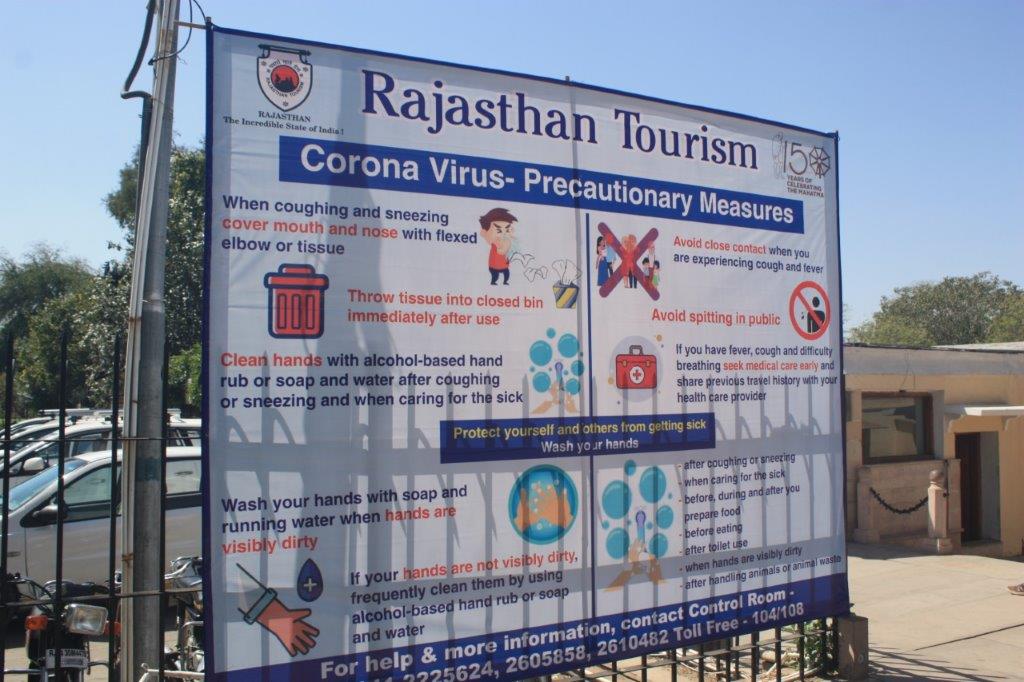
I just returned from a week of traveling in Rajasthan and Punjab for Holi and Hola Mohalla, respectively. Because my trip involved only domestic travel within India, there were no formal disruptions, but evidence of concern about the virus was widespread.

The first thing one notices is that instead of a few East Asian tourists protecting themselves against the poor air quality of megalopolises, at least a third of those traveling were wearing masks. Some unknown percentage of these travelers presumably have sound, medically-directed reasons for donning the masks (e.g. they have some sort of infection, they have compromised immune systems, etc.) but for many they are merely a security blanket. I suspect the reason that “wear masks” isn’t a part of the advice of public health experts has to do with the two types of masks that one sees:

First, the type that are to keeping out virus as a chain-link fence is to keeping out mosquitos.

Second, the type that will keep out virus (if worn / changed as directed,) but which — because they are expensive and hard to come by — are worn far too long, such that they become a nice warm, moist petri-dish pressed up against one’s face.

I don’t begrudge anyone a security blanket. In fact, a lot of what I’m suggesting herein are ways to maintain a confident and positive attitude so your immune system can be its awesome self — whatever that takes. My worry about the mask phenomena is that some people seem to believe that if one little viral agent makes it inside their body they are doomed. That’s simply not the case. If a viral marauder gets into your body, its chances of being escorted right back out by your body’s mucosal bouncers, swallowed whole by a macrophage, dissolved in your stomach’s acid bath, or otherwise being discovered and destroyed by your body’s sentry force is quite good.

In short, a mask isn’t your last line of defense. It’s a first line of defense that’s followed by an immune response that is swift and deadly to foreign invaders. It should be noted that nose-breathers already have a kind of mask, in the form of the nose and nasal passages. When you breath through your nose, your natural filtration system is at work. If you tend to breath through your mouth (particularly during inhalation) you have a lessened defense.

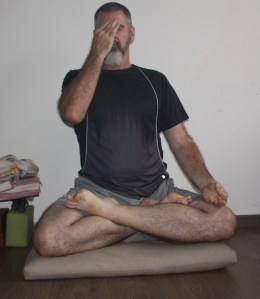
If you have trouble maintaining nose-breathing under all circumstances, I’d recommend a pranayama (yogic breathing exercises) practice. I don’t know how well it’s established by study, but I’ve found that I breath much more effectively and consistently through my nose since I’ve regularly practiced pranayama. Another helpful yogic tool is kechari mudra, which has helped me to even run without mouth breathing. (Kechari mudra involves curling the tongue so that the bottom of the tongue rests against the soft palate at the back of the roof of one’s mouth. This seems to reduce turbulence that would be created by air swirling in one’s oral cavity, and makes more of a direct line of travel for the breath in and out through the nasal passageways. At a minimum, it focuses one’s attention on the area the breath is passing through, and makes one aware of the breath.)

All this talk about one’s immune system keeping one safe may seem a bit pollyannaish or over-optimistic. Don’t get me wrong, I follow and would recommend others follow all the basic precautions regarding washing one’s hands and minimizing hanging out in high density environments — particularly high density environments with high-risk individuals. (i.e. for the asymptomatic [or alternatively-symptomatic individuals, i.e. those who have something but probably not COVID-19] who think they absolutely must be tested to have peace of mind, realize that you are likely walking into a high-risk environment and increasing your chance of self-fulfilling prophecy. Just sayin’. If you are able to rest comfortably, you might want to consider doing so.)

Back to the issue of being irrationally optimistic or a Pollyanna. My response is: fair enough. But there is an upside to being overly optimistic (if cautious) but none-whatsoever to being a worrier. Again, by being “a worrier” I’m not talking about taking precautions, I’m talking about obsessing or being needlessly pessimistic about the bodily systems (e.g. your immune system, your lymphatic system, your digestive system, etc.) that are keeping you safe all day and everyday.

I’d say if there is an upside to the pandemic, it was in reminding me to practice gratitude toward my body, my immune system, my gut bacteria, etc. — all of which keep me feeling excellent 99.9% percent of the time. Does that mean I think I can’t catch infection? No, it doesn’t, but it does mean that if I catch one my body will be much more effective at defending itself.

So when people ask me why I’m not worried about traveling, it’s because my immune system is awesome and I’m thankful for it every day.

A couple of post-scripts:

– I’ve been seeing the swarm of memes about toilet paper shortage in the US. Having moved to a part of the world that recognizes that wiping one’s backside with dry paper isn’t the height of sanitary practice, all I can say is: “You might want to look into what most of the world does most of the time.”

– I understand that there is a desire to curtail a wider spread of the virus, but this easily tips into a form of xenophobia — “a your COVID-19 is worse than our COVID-19.”  If a person is without symptoms, being Chinese (or from any other country with many cases) doesn’t mean that they are Typhoid Mary.

BOOK REVIEW: Pain: Considering Complementary Approaches by NCCIH

Pain: Considering Complementary ApproachesPain: Considering Complementary Approaches by National Center for Complementary and Alternative Medicine
My rating: 4 of 5 stars

Online here


The National Center for Complementary and Integrative Health (NCCIH) has put out a new edition (dated 2019) of its pamphlet (about 50 pages) about how useful various complementary practices are in helping patients reduce, or cope with, pain. The NCCIH is a center in the National Institutes of Health (NIH) that serves as a clearinghouse for information about how alternative and complementary practices perform in treatment of various ailments. While alternative (instead of mainstream medicine) and complementary (in conjunction with mainstream medicine) are quite different, in almost all cases this work herein is reporting on the latter basis. The complementary practices in question include: yoga, taiji, meditation and mindfulness, massage, acupuncture, chiropractic manipulation, relaxation methods, and others.

Complementary approaches to treatment of pain is a particularly salient topic these days as the mainstream medical approach (giving patients pills to gobble down) has resulted in what many have called a “crisis” of opiate addiction. So, if it’s possible to reduce the grip of pain with practices that at best have numerous other health benefits and at worst do no harm, than that’s a pretty good outcome.

Chapters three through eleven form the pamphlet’s core, and all but the last of those look at one complementary practice each, including (in order): acupuncture, massage, meditation, relaxation techniques, spinal manipulation, taiji (a.k.a. tai chi, or tai chi chuan), yoga, and dietary supplements and herbs. Chapter 11 discusses a few additional (less popular) practices. These chapters follow a three-prong approach: 1.) is it safe? 2.) does it help mitigate pain? and 3.) where can I find more information? [Spoiler alert: In almost all cases the answer to #1 is roughly “Yes, for most people, but possibly not for you. Check with your doctor,” and to #2 is usually something like: “there is some preliminary evidence that in certain cases certain people may have benefited.”] The chapters before (ch. 1 & 2) and after (ch. 12 to 14) provide background context and additional information.

On the positive side, it’s great that this information has been gathered together and packaged into a readable format with pictures and easy to read text.

On the down side, this was clearly a document put together by a committee of bureaucrats in consultation with lawyers. It is so laden with qualifiers and spongy speak that it’s impossible to discern how strong the evidence is for the various practices or how one compares to another. I felt that they could have given the same information in a three-column table in which the first column is the practice, the second column is “can’t hurt to try*” [*provided your physician concurs,] and the third column would be “nah, this stuff is fake.” [Spoiler alert: almost everything besides homeopathy would have the first column checked, but the consensus seems to be that homeopathy is pseudo-scientific quackery designed to sell water at medicinal prices.]

This booklet is available on the web for free, so if you’re interested, check it out. But don’t expect to come away with any profound insights. It’s not that kind of booklet.

View all my reviews

An App for That: Profound Yogic Practices You May Not See in Class

To the average person, yoga consists of a series of poses that stretch the muscles and strengthen the core.  In truth, often the most profound and life-altering experiences had by yoga practitioners involve only a seated or lying posture. If you practice yoga, you’re probably aware that postural practice, or asana, is just only one element of yoga, and perhaps you’ve experienced some of the other elements of yogic practice. However, it’s not always easy to access such training at the local studio.


These days there’s another way. These practices can be accessed through apps such as EKA.


Below are five powerful yogic practices that you might not find taught at your local yoga studio, but that you’ll find on EKA.


5.) Yoga Nidra: Yoga Nidra translates to “yogic sleep.” It’s a practice in which one stays in the mind-state between wakefulness and sleep, i.e. hypnagogia, for an extended period while working through a sequence of practices. Yoga nidra is extremely relaxing, but also allows one to access the subconscious in a manner similar to that of self-hypnosis. This makes the practice useful both for people who have trouble with sleep or settling into rest, but it also allows one to influence the subconscious so that one can make changes in areas where subconscious influence is strong.


For example, a person seeking to lose weight understands that they need to be careful about what they eat. However, the subconscious isn’t always on the same page as the conscious mind, and cravings for sugary or fatty foods may win the battle. In yoga nidra, we use sankalpa — a resolution, to help win the subconscious over. We also use practices like visualizations to gain insight into what is happening outside the bounds of conscious thought, and to exercise influence over it.


4.) Kaya Sthairyam: Kaya Sthairyam translates to bodily stillness, or steadiness. If you’ve done any meditation, you were probably taught to adopt a position in which you could be as still as possible throughout the practice. The reason for this is that even subtle movements can distract one, weaken one’s concentration, or have a stimulating effect. In yoga, kaya sthairyam is used to achieve a state of maximum stillness. If one wishes to increase one’s ability to concentrate for extended periods, one must build one’s capacity to remain still. That said, kaya sthairyam need not be thought of as only a prelude to meditation. The tranquility that arises from these practices make them worthwhile in their own right.


3.) Bija Mantra: In India, chanting is a very popular practice among yoga practitioners, and many have found great clarity in it. In one of my early classes teaching yoga to children, I found that as soon as the kids sat in a cross-legged pose many of the younger children spontaneously started softly reciting the gayatri mantra. That’s how intense was their association between sitting down cross-legged and chanting.


In the West, mantra chanting is less familiar. The six bija mantra, or seed mantra, are a beautiful way to introduce oneself to mantra chanting because of their simplicity. Because the bija mantra (LAM, VAM, RAM, YAM, HUM, and AUM) are all monosyllabic, easily pronounced, and are related sounds, they can be picked up quickly and easily.


2.) Witnessing Meditations: The yogic teaching that has had the most life-changing effect on me has been dispassionate witnessing. While it’s not a complex idea, it requires some explanation.


Let’s first consider what minds usually do in the face of a problem. There are two common responses that are not particularly healthy.


The first is to distract oneself from the problem. In some cases, this distraction can be an unhealthy activity — such as drug abuse, but it might also be something neutral like watching television. However, even if you distract yourself with a wholesome activity like volunteering at a soup kitchen, the problem is still there and it will have its say. If not directly, then indirectly through nightmares, indigestion, or a stress-induced illness.


The second option is obsessing. The brain tries to lessen the sting by anticipating the worst possible scenario. The trouble with this obsession is that to find our worst case scenario — we have to hang toxic labels on all possible events and invent possibilities that are so unlikely as to be nearly impossible. And having invented such dire cases, we often give them too much weight. As Mark Twain put it, “I’ve had a lot of worries in my life, most of which never happened.”  The negativity piles up and causes stress and anxiety to balloon out of control.


In dispassionate witnessing, we don’t ignore or distract ourselves, but we also don’t strap on value judgements or build worst cases. We simply recognize what we are feeling, acknowledge it, but don’t feed our anxieties.


One of the most basic witnessing practices involves watching sensations in the body. Imagine you’re doing this practice and you feel an ache in your back. If you try to ignore the sensation, the mind may turn up the intensity to get your attention.  If you obsess, you’ll soon convince yourself that this sensation is really an ache… no, a pain… no, it’s agony… oh no, could there be a tumor growing on my spine? [That may be exaggerating a bit, but you see the point.] However, if you focus your attention on the sensation without labeling it, you’ll probably find that the sensation passes. In essence, the body says, “Hmm, the brain examined this sensation and didn’t think it was anything to be concerned about, let’s move on.”


1.) Pranayama: Probably the most under-rated yogic practice is pranayama, or breathing exercises. By controlling one’s breath, one can influence one’s emotional state, one’s physiological processes, and the state of agitation in one’s mind. Breath practices are the most direct means to counteracting the stress response. However, despite constantly breathing — day in and day out — most people remain unaware of the incredible power of consciously controlling the breath.


There are a variety of types of breath exercises. There are breaths that have a stimulating effect on the body and mind, and those that have a calming effect. Scientific evidence has accumulated that there are benefits to practicing slower and deeper breathing, and pranayama offers a systematic approach to building this capacity. No matter what kind of pranayama one is doing, there is a side benefit from holding one’s focus on one point, the breath.


Pranayama is a great lead-in to meditative practices. It helps achieve a state of mind which is neither drowsy nor agitated. That said, pranayama is also beneficial on its own.


If you’re interested in exploring any of these practices, the EKA app is a great place to start.


DAILY PHOTO: Ramakrishna Math, Bangalore

Taken on January 26, 2020 in Bangalore.

C1149698-95C3-4E01-8FA9-A78942796122

688B2964-1B98-4F93-B41D-CC005AF95018

BOOK REVIEW: Prescriptive Stretching by Kristian Berg

Prescriptive StretchingPrescriptive Stretching by Kristian Berg
My rating: 4 of 5 stars

Amazon page


Many people have problems that they are only aware of through symptoms like head aches or back pain that result from imbalances in muscle tightness. This book explores stretching, systematically.

The book is divided into four parts. The first, entitled “Stretching Fundamentals,” presents fundamental principles and background information. Besides basic guidelines for stretching, it also discusses anatomy and physiology of the muscular system at a rudimentary level.

The second part is about targeted stretches, and it forms the heart of the book. This section, literally, goes from head to toe (and then back to the arms) explaining techniques for stretching major skeletal muscles. For some muscles, there is more than one stretch shown, but for others there is just one. Each entry on a muscle is divided into two parts. The first, “Muscle Facts,” describes the muscle, the causes of tightness, the symptoms of tightness, tests to gauge how tight the muscle is, and any precautions that should be considered when stretching the muscle. The second presents the stretching technique with a line drawing and mention of any mistakes to avoid. There are a mix of solo and partner stretches, as well as those using a ball.

The third part presents programs for pain relief. There’s a useful section that discusses morning aches and pains, and the ways in which one is sleeping might be leading to a crick in the neck or shoulder pain. This section not only lists the muscles that one should stretch to address various issues, but it gives little anatomical drawings in the context of the stretch that both help show what one is stretching and gives a reminder of the stretch.

I came to this book from the perspective of a yoga practitioner and teacher. If you’re wondering how these stretches differ from yoga, a major factor is that balance is taken out of the equation. The stretches in the book are done in a stable position. The downside of this is two-fold. First, if you want to build and maintain balance, you need to do an entirely separate set of exercises for that (depending upon the condition of the individual that could be necessary or a waste of time.) Second, one needs access to a wide range of equipment such as tables, adjustable benches, etc. (not to mention a partner, in some cases) to make these exercises work. The upside is that the individual is in a safe and stable position, so if they have poor balance they are at minimal risk.

The last section is one assessing flexibility and muscle balance. People think more about the former than the latter, but for most people, how balanced opposing muscle groups are probably contributes more to painful problems in the body. Because some muscles are easier to stretch than others, a book that shows how to get to the more challenging muscles is a great thing to have.

The ancillary matter includes a variety of graphics (mostly line drawings and anatomical drawings), a section upfront on the major components of the muscular and skeletal systems, and a references section in back.

I found this book to be useful and informative. I’d recommend it for individuals such as trainers, yoga teachers, athletes, and others who want to understand stretching at a level beyond technique.

View all my reviews

BOOK REVIEW: Sound Medicine by Kulreet Chaudhary

Sound Medicine: How to Harness the Power of Sound to Heal the Mind and BodySound Medicine: How to Harness the Power of Sound to Heal the Mind and Body by Kulreet Chaudhary
My rating: 4 of 5 stars

Amazon page


The Longfellow poem “There Was a Little Girl” has a line that says, “…When she was good, She was very good indeed, But when she was bad she was horrid.” That’s kind of how I felt about this book. At its best, it reports findings about how practices involving sound (i.e. mantra chanting) effect health and well-being, and lends insight into why sound sooths. At its worst, it tries to sledgehammer the square peg religious / spiritual practices into the round hole of quantum physics and foundational physics, often engaging in leaps that are at best wildly speculative, while presenting them as though they are as likely as not.

My favorite professor from undergraduate studies was a folksy Religious Studies Professor who cautioned against two opposing fallacies. The first he called “the outhouse fallacy.” This is assuming that because people of the past didn’t have indoor plumbing that they were complete idiots. Let me first say that, until recently, yoga (and other complementary health practices) suffered its fair share from this fallacy among doctors and the scientific community who felt that it couldn’t possibly help with health and well-being because it wasn’t rooted in the latest scientific findings. However, there is an opposing fallacy that my teacher called the “firstest-is-bestest” fallacy, which assumes the ancients figured it all out and we are just bumbling around in the dark hoping to stumble back into what they once knew. Scientists are prone to the first fallacy and the second is rife among religious folk. As a medical doctor who turned to siddha yoga (a form that puts a great deal of belief in superpowers and magic), Chaudhary had a rough road to not fall into one of these fallacies and, in my opinion, she falls more into the second — sounding at times like the ancient yogis knew more about the subatomic world and consciousness than science ever will. Most of the time, she words statements so that a careful reader can recognize what is well-supported and what is speculative, but she’s rarely explicit about the degree to which speculations are such, and I don’t remember an instance in which she presented an alternative that would undermine her argument. (i.e. The unstated argument seems to be that mantra is special among practices, that its usefulness is embedded in the fundamental physical laws of the universe, and, therefore, that it works by mechanisms unlike other meditative / complementary health practices [i.e. by engaging the parasympathetic nervous system so the body can make repairs using established biological mechanisms.])

In a nutshell, there is a “god in the gaps” approach to the book that says, look we don’t understand consciousness or all the “whys” of quantum mechanics, ergo there must be supernatural explanations. I don’t think that because we’ve used EEG since the 1920’s and fMRIs since the 1990’s and still haven’t yet unraveled the hard problem of consciousness that we need to say that god / supernatural forces are where we must look for explanation. The gap is ever closing, slowly but surely, and there’s no reason to believe it’s reasonable or useful to cram commentary from Vedas (or any other scriptures) to fill the gap.

It’s not only the science where Chaudhary presents a belief as though it is established truth without alternative explanations. Early on, she states that colonization is the reason for the decline of meditation in India. Don’t get me wrong, I’m as accepting that colonization resulted in a great number of evils as anyone, but it’s a leap to say that – therefore – every negative a society faces is because of its colonizer. I would point to Thailand, a society that was never colonized (except a brief period by the Burmese) and which is primarily made up of Theravadan Buddhists (a system for which meditative practice is considered central,) most of whom also do not meditate regularly today. I suspect a more logical explanation for the fact that most Indians don’t meditate today is that: a.) it’s hard work and time consuming (as a productive endeavor it’s not bread-winning and as a leisure time activity it’s laborious,) and b.) the majority of Indians (like the majority of Thais) probably never mediated. (When we look back in time, we often want to create this wholesome and uniform image that what we have writings about was how everyone lived, and that probably never reflects the truth.)

So now that my rant is over, I should say that I didn’t think this book was horrible, by any means. It has a lot of good information, and some of the speculative bits offer interesting food for thought. As long as one reads it carefully and with a healthy dose of skepticism, it’s a beneficial consideration of sound and vibration in health and well-being. It’s just that when I compare it to, say, Davidson and Goleman’s “The Science of Meditation” (which I reviewed recently) this book is far less careful about presenting the science, eliminating pseudo-science, and letting the reader know what is controversial and speculative versus what is well-supported by sound and rigorous investigation.

View all my reviews

HAIKU OF BREATH

F56802D5-FFD7-4436-88DC-8BB06B89C43B


at the seashore
breath syncs to lapping waves
sea teachings


in between
the inhale and exhale
lies stillness


a breath missed
life takes a moment’s pause
mind is void


slow the breath
drawing each instant out
slow your world


breath control
lets one drop the sails
in rough seas

My Year of Discovering How Weird the Mind Gets, Pt. XI [Chanting]

Some people swear by the mind-altering properties [and other benefits] of chanting mantras. I’ve been reading a review copy of Kulreet Chaudhary’s “Sound Medicine,” a book whose play-on-words title says it all. It’s about the way sound is either shown or speculated to have health effects. (Full-disclosure: Some of the speculation gets a bit out there.)  Chaudhary is both a medical doctor and an Ayurvedic practitioner, and has an outlook akin to that of Deepak Chopra.

Chanting has never been my thing. I’ve learned about it and done some in yoga training, but I can’t say it ever resonated [no pun intended] with me. However, in the spirit of investigation, this month I did a few one hour and half-hour sessions of chanting. I kept it very basic, chanting AUM as I was taught with equal parts of A – U – and – M.

While I can’t say that I’m sold that chanting is the ultimate practice that achieves outcomes unachievable through other means, I will say that after these sessions I do feel a sense of calm and clarity. I can certainly see why mantra chanting has appeal for so many people, even though I also believe that, sadly, it’s sometimes oversold as something supernatural and the discussions about it are needlessly complicated.

BOOK REVIEW: Prana and Pranayama by Swami Niranjanananda Saraswati

Prana And PranayamaPrana And Pranayama by Swami Niranjananda
My rating: 5 of 5 stars

Amazon page


This is the Bihar School of Yoga manual on pranayama, or yogic breathing exercises. The book is a one-stop reference for yoga students and teachers wishing to review the philosophy and physiology of breathing practices, as well as to put together lessons or a plan of action for practice that consists of both preparatory exercises and classical pranayama.

Students in the West may be more familiar with B.K.S. Iyengar’s “Light on Pranayama,” which offers a similar set of material and is this book’s main competitor for most readers. In my view, Swami Saraswati’s book is a bit more pragmatic and gets caught in the weeds less, but offers fewer detailed photos and is a little bit less precisely organized. If one is considering between the two books, I’d say the advantage of Iyengar is a 200-week course plan that some individuals may find a handy way to systematically advance their practice pranayama. The disadvantage of Iyengar is that he goes into vastly greater detail than most people will be able to take advantage of via book. (For example, there’s 22 pages of precise explanation of closing off one’s nostrils for digital pranayama.) In short, both books give the reader everything they’ll need in a pranayama reference, Swami Saraswati’s book is a bit more laid-back, and Iyengar’s a bit more oriented as a step-by-step instruction manual.

The twenty-one chapters of this book are organized into three parts, but we’ll call it four because the last part is divided in two sub-parts. The first part of the book is entitled, “Philosophy of Pranayama” and it dives into the definitions of prana, kosha (sheaths), chakra, nadi (channels), pranic fields, and discusses the connection between prana and chanting.

The second part of the book (ch. 8 – 13) explores the physiology of breath. This section explains the anatomy of the musculature that drives respiration (e.g. the diaphragm, intercostals, etc.), the processes of respiration and circulation, and the importance of the nose in breathing (which is more extensive than the average person could imagine.) This section also discusses the classical distinction between pranayama and rudimentary breath practices (i.e. whether there is breath retention, or kumbhaka), and has a separate chapter explaining retention. It also has a couple chapters that present the research on the benefits and effects of pranayama practice. (Full-disclosure: this isn’t up-to-date in the edition I read, and that was the 2016 — first digital — edition. So, I wouldn’t go here looking for information on the state of research because there’s been a virtual explosion of research that’s more recent than what is covered in the book. However, it will give one a gist what has been known for a while.)

Part III consists of two sub-parts. The first is called “Pre-Pranayama” and it includes many exercises to help one become familiar with one’s breath as well as to develop the foundational breaths (e.g. abdominal / diaphragmatic verses chest breathing) that are built upon in the final section. Part III.B presents the classic pranayama. The four chapters of this section are conveniently organized into: guidelines for practice (e.g. contraindications and general concepts to keep in mind), nadi shodhana (alternate nostril breathing), tranquilizing / calming breaths, and vitalizing / excitatory breaths.

There are five appendices as well as a glossary and two indexes (an index of practices and a general index.) The five appendices provide instruction on practices that are employed in pranayama, but are not pranayama themselves. These include supplementary practices, asana (seated postures for doing pranayama more than asana for opening the rib-cage, etc.,) mudra (“seals” postures of specific body parts), and bandha (locks). The presence of the first four appendices mean that one doesn’t have to buy other books (e.g. the APMB) to access this information. The fifth appendix gathers the sutra from “Hatha Yoga Pradipika” that deal with pranayama and provide an English translation. (HYP is a 15th century manual of Hatha Yoga that is much more detailed than Patanjali’s sutras.) There are graphics throughout the book as needed to convey information, mostly line drawings.

I found this book very useful and well presented. If there is one change that would improve the book it would be less crow-barring of science and traditional / philosophical beliefs about the body to be consistent with one another. I see the value of presenting both sets of information as both this book and the Iyengar book do, but a muddle is created by trying to force the explanations into consistency when they aren’t. (I think this book does it a bit more than Iyengar, but only because Iyengar puts much less emphasis on science than does this one.) The problem is that one ends up with low-quality pseudo-science amid the strong studies, and most readers won’t be able to tell scientific consensus and from the lunatic fringe. (e.g. The belief that kirlian photography is evidence of pranic fields or qi is far from scientifically supported.) That said, for most practitioners it doesn’t much matter as it doesn’t affect the nature of the practices, which are sound and well-described.

If you’re looking for a pranayama reference, this is a great option.

View all my reviews

My Year of Discovering How Weird the Mind Gets, Part VII [Lucid Dreaming]

Lucid dreaming is the act of becoming aware that one is in a dream while dreaming. It’s called “Dream Yoga” in some Eastern traditions (most notably, Tibetan [Vajrayana] Buddhism.) Many people pursue lucid dreaming because they find it just too cool to experience the world of dreams consciously, but — for those who don’t — the natural question is “why bother?”  Well, it gives one an unprecedentedly vivid insight into one’s subconscious mind. [For those who are still wondering “why?” This post is probably not for you.]

Since I was young, I’ve occasionally experienced lucid dreams. But it wasn’t until recent years that I began a dream yoga practice — which I had discontinued until resuming it for this month’s study. Those unfamiliar lucid dreaming might wonder how one “practices” becoming aware that one is in a dream in the midst of dreaming. If one didn’t come to the table with a talent for lucidity in dreams, one can’t exactly do anything about it in the middle of REM sleep (rapid eye movement, when the bulk of dreaming occurs.)  A dream yoga practice consists of actions one takes during the day to help facilitate becoming lucid during one’s dreams. These actions include:

  • Journaling one’s dreams (i.e. writing down whatever one remembers of one’s dreams as soon as possible so that one builds the capacity to remember dreams, which can be ephemeral.)
  • Doing reality checks in waking life whenever one notices anything that has an unreal quality about it. This is done in an attempt to train your brain’s BS detector — that’s obviously not how neuroscientists refer to it, but in waking consciousness we have a potent ability to notice and focus our attention on apparent incongruities. The parts of the brain that manage that responsiveness tend to be down for the count during sleep. Hence, in a dream one can walk out of one’s bedroom onto the Serengeti Plains without a second thought. So you are attempting to train your brain to become aware when the anomalous takes place. If it works right, you will begin to do the reality checks in your dreams as well. Of course, real life offers much more subtle seeming incongruities, hence the need to be on the look out for them. There are two approaches to reality check with which I’m familiar. The one I use is to count my fingers, and then flip my hand over and count them again. In a waking state, I always have five digits during counts. In dreams, my hand does some funky stuff. An alternate method is to look at a clock or watch, look away, and then look back at it. In real life, only a second or two will have passed, but in a dream the times will likely be entirely different.
  • Bedtime resolutions to remember one’s dreams and to become lucid during them. For yogis and yoginis, this is like a sankalpa, a resolution that one repeats during yoga nidra (“yogic sleep,” a yogic relaxation and mind development technique that — ironically — doesn’t involve sleep but rather a prolonged hypnogogic state [between waking and sleep.]) The resolution should be a short statement without negation that is repeated exactly the same way several times.
  • Meditative practices that recall dream settings. One practice that I stumbled onto is done in a meditative state. When my conscious mind quieted and I was experiencing subconscious imagery, I found that I could remember many more of the settings in which dreams take place. I have a lot of recurring settings for dreams. [Typical of dreams, these places don’t always look exactly the same, but they feel like they are meant to be the same place.]

Long story short, one is doing two basic things in the practice of dream yoga. First, you’re trying to remember your dreams better. As I suggested, you could be becoming lucid in dreams every night, but if you don’t remember them you’re not gaining any conscious insights from them. Second, you’re trying to recognize the dream state by way of the bizarre incongruities that take place in dreams.

I should point out that mine is a bare bones practice, there are other activities one can do as well. Really hardcore practitioners set alarms in an attempt to wake themselves up in the midst of a dream. This allows them to remember dreams better and to help them become aware they are in a dream when they return to the dream after going back to sleep. This isn’t so far fetched as it might sound. We tend to dream in cycles of around 90 minutes and proceed through the same sequence of mind states from waking consciousness through hypnogogic state through various stages of sleep into a hypnopompic state and the back to waking consciousness. So, there is a degree of predictability on which to base one’s alarm estimate. I’m not so keen on disrupting my sleep. [Part of the reason that I discontinued practice is that I found I really only remembered lucid dreams when my sleep was troubled. (Usually it is not so much “troubled” as I when I’m sleeping lightly because I’ve slept longer than usual — e.g. occasionally oversleeping on the weekend.)  If I sleep like a baby, I typically don’t remember lucid dreams — that doesn’t mean I’m not having them, but I wouldn’t know if I did.]

Even though a dream yoga practice has often seemed to have little influence on my having [or, perhaps more accurately, remembering] lucid dreams, this month I’ve had five that I remembered — a couple of which I only remembered the in-dream reality check (counting fingers.) [A warning to would-be lucid dreamers, its possible to wake yourself up with the excitement of becoming aware that you are in a dream.] I’ve been consistently journaling and have picked up doing more reality checks. [Bangalore is a great place for this because it’s in constant flux, so I’m forever having “was that there yesterday” moments and “has that looked like that for the past five years” moments as I move about the town.]

It’s been fun coming back to this practice. I’m one of those who doesn’t really need another reason for trying to dream lucidly other than the fact that I’m so in awe of being in a dream and knowing that anything my mind can conjure might come next. Still, the lucid dreams I’ve had this month have offered some interesting features to contemplate the meaning of, including: faceless people, being on some kind of backward moving speed-walk while I tried to go investigate a scene in front of me, and something akin to being in a video game.

I’m leaning toward doing a short stint of sleep deprivation for next month, if I can find two days or so to safely give it a try (i.e. no need to drive or do anything else requiring fresh faculties.) I’ve gone about 54 hours without sleep before (not for its own sake, but because of the situation at hand,) and know it can have some interesting effects.