BOOK REVIEW: Characters, Emotion & Viewpoint by Nancy Kress

Characters, Emotion & Viewpoint: Techniques and Exercises for Crafting Dynamic Characters and Effective Viewpoints (Write Great Fiction)Characters, Emotion & Viewpoint: Techniques and Exercises for Crafting Dynamic Characters and Effective Viewpoints by Nancy Kress
My rating: 4 of 5 stars

Amazon page


This book is about how to write characters with sufficient depth that readers will follow them through to the end of a story. As the title suggests, there are three major components to the book: character building, emotional considerations, and point of view. A story requires a character who needs or wants something and faces barriers to that goal. The character has to be someone who the reader is interested in seeing through a process that involves inching toward a goal while being repeatedly beaten back. This doesn’t mean the character has to be likable, but if the character is unrealistic and uninteresting readers won’t get far. (In other words, they don’t have to like the character, but they do have to feel some sort of way about them.) Facing barriers to one’s goals creates emotional states that must feel authentic. If a character doesn’t respond emotionally to events, then the story is likely to feel flat (unless one has built a hilarious Sheldon Cooper-like character on purpose.) The perspective from which the reader learns of events is critical because it determines what information the reader is privy to, and—in particular—information about thoughts and emotions that are sometimes falsely portrayed.

Of the sixteen chapters that comprise the book, the first seven explore character development. Chapter 1 describes character in terms of general types. The book goes on to discuss the importance of how one introduces key characters. The next three chapters drill down into the challenge of building an authentic character: 1.) What is the character like deep down? 2.) Are the motives of the character clear-cut or complex? 3.) How can one show that the character has changed over the course of the story, and, if they don’t change, will the reader be satisfied? Chapters 6 and 7 investigate specialized types of characters (i.e. genre characters such as in romance, mystery, thriller, or sci-fi [Ch. 6] and in humor [Ch.7.])

Chapters 8 through 11 examine emotion and how it’s conveyed to the reader. The means by which writers communicate emotion include: dialogue (Ch. 8), metaphor, symbolism, and sensory experience (Ch.9.) Chapter 10 delves into special cases that are common in fiction but which require unique consideration (love, fighting, and dying.) Frustration has its own chapter (Ch.11,) and that may seem odd, but one must remember that a story is one barrier after another being erected in the way of the character’s pursuit of his or her objective.

The next four chapters present information to help the writer evaluate different approaches to viewpoint. Not only are there various pros, cons, and considerations one must take into account when deciding upon viewpoint, each approach has a several variations. The first of these chapters (Ch. 12) outlines the broad-based considerations. The next three chapters deal with first person (Ch. 13), third person (Ch. 14), and omniscient points of view (Ch. 15,) respectively. (The rarely used 2nd person point of view is also discussed briefly, but largely as a warning.) The last chapter explores how to make it all work by way of what Kress calls the “fourth persona.” Early in the book, one is told that the writer must simultaneously embody three personas (i.e. the writer, the character, and the reader.) Kress’s “fourth persona” is that of the critic, and it becomes necessary once one has drafted a story and character.

The book has a few extras. At the end of each chapters there are several (usually 4 to 6) exercises to help writers understand the concepts through practice. The chapters each have summaries, and at the end of the book there’s a summary in the form of a checklist. That is about it for ancillary features. There are a couple of graphics in the form of pictures of a “mini-bio” and an “emotional mini-bio.” These are single page fill-in-the blank summaries that help one build a character that has depth and an authentic feel.

I found this book to be interesting and educational. The writer uses examples from a number of popular commercial and literary fiction authors. There’s no real need to be familiar with any particular author, but being familiar with them might present one with additional insights. The book is readable.

I would recommend this book for writers of fiction.

View all my reviews

BOOK REVIEW: Wired for Story by Lisa Cron

Wired for Story: The Writer's Guide to Using Brain Science to Hook Readers from the Very First SentenceWired for Story: The Writer’s Guide to Using Brain Science to Hook Readers from the Very First Sentence by Lisa Cron

My rating: 5 of 5 stars

Amazon page

There are countless books offering advice to writers. Some are good. Some are not. Good, bad, or ugly, few of these books offer anything new beyond particularly artful (e.g. humorous or poetic) explanations or superior examples. In other words, if you’ve read five writer’s guides you’ve read five thousand. Cron’s book is the rare guide worth a read even if you’ve read a hundred other such books. It’s not that Wired for Story offers radical or novel advice on story building (its writer’s tips are orthodox.) It’s the way this book couches the arguments for what can admittedly be hackneyed advice. As the title suggests, Cron’s book is about how our brains are wired to love stories–as long as said stories contain certain attributes that the brain finds appealing. (Conversely, there’s a reason why books that go wildly off the reservation with “experimentalism” are doomed.)
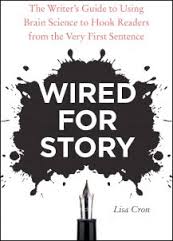
While I’ve read many a book on writing, I picked up Wired for Story more out of an interest in the subject of the neuroscience of story. The book doesn’t delve deeply into the science, but it does cite leading thinkers in the field as well as providing a good layman’s overview of the neuroscientific principles that inform the book’s tips. Cron’s background is in publishing and her bona fides to write this book are as someone who came from a career reading and rejecting / accepting manuscripts. However, I believe she did a good job of laying out science.

The central idea is that humans love stories because the narrative structure allows people to simulate a nasty chain of problems without suffering the real world consequences. The brain loathes uncertainty and randomness, and loves whenever it can learn about how to face a problem or make sense of the world. This is why we love conflict, tension, and an unrelenting unfolding of worst case scenarios in our stories even though we tend to hate those characteristics in our own lives. This results in both the tried advice to keep putting the protagonist through the wringer, and the qualifications that a writer should do so in a way that is believable (our brain’s BS-detector is ever on) and which will eventually force the protagonist to change. Cron offers a definition of story that has the usual elements: “A story is how what happens affects someone who is trying to achieve what turns out to be a difficult goal, and how he or she changes as a result.” As with many guides, the definitions of plot, the protagonist’s issue / goal, theme, and tone are elaborated at length—as well as being differentiated because these topics tend to be confused by neophytes—often resulting in a failure to clarify one or more of them.

Stories also give us an opportunity to anticipate what others will do, and forecasting the behavior of others gives one a nice little dopamine dump. The ability to foresee what others will do has always been a powerful evolutionary advantage, and those who did it better passed on their genes more than their oblivious counterparts. Owing to this idea, there is a great deal of advice about what should be in the book (only what is relevant), and how it should be revealed (in a way that eschews attempts to play “gotcha” with your readers.)

One may wonder why I’m so pleased with a writer’s guide that gives common advice about writing–just because it explains said tips in terms of evolutionary biology. The answer is that it’s far easier to keep these lessons in mind when they’re held together by a logic rooted in what all readers have in common (e.g. conscious and unconscious minds, emotions, instinctual drives, etc.) For example, knowing why readers hate an overly simple resolution for a problem that’s presented as insoluble (i.e. robbing them of dopamine reward for figuring it out) helps one better recognize this pitfall in all its forms and to avoid it. Such an approach allows for a deductive approach and is far more useful than having memorized “avoid deus ex machina” as a disparate tip that’s attached to a specific example. In short, it’s both easier to remember and broadly implement these ideas when one understands the rationale from the ground up.

Beyond the reason in the last paragraph, I enjoyed this book for reasons that have little to do with its advice to writers. While I now know that there are other books on the evolutionary biology of story that deal with the subject more from a scientific perspective (while I haven’t read it yet, you might try this book), this was the first book that I stumbled across on that topic. And, it’s a topic that’s well worth understanding whether you’re a writer or not. No matter what one does, understanding the universal appeal of a story can be beneficial, whether it’s in the context of teaching, parenting, or business.

I’d recommend this book for writers—particularly those who think about the world in scientific terms. Beyond writers, if you have cause to construct or use stories in your life—or suspect you should—you can benefit from this book.

View all my reviews

BOOK REVIEW: Gotham Writers’ Workshop: Writing Fiction by Various

Writing Fiction: The Practical Guide from New York's Acclaimed Creative Writing SchoolWriting Fiction: The Practical Guide from New York’s Acclaimed Creative Writing School by Alexander Steele

My rating: 4 of 5 stars

Amazon page

This workbook-style guide to writing fiction is put out by the well-known New York City creative writing school. With 11 chapters, it delivers lessons on all the elements of fiction including: character development, plotting, establishing point of view, honing description, building realistic dialogue, varying pacing, establishing voice, determining a work’s theme, and carrying out revisions. It also has a chapter that goes into the business of writing (as opposed to the craft of writing which is the bailiwick of the first ten chapters.)

There are a couple of features of this book that set it apart from the vast canon of writers’ guides. First, this isn’t a single author work, which means the reader has access to a much broader pool of experience than one would in a single author text. It also means that an author can be assigned a topic according to his or her strengths as a writer.

Second, across the chapters, they use Raymond Carver’s Cathedral as an example work, and they provide that story in an appendix for those who haven’t read it. It’s not that the authors exclusively use this short story for examples. But it’s useful to have a common story and to include it because there are so many great stories and novels available that no matter how well-read one’s readership, there will be works that some haven’t read. (e.g. Much as I should’ve, I haven’t yet read nor seen the movie Gone with the Wind–a common exemplary work because it’s a beloved book, a movie, and because pop culture references [e.g. The Simpsons] have made the gist of it available to even those slackers who’ve neither read the book nor seen the movie.) There’s a reason why writers’ book authors often use movies to describe story elements, because there are many fewer movies than books and vastly fewer good movies—thus a higher likelihood of a common experience. Yes, there are a few works common across most school curricula, but there’s no better way to ensure that a book doesn’t get read thoroughly than to assign it as required reading.
A third useful feature of this book–but not one that is in any way unique to it–is that it offers writing exercises throughout to help build one’s skills through practice. This is where the value of such a book truly lies. The advice such books offer are almost always the same—sometimes hackneyed but almost always valuable. (A lot of tired advice is tired because it bears repeating owing to the constant infusion of new writers who repeat the same errors.) A final useful element of the book—but also one that features in many similar guides—is a checklist in the appendices that allows one to rapidly consider the book’s key questions as they apply to one’s own writing project.

I’d recommend this book as one of the most useful writers’ guides that I’ve read.

View all my reviews

READING REPORT: April 10, 2015

Ikkyu_Berg

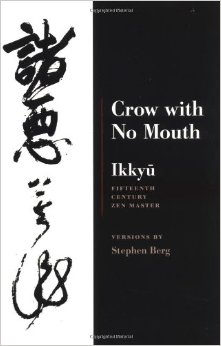
I finished four books this week. That makes it sound like a big reading week, but two of the books were tiny and I was well into the other two at the start of the week. I will present them in the order in which I enjoyed them because they hit the great, the middling, and the awful. The best was Ikkyu: Crow With No Mouth, which is a poetry collection by an irreverent 15th century Zen monk. Given that this is a collection of Japanese short form poetry, you may have guessed that it’s one of the short books (as opposed to one that was half read.) [Full disclosure: some will find a few of the poems vulgar, and it’s probably not a collection you want your kids reading until they are of suitable age for graphic sexual description.] Among my favorite verses are:

you can’t make cherry blossoms by tearing off petals

to plant only spring does that


and

it’s logical: if you’re not going anywhere

any road is the right one

and

I live in a shack on the edge of whorehouse row

me autumn a single candle

or

the edges of the sword are life and death

no one knows which is which


HaikuHandbook

(Yes, I’m on a bit of a haiku kick lately. With my RCYT training in progress, I haven’t had a lot of time for more extensive reading or writing lately.) Unlike the previous book, this book on Haiku isn’t a poetry collection–though it does assemble a lot of great haiku, tanka, renga, and haibun as examples. However, this book is–as its subtitle suggests–about writing, sharing, and teaching haiku and related poetic forms. The book teaches one that five-seven-five syllable organization isn’t an essential element haiku,  but rather it should be considered the most readily abandoned and superficial aspect of this form. However, beyond teaching one what one really needs to know to construct haiku, the book offers a lesson plan for teaching haiku to school children and tells us how this Japanese poetry form went global.


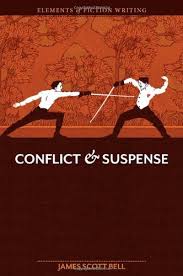
Elements of fiction writing conflict & suspenseElements of Fiction Writing: Conflict & Suspense is my second read by Bell on writing. The first one was on plotting and structure. That first book must have been useful enough to get me to read a second. This book is divided in two parts, the first one on conflict and the second on suspense. (The first is much longer.)  In both cases, the chapters examine how the various elements of fiction (i.e. setting, plot, character, dialogue, etc.) can contribute to creating the much-needed characteristics of conflict and suspense. Bell uses a lot of example text to illustrate his points (mostly–but not exclusively–from commercial fiction), and this is a valuable feature of his guides.
 

wit&wisdom_yoda

This book was a stinker, and I can’t recommend it for anyone–though its saving grace is that it’s slim and thus only wastes a tiny bit of one’s time. What the author apparently did was to watch a Star Wars movie marathon and pull every Yoda line out and collect them together. This is a sad effort in two ways. First, while Yoda isn’t a lead in the movies (and, therefore, has a limited number of lines), there’s a vast canon of Star Wars books, and it doesn’t look like the author trolled any of them for quotes. Second, some of the lines are neither witty nor wise. Occasionally, Yoda has a line equivalent to, “take a left at the second light,” and the author includes such banal quotes. Furthermore, some of the quotes appear a second time in either reduced or extended form. Beyond all these complaints, the author doesn’t even take the time to put together meaningful front matter to tell the reader something interesting that they don’t already know, and thus doesn’t establish his worth in producing such a book. (Also, he doesn’t seem to know accepted protocol for writing quotes inside quotes–i.e. use of single quotes. Which I guess means he probably didn’t just cut and paste all the quotes because then they would have been grammatically correct.) He also could have at least provided told us which movie each quote was from. It’s a lazy effort. It succeeds spectacularly in being lazy.  If you’ve seen the movies (or have basic cable so that you can readily do so by way of one of the frequent Star Wars marathons) you’ll gain nothing from this book.


I bought three books during this week, but one of them was the aforementioned Yoda crapfest. On the other hand, one of these books I have high hopes for being both fascinated and educated by, and that’s Wired for Story. This book is about how our brains are evolutionarily optimized to the narrative form, and how one can use this fact to one’s advantage as a constructor of stories.

Wired for Story

The second book was a poetry collection that is on sale on Amazon entitled Love Alone. I must admit that I picked this book to meet one of my remaining requirements in the 2015 Book Riot Read Harder Challenge–nevertheless I have high hopes for this work.

LoveAlone


READING REPORT: April 3, 2015

I finished two books this week. The first was the Gotham Writers’ Workshop guide to writing fiction. This book offers advice on the key elements of fiction writing including character, point of view, setting, pacing, description, plot, revisions, and marketing one’s work. It includes exercise prompts throughout, and is set up as a workbook. It’s written by a number of contributing authors, and offers a broader experience than a single author book.

GWW_WritingFiction


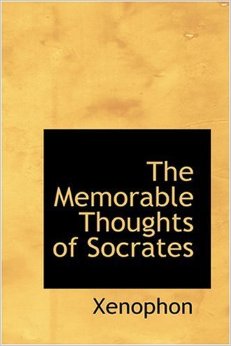
The second book I finished was The Memorable Thoughts of Socrates. This is a book first published before 1850, and puts me more than half way through the 24 tasks of Book Riot’s Read Harder Challenge. (Yes, this may be a cheat as the translation was first published in 1889, but I’m sticking to my story.) I read about two-thirds of this book a while back, but just got around to finishing it off. I can’t say I enjoyed it as much as Plato’s Apology, Crito, and Phaedo, but it’s still full of thought-provoking ideas. (How bad could Socrates be?)

MemorableThoughtsofSocrates_Xenophon


Besides the books I completed, I finished off a couple of chapters [and part 2 (of 4)] of William J. Higginson’s The Haiku Handbook. This book’s subtitle, “How to write, share, and teach haiku,” says it all. If you think that the essential feature of haiku is that it occurs in three lines of 5 – 7- 5 syllables, then you could learn a lot from this book. It turns out that there’s much more to the traditional form (e.g. seasonal focus, nature observation without analysis, etc.) than syllable count. Furthermore, it’s argued that the 5 – 7 -5 isn’t the optimal way of emulating the Japanese form in English (because English syllables average longer than Japanese syllables.)

HaikuHandbook


I resumed reading another book for writers that I started back around the time I began the Gotham Writers’ Workshop book. This one is James Scott Bell’s Elements of Writing Fiction – Conflict and Suspense. I read another book on plotting and structure by Bell that was probably in the same series, and it wasn’t bad. I’m about half way through and found some worthwhile nuggets among a field of self-evident info.

Elements of fiction writing conflict & suspense


I purchased two books this week–both were on sale. The first was The Backpacker’s Handbook, 4th Ed. As I prepare to do some trekking in the Himalayas this summer, I’m hoping to glean some tips that will save me some pain. I’ve read a number of such books in the past, but it’s been a while and my memory degrades.

BackpackersHandbook


The other book was Robert Silverberg’s Kingdoms of the Wall. As Silverberg is an icon of science fiction, but I haven’t read any of his novels, I figured that it would be good to do so–especially on sale.

Kingdoms of the Wall


That’s it for this week.


BOOK REVIEW: The Naive and the Sentimental Novelist by Orhan Pamuk

The Naive and the Sentimental NovelistThe Naive and the Sentimental Novelist by Orhan Pamuk

My rating: 5 of 5 stars

Amazon page

The Naïve and the Sentimental Novelist is Orhan Pamuk’s theory of the novel, and is based on a series of lectures given by the Turkish Nobel Laureate in 2009. It’s a brief work, consisting of less than 200 pages written across six chapters plus an epilogue. Pamuk explores just a handful of concepts, but he elaborates on each with examples from literature. Having said that, Pamuk has the novelist’s gift for strategic ambiguity, and there are some ideas–such as the “secret center of the novel”–for which the author leaves much for the reader to interpret.

In the first chapter, Pamuk explores what occurs in the mind of a reader as they consume a novel. He proposes nine mental activities that one engages in over the course of reading a novel. These activities range from the essence of reading, such as observing scene and narrative arc, to less essential acts such as self-congratulatory narcissism. A central theme is the novel as a visual medium in that the mind converts words into images and those images are what are experienced in reading. The final action is search for the novel’s “secret center,” an important element of Pamuk’s theory and the topic of the book’s final chapter.

The title subjects are also introduced in the first chapter, i.e. naïve and sentimental novelists. Pamuk borrows this concept from Schiller, who used it to describe poets. The naïve novelist writes spontaneously and with confidence that he or she is capturing reality in the work. The sentimental novelist is much more uneasy about the degree that his work will convey something true. While an oversimplification, this idea corresponds somewhat to the much more commonly known division of writers into outliners and non-outliners, i.e. some writers can’t get started until they’ve done extensive research and outlining, but others begin with—at most—a vague outline in their heads and let the words stream from deep within.

The second chapter discusses the reader’s inability to accept that the novel is complete fiction—and, conversely, what truths a novelist reveals in the process of writing a purely fictitious work. (It should be noted that while Pamuk refers throughout to the “novel,” he’s really referring to the “literary novel.” Much of what he has to say isn’t relevant for either commercial or genre fiction.) Pamuk points out that it’s not just gullible yokels who believe that what he’s writing is autobiographical. Sophisticated readers who work in the publishing industry have been known to think he is living the life of one of his characters. On the other hand, when an avid reader suggested that they knew Pamuk so well because they had read all his books, he found himself being embarrassed. This embarrassment wasn’t because he felt they had learned any details of his life, but that they had developed a psychological insight.

The next chapter is on character, plot, and time. As one would expect, character is the most important and substantially addressed topic. I say that not because it’s listed first, but because we are talking about literary fiction—a medium in which character is of the utmost importance and plotting is loose to optional. However, the portion of the chapter that I found most interesting was the question of time in novel. Time stretches, compresses, and can bounce non-linearly in a novel. The protagonist’s time is on display in the novel, and that can be done artfully or not.

The fourth chapter is the one that most deeply delves into the topic of novel as a visual media, one which is more closely related to painting that to the media to which the novel is more frequently compared. Here he divides novelists not into the naïve and the sentimental, but into visual versus verbal writers. Pamuk suggests that the novel is a series of frozen moments as opposed to a continuous running of time—and thus its connection to paintings. Of course, Pamuk was a painter before being a novelist, and thus may be more prone to see that connection than most

The penultimate chapter is a comparison of novels to museums. No two things might seem farther apart at first blush, but a museum is a themed collection of artifacts that hopefully serve to tell a story—story here being used not as fiction but as a narrative that could contain fact, fiction, or mythology. This discussion really continues on the theme of the visual aspect of the novel. It suggests that those artifacts that are seen or manipulated in a novel convey a great deal of what the author wants to get across and help to create a more real fictional world. Pamuk elaborates on the connection by using three points to connect museums and novels that are all related by pride.

The final chapter elucidates the “center” of the novel. This is a concept that Pamuk has written around since the beginning of the book without providing a clear conceptualization. The first line of the last chapter defines the center as: “…a profound opinion or insight about life, a deeply embedded point of mystery, whether real or imagined.” The idea of a center, we are told, separates literary fiction from genre / commercial fiction. Readers and authors of genre fiction may find themselves becoming miffed with Pamuk for saying that such works either don’t have a center or have one that’s painfully easily found. He does make explicit exceptions for works by Philip K. Dick and Stanislaw Lem, and one would expect that works of speculative fiction by the likes of Vonnegut, Murakami, and LeGuin would meet his approval as well. However, the presence of a tight story arc—one of the factors that makes work salable—is part of the reason genre fiction tends to have a readily discovered center. For Pamuk, the name of the game is writing a work that has a center that isn’t easily discovered, but neither is so deeply hidden as to remain forever beyond the grasp of most readers. He suggests the novel should be a puzzle, which is solved to reveal the center.

The epilogue includes some autobiographical insight and elaboration on what Pamuk was attempting to convey in this work.

I’d recommend this book for writers as well as serious readers of novels. Obviously, it’s well-written, but beyond that it offers insights that make the reader do some of the work—just what Pamuk proposes a novelist should do.

View all my reviews

BOOK REVIEW: Write the Fight Right by Alan Baxter

Write The Fight RightWrite The Fight Right by Alan Baxter

My rating: 3 of 5 stars

Amazon page

I was going to pan this for being the wrong book, but then I read through the blurb (and even the subtitle) and realized that it was largely my fault that I got the wrong book. Furthermore, I recognized that the information contained in this tiny e-book is good and that it’s packaged in a concise form. I, thus, concluded that this is the right book for someone—just not me nor many of you. I’ll, therefore, devote the bulk of this review to differentiating for whom the book will be beneficial and for whom it won’t. Because of the dearth of books on the topic I was interested in, I can imagine others erroneously purchasing this book and having (the albeit tiny) $2.50 worth of buyer’s remorse.

I purchased this book (and another one that returned on the search for “writing fight scenes”) because I’m rewriting a chapter in my novel in which fight scenes are prominent. I realized that there is a fine art to writing a good fight scene, and that I could use some help in being more effective at it. One needs fight scenes to have fast pacing and to be visceral. At the same time, one must avoid getting bogged down in detail even in the face of multiple attackers or unfamiliar and complex weaponry. This book won’t help you one iota in this regard, and, to be fair, it says in the blurb that the book will not help with one’s writing.

The book is about what it’s like to be in a fight and how to separate Hollywood myth and misconception from reality. As a long-time martial artist with both military and law enforcement training as well as an avid reader, there was nothing new or interesting in this book—though there wasn’t much I would disagree with either.

Three criteria for readership:
1.) You haven’t witnessed or experienced a fight (outside the choreography of the silver screen) since middle school. This book describes the experience and effects of fighting and what skilled fighters try to do in close-quarters combat. It aims to help writers purge theatrical nonsense from their fight scenes and inject some verisimilitude.

2.) Your fight scene is a standard 20th/21st century brawl. What is discussed is one-on-one fighting–unarmed or with weapons that one might see wielded today. One won’t gain insight useful in historical fiction, or anything that doesn’t echo today’s form of fighting.

3.) You don’t want to put a lot of time or effort into reading and / or researching the subject. The author does advise the reader to take martial arts or self-defense classes as a superior way to learn what he is trying to teach. What this book has going for it is that it’s only a 43 page (and a couple dollar) investment. If one is interested in getting a much deeper understanding of the topics covered, I would recommend a combination of Lt. Col. David Grossman’s On Killing in conjunction with any number of full-length martial arts books (I’m reading Bruce Lee’s Tao of Jeet Kune Do presently, and it’s certainly an excellent candidate.)

To summarize: this book is useful to teach one about realism in fight scenes, and not about structuring such scenes. There are only three examples (2 short and one long) in the book—none from what would be considered exemplary works. If you’ve taken a martial art or had military or law enforcement experience, there’s unlikely to be anything new or intriguing in this book. Even if you just watch MMA regularly and / or read about fighting or combat, there’s a good chance you won’t learn much.

However, if watch Crouching Tiger, Hidden Dragon or Rumble in the Bronx and say, “So that’s what a fight looks like,” you should definitely give this book a read.

View all my reviews

A Few Thoughts on Writing Book Reviews

UlyssesOne gets an entirely different perspective on reading and writing when one starts doing book reviews. One finds that many of works that have been capturing one’s attention are, in fact, crap in one or more dimensions.


I think about books along five dimensions. I’d like to claim that I synch these five dimensions to the five-star rating system that I inherited from GoodReads, but I don’t. How I rate the book is more subjective than that, though the five dimensions are roughly the basis of my scoring. One will note that most all of my ratings are three through five. This may make it seem like I’m a softy, but it’s because I review what I want to read. By passing the twin threshold of having been started and having been finished, the books I review have generally shown themselves to have some merit in my eyes. I’ve occasionally given a lower rating to a book that was intriguingly bad or deliciously bad—or because it seemed good until the ending was botched. Just know that if someone else were picking my books, my rating distribution would be much more bell-shaped.


So, back to the five dimensions:

1.)    Language: For a book to get a five-star score, it’s usually got to impress me with its use of language. Note that I didn’t say “dazzle” me. Authors that try to “dazzle” are as likely to get points deducted for lack of readability. Not that I don’t agree with what Neil Gaiman said, “…, if one is writing novels today, concentrating on the beauty of the prose is right up there with concentrating on your semi-colons, for wasted effort.”  Still, I like to find something that intrigues in the use of language. It’s as likely to be successful use of sparseness as it is colorfulness. And, if you’re going to thwart convention, do it artfully and thoughtfully. Incidentally, it’s not just fiction in which I’m looking for creative and intriguing use of language, but it’s more likely to be pursued in that domain.

2.)    Organization: In fiction this might be a narrative arc that builds and maintains tension. In nonfiction, it can be narrative, but more likely it’s just a logical arrangement so that the information is easily consumed.

3.)    Readability: This is related to the previous items, but it’s not identical to either of them. It’s also hard to define readability except to say that it’s as easy to read and comprehend as it can be and still get the message across. Obviously, some works have a more difficult message to get across, and some works have to be purposefully vague in places. I also grade on a curve or older literature which might be needlessly purple, but right for its time. However, writing is always and everywhere and act of communication and, therefore, the clearer one can be the better. If I can read through once and not have to go back to figure out what’s going on because of what seem like conflicts, I’m usually pleased.

4.)    Uniqueness: Sure, there’s nothing new under the sun, but if you’re the four millionth teenage vampire novel, good luck getting my attention. That’s not to say that any hackneyed-looking concept can’t be done up with new and interesting specifics. Unless you have a James Patterson-like sweatshop of writers in your basement, you’re not going to catch the latest fad while it’s still a fad so give it and think creatively. It’s like they say about taxi drivers and stock market advice. You know when to sell a stock when a taxi driver gives one a hot tip to buy it.

5.)    Thought-provocation: This is simply, does the book offer food for thought. This applies not only to nonfiction works that are trying to inform. A novel, too, is hard pressed to get a five-star rating unless it makes me go “huh” about something.


It’s worth pointing out that I use GoodReads as my platform for building reviews. I use it because it’s very simple. One drops the review into a box and, when one publishes it, the cover photo and hyperlinked title and author are right there without ever having to mess with finding a photo of the book jacket or deal with building links. They also have a quick-study guide to the html code one may need for font manipulation and so forth. I do write the reviews in Microsoft Word and paste them into the GoodReads form because I’ve been twice bitten with accidently pushing some random combination of buttons that irrevocably deletes my post—inevitably as I’m putting the final edits on it.

BOOK REVIEW: 250 Things… by Chuck Wendig

250 Things You Should Know About Writing250 Things You Should Know About Writing by Chuck Wendig

My rating: 3 of 5 stars

Amazon page

You’re not going to get any visionary insight from Wendig’s book. What you will get is a lot of practical advice on writing salable commercial fiction delivered in a concise and humorous package. However, be forewarned, Wendig’s humor isn’t for everyone. It’ll appeal most to frat boys and others who enjoy the gratuitously bawdy.

The book really is arranged as a list of 250 pieces of advice on writing commercial fiction. These items are arranged logically into chapters covering topics such as character, setting, plot, description, screenwriting, and marketing your manuscript. The book offers a good way to review a lot of information if you enjoy the author’s sense of humor.

Rather than recommend the book without reservation, it may make more sense to make a couple lists of my own.

List I: People who will love this book.
-If you watch Robot Chicken and Archer, you’ll love this book.
-If you want to be the next Chuck Palahniuk,…
-If you send freakish porn to co-workers and are shocked by their stunned silence,…

List II: People who will hate this book.
-If you watch Downton Abbey and The MacNeil Lehrer Newshour, you’ll hate this book.
-If you want to be the next Chaucer,…
-If you are a deacon or lay minister in your church,…

Wendig’s language doesn’t leave a lot of room for middle-of-the-road views. His attempts to entertain as he informs will make the book quite readable for some and unpalatable for others. However, I suppose if you’re in the Venn intersect of those who watch both Downton Abbey and Robot Chicken you might have middling views on the book.

View all my reviews

Drunk, Narcissist, or Buddha: What Kind of Writer Are You?

IMG_0173I read a story in The Guardian the other day entitled “What drives writers to drink?”  It was actually an edited excerpt from a book by Olivia Laing entitled The Trip to Echo Spring: Why Writers Drink.

I found this piece fascinating despite the fact that the title question seemed readily answered with another question, “In what other occupation must one regularly, repeatedly, and thoroughly get punched in the soul in order to succeed?” Writing is a personal act, and no piece of writing that is read escapes the assault of criticism, invited and uninvited, which ranges from sagacious to ridiculous.

One somehow has to find the courage to wade through what feels a lot like attacks on one’s intellectual self in order to discover what is useful and what is not. If one summarily rejects all criticism and advice, one will neither grow nor is one likely to be published. If one accepts all criticism as having merit, one may find a psychiatric ward in one’s future–and one is likely to remain unpublished. So the trick is to be able to answer the question, “What within this writing is genuinely bad?”

The problem is that it feels like the question is, “What about me is flawed?” It’s like holding a mirror up to the core of one’s being and noticing that you have some rot.

How do writers do this? There are probably innumerable approaches, but three common ones come to mind. The first is the one thoroughly addressed in Laing’s book; that is, some writers self-medicate. The article references a quote by Tennessee Williams, “…you felt as if a new kind of blood had been transfused into your arteries, a blood that swept away all anxiety and all tension for a while, and for a while is the stuff that dreams are made of.”

A second unhealthy approach is to reject any assertion that contradicts one’s perfection. In other words, be a narcissist. These are the writers who meet each and every piece of criticism with statements like, “you just don’t understand what I was trying to do there, my misspelling was actually a clever commentary on the zeitgeist of 20th century Armenia.”

The narcissists have the advantage not becoming clinically depressed by the constant rejection and criticism that is a life of writing. The downside is that they have to live in a world in which everyone else on the planet is ignorant and incapable of recognizing brilliance when it’s shining in their faces, and that is depressing in its own way. Only a few in this group manage to get published, and they do so through a combination of being truly great and, at least early on, being willing to tarnish their awesomeness by accepting some editorial suggestions.

The third approach is the one that we should all aspire to, but it’s a bitch getting there. In the title I used “Buddha” as a code word for the enlightened approach. What is the enlightened approach to dealing with rejection and criticism? First, one must realize that equating one’s writing and one’s self is illusory, and that criticism of one’s work isn’t criticism of self. Before any writer gets to the point of submitting works to agents, editors, or publishers someone along the line has told one that one’s writing is good. This fatal compliment causes one’s self-worth to become entangled in one’s writing.

Second, one must develop a confidence that isn’t rooted in external validation. In less pretentious words, one mustn’t feel it necessary to be loved by everyone with whom one comes into contact. This is hell if one’s entire life is writing. The value of published writing is inseparable from how it’s received. My only suggestion on this point is to find something else in one’s life that allows one to build self-confidence. For me, this has been martial arts. Sure there are usually rank tests, which are about validation from one’s teacher. However, what it really comes down is whether one experiences success in training and sparring. If one sees some success, the rank starts to be irrelevant to one’s confidence. I think outdoorsmanship is another such skill– for those less scared of bears than being beaten ugly with a stick. There are few activities in which other’s evaluation of one is ultimately irrelevant, but those are the activities with which one should seek to balance one’s writing.

If anyone needs me I’ll be guzzling Bourbon and contemplating how the publishing industry is run by poop-weasels.