


Andy Griffith Show, Carol Burnett Show, Dick Van Dyke Show… wow, they were not creative with names in those days.
PROMPT: TV Shows
2

Andy Griffith Show, Carol Burnett Show, Dick Van Dyke Show… wow, they were not creative with names in those days.
Movies: The Matrix (1999), Kung Fu Hustle (2004), and – possibly – The Dark Knight (2008) and Inception (2010). [Really, I could watch any Christopher Nolan film more than once (and probably need to in order to fully get them.)]
TV Series: None. I can’t think of a series that I’ve watched more than once — except maybe in reruns as a kid, watching episodes out of sequence and on a hit or miss basis.

A TV executive for the show, Kung Fu,
 was unsure of just what he should do.
   Carradine or Lee?
   Which one should it be?
 One knows Kung Fu, but Asian, he is too.
 The Simpsons and Their Mathematical Secrets by Simon Singh
My rating: 4 of 5 stars
It will come as no surprise that television comedy writers are disproportionately Ivy League educated individuals. What may come as a surprise is that a number of comedies—particularly animated series—have a large number of technically and mathematically educated individuals on their writing staffs. Mathematicians, computer scientists, engineers, and physicists regularly work in hidden humor that only a math geek could love—or get—into episodes of The Simpsons and Futurama. Singh’s book explores the subtle mathematical references and humor that swoosh over the heads of most viewers.
While the title doesn’t mention Futurama, it should be noted that there are four chapters devoted to that series. (This in contrast to the 14 chapters dedicated to the much older show, The Simpsons.)
Let’s assume that nerds can be categorized into three sets: nerds, super-nerds, and mega-nerds. This book takes as its core demographic the largest of these groups, run-of-the-mill nerds. How does one define these three apparently arbitrary designations? A mega-nerd would see the humor in the equation scrawled on a blackboard in the background as he (or she) watched an episode of The Simpsons. (All Hail, King of the Nerds!) A super-nerd wouldn’t get many of these jokes as he (or she) watched, but he would freeze-frame the scene, and would have enough mathematical skill to decipher the cryptic jokes. A regular nerd misses the joke altogether, but is interested enough to take the time to read an explanation of these obscure references. (These categories are contrasted with the typical TV viewer, who doesn’t get the joke, but is blissful in his ignorance.)
While much of the book is devoted to these series’ mathematical gags—which range from the elementary to the arcane—Singh offers interesting insight into the writing process on shows with a team that mixes traditional writers (English and Literature majors) with mathematical types. One of the most interesting behind-the-scenes questions is why mathematical writers work so well for the The Simpsons? Futurama, being a science fiction series–and thus aimed at the geek/nerd nexus, isn’t so much a surprise, but Homer and his family don’t have any motive to be particularly mathematical—with the possible exception of the occasional reference by brainy Lisa. The chapters are arranged by various mathematical themes, such as prime numbers, pi, statistics, topology, etc.
There are some ancillary sections that deserve mention. First, there are a series of “quizzes” that consist of jokes with the set ups written as the question and the punchline serving as the answer. These jokes get progressively more complicated—starting with crude elementary school jokes (e.g. “Why did 5 eat 6?”) and ranging to the truly obscure (e.g. “What’s big, grey, and proves the uncountability of the decimal numbers?” The answer, if you’re wondering, is “Cantor’s Diagonal Elephant.”) Second, there are five appendices that are used to go into more mathematical depth on some of the topics under discussion. This is written as a book for the masses, and so attempts are made to minimize and simplify equations. There are equations and graphic representations, but they’re kept at a relatively elementary level of mathematics.
I enjoyed reading this book and would recommend it for anyone who—like me–kind of likes mathematics, but finds it more palatable with a spoonful of sugar. In this case, the sugar is the discussion of the humorous scenes of these two comedies.
 I learned the terms “hot media” and “cool media” during my weekend reading. These terms were coined by Marshall McLuhan, and don’t seem to have caught on outside of academia.
Hot media are information sources that are packed with data (often simultaneously transmitted to multiple sensory organs at once), and that require little or no interpretation or analysis on the part of the recipient. Television and movies are prime examples.
Cool media are those information sources that offer relatively little data, but which require the receiver to interpret, interpolate, analyse, and draw conclusions about the information they receive. Books are the prime example of cool media.
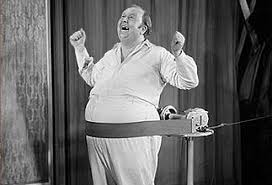
There are people who proudly say, “I don’t have the time to read, but I only watch the Discovery Channel and Public Broadcasting.” If you think you’re getting smarter just like readers, you’re not. You’re still mainlining information, and the parts of your brain that have to exercise when you read (or otherwise take in information in an abstract form) are shut down.
I’m not suggesting one shouldn’t watch television, or that you can’t learn something from it. I’m just saying that if you don’t read, but try to educate yourself via TV, you are the intellectual version of this guy…
As my wife and I prepare for our move to Bangalore, we are doing research to help us avoid inadvertent insult and blasphemy . We’ve learned such useful facts as: a.) don’t tug on a Sikh man’s beard, and b.) don’t buy a statue of the goddess Durga to use as a hat rack.

Durga Source: Dipankan001 (via Wikipedia)
These are just the kind of faux pas a well-meaning but uninformed American couple might make. (Oh, you say, not really?)
Every culture has its little proclivities that seem insane from the outside, but which are so deeply ingrained as to be invisible from the inside. (In fact, I had trouble thinking up such American cultural proclivities, but I believe they exist. Our norms are just so ingrained as to be hard to see. Of course, we are also a diverse society, a young nation, and tend toward the irreverent in the social domain– all of which may make our cultural idiosyncrasies look a bit different from those of more traditional societies.)
We’ve been reading books like Culture Shock! India, which is one of a series of books that explain the various cultural idiosyncrasies of different countries. (I was first introduced to the series through Culture Shock! Cambodia, though I have read other such books about China and Japan.) Such guides are extremely useful for explaining do’s and don’ts. However, they don’t necessarily prepare one for the corporate culture of India, which is a mix of Indian, Western, and multinational business cultures. For insight into the corporate culture we turned to:
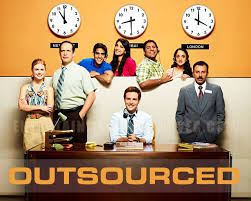 For those of you unfamiliar, Outsourced was a sitcom that ran for one season (2010-2011) on NBC. The premise of the show was that the manager of a novelty company call center is moved from the US to Mumbai. He becomes acquainted with Indian culture as he must teach his staff enough about American culture so that they can communicate with the customers they are on the phone with all day. Some of the humor comes from the exposure of a very conservative workforce to products that include dildos and slutty Halloween costumes, but much of it is just cultural tension more broadly. The show was popular with critics and Americans familiar with India. Unfortunately, that was not enough to keep it on the air, particularly when Americans who buy tacky crap and couldn’t find India on a map were the butt of the joke at least as much as were Indians. (Americans who buy tacky crap and are geographically illiterate are a large demographic within the television viewing public.) At any rate, the show was clever and well-acted.
One may scoff at the use of a sitcom as reference material, but the show seemed to be well-researched. For example, I know that its discussion of the famous Indian head bobble matched the description in the cultural guide quite well. The bobble is a non answer that can mean virtually anything. The video below gives a more detailed explanation, but the visual is not so good. From what I’ve seen, most people tend to do this action more with the top of the head staying relatively stationary while the jawline swings side-to-side.
This left us wondering whether other elements of the show will ring true. The show introduced me to a new term, “holiduping.” This is when one’s employees convince a manager that a day is a holiday, when in reality it isn’t. To get the joke, you must know that Indians have enough work holidays to make US Federal employees say, “Damn, that’s a lot of holidays!” Furthermore, not all the holidays are national. There may be days taken off in Karnataka that are not in Gujarat, and vice versa. This can make it a challenge for new comers to keep track.
I’m curious as to the views of people in-the-know about how accurate Outsourced was. Most of the cast were Americans of Indian origin, but it doesn’t look like the same was true of the lead writers.


 Tiger Riding for Beginners