BOOK REVIEW: The Tibetan Yogas of Dream and Sleep by Tenzin Wangyal Rinpoche

The Tibetan Yogas Of Dream And SleepThe Tibetan Yogas Of Dream And Sleep by Tenzin Wangyal

My rating: 5 of 5 stars

Amazon page

I stumbled upon this book in a used bookstore, and didn’t know what to expect–but was intrigued. It’s a book on the Tibetan Bön approach to dream yoga and sleep yoga, written by a Bön lama (monk.) Dream yoga is a term used in Buddhism and other Eastern traditions to refer to what is called lucid dreaming in Western scientific circles. My review will focus on the more than 3/4ths of the book that deals in dream yoga (lucid dreaming.) The 40-ish pages that deal with sleep yoga are outside my wheelhouse. The author suggests that that part is for initiates who are familiar with certain background concepts. I’m not an initiate, and—in fact—I have no idea whether there is any merit to sleep yoga practice. Lucid dreaming is a well-studied and documented phenomena, but, as far as I know, what the author calls sleep yoga remains unstudied. All I can say is that the part on dream yoga is readily comprehensible, despite much of it being couched in spiritual terms, but a lot of the section on sleep yoga is arcane and ethereal.

As it happens, I was pleasantly surprised with the portion of the book about dream yoga. Having read a number of books dealing with the subject recently, I wasn’t sure whether I would learn anything that was both new and useful. But I was exposed to ideas that were new, useful, and mind-blowing. There were a few ideas for helping one to achieve lucid dreaming—mostly through practices carried out during the day—that I’d not seen in other works, at least not put in such clear terms. Also, while there is a lot of reference to the Bön and Buddhist spiritual traditions, this didn’t result in the explanations being needlessly complicated or arcane. There is a lot of information that one doesn’t need if one is a secular practitioner, but many readers will find it interesting, even if it’s not necessary to advance their practice.

The book is organized into six parts: 1.) The Nature of Dream, 2.) Kinds and Uses of Dreams, 3.) The Practice of Dream Yoga, 4.) Sleep, 5.) The Practice of Sleep Yoga, and 6.) Elaborations. The last part has information pertinent to both dream yoga and sleep yoga.

There are some graphics in the book including photos, line drawings, and tables. Most of these aren’t essential, but some make it easier to imagine what the author is describing (e.g. when he discusses sleeping positions.) The book has a glossary and bibliography. The former is useful, and the latter doesn’t hurt (but it’s only one page and offers only a handful of citations.) The glossary is mostly of foreign terms, but includes English terms specific to the religious traditions discussed. It offers both Tibetan and Sanskrit variants of the word if they exist, which is a nice feature. There is also an appendix which summarizes the crucial practices elaborated upon in the book.

I’d recommend this book for those interested in developing a lucid dreaming practice. I will say that it may not be the best first book to read on the subject, unless you are a practitioner of Bön or intend to be. (For that, I would recommend Charlie Morley’s “Lucid Dreaming: A Beginner’s Guide…” which I recently reviewed.) However, this book makes an excellent follow-up once one has read a book that is couched in simpler terms (i.e. not specific to a certain spiritual tradition) and which reports on the science. I found that the book gave me a number of new ideas, and—in fact—offered some insightful ideas.

View all my reviews

Even imaginary monsters get bigger if you feed them

Public domain image sourced from Wikipedia

Public domain image of Epictetus, sourced from Wikipedia

There’s a story about Epictetus infuriating a member of the Roman gentry by asking, “Are you free?”


(Background for those not into Greek and Roman philosophy. Epictetus was a Roman slave who gained his freedom to become one of the preeminent teachers of stoicism. Stoicism is a philosophy that tells us that it’s worthless to get tied up in emotional knots over what will, won’t, or has happened in life. For Stoics, there are two kinds of events. Those one can do something about and those that one can’t. If an event is of the former variety, one should put all of one’s energy into doing what one can to achieve a preferable (and virtuous) outcome. If an event is of the latter variety, it’s still a waste of energy to get caught up in emotional turbulence. Take what comes and accept the fact that you had no ability to make events happen otherwise.)


To the man insulted by Epictetus, his freedom was self-evident. He owned land. He could cast a vote. He gave orders to slaves and laborers, and not the other way around. What more could one offer as proof of one’s freedom? Of course, he missed Epictetus’s point. The question wasn’t whether the man was free from external oppressors, but whether he was free from his own fears? Was he locked into behavior because he didn’t have the courage to do otherwise?


I recently picked up a book on dream yoga by a Tibetan Lama, Tenzin Wangyal Rinpoche. Lucid dreaming has been one of my goals as of late. I wasn’t expecting to learn anything new about practices to facilitate lucid dreaming because I’ve been reading quite a bit about the science, recently. I just thought that it would be interesting to see how the Tibetan approach to lucid dreaming maps to that of modern-day psychology. Tibetan Buddhists are–after all–the acknowledged masters of dream yoga, and have a long history of it. Furthermore, I’ve been doing research about the science behind “old school” approaches to mind-body development, lately. At any rate, it turns out that there were several new preparatory practices that I picked up and have begun to experiment with, and one of them is relevant to this discussion.


This will sound a little new-agey at first, but when you think it out it makes sense. The exercise is to acknowledge the dream-like quality of one’s emotionally charged thoughts during waking life. Consider an example: You’re driving to an important meeting. You hit a couple long red lights. You begin to think about how, if you keep hitting only red lights, you’re going to be late and it’s going to look bad to your boss or client. As you think about this you begin to get anxious.  But there is no more reality in the source of your fear than there is when you see a monster in your dreams. There’s a potentiality, not a reality. Both the inevitability of being late and the monster are projections of your mind, and yet tangible physiological responses are triggered (i.e. heart rate up, digestion interfered with, etc.) It should be noted the anxiety isn’t without purpose. It’s designed to kick you into planning mode, to plan for the worst-case scenario. Cumulatively, one can get caught up in a web of stress that has a negative impact on one’s health and quality of life.  For most people, when they arrive on time, they forget all about their anxiety and their bodily systems will return to the status quo, until the next time (which might be almost immediately.) Some few will obsess about the “close call” and how they should have planned better, going full-tilt into a stress spiral.


Mind states have consequences, whether or not they’re based in reality. I’ve always been befuddled by something I read about Ernest Hemingway. He’d won a Nobel Prize for Literature and was universally regarded as one of the masters of American literature, but he committed suicide because he feared he’d never be able to produce works on the level that he’d written as a younger man. There seems to be more to it than that. Many others managed to comfortably rest on their laurels when writing became hard[er]–including writers with much less distinguished careers.  The monster may be imaginary, but if you feed it, it still gets bigger.


As you go about your day, try to notice your day-dreams, mental wanderings, and the emotional states they suggest. You might be surprised to find how many of them have little basis in reality. They are waking dreams.

BOOK REVIEW: Running with the Mind of Meditation by Sakyong Mipham

Running with the Mind of Meditation: Lessons for Training Body and MindRunning with the Mind of Meditation: Lessons for Training Body and Mind by Sakyong Mipham
My rating: 4 of 5 stars

Amazon page

Tibetan Buddhists believe Sakyong Mipham is the reincarnation of a great teacher from late 19th century Tibet. He’s also completed many marathons—nine at the time of this book’s publication. He’s certainly qualified to comment on meditation, running, and the nexus of the two–if there is such a thing. However, it may not be clear that the topics are particularly connected. Readers may have an intuitive sense that they are closely connected, but without sufficient understanding of both elements to draw sound conclusions.

The author, himself, proposes that one should recognize the points of contrast as well as comparisons between the two activities. A couple quotes make this clear:
“People sometimes say, ‘Running is my meditation’… in reality, running is running and meditation is meditation… It would be just as inaccurate to say, ‘Meditation is my exercise.’”
“The body benefits from movement, and the mind benefits from stillness.”
Later in the book, the author suggests that the apparent clarity after running usually has more to do with the “wild horse” of the mind being tired, rather than it being tamed. (Taming the mind being the objective of meditation.) That said, Mipham Rinpoche clearly believes that there are benefits to be had from an interaction between these two activities.

The book is divided into six parts. The first part gives background on basics like base-building, breath, what meditation is, and the challenge of starting to build a regime (either of running, meditation, or both.) The rest of the book is organized by way of a Tibetan Buddhist conception about how new skills are learned. This schema relies on animal symbolism. The first level is that of the tiger, and this is when one works on attentively and conscientiously building one’s technique. The lion level follows the tiger. The lion phase is a joyful one because a base capacity and fundamentals have been built and the initial struggle is in the past. The next phase is represented by the Garuda (a mythical eagle-like creature that features in Hindu as well as Buddhist mythology), and it’s expressed by challenging oneself to more demanding practice. The final phase is the dragon, and it involves moving beyond doing the activity for oneself to doing it for others. There’s a final part, entitled the windhorse, that is based on the notion of an energy that Tibetan Buddhists believe accumulates when one follows the aforementioned 4 phase path. This last part is a description of events that might be seen as the culmination of the author’s running career.

Within the aforementioned six parts, there are 40 chapters—most of which are only a few pages and deal with a specific aspect (or pitfall) of that phase of training.

I found this book interesting. Learning about the four phases (tiger, lion, garuda, and dragon) of skill development was illuminating, and I found myself thinking about how this idea could be more widely applied. It’s a handy conception with broad utility. The author uses stories from his own experience to add credibility as well as light-heartedness to the philosophy lessons being taught. While the book may seem ethereal, much of the discussion is on down-to-earth subjects like dealing with pain and injury. It should be noted that the introductory and tiger parts make up a little more than half the book—suggesting the importance of fundamentals. There’s a lot of valuable information on fear, confidence, and how to view pain.

I’d recommend this book, especially for runners and meditators—but not exclusively so. Many people who are interested in mind / body interaction will be able to draw useful lessons from the book, even if running isn’t your thing.

View all my reviews

DAILY PHOTO: Namdroling Façade

Taken in March of 2014 at Namdroling Monastery

Taken in March of 2014 at Namdroling Monastery

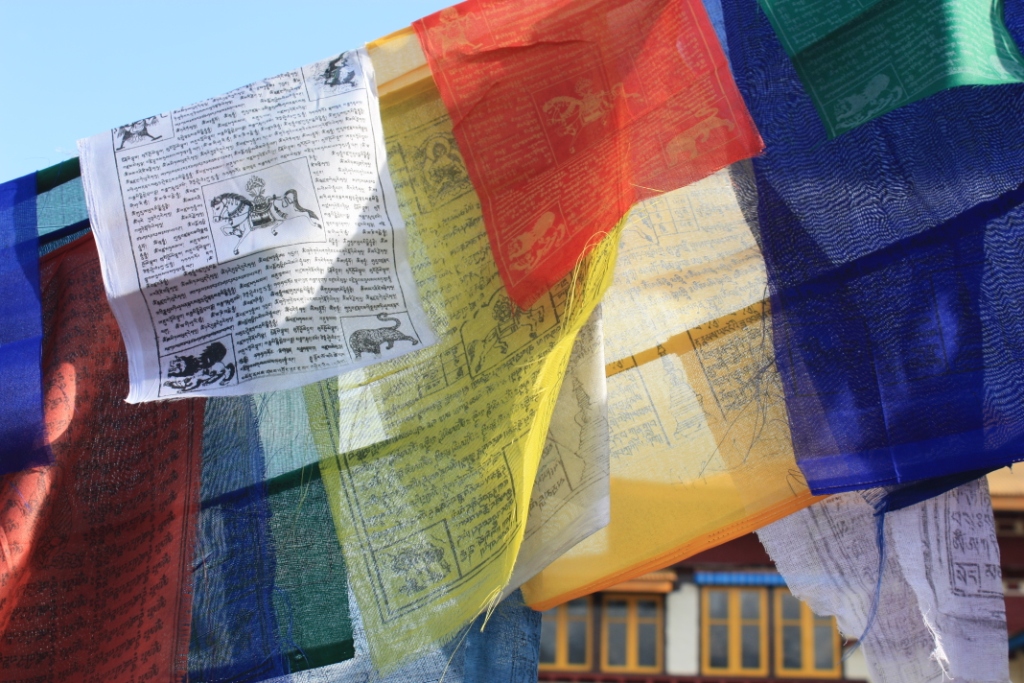
DAILY PHOTO: Prayer Flags, With Fun Facts

Taken on June 16, 2015 in Manali

Taken on June 16, 2015 in Manali at Gadhan Thekchoking Gompa


Now heavily associated with Tibetan Buddhism, colorful prayer flags are believed to have originated with Bon–an indigenous religion of Tibet that predated Buddhism’s arrival.

Traditionally, the color progression from left to right is blue, white, red, green, and yellow (i.e. as seen in the top row), but variations can be seen.

Besides monasteries and temples, one will often see strings of flags out in natural settings on mountains.

The day and time of placement of the flags is considered carefully because it’s believed that if they are hung at inauspicious times they may bring bad fortune instead of the desired compassion and peace.

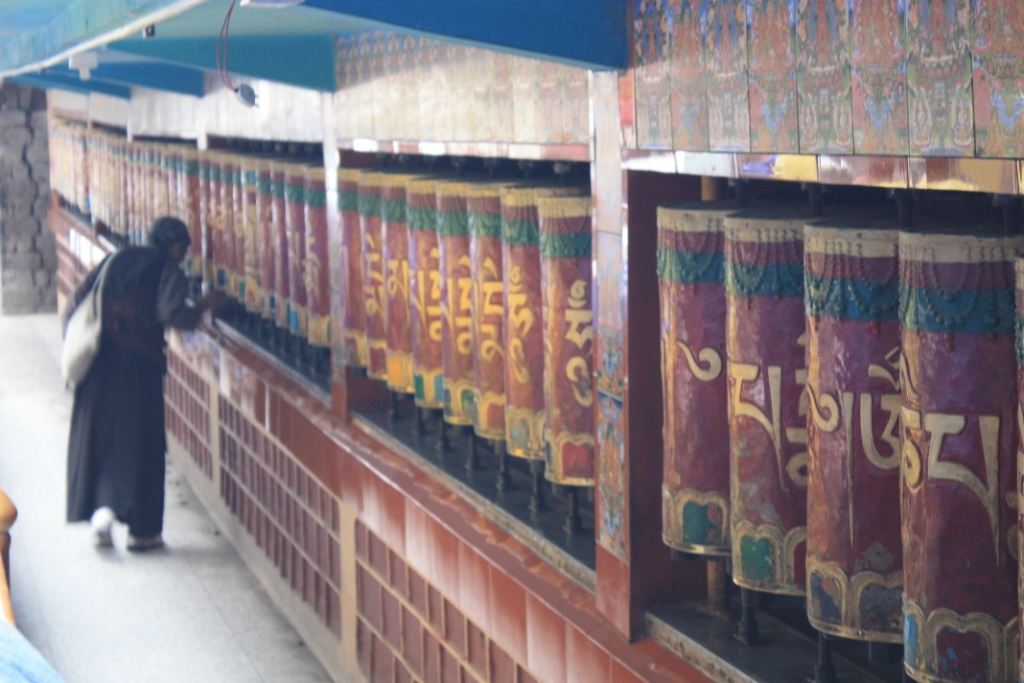
DAILY PHOTO: Woman Spinning Wheels at Kalachakra Temple

Taken on June 23, 2015 in McLeodganj

Taken on June 23, 2015 in McLeodganj

BOOK REVIEW: The Voice of the Silence by Helena Petrovna Blavatsky

The Voice of the Silence: Being Extracts from The Book of the Golden PreceptsThe Voice of the Silence: Being Extracts from The Book of the Golden Precepts by Helena Petrovna Blavatsky

My rating: 3 of 5 stars

Amazon page

According to Helena Blavatsky, the three “fragments” that make up The Voice of the Silence are her translations of three tracts from The Book of Golden Precepts, of which there are 90 and she had memorized 39. The Book of Golden Precepts is said to include both Buddhist and pre-Buddhists views on spirituality.

Blavatsky was one of the founding members of the Theosophical Society, an organization that proposed and advanced a certain brand of mysticism. Mystic traditions are those which believe that one must look inward to find the divine, i.e. to know god. The Theosophical approach isn’t without controversy. Blavatsky’s allusion to a secret path to wisdom and the suggestion that most of the world isn’t ready for the high level teachings sits in contradiction to a Siddhartha Buddha who was transparent. Buddhists have been known to claim that in as much as an idea is a teaching of the Buddha, it wasn’t secret, and in as much as a teaching was secret, it wasn’t the work of the Buddha. But there is disagreement. Some believe that what Blavatsky is presenting is high level Mahayana Buddhism, but others think that it’s a hodge-podge of Kabbala, esoteric Buddhism, and yogic teachings.

The first “fragment” is also titled “The Voice of the Silence.” This section suggests that there are three stages to one’s journey: ignorance, learning, and wisdom. It states that one must take care to not to be distracted from the path by sensual inclinations or by desire. The path described mirrors the advanced stages of Patanjali’s eight-limbs. In other words, she discusses a progression from pratyahara (not explicitly named, but described as the withdrawal of sensory input), dharana (concentration), dhyana (meditation), and Samadhi (liberation.)

The second part is entitled “The Two Paths.” Liberation and renunciation are the two paths in question. The central topic of this chapter is Karma, and the questions of action versus inaction that are also discussed in the Bhagavad-Gita.

The third part is “The Seven Portals.” These seven doors through which one must pass on the way to wisdom are essentially the same as the six paramita of Buddhism with an additional one, Virag, inserted between the third and fourth spot. The portals are Dana (generosity), Shila (a.k.a. Sila, or virtue), Kshanti (patience / perseverance), Virag (illusion conquered), Virya (energy), Dhyana (contemplation), and Prajna (wisdom).

A nice feature is a “glossary” at the end of each of the fragment that explains some of the terminology and concepts. While this is called a glossary, it’s not one in the usual sense, i.e. it’s not in alphabetical order and is not exclusively definitions. It would better be described as chapter notes. The idea is to convey the information that a lay reader may need, but which the author / translator doesn’t want to muddle the text with.

I think this book is worth a read. It’s short, and for a work written in the 19th century it’s quite readable—that doesn’t mean that the message is always clearly conveyed—whether on purpose or accident.

Note: While I read this on Kindle for a nominal price, it’s available on the web free of charge (see here.)

View all my reviews

BOOK REVIEW: The Mind of the Guru by Rajiv Mehrotra

The Mind of the Guru: Conversations with Spiritual MastersThe Mind of the Guru: Conversations with Spiritual Masters by Rajiv Mehrotra

My rating: 3 of 5 stars

Amazon Page

The Mind of the Guru is a compilation of 20 interviews with various teachers and spiritual leaders. While most of the individuals are from Indian spiritual traditions or offshoots thereof, the author makes concerted efforts to represent a range of religious and spiritual traditions.

The list of interview subjects is impressive and includes: The Dalai Lama (Tibetan Buddhism), Thich Nhat Hanh (Zen), S.N. Goenka (Vipassana), BKS Iyengar (yoga), Deepak Chopra (medical doctor and spiritual pundit), Sri Sri Ravi Shankar (Art of Living founder), Desmond Tutu (Christianity), and The Aga Khan (Islam.)

The book is at its best when these gurus are discussing their thoughts on development of the mind and spirit. Obviously, there is a lot of this type of discussion as that is the expertise of most all of the assembled teachers.

A brief forward by The Dalai Lama sets the theme of the discussion. His Holiness states that in Buddhist tradition one becomes a teacher because one has students. Consider this in contrast to traditions that fallaciously believe the title of teacher is granted from above. A master teacher may grant a teaching licence, but that’s just a piece of paper unless someone shows up to one’s lessons. He then goes on to say that one should abandon teachers who act in an unwholesome manner. This, too, is an important point. Having invested oneself in loyalty, it can feel like betrayal to leave a teacher who no longer suits one.

His Holiness is the lead chapter interviewee. In the early part of the chapter, he presents many thoughts on Tibetan mind science. “Mind science” may seem like a strange term, but there’s an important part of Tibetan Buddhism that deals not with deities and conceptions of morality, but with understanding and improving how the mind operates.

If one comes from a tradition in which science and religion are in tension, this may seem unusual, but there is a definite scientific approach (observing the mind and playing out experiments with it.) One doesn’t see a rift between science and religion in Tibetan Buddhism. In fact, His Holiness says that if certain parts of the religious tradition were proved not to exist, they would have to be abandoned. (For those beginning to raise objections, shown to be unlikely and disproven are two different things.)

A second Tibetan Buddhist, Sogyal Rinpoche, addresses the topic of death, and lends the book one of my favorite quotes: “If you are worried about dying, don’t worry, you will all die successfully.”

The first part of this five part book also includes interviews with Thich Nhat Hanh and S.N. Goenka. The former talks about mindfulness and the “interbeing,” and the latter describes the Vipassana approach to meditation and its development. Interbeing is a term coined by Hanh to address a being who is connected to all things. For those unfamiliar with Vipassana, it’s a meditation practice that emphasizes 10-day intensive meditation retreats. There are many retreat centers where this is practiced around the world, including one in the city in which I currently live, Bangalore.

The second part deals with the unity of mind and body. BKS Igenyar, head of a self-named branch of Hatha yoga, opens the chapter with discussion of his background and approach to yoga. Deepak Chopra talks about the intersection of science and spirituality. David Frawley talks about Ayurvedic medicine as well as some more “out there” subjects, such as astrology.

I hadn’t heard of two of the three interviewees in part three, Swami Ranganathananda and Mata Amritanandamayi. However the third interview was Sri Sri Ravi Shankar, a guru well-known internationally for his soft-spoken teachings that combine yoga with a secular spiritualism rooted in Hinduism but not explicitly advocating it. Swami Ranganathananda is from Ramakrishna’s order, which was a secular spiritualism movement rooted in Vedantic traditions but embracing diversity of belief. Mata Amritanandamayi is one of only two women interviewed for the book, indicating women haven’t achieved equality in guru-hood just yet–for all the talk of enlightened thinking. (This is not a dig at the author, who probably went out of his way to include these two to have diversity in gender as well as diversity of tradition.)

The fourth part adds to the diversity by opening with an interview with Sufi Muslim, Pir Vilayat Inayat Khan. Sufi is the mystical branch of Islam. (Mysticism meaning a belief structure in which God is considered to be part of one and is accessed by mindfulness and introspection. This in contrast to the largest strands of the world’s major religions in which God is conceptually something distinct from the self and is an entity to be worshiped. Most major religions have mystical elements or a mystical branch, including Christianity and Islam.) This interview eases us away from the traditions that are either of India or have their roots in India. (By that I mean that Buddhism has its roots in India, though, for example, Zen is different from Buddhism as practiced in India today.)I say “eases us away” because the mystical nature of Sufi would not create much cognitive dissonance in yoga practitioners, Hindu spiritualists, or Zen monks, but, instead, shares much common ground.

The second chapter in part 4 is that by the other female guru, Radha Burnier, who is a practitioner of Theosophy, which means “divine wisdom.” This modern development is secular in that it doesn’t advocate a particular religion, but rather engagement to fix societal problems and eliminate biases and divisions. In the interview we get a hint of the divides that plagued this organization.

Part four is rounded out by interviews with Swami Parthasarathy and U.G. Krishnamurti (not to be confused with Jiddu Krishnamurti, who probably would have been included in this book if he hadn’t died in the 1980’s.)The former speaks about the end of knowledge and the latter about his role as an anti-guru, rejecting traditional approaches to thinking about spirituality.

The fifth part of the book is entitled “The Ethics of Engagement” and I’m afraid it’s where the wheels roll off. It has six excellent authorities, Desmond Tutu, Baba Amte, Ajarn Sulak Sivaraksa, Swami Agnivesh, The Aga Khan, and Karan Singh.I don’t criticize the selection of interviewees, but what happens here is that the chapters predominantly become about politics and policy. Some of this discussion is present throughout the earlier chapters, it’s a point that the author/interviewer finds either intriguing or salable. For example, he asks The Dalai Lama about the politics of Tibet and China, but only after much wisdom is shared.

Here is my–sure to be highly controversial–view on the subject. Wise people show the least wisdom when they’re speaking of politics and policy. I understand why readers may want to hear their thoughts, and I know that as leaders they shape movements in these domains. However, their thoughts on such subjects rarely pack the wallop of value they do when they are talking about subjects like improving one’s mind or living a moral life–subjects on which they have great authority.

What happens when the wise talk about policy is the same thing that happens when most people do, they fail to understand the complexity of the issues and they end up making a lot of “have our cake and eat it too” statements. The most common of these is that we need to: a.) raise all the poor to a certain standard of living (a noble cause), b.) eliminate attachment to materialism and consumerism (also a fine cause, no one should be addicted to “stuff.”)

As one trained as an economist, however, when I see these statements issued by the same person in the same interview, I laugh. We have no idea how to achieve these two things simultaneously; anybody who tells you they do is living in a dream world or is deceiving you. If everybody decided tomorrow that they didn’t need a bunch of new gadgets and widgets, this wouldn’t help pull the poor out of poverty. On the contrary, it would lessen their opportunities to raise their quality of life. Conversely, if you want to pull people out of poverty, they have to produce and sell things that other people want. Rising incomes result from rising productivity, and rising productivity comes with rising production–but someone has to buy that increased production. If you have a way to truly get around this dilemma and it’s one that economist haven’t thought of before and which hasn’t either been proved wrong or internally inconsistent, I will personally lobby for you to be nominated for next year’s Nobel Prize in Economics, and would place a bet on you to win.

I will say that some of the authors seem more savvy of the political and societal domain than others. For example, Mata Amritanandamayi says, “Even if we remove all nuclear weapons from our armories and transfer the to a museum [that last bit is, admittedly, a really bad idea], it wouldn’t bring an end to war. The real nuclear weapons, the negative thoughts in our mind, should be eliminated.” In other words, you can’t fix society’s problems through dictates, particularly when those dictates are in contradiction.

One of my lesser complaints with the book is that the author sometimes asks leading questions (i.e. he subsumes a conclusion in the way he forms the question.) However, almost invariably the speaker sets the record straight, but it makes one wonder about how the message is shaped by the interviewer.

There may be a little too much cultural self-congratulation going on throughout the book for some. There’s a primacy fallacy theme throughout the book that India had everything perfect until it was infected by Western ideas. This isn’t to imply there aren’t fantastic ideas and cultural developments that have come out of India. I wouldn’t have read the book if I didn’t believe there were, but there was also the caste system and some other fairly giant issues of institutionalized injustice like women essentially being sold off into marriage.

An example of this bias can be seen in the talk of Swami Ranganathananda. He says of Socrates, “Had he been in India, he would have been honored and worshipped.” Yeah, if he were of the right caste, maybe, but he also might have been bludgeoned to death in a fashion far more brutal than having to drink hemlock.

Overall, I would recommend the book. It is an impressive collection of teachers and all of them have something intriguing to offer in food for thought. One just needs to go back to The Dalai Lama’s Forward and not be so awe-inspired that you fail to look critically at the message of each.

View all my reviews

Mindfulness Meditation: Why be Mindful?

IMG_0430“Why be mindful?” That was the question asked to the group assembled at the Thubten Lekshey Ling Tibetan Buddhist meditation center on Sunday.

We had just completed a couple of rounds of mindfulness meditation. We’d been told that there are four themes of mindfulness meditation, but there can be variations on each. First, there is mindfulness of the body. This was the first type of meditation that we practiced. It isn’t about recognizing the body as an object so much as a field of perceptions.

Second, there is mindfulness of one’s feelings or sensations, in other words, mindfulness of the outside world as perceived by our sense organs. We did a meditation in which we were mindful of sound in particular. The key, we were told, was to hear everything–even the sound of silence. “Listening to the sound of silence” may sound like an oxymoron, but it makes sense as one experiences it. When one thinks in terms of hearing sounds, one begins to actively try to “catch” a sound. One may even try to anticipate sounds, particularly sounds in series–like a roofer using a nail-gun on a nearby roof. This active listening, rather than hearing, is not what one wants.

We also did a mindful eating/tasting exercise. We ate a tiny bit of snack mix. The whole processing taking many times what it normally does to shovel a bit of snack into one’s mouth and wolf it down. The food was raised to one’s face, experienced, placed in one’s mouth, experienced, chewed, experienced, and swallowed.

Third, there is meditation on the mind. That is, one watches one’s thoughts. We didn’t do one of these meditations. However, I’ve tried it in the past, and I find this particularly difficult . Watching thoughts go by as if they were rising bubbles or logs floating on a river suggests a division between the observing mind and the thought-producing mind. Recognition of the thought intrudes upon it, and this becomes a whole new line of thought.

Finally, there is meditation on emotion. We did not do one of these in this session either.

Our final meditation was another type of meditation on the body, but it was a moving meditation. We walked and experienced the motion of the body as it moved through the room. I particularly enjoyed this.

However, before the last meditation, we discussed this question of “why be mindful?” I had my own ideas, which I shared. Others had their own ideas, some closer and others farther from my own thinking, but all thought-provoking and valid.

My own thoughts were two-fold. First, mindfulness allows one to be more stable and grounded. Fear is about the future and anger and sadness are about the past. In the present one is neither afraid nor fearful. Second, by being mindful, we can come to see problems before they tumble out of control. We can catch our angry thoughts and dissect them before they do us harm. We can recognize the subtle problems with our bodies before they come full-blown ailments.

Of course, as a martial artist, I had always thought in other terms about mindfulness. There’s no time at the speed of combat to consciously recognize and consciously respond to attacks, one must be mindful to have any hope of surviving a surprise attack.

My First Tibetan Buddhist Meditation & Lecture

Having settled into life in India over the past month, I’m now getting around to some of the self-enrichment activities I’ve planned on taking advantage of here in Bangalore. Today I attended a meditation session and discussion/lecture at the Thubten Lekshey Ling Tibetan Buddhist Meditation Center. I’ve read a few books on Buddhism and even one or two specific to Tibetan Buddhism, but this was my first time attending such a session. Also, while I’ve done several kinds of secular meditation, both in a group and individually, this was my first exposure to guided meditation in the Tibetan Buddhist tradition.

The title of the session was As the Clouds Drift by… The first hour was the meditation portion and the following two hours were the lecture / discussion portion. The session opened with a few prayers that were chanted in what I believe was Sanskrit, but there was an English translation for newbies such as myself to follow along with the meaning. Then we did a few short meditations that were much like others that I’ve done: meditation on breath and meditation on bodily awareness. Then there was a visualization as we read a sutra in English.

Transitioning into the discussion and lecture portion, we first discussed the meaning of life. No, I’m not making that up. While it might seem like a hackneyed question, some intriguing points were raised. We were directed to think of the question as having two alternative meanings. First, why am I here? Second, what is my purpose? The conversation gravitated to the latter topic. I’m not sure if this was because there was a consensus that the question “why am I here?” is meaningless, or if the question of purpose was just more intriguing. There were various opinions about whether there was a purpose, and–if so–whether it is universal or individual-specific.

After a brief tea break, the remainder of the session involved readings from The Way of Bodhisattva followed by analysis and prompted discussion. Much of the discussion revolved around the issue of how compassion is expressed and the difficulty (or ease) of being a Bodhisattva. (A Bodhisattva is one who seeks enlightenment out of compassion for all sentient beings.)

I found the session to be thought-provoking and beneficial, and thought the atmosphere was conducive to growth. Emphasis was placed on discussion rather than straight lecturing. I will no doubt be back to visit in the future.

I did learn something interesting about myself through the process of the class, and that’s that I need to learn to be still for more than two hours. While there was no prohibition on moving around–particularly beyond the meditation portion– in an effort to not be a distraction, I tried to keep fairly still. I practically ran home afterwords. I had all this pent-up energy. I would have thought myself better than average at sitting in a contemplative state. I’m a writer for goodness sake. I spend entire days at my computer. However, in truth, I rarely sit more than an hour without getting up and stretching or doing some sort of movement to limber up my body and get the blood flowing. I was raised Catholic, and so I’m not new to sitting quietly for long periods of time. Though that was a long time ago. I also have three college degrees and have spent more than my fair share of time in classrooms, but the wandering mind is not discouraged in that environment–in a way it’s encouraged.