The Way [Haiku]

the mountain trail rounds
from shady to sunny side,
where caves line the path.

Yin & Yang [Haiku]

the sunny side
of the mountain falls into
a cloud’s shadow.

Crouching Tiger [Free Verse]

In a square hut -
beside a craggy pass -
lived a Crouching Tiger,
a man of spontaneity
who danced to no music,
staggered when sober,
rested in times of urgency,
& labored when there seemed
to be nothing in need of doing.

He was courted by Emperors,
but shunned them.
The only way the Emperor
could get him to visit was
to order his exile.

BOOK REVIEW: Dao De Jing: A Minimalist Translation by Lao Zi [Trans. Bruce R. Linnell]

Dao De Jing: A Minimalist TranslationDao De Jing: A Minimalist Translation by Lao Zi
My rating: 5 of 5 stars

Available Free on Project Gutenberg

The Dao De Jing presents the core philosophy of Taoism, a philosophy that values simplification, non-action, naturalness, spontaneity, and recognition of opposites in [and their influence on] each other. There are numerous editions (this is the Wang Bi / “standard” ed.) and English translations of this Daoist tract, and the translation matters because the Dao De Jing is at once simply stated and arcane. I liked what Linnell did with this translation, which – as the subtitle suggests – he aimed to make simple and straightforward.

One nice feature of this translation is that each of the 81 chapters has four segments: the original Chinese text, a readable English translation, a word-for-word literal translation, and notes. Having the Chinese, a literal translation, and notes can be helpful when one has trouble deciphering the more cryptic passages. Another nice feature is an appendix in which the author discusses another scholar’s hypothesis that the chapters of the Dao De Jing were composed in layers, and Linnell re-orders the chapters as suggested by this hypothesis. Finally, the book ends with a Jefferson Bible-esque excerpt collection that takes all the places where Lao Zi wrote “Thus the sage:” and builds a single composition describing a wise person.

If you’re interested in Taoist philosophy, you may want to read this translation, whether you’re new to the Dao De Jing or you’ve read other translations or editions in the past.


View all my reviews

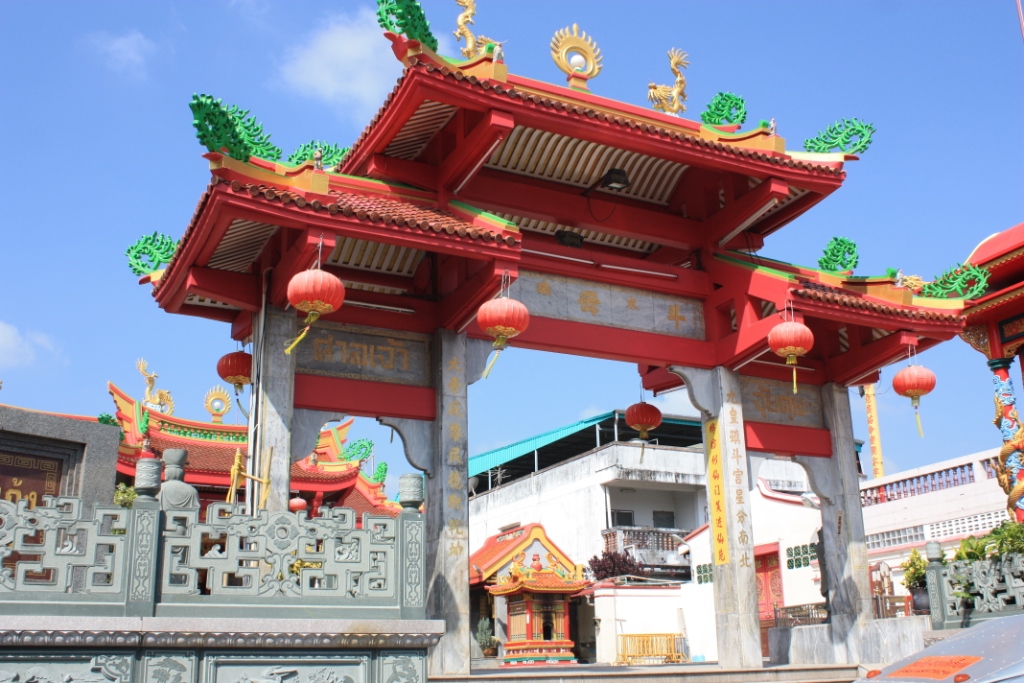
DAILY PHOTO: Gate of the Jui Tui Chinese Temple

Taken in January of 2014 in Phuket

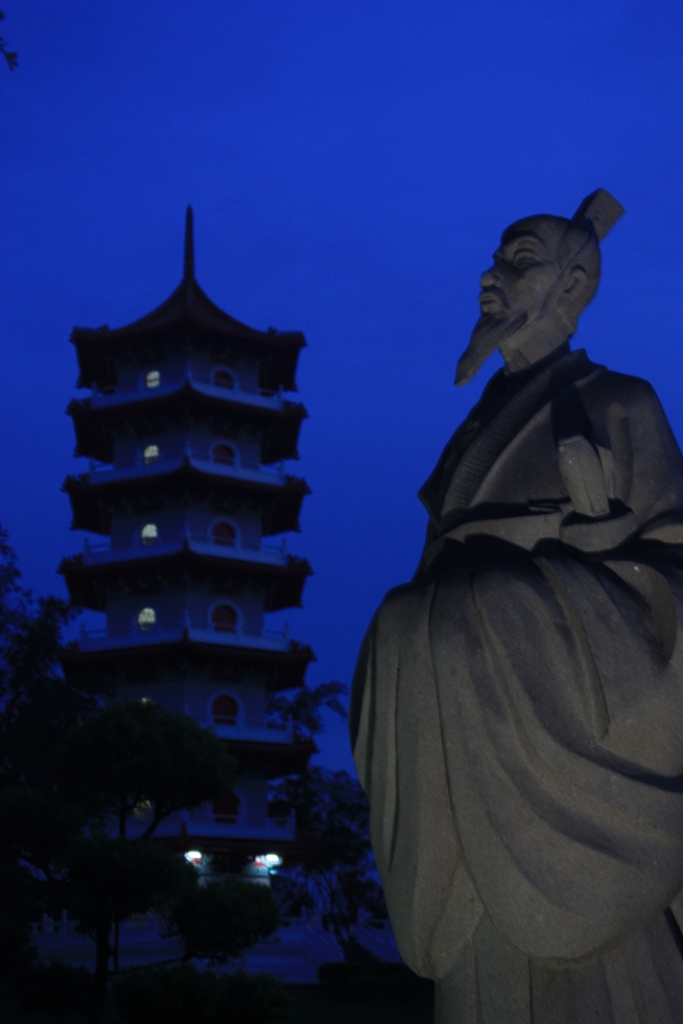
The Taoist [Free Verse]

In the pagoda garden,
the philosopher stares
into the inky darkness,

contemplating its slow
flow into the light,

reflecting upon the light
embedded in all darkness,

light that he sees in
a glint of moonlight 
on still waters.

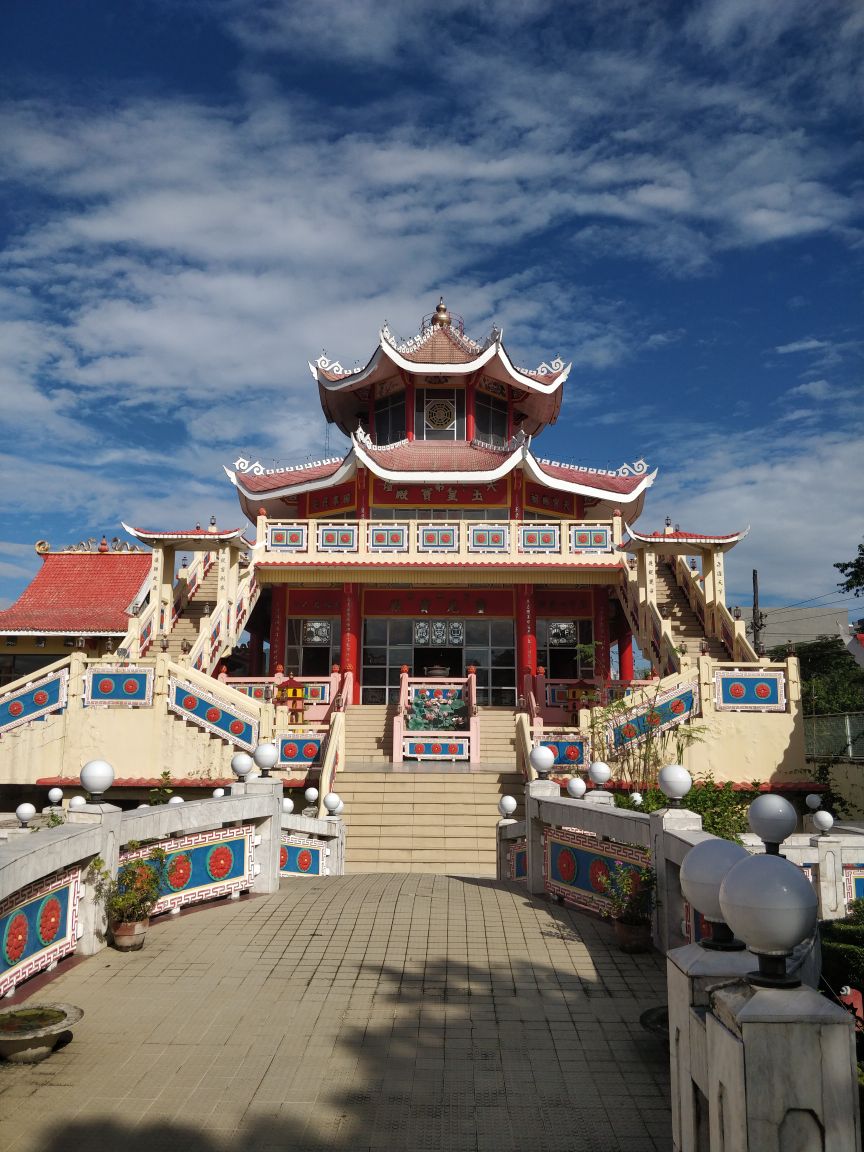
DAILY PHOTO: Taoist Temple Under Blue Skies

Philippine Chinese Spiritual Temple; Cebu City

BOOK REVIEW: The Te of Piglet by Benjamin Hoff

The Te of PigletThe Te of Piglet by Benjamin Hoff
My rating: 3 of 5 stars

Amazon.in page


Once in a while, one runs across a book that is much beloved by the general public, and one can’t figure out why. For me, this is one of those books, (as is its predecessor, “The Tao of Pooh.”) I certainly get the appeal of such a book, in principle. A book that clarifies and simplifies a subject as complex as philosophy using straightforward, down-to-earth, and well-known children’s stories like those from A.A. Milne’s “Pooh” book series is a brilliant idea, and is the kind of book I’d generally enjoy reading. [I’m a big believer in Einstein’s notion that, “If you can’t explain it to a six-year-old, you don’t understand it yourself.”] Maybe that’s why I gave this book a rare second-chance. I’d listened to the audiobook from the library many years back, and didn’t much care for it at the time. However, the idea of the book was so appealing that I picked up a copy at a used bookstore recently, figuring that I’ve certainly changed my mind on many things over the years. Unfortunately, my opinion of this book has not improved. It’s a stellar book idea that, in my view, was poorly executed.

Before I get into what I found objectionable about this book, it’s worth noting that when the book is at its best it delivers some beautiful lessons on Taoist thought in a humorous and lighthearted way, illustrating these lessons through a mix of Pooh character interactions and quotes and tales from Lao Tzu, Zhuangzi, and other Taoist sources. When is the book at its best? When there is an interaction between two streams of voice: Taoist sage and Pooh-universe kid’s characters. Perhaps surprisingly, those two voices work well together – harmoniously and effectively.

So, what, you may ask, is my problem. It is the frequent interjection of a third voice, one that I will call “angry ideologue.” This angry ideologue is not at all in harmony with the other two voices, and –in fact — frequently detracts from the lessons by violating them outright. A prime example of this can be seen with respect to the fifth chapter’s (i.e. “The Eeyore Effect”) lesson against belittling others to make oneself feel bigger. A great lesson, except that Hoff is so quick to behave in conflict with it. A minor, but unfortunately not atypical, example can be seen in the previous chapter in which Hoff proves unable of extolling the virtues of Taiji and Pa Kua Chang (two Chinese martial arts) with the need denigrate a couple of Japanese martial arts (judo and aikido) in the process.

The most widespread example of his failure to do as he says, however, involves Hoff’s attacks against Confucianism. To be fair, there is a long history of Taoist and Confucianists badmouthing each other, but this need to tear down others to feel better about oneself is not consistent with the ideas that are explicitly expressed in the book. Hoff greatly oversimplifies Confucianist arguments, and while it’s certainly alright to simplify for the purposes of such a book, one can employ simplification as a weapon — cherry-picking ideas and statements out of context to make the other side look inept and illogical. Hoff violently swerves between the book that is advertised into political diatribes that often employ gratuitous attacks. To be fair, these digressions are probably not so dominant in the book as I make them sound, but the effect is multiplied by the distraction created – particularly when there is a sequence in which Hoff shares some Pooh wisdom to be kind, tolerant, or humble and he follows this by being none-of-the-above in his vilification of those with differing views.

While there are obviously many who would disagree with me, I’d recommend one look elsewhere to better understand the tenets of Taoism. There are certainly books that are more balanced and which will teach one more about Taoist thinking (as opposed to how to cherry-pick and twist Taoist ideas so that they seem to support a particular political stance.)

That said, one advantage of this book (and its predecessor) is that it is designed to speak to a wide age-range, and while books like Puett’s “The Path” and Slingerhand’s “Trying Not to Try” are better books for learning about Taoism but yet are very readable for a non-scholarly reader, they are not necessarily kid-friendly. I can’t say that I know any good kid-oriented books on Taoism (though some may well exist,) but I tend to believe that kids are more likely to pick up bad habits of thinking about people with different points of view and about interacting with others through this book then they are to learn good habits of mind. [Although, if one skips over the diatribes, it might serve quite well. And if one doesn’t skip them, one will still be preparing your child to participate in what passes for political discourse in the modern era.]

View all my reviews

POEM: The Tao of Being

Dance that mad head-on collision
into that which spins like a top.
Let it roll; but don’t make it stop.
Cleave, but don’t create the division.

Don’t strike out for fields, Elysian;
find Eden in being unaffected.
Be none; be all, & thus connected.

Sometimes, there’s might in precision,
but, sometimes, it kills through indecision.

Heed the Way more than the result.

No one ‘s converted by insult.
Stifle the urge to spew derision.

Moral superiority won’t keep you warm;
it’s just illusion of another form.


BOOK REVIEW: Cold Mountain: One Hundred Poems by the T’ang Poet Han-Shan

Cold Mountain: One Hundred Poems by the t'Ang Poet Han-ShanCold Mountain: One Hundred Poems by the t’Ang Poet Han-Shan by Hanshan
My rating: 5 of 5 stars

Amazon.in page


This brief collection gathers one hundred poems from the T’ang Dynasty poet Han-Shan. Most of the poems included consist of a single eight-line stanza of unrhymed verse of varied meter. [With a few exceptions that had more or fewer lines (often four or twelve.)] I do like that they didn’t pad out edition that I read with a lot of inane babble [as publishers are want to do when a volume is on the thin side.] Part of the reason that they may not have done so is that there is virtually nothing known about the author. It’s not even known whether there was a Han-Shan (i.e. as opposed to a group of people whose poems were anthologized under one name.)

The poems reflect Taoism’s disdain for pretension, authority, or scholarship for scholarship’s sake. Many of the poems reflect Zen sensibilities (which became entwined with Taoist sensibilities.) That is to say, like Zen koan, they seek to interrupt the tendency to overintellectualize matters. That said, in places the poems take a bit of a mocking attitude toward Buddhism. Nature plays prominently among the poems. And some of the poems are humorous or irreverent.

There are footnotes that are helpful in explaining verse that references teachings and events that would have been known to Han-Shan’s readership back in his day, but which most individuals who aren’t experts on Chinese folklore, literature, or religious teachings wouldn’t be likely to get, otherwise.

I enjoyed these poems tremendously. While I can’t say how they related to the original text, the translations were — on their own – works that conveyed wit and wisdom. I’d highly recommend this collection for poetry readers.

View all my reviews