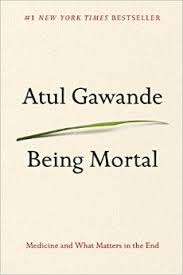
 Being Mortal: Medicine and What Matters in the End by Atul Gawande
My rating: 5 of 5 stars
Amazon page
This may be the scariest, saddest, and most necessary book that I’ve read in some time. In it, Dr. Gawande discusses how medicine has proven increasingly effective at extending life, but—at the same time–we are less able to care for the elderly. The traditional approach, in which the elderly move back in with their families (or live independently near them,) often proves untenable. And it’s not necessarily because people are too busy, lazy, or indifferent to put up with granny, but rather that granny is likely to end up with needs that require a professional caregiver—in some cases for virtually every aspect of her daily life. In short, we’ve done a great job of extending life, but often with a sharp dip in the quality of life at the end.
The nursing home was the solution that the health care community came up with when this problem first became apparent. While the nursing home is both necessary and effective for many, for those of sound mind and sound-ish body, the move can be highly demoralizing. People revert from being independent and autonomous adults into a child-like status in which they have little freedom or privacy. Again, if grandpa has dementia or needs to be tube-fed, there’s no way around this, but if he’s just at risk for a fall that might break his hip, then it can be humiliating.
When it comes down to the end, fear of death has led to an unwillingness to ask important questions or even consider what might be just around the corner. This has led patients to keep asking for that one treatment that just might extend their lives—and doctors have been more than willing to allow this. This may be fine in the early days of a terminal illness, but once one has gone through—say–a couple of courses of chemotherapy, the treatment one is likely to get is some trial phase experiment that is as likely to kill one cruelly as extend one’s life—and to the degree that it does extend one’s life one may suffer a set of complications far more miserably than one would in letting the disease kill one. One of the most intriguing study results cited showed that people who took up hospice palliative care (making one comfortable) were found on average to live a little longer than those who kept seeking whatever treatment they could find.
This all sounds like bad news, but the author devotes much of the book to exploring the options that have been put forth in the face of these problems. One of these is the assisted living facility as an alternative to a traditional nursing home. These facilities work for people who are of sound mind and who aren’t too bad off physically. They allow the individuals to live as they might in a condo or apartment, but there are on-sight caregivers and assistance with all the tasks around the house that might prove too challenging for an older person. The other major solution is hospice care. Not that palliative care is new, but it’s increasingly being show to be a preferable option for all concerned. Another important outcome resulted from a major insurance provider’s decision to allow individuals to pursue palliative care while they were still being treated. [Historically, one only had the option of hospice once one had given up on treatment.] At any rate, the intriguing finding was that the insurance company actually ended up paying less because more people signed up for palliative care and those individuals used expensive health care elements like emergency rooms and intensive care units (ICU) less.
While I can’t say that I enjoyed reading this book, I would recommend it for everyone. It’s very readable. The approach is case-based. Dr. Gawande talks not only about his own patients and the patients and caregivers that he interviewed (his practice is not geriatric in nature, so he spoke with several experts), but also about the end of his own father’s life. It’s a short book of about 300 pages arranged into eight chapters. There are no graphics, and endnotes are the only ancillary matter, but nothing else is necessary for this book.
Read it.
View all my reviews
Share on Facebook, Twitter, Email, etc.









 Tiger Riding for Beginners