Twelve o'clock. Along the reaches of the street Held in a lunar synthesis, Whispering lunar incantations Dissolve the floors of memory And all its clear relations, Its divisions and precisions, Every street lamp that I pass Beats like a fatalistic drum, And through the spaces of the dark Midnight shakes the memory As a madman shakes a dead geranium.
Half-past one, The street lamp sputtered, The street lamp muttered, The street lamp said, 'Regard that woman Who hesitates towards you in the light of the door Which opens on her like a grin. You see the border of her dress Is torn and stained with sand, And you see the corner of her eye Twists like a crooked pin.'
The memory throws up high and dry A crowd of twisted things; A twisted branch upon the beach Eaten smooth, and polished As if the world gave up The secret of its skeleton, Stiff and white. A broken spring in a factory yard, Rust that clings to the form that the strength has left Hard and curled and ready to snap.
Half-past two, The street lamp said, 'Remark the cat which flattens itself in the gutter, Slips out its tongue And devours a morsel of rancid butter.' So the hand of a child, automatic, Slipped out and pocketed a toy that was running along the quay. I could see nothing behind that child's eye. I have seen eyes in the street Trying to peer through lighted shutters, And a crab one afternoon in a pool, An old crab with barnacles on his back, Gripped the end of a stick which I held him.
Half-past three, The lamp sputtered, The lamp muttered in the dark. The lamp hummed: 'Regard the moon, La lune ne garde aucune rancune, She winks a feeble eye, She smiles into corners. She smoothes the hair of the grass. The moon has lost her memory. A washed-out smallpox cracks her face, Her hand twists a paper rose, That smells of dust and old Cologne, She is alone With all the old nocturnal smells That cross and cross across her brain.' The reminiscence comes Of sunless dry geraniums And dust in crevices, Smells of chestnuts in the streets, And female smells in shuttered rooms, And cigarettes in corridors And cocktail smells in bars.
The lamp said, 'Four o'clock, Here is the number on the door. Memory! You have the key, The little lamp spreads a ring on the stair; Mount. The bed is open; the tooth-brush hangs on the wall, Put your shoes at the door, sleep, prepare for life.'
I
 Among twenty snowy mountains,
   The only moving thing
  Was the eye of the blackbird.

II
 I was of three minds,
   Like a tree
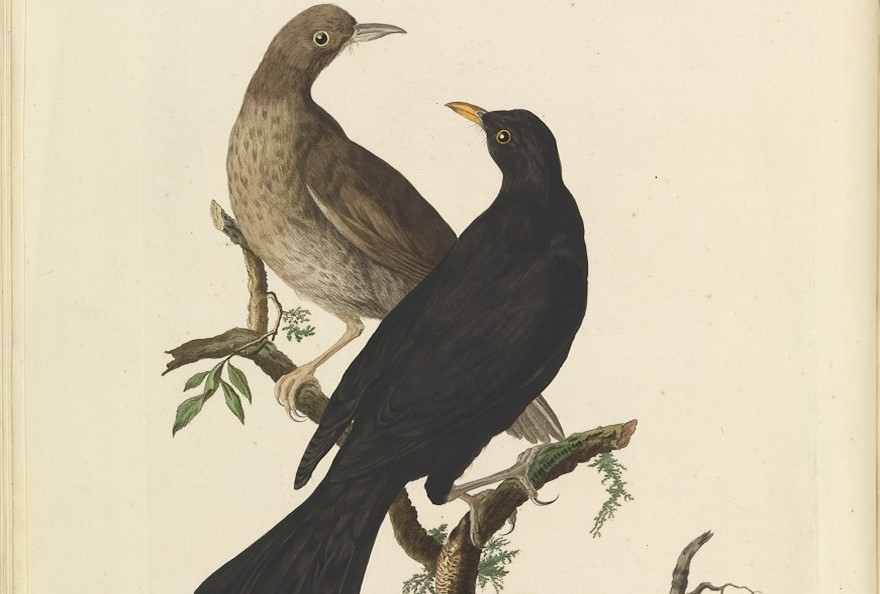
  In which there are three blackbirds.

III
 The blackbird whirled in the autumn winds.
   It was a small part of the pantomime.

IV
 A man and a woman
   Are one.
 A man and a woman and a blackbird
   Are one.

V
 I do not know which to prefer,
   The beauty of inflections
 Or the beauty of innuendoes,
   The blackbird whistling
     Or just after.

VI
 Icicles filled the long window
   With barbaric glass.
 The shadow of the blackbird
   Crossed it, to and fro.
 The mood
   Traced in the shadow
     An indecipherable cause.

VII
 Old thin men of Haddam,
   Why do you imagine golden birds?
 Do you not see how the blackbird
   Walks around the feet
     Of the women about you?

VIII
 I know noble accents
   And lucid, inescapable rhythms;
 But I know, too,
   That the blackbird is involved
     In what I know.

IX
 When the blackbird flew out of sight,
   It marked the edge
 Of one of many circles.

X
 At the sight of blackbirds
   Flying in a green light,
 Even the bawds of euphony
   Would cry out sharply.

XI
 He rode over Connecticut
   In a glass coach.
 Once, a fear pierced him,
   In that he mistook
 The shadow of his equipage
   For blackbirds.

XII
 The river is moving.
   The blackbird must be flying.

XIII
 It was evening all afternoon.
   It was snowing
 And it was going to snow.
   The blackbird sat
     In the cedar-limbs.




 Tiger Riding for Beginners