5 Myths of the Mind


I wrote a post a while back about six persistent brain myths that has some overlapping relevance to this one.

5.) A person is a unitary actor (the spherical cow of social sciences.) When I was a graduate student studying International Relations, a popular theoretical assumption was that nations were “unitary actors.” This meant that no matter how schizophrenic a government (and a nation’s civic institutions) might appear, they ultimately always pursued a national interest via a solitary hand. Like physicists assuming spherical cows, this makes life easier — even if it bears little resemblance to reality.

The full extent of the folly of the rational unitary actor assumption became apparent when I discovered that an individual isn’t even a unitary actor systematically pursuing its best interest. An individual is a collection of impulses, thoughts, feelings, etc. that seems like its under the command of a central authority only because that “central authority” [our conscious mind housed in our Pre-Frontal Cortex (PFC)] is really good at forming post-hoc rationalizations and making up stories that let us feel unitary. The reader may think I’m just talking about some slim segment of the population with a multiple personality disorder, but no. I’m talking about anyone who has ever agonized over whether or not they should have an ice cream treat or take the healthy route. At the end of an internal battle that ends with the levers of action being operated by parts of your nervous system beyond your conscious control, you walk away with your conscious mind building a nice story that explains how it chose to either treat its taste buds or take it easy on its pancreas by keeping insulin production stable.

To consider how the conscious and subconscious mind can be on two entirely different pages on a subject, we’re going to veer into controversial and provocative territory. [So be warned, and if you’re sensitive about sexuality and particularly coercive sexual fantasy, you may want to skip down to the next paragraph.] Across a series of studies, an average of 40% of subjects (generally, or maybe exclusively women) admitted they’d had a fantasy about being raped. Many readers will react with incredulity, perhaps suggesting that there must be something wrong with such a person. However, obviously numbers like that aren’t describing a lunatic fringe. The next response one might here is, “Why doesn’t a person with a rape fantasy know how horrible and decidedly unsexy rape is?” If you’re following my gist, you know the answer is that said person knows very well. Consciously, she is aware that rape is violent and horrific, and moreover she probably even knows that it’s about commanding power rather than sexual desire for the rapist. This knowledge doesn’t undermine the fantasy [unless, perhaps, she really forces herself to think about it intensely] because the arousal is driven by a more visceral part of the mind that FEELS that the act is about the rapist being overwhelmed with sexual attraction even though the person KNOWS that that’s not the case.

[Note: I do realize that it might theoretically be possible that a much more complex collection consisting of many individuals and organizations might behave in a more unitary fashion than an individual. That is, even though a nation his made up of many non-unitary actors, perhaps the nature of the game forces it to behave in a unitary fashion. I don’t buy it. I’ve been reading a great example in a biography by Ingrid Carlberg about Raoul Wallenberg where both the Soviets (who had Wallenberg in custody but wouldn’t admit it) and the Swedes (who didn’t know whether Wallenberg was alive and sent mixed signals) were befuddled by varying actors sending mixed messages and collectively behaving ineffectively. It’s hard to come away thinking that Stalin and his Ministers had a rational and unified decision process. Instead, it seems like a perfect storm of incompetency and incorrect assumptions resulted in an outcome that wasn’t ideal for any of the parties.]


4.) Everyone can be hypnotized via instant induction and then commanded to do anything that’s asked of them.  Hypnosis is among the most misunderstood activities around. There are a couple of reasons for this. One is that hypnosis is a favorite device in movies and fiction, and people draw information from these fictitious sources. The “Now You See Me” movies (see above) offer many such displays of a person being instantaneously hypnotized against his will even when the person is an expert himself, and made to do things against his interests. Misconception also flowers when people hear real or fictitious accounts of Cold War programs like America’s MK Ultra or the Soviet’s psychotronics. The lesson to be taken away from those expensive and morally-dubious programs is that it may be possible to break a person’s mind, but you can’t force someone to do something they abhor while programming them to forget all about it afterwards.

Another reason for the misunderstanding, is that there’s a disreputable group of stage hypnotists and others who love to spread these ideas because it’s more intriguing if people think they can do it to anyone at any time than if they understand that their subjects have been carefully selected to be among the more readily prone to achieve trance states and to be responsive to suggestion. It’s true that most people are hypnotizable and will respond to suggestions to do things they wouldn’t otherwise do (as long as it’s not something that they don’t want to do.) But highly hypnotizable individuals are only about 15% of the population, and there’s another 15% at the other end that are virtually impossible to hypnotize. The video below has more detail on the science.


3.) One has no access to one’s subconscious mind. The conscious mind is like the loudmouthed drunk who swears he invented the potato chip bag clip, the envelope-wetting sponge, and Velcro. That is, it’s hard to hear over the din of incessant yapping, and since the conscious mind claims credit for everything, it’s easy to be fooled that there’s nothing else to listen to in the mind. However, if you can knock the drunk out, you start to become aware of what the subconscious has to say. Those who don’t meditate may be aware of subconscious imagery as they are falling to sleep (the hypnogogic state), as they are waking up (the hypnopompic state), or sometimes even during dreams (i.e. so-called lucid dreams or dream yoga.) Those who do meditate will be well aware of images that spontaneously form and fade in the meditative mind, and which can give rise to conscious thoughts if left unchecked.


2.) Memory is a recording of life events.  I’ve been reading Julia Shaw’s “The Memory Illusion” recently. It’s a fascinating look at false memories. There are many famous cases of false memory, but what is most interesting is Shaw’s success in planting false memories of criminal activity. “Planting” isn’t the best term to describe this. It’s more about getting the subject to visualize events such that they create the false memory. While I stand by what I said about the myths of hypnosis, there have been a number of cases of false memories being implanted while an individual was in a hypnotic trance, and so one shouldn’t disregard the power of hypnosis altogether.  The fact of the matter is that what we remember isn’t the occurrence of the event itself, but the last remembrance of said event. This means that there’s a great deal of room for memory degradation over time, and for a false transcript of events to form in the mind.


1.) Emotions get in the way of good decision making. I just posted a review of Antonio Damasio’s book “Decartes’ Error,” which examines this subject in great detail. Damasio found that patients who had damage to parts of the brain responsible for emotion often became victims of paralysis by analysis. That is, without emotion to give them a kick, they can’t make decisions. Reason doesn’t always provide a clear answer because the world is filled with uncertainty. When there’s not enough information, we still need to make decisions, and this is accomplished by emotional “gut instincts.”

BOOK REVIEW: Conversations on Consciousness ed. by Susan Blackmore

Conversations on Consciousness: What the Best Minds Think about the Brain, Free Will, and What It Means to Be HumanConversations on Consciousness: What the Best Minds Think about the Brain, Free Will, and What It Means to Be Human by Susan Blackmore
My rating: 4 of 5 stars

Amazon page


Blackmore gathers together interviews from a veritable who’s who of consciousness experts from neuroscience, philosophy, physiology, psychology, and physics. While the interviews are in part tailored to tap into the special insights of the given expert, a consistent series of questions is asked of each of the interviewees. Each expert is asked what they think is challenging about consciousness, what they think about the feasibility of philosopher’s zombies (a popular thought experiment about an individual who seems to behave like an ordinary human but who has no conscious experience), what they think about the existence of free will, what happens to consciousness after death, and what got them interested in the subject. This makes it easy for the reader to see not just differences in thinking across disciplines, but also different schools of thought within disciplines. There’s enough variety to make for intriguing reading. There is also a mix between individuals who have experience with meditation (e.g. the interviewer) and those who don’t, and so it’s interesting to compare views of those with such insight to those who study consciousness entirely abstractly.

I won’t list all the authors, but they include: David Chalmers (who famously coined the term the “hard problem” of consciousness, which is one of the most widely discussed ideas in the book), Francis Crick (of DNA fame who later shifted focus), Daniel Dennett (a well-known philosopher), V.S. Ramachandran (a neuroscientist famous for work on phantom limbs and behavioral neurology), and Roger Penrose (a physicist who believes that quantum mechanics may prove crucial to figuring out consciousness.)

It’s a straightforward book. There’s an Introduction by Blackmore and then the 20 or 21 interviews (one “chapter” is a married couple – Pat and Paul Churchland — whose insights are presented together.) The only back matter is a glossary, which is quite in-depth and which helps to clarify the many confusing concepts from various disciplines. There are a few cartoon drawings that lighten the tone, but serve no essential purpose.

I enjoyed this book and found it thought-provoking. It’s quite old at this point – having come out in 2005 – but since consciousness is so intractable, it’s not like any of the questions have been cleared up. (If it were a book on AI, I’d probably say it was worthless at this point, but not this book.) I’d recommend it for anyone looking to understand the lay of the land with regards thinking about consciousness.

View all my reviews

BOOK REVIEW: The Spread Mind by Riccardo Manzotti

The Spread Mind: Why Consciousness and the World Are OneThe Spread Mind: Why Consciousness and the World Are One by Riccardo Manzotti
My rating: 3 of 5 stars

Amazon page


Manzotti puts forth a bold and intriguing hypothesis that one’s mental experience is the physical world and not a model or representation of the world. Unfortunately, his book doesn’t make a compelling case for “The Spread Mind” (as he calls it) over its competition. Consciousness is one of those still dim corners of our world that isn’t yet fully understood by anyone, and this has spurred many competing ideas ranging from: a.) it being illusory; b.) it being purely a construct of a complex brain; c.) it hinging on some quantum mechanical action not yet understood; d.) panpsychic (all-pervading consciousness) arguments that may or may not resonate traditional Indian / Eastern conceptions; and e.) this idea that consciousness is identical with the physical world of which one is conscious.

However, for simplicity’s sake, one can contrast Manzotti’s idea with the most widely accepted view offered by science, which is that our brains construct mental models of the world often based on [but not identical to] sensory information they take in. (If my statement isn’t clear, you can check out neuroscientist Anil Seth’s TED Talk on “how our brains hallucinate reality,” which is as diametrically opposed to Manzotti’s hypothesis as one gets – and which, unfortunately for Manzotti, also makes a more cogent argument.)

At first blush, Manzotti’s idea might look appealing. It does, after all, simplify the picture. It eliminates the middle-man of mental models and seemingly solves the mind-body problem. The mind-body problem is how to reconcile how the body (wet, physical, objectively observable matter) relates to mind (intangible, subjective, ephemeral thoughts and feelings,) — if it does. Descartes famously suggested that mind and body were simply two separate things (i.e. dualism), and while that notion has remained popular with homo religiosis it’s all but dead in the world of science. However, there is no one monism that has unambiguously replaced Cartesian dualism. The most popular variant among those who study the brain is that some action in / across neurons creates a series mental imagery, internal monologuing, and emotional sensations that make up our mental experience. The mechanism by which this could happen is still not understood, but it’s an inherently hard problem to peer into because on can’t observe mind states directly and the best tool for studying it – i.e. functional Magnetic Resonance Imaging (fMRI) is only a couple decades old (and it’s still looking at brain blood flow and not consciousness, itself.) [I defend that this mechanism isn’t yet explained because one of Manzotti’s points seems to be: neuroscience hasn’t yet explained how neurons produced mental experience so just believe in my hypothesis which offers not even a hint of a mechanism by which it could work.] Manzotti’s is also a physical monist argument, but one that denies the mind is anything more than our experience of the physical world. In other words, there is a spoon, but there’s no mind separate of it.

So, what’s the problem? The reader may have already thought of some challenges confronting Manzotti’s hypothesis, and many of the most common ones the author refutes in the middle portion of the book. Dreams, hallucinations, fantasies, and even memory (certainly false memories, which we know are a wide-spread phenomenon) should utterly destroy the Spread Mind, given the simple definition we’ve given so far. After all, if your mental experience consists entirely of the physical objects that you are exposed to, then how does one explain the doughnut-shaped, sprinkle-breathing dragon that you hallucinated when you did ayahuasca on your trip to Iquitos? OK, you say you’re not such a wild child? Alright, how do you explain your detailed remembrance of putting that water bill into the mailbox, but then finding it under the seat of your car after you got a late notice from the water utility? If our mental experience is identical to the physical objects we experience, mentally experiencing things that don’t exist or events that never happened should never occur.

Manzotti elaborates upon Spread Mind to fend off these crippling attacks to his “theory.” (I use quotes because a theory is usually defined as “a well-substantiated explanation of a phenomenon” and it doesn’t seem to me there’s much in the way of substantiation of this idea.) There are two main prongs to his defense, one of which is unproven but soundly stated and consistent with the thinking of many physicists. The other defense seems to simply be a post-hoc rationalization used to make his “theory” work. Even though these ideas are presented in the opposite order in the book, I’ll deal with the first one I mentioned first because it’s relatively simple to cover. That’s the idea that past and present all exist always and at the same time. That may seem like an out-there idea because we can only ever be in touch with a moment we think of as the present and everything else is memory or fantasy /forecasts. However, it’s not exactly a rogue notion in science, especially once one starts thinking about making sense of Einsteinian Relativity. So, without this idea, if Spread Mind was correct, we could never have that fond memory of Mr. Fluffers, the pet we had in first grade who died decades ago. If our mental experience is Mr. Fluffers and not our mental model of Mr. Fluffers, we can’t have such an experience so long after he passed away. But if all time exist simultaneously, then one can conceive of how such a remembrance could happen. The only thing special about the present in Manzotti’s conception is that it’s the time during which we can interact with objects that also exist in the same time. This may or may not prove to be true. If it proves false it will kill Spread Mind, but if proves true the theory still has many questions to answer to prove itself worthy.

The second, and far less well-supported, defense could actually be divided in two ideas, but I’ll deal with it as a unit for simplicity’s sake. The parts of this defense our: a.) misbelief about our mental experience can happen, somehow [potential mechanisms by which this might occur are not described and that’s a huge problem for the author]; b.) objects we’ve experienced can be reshuffled to make objects appear to be entities that we know do not exist [Again, the mechanism by which this could occur is never explained or even seriously speculated about.] Let me give an example to explain how these defenses work. Say you drop a tab of acid and are having a hallucination of a dragon flying through the sky. Manzotti’s idea is that you are experiencing a reshuffled creature consisting of legs, a serpent, maybe some fire, a backdrop of sky, and you have a misbelief that all these constituent parts are in the present and co-exist together in space and time (as opposed to being disparate objects from varied past times.) This is a very convenient idea for Manzotti’s “theory” but it’s not really clear why we should buy it. In the competing notion that a mental model is built, one can imagine how the mind might construct something that doesn’t exist due to neuronal cross-firing or something like that. (The bigger question, in fact, might be why it doesn’t happen more often.) However, if our experience consists of objects that we’ve shared space-time with at some point, how and why should such weirdness occur? If the author made a compelling attempt to explain how this occurrence is reasonable, one might leave the book thinking his “theory” is – in fact — a theory and give it equal or superior footing to other approaches to consciousness, but as the book mostly offers gratuitous statements telling us to accept this all as a given, it’s not very powerful.

I’d like to get into one crucial example where I think Manzotti’s thinking is flawed in a way that could prove devastating to the Spread Mind. The author admits that an extraordinary hallucination would kill the Spread Mind. He defines an extraordinary hallucination as one consisting of objects that are non-existent in our world. Earlier, I used the example of a dragon which we know doesn’t exist, and we can be reasonably certain never existed. However, Manzotti would say that it’s just a reshuffling of parts like legs and snakes that we do know exist, combined with a misbelief about when these objects exist and that they co-exist in the same time. Manzotti says that there is no evidence that a hallucination that can’t be explained by reshuffling and misbelief ever existed. I have no doubt that if one read accounts of hallucinations; one could come away with that conclusion. However, I think it’s more convincingly explained by the nature of language as a unit of communication (hence necessitating common vocabulary.)

Example: Let’s assume for a minute that I had an extraordinary hallucination, and I decide to document it. I could take one of two approaches. On one hand, I could describe every completely novel element with a new word. I could say I saw a gruzzy-wug which had three separpals and a florgnak and a long and bushy krungleswam. Of course, I’m not communicating at this point because communication requires common vocabulary. Manzotti would likely argue that I’m just reshuffling letters [linguistic objects] to make up non-sense. On the other hand, as soon as I use a common vocabulary and analogy saying such and such is “kind of like a leg, but sort of with a curly-cue spiral and a mouth on top” Manzotti would say, well it’s a reshuffling of a leg and a pig’s tail and a mouth all of which the individual has seen before.

However, an even more devastating oversight is ignoring vast tracks of what most people would consider their mental experience. It’s the penultimate chapter before the book even touches upon emotion, which most would argue is a huge part of mental experience. Throughout most of the book, one is left wondering whether the author thinks of such things as emotion and language as part of consciousness. One imagines Manzotti’s experience of the world is one physical object after the other (mostly red apples with the occasional pink flying elephant – examples he uses ad nauseam) without any conceptual experience. Manzotti does explain that one must revise one’s conception of an object to think in terms of the Spread Mind, and one can see how this might explain language – which has a huge and powerful role in one’s mental experience and which is left unexplored by the book. But while language could arguable be explained as consisting of objects, emotional experience seems hard to fit Manzotti’s hypothesis.

The book consists of nine chapters. It has graphics and bibliography as one would expect of a scholarly work

I think most readers will find this book to be repetitive and frustrating in its lack of explanation. It’s not that it’s speculative; it’s that it just bludgeons the reader with gratuitous assertions that we expect will pay off in at least a hint of how the Spread Mind could work, but it never does. (For example, I greatly enjoyed Max Tegmark’s “Our Mathematical Universe” that speculates that our world is a mathematical structure – not that it can be described mathematically but that it fundamentally is mathematical.) Spread Mind is an interesting idea, but I can’t say I’d recommend the book unless one is really interested in knowing all of the varied lines of thinking about consciousness that exist out there. I must say it was a beneficial read because it made me consider some interesting ideas, but nothing in it swayed my thinking.

View all my reviews

POEM: Thought Bubbles

Source: Spiff via Wikipedia


Silence the jittery critter.
Ride the dullness down
to where images bubble.

In that blurry dimness
one feels their logic,
but shine the mind’s light
and all sense shatters —
scattering,
dissolving into shadows
without a trace.

Leaving only the dull ache of betrayal
that, as in a dream,
something so absurd and fragile
could feel so wise.

BOOK REVIEW: Sure Ways to Self-Realization by Swami Saraswati

Sure Ways to Self RealizationSure Ways to Self Realization by Satyananda Saraswati
My rating: 5 of 5 stars

Amazon page


This book is one-stop shopping for the yogic meditator. The first half of the book explores many of the most common yogic practices of dharana (concentration) and dhyana (meditation) in step-by-step detail. The second half of the book situates yogic meditation in a global context of meditation by introducing various techniques of meditation and mind science seen around the world. This allows the reader to compare and contrast the yogic approach to that of other systems — be they closely related systems such as Buddhism or Jainism or more remote ones such as hypnosis or moving meditations like dance or the martial arts.

I found this book to be incredibly useful. While there are mountains of books on yoga, there are relatively few that shine a light on the practices of the mind, and among those that do only very few are nonsectarian. Many books look at meditation solely as a spiritual practice and a few others present it exclusively as a secular scientifically grounded practice. This book skillfully bridges between, and does its level best to get the accounts of different systems right. That doesn’t mean that there aren’t a few oversimplifications or minor misunderstandings here and there, but the good overshadows them by far. It should be noted that even within the domain of yoga, many authors warp concepts such as jnana yoga and tantric yoga to fit their worldview or sect instead of reporting on how practitioners of those systems would see them. This book seemed to me to be much fairer than many in this regard.

The book consists of an Introduction and seven chapters. Chapters 1 and 2 discuss tools and aids used in meditation. The primary difference between the two chapters is that the first looks at traditional aids such as mantra, mandalas, and symbology, and the second discusses more modern scientific aids such as biofeedback, drugs, and sensory deprivation tanks.

Chapter 3 is one of the largest (more than a quarter of the book) and it explores the many yogic meditation techniques, including: antar mouna, japa, ajapa japa, chidakasha dharana, yoga nidra, prana vidya, trataka, nada meditation, jnana yogi meditations, kriya yoga techniques, and tantric techniques. While the later discussion of non-yogic approaches generally includes instructions for basic exercises, the descriptions in this section are much more detailed, and some include variations on the primary practice.

Chapter 4 is about the same length as chapter 3, and it investigates many of the other systems of meditation from around the world. These include religious systems such as those in: Hinduism, Jainism, Taoism, various sects of Buddhism, Zoroastrianism, the mystical branches of Christianity and Islam (Sufi,) and Native American animist traditions. It also includes secular systems such as hypnosis and autogenic therapy.

Chapter 5 delves into how movement of the body is used as an anchor point in meditation in yoga, on pilgrimage, in Tibetan Buddhism, in Zen Buddhism, in the martial arts, in dance, and in sports. This is where I saw those few of the aforementioned minor oversimplifications and misunderstandings (e.g. referring to all martial arts under the rubric “karate.”) However, I greatly appreciated that the authors included discussion of this important topic, and so I can’t say that there was anything that detracted from my enjoyment of coverage of the topic.

The penultimate chapter is a catch-all for miscellany not covered earlier in the book. It includes meditations for kids (who require a very special approach, I can attest.) It also has a section on meditation on death, which I believe to be an immensely important topic for helping people shed their fear so they can get the most out of their lives. The other two sections are on nature and sensory meditations, respectively. The last chapter is short and discusses samadhi as the goal of meditative practice.

There are only a few graphics in the book, mostly symbology, but there is a glossary and a bibliography.

I would highly recommend this book for yoga practitioners and those who have a broad interest in meditative and mind science practices.

View all my reviews

5 Essential TED Talks on Consciousness

5.) Anil Seth: Your Brain Hallucinates Your Conscious Reality


4.) David Chalmers: How Do You Explain consciousness?


3.) Max Tegmark: Consciousness is a Mathematical Pattern


2.) Antonio Damasio: The Quest to Understand Consciousness


1.) Oliver Sacks: What Hallucination Reveals about Our Minds

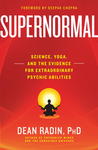
BOOK REVIEW: Supernormal by Dean Radin

Supernormal: Science, Yoga and the Evidence for Extraordinary Psychic AbilitiesSupernormal: Science, Yoga and the Evidence for Extraordinary Psychic Abilities by Dean Radin
My rating: 4 of 5 stars

Amazon page


With this controversial book, Dean Radin presents the scientific evidence for an array of psychic powers, but he frames the discussion in terms of yogic siddhis. “Siddhi” is a Sanskrit term for an ability that isn’t seen among the general population–at least not reliably so– and for the most part these “accomplishments” correspond to the categories discussed in parapsychology (i.e. telepathy, precognition, psychokinesis, and clairvoyance.) [Note: As mentioned, this is a controversial book. I will attempt to provide as unbiased a review as possible. I am generally skeptical, but don’t believe in poo-pooing the study of subjects because they offend my skeptical sensibilities. Furthermore, I try to keep an open mind because: 1.) there is no scientific consensus about what consciousness is or how it works, 2.) quantum biology is a subject in its infancy and we may yet learn there is more quantum “spookiness” going on in the brain than we think. 3.) for all I know we are in an simulation and then it’s all a matter of programming.]

The yogic emphasis doesn’t change the book much from the pop psych literature review of parapsychology studies it would otherwise be, except to necessitate background information on yoga and siddhis. However, this emphasis may or may not have opened up a huge additional readership. Outside of a fringe, siddhis aren’t much in vogue among yoga practitioners these days. Among modern day yogis and yoginis, there are some who believe in them and some who think they’re throwbacks to an era of superstition, malnutrition, and wishful thinking. However, even among the former, siddhis are generally considered a distraction. The advice of most of the great yogis has been to not get lost in the pursuit of such powers because chasing siddhis can derail one from one’s ultimate objective (e.g. liberation.) Still, if even a small fraction of yoga practitioners take an interest, that’s a fairly large readership.

So what exactly is the controversy? Obviously, there are many divergent demographics with differing views on the topic. For hardcore skeptics, parapsychology is right up there with alien abduction, bigfoot /yeti sightings, and the anatomy of the Loch Ness monster with respect to being a legitimate topic for scientific study. On the other hand, there are believers who are offended by the mere notion of studying such phenomena with science, and who say such investigations are an assault on their beliefs.

But that’s not a very interesting controversy—i.e. there are some people who won’t believe in such abilities no matter what the evidence, and others who will believe in them no matter what science has to say. So let’s chop off the hardcore skeptics and hardcore believers and ask what the controversy is as it pertains to those of us who consider evidence when drawing conclusions.

The root of the controversy can be stated rather quickly and clearly. Here it is: the effect size is small but statistically significant. What does that mean? Say this study asks a subject to determine which of five randomly selected shapes has been chosen using nothing but his / her mind. Using pure guessing, one would expect to be right 20% (i.e. 1/5th) of the time. If a person happened to get 32% right in a given trial, that means nothing because small samples don’t give one a convergence towards a mean value. (i.e. Intuitively, you know that if you flip a coin 10 times and get 7 heads, it doesn’t necessarily mean anything. If you repeat that 10-flip set 10,000 times, and still get 70% heads, then you probably have a trick coin or something else odd is going on.) So the issue is that even when experimenters repeat the experiment over and over again such that the average value should converge on 20%, it doesn’t. It stays at, say, 30% (exact effects vary but it’s on this order.)

At this point the reader might be thinking of all the factors that could result in this effect (i.e. cheating [insider or outsider], subconscious observation of facial expressions, random selection that is biased, etc.) Well, so have the scientists. In any study, one wants to account for alternative explanations to the utmost. Over the years, researchers like Radin have put all manner of protections in place from quantum random number generators to booths with extreme sound-proofing and Faraday cages (prevents radio signals from transiting.) Still they get this small positive effect that can’t be explained by alternative explanations.

There is also the issue of the filing drawer problem, which Radin devotes considerable space to discussing. It’s the idea that when drawing conclusions from many similar studies, one must accept that there may be many unpublished studies that sit in file drawers because they didn’t produced negative results. These filed / unpublished studies could negate the outcome of the body of studies of that nature. While this remains an open criticism, there is mathematics for determining how many negative studies would have to be turned up to make the results insignificant. Radin argues that the numbers calculated strain credulity.

So this “small but statistically significant effect” is generally agreed upon by all, excepting conspiracy theorists. Now we get to the controversy, which is how to explain this effect. Skeptics run the gamut from hot-blooded haters who claim that it’s all just a scam perpetrated by hoaxers with tenure, to more diplomatic challengers who provide thoughtful, plausible, and non-nefarious explanations for what they believe are false results. Said objections include file drawer problems, statistical “crud factor” (an observed effect in which large sample size studies can show a significant correlations between any two random variables—i.e. everything is correlated with everything else to some degree), and outlier effects.

The latter is a particularly revealing controversy. Say your study results in this 30% instead of 20% effect, and there’s one subject in the study who (over many trials) got the shape right 80% of the time. If you’re a skeptic, you call that an outlier and you want to cut it out of the study because it may be causing part, most, or all of the effect you see. Your assumption is that that this outlier could be anything from a data entry error to an outright cheater, but it’s obviously not a gifted psychic. If you’re a believer, not only do you want to keep that result, you want to find that person and study them to find out if the result was a one-time fluke, or if you have some rare, gifted person.

The book is arranged into three parts. The first part offers background on yoga and siddhis. The second part is the heart of the book and it presents an overview of results from studies of precognition, telepathy, psychokinesis (both of animate and inanimate objects), clairvoyance, and the effect of meditation on these abilities (which also shows a small positive effect, i.e. the general population outdoes probability by a little bit and experienced meditators outperform the general population by a little bit.) The last section is just a couple chapters about the future of parapsychology.

I found this book to be interesting and thought-provoking. Radin comes across as a reasonable investigator who is willing to accept that there is a lot of duplicity going on out in the world, but yet when one uses the methods of science one obtains results that would be generally accepted as successful across the social sciences. At times he does go on anti-skeptic rants. On the other hand, one can imagine his frustration in dealing with individuals unwilling to pin down how much higher the bar must be for parapsychology results over results in more mainstream topics. I think Radin’s greatest mistake was in discussing levitation. Besides at a quantum level, the effects of gravity are well-understood and non-negotiable. While our lack of understanding of consciousness leaves wiggle room to at least consider some unusual happenings, levitation seems a non-starter. Fortunately, as it hasn’t been studied, Radin just presents a couple historical anecdotes and moves on (while—to be fair–acknowledging the fundamental risk in relying on anecdotes.)

I’d recommend this book. I can’t say it swayed my belief on the topic, which tends skeptical, but it did inform my confusion. (It should be pointed out that not all these abilities are equally reviled by science. Precognition is the most fundamentally opposed because it seems to violate the fundamental cause and effect nature of the universe at our scale and larger [as opposed to the quantum level were all sorts of weird happenings transpire.]) I do agree with Radin that there shouldn’t be taboos in science in which scientists are afraid to study a subject of interest because the prevailing notion is that it probably doesn’t have merit. If there weren’t scientists with the cojones to study “crazy stuff” we’d no doubt be far behind our current understanding of the world.

View all my reviews

POEM: Literarily Insane

Hemingway off’d himself–
curled up under his
own looming shadow.

What loomed beyond
that shadow was the
great unfathomable.

Peering into it might
have been a comfort,
or might have killed
him in pre-greatness days.

***

Kesey’s Chief wondered
how the Irishman could live
in his own grandiosity of being.

McMurphy’s sanity was surely
built upon a foundation of delusion–
sanity and delusion forged iron-clad.

Meanwhile, those free of such
delusions huddled in the fog,
unable to step out into life.

***

Heller’s Yossarian summed
up the whole damned mess:
claims of insanity are a
recognition of one’s sanity.

Who else seeks to turn down
the volume on reality?

Other than one who can
hear it well enough to know
when it peals thunderous?

5 Minds You Meet in Meditation


No matter what style of meditation you practice, you’ve probably heard the following refrain: “And if you find your mind wandering, non-judgmentally make a note of where your mind went, and let that thought drift away as you return your awareness to __________.”


I’ve certainly heard many takes on that teaching, and had plenty of opportunity to implement that advice. In the process, I’ve noted that the places my mind wanders can be classified into several categories.


5.) The Planner: Our conscious mind is first and foremost about answering the question, “What’s the worst that can happen, and how can I make that worst case less bad?” The mind wants to anticipate undesirable events and either make an end run around them or figure out a way to make them less troubling. The Planner wants to rehearse everything from making dinner to being interviewed for a job to having a dreaded conversation.


4.) The Entertainer: This is the mind that sticks songs in your head and replays clips of movies.


3.) The Walter Mitty / The Bolsterer: This is the daydream mind which cooks up scenarios in which you are the hero.


2.) The Subconscious Image Generator: In a relaxed state in which the conscious mind is quieted, one may find oneself seeing images that probably don’t make a lick of sense. The pictures may come and go in a way that make them hard to maintain even a glimpse of. This is the same kind of imagery that one experiences in the hypnagogic state–as one is drifting towards sleep.


1.) The Critic: Saving the most despicable for last; this is your inner critic. The one who thinks that you won’t succeed at any given task.

5 Tools to Hulk Your Way Out of Your Comfort Zone


5.) Take a class / Join a group: While I’m partial to yoga and the martial arts, the class could be in any area that presents a challenge.  However, there are a couple of advantages to the aforementioned two (to which I would add dance.)


First, these disciplines train one to be expressive with one’s body and to move more freely. This can do wonders for confidence. People store tension in their bodies without even realizing it. Many have postural problems that effect confidence and self-perception.  A 2014 New Zealand study found that posture can have a strong effect on emotional state.


Second, no matter who one is, one will be challenged by new approaches to movement.  The average person has great difficulty learning to use their body in new ways. One needs to drill in movements conscientiously to achieve competency. Our conscious mind, frequently gets in the way. Even the most athletic and coordinated people will need to work it, failing repeatedly until they succeed.


Why is the challenge so important? Many people go through life afraid to fail, but far too few fear never failing. Sounds idiotic. Nobody wants to fail. I have some hard news. If you’ve never failed, it’s not because you are unmitigatedly awesome in all things. It’s because you’re living in a box and cherry-picking life experiences that feel unthreatening.


If, like me, you’re an introvert, this approach offers the additional benefit of social interaction that is of a predictable / schedulable nature. One needs the interaction, but the problem comes when one has social interactions and / or sensory stimulation that go on too long and in an unpredictable fashion. Therefore, being able to schedule such time is a good way to go about being a more productive introvert.


4.) Writing  / Visualization:  These two approaches to mentally rehearsing allow one to keep one’s inner critic in check. The problem with simply day-dreaming it is that critic can chirp in without being that cognizant of it.

In visualization, one quiets the mind and can then non-judgmentally acknowledge and dismiss the negative thoughts. In writing–be it as a journal entry, poem, or a story–we may not notice the nagging voice of the inner critic on the first draft, but you can take note of it and undo it in rewrites.


3.) Travel / Living abroad: I should point out that not just any old travel will have the desired effect. Many people plan their travel with the objective of being comfortable at the fore.  They eat at places that serve the same kind of food as at home. They stay in hotels with virtually all of the comforts of home, and sometimes many more. This is understandable because the traveler might just be seeking rest.  However, if one is seeking the epiphany or enlightenment experiences talked of by backpackers and ashram-dwellers, that’s not something that comes from staying in resorts or eating at American fast food joint. Those kinds of brain changing experiences come when one is stripped from the familiar and has to surrender one’s attachments to the way one thinks the world should be. One’s perception of culture and worldview changes radically when immersed in a foreign environment.


2.) Game it / Roleplay: There’s a big movement to gamify all manner of everyday activities.  In her book, “Reality is Broken,” scholar of game design Jane McGonigal describes a game called “Chore Wars” that incentivizes the doing of mundane household chores.


What is it about games that help one move beyond one’s limits? First of all, it incentivizes actions. And if you’ve ever noticed people playing games on their phone or FB for hours on end, you’ll note that it doesn’t take much reward to keep people plugging away—as long as the game is structured well.


Second, good games provide a built-in process of “leveling up.” This means that the challenge keeps being intensified as our skill level advances. Those familiar with Csikszentmihalyi’s conception of “Flow” will recognize that matching skill level to challenge level is one of the most crucial elements in facilitating flow-state.


Roleplaying is a bit like the previously mentioned tools of visualization and gaming in that it’s a way to have a low-cost rehearsal. If one has someone with whom one can engage in such a roleplay, than one also has someone to help make you aware of your inner critic and its deleterious effects. And that brings us to the final tool:


1.) Have a spouse, partner, and or confidant: In “Why Zebras Don’t Get Ulcers” Robert Sapolsky tells a story of being interviewed by a magazine. He was asked what the number one thing that they could tell their readers about reducing stress.  To which he replied that the most well-established factor in stress reduction is to have a spouse / life partner with whom to share one’s challenges.  Unfortunately, this was a magazine for women business leaders, a significant portion of whom had given up on permanent relationships and families. They, therefore, asked him what else he had.  Still it’s hard to overlook the anxiety-fighting effects of having someone around with whom to share one’s dread.