BOOK REVIEW: Wrath of the Dragon by John Little

Wrath of the Dragon: The Real Fights of Bruce LeeWrath of the Dragon: The Real Fights of Bruce Lee by John Little
My rating: 5 of 5 stars

Amazon.in Page

Release Date: September 5, 2023

There are many Bruce Lee biographies out there, from general bios (such as Matthew Polly’s Bruce Lee: A Life) to those that are much more narrowly focused (e.g. Rick Wing’s Showdown in Oakland about Lee’s fight with Wong Jack Man.) This book is somewhere in between in that it is theme-focused (Lee’s fights and matches,) but it does offer insights from Lee’s childhood through to his death as they pertain to these fights and sparring experiences. The book explores all of the known real-world scraps and matches, as well as some of the more telling sparring sessions. Fights range from Lee’s adolescent skirmishes as a punk kid through the challenge matches with extras on the set of Enter the Dragon as an astute (if still quick-tempered) master. When I say that the book includes sparring sessions, I’m not talking about every time Lee sparred, but rather those exchanges that offered particular insight into Lee’s prowess, such as his last ever sparring session with his old Wing Chun teacher, Wong Shun-Leung (a senior student of Ip Man’s) as well as those with athletes at the top of their respective combative sports.

The point of the book is to challenge a belief — widespread at times — that Lee was a blow-hard offering banal quasi-mystical Eastern philosophy and martial insights that were based only on a few Wing Chun lessons from Ip Man. In contrast, the book paints a picture of a broadly experienced fighter who was obsessive about his betterment as a martial artist. Lee was an innovator and trained with great endurance and intensity. The book portrays Lee as a martial artist of such speed and athleticism that even World Champion competitors were left in awe.

While reading, one does have to question how objectively the information is being presented. After all, Little is definitely a bit of a fanboy and he’s clearly taking a stance on Lee’s prowess. Furthermore, the fact that (at one point, I’m not sure about presently) Little was the only one with full access to Lee’s archived notes suggests his message was sufficiently on point for Lee’s family to feel comfortable with him. That said, I felt there was enough admission of Lee’s weaknesses and mistakes as well as a willingness to present competing statements when details were in question that I believe this is an honest attempt to get the details right (within the unavoidable constraints of memories of events being decades in the past and being seen from multiple perspectives — psychologically as well as geographically.)

I found this book to be fascinating from cover to cover, and well worth reading. In addition to the stories of the fights, the author discusses the lessons that Lee learned along the way. Even in winning, Lee was sometimes dissatisfied with his own performance, and this drove him to adapt and to develop new training methods. I’d highly recommend this book for those interested in the martial arts or who love a good biography.

View all my reviews

Of Samurai & Cats: Issai Chozan’s Neko no Myōjutsu

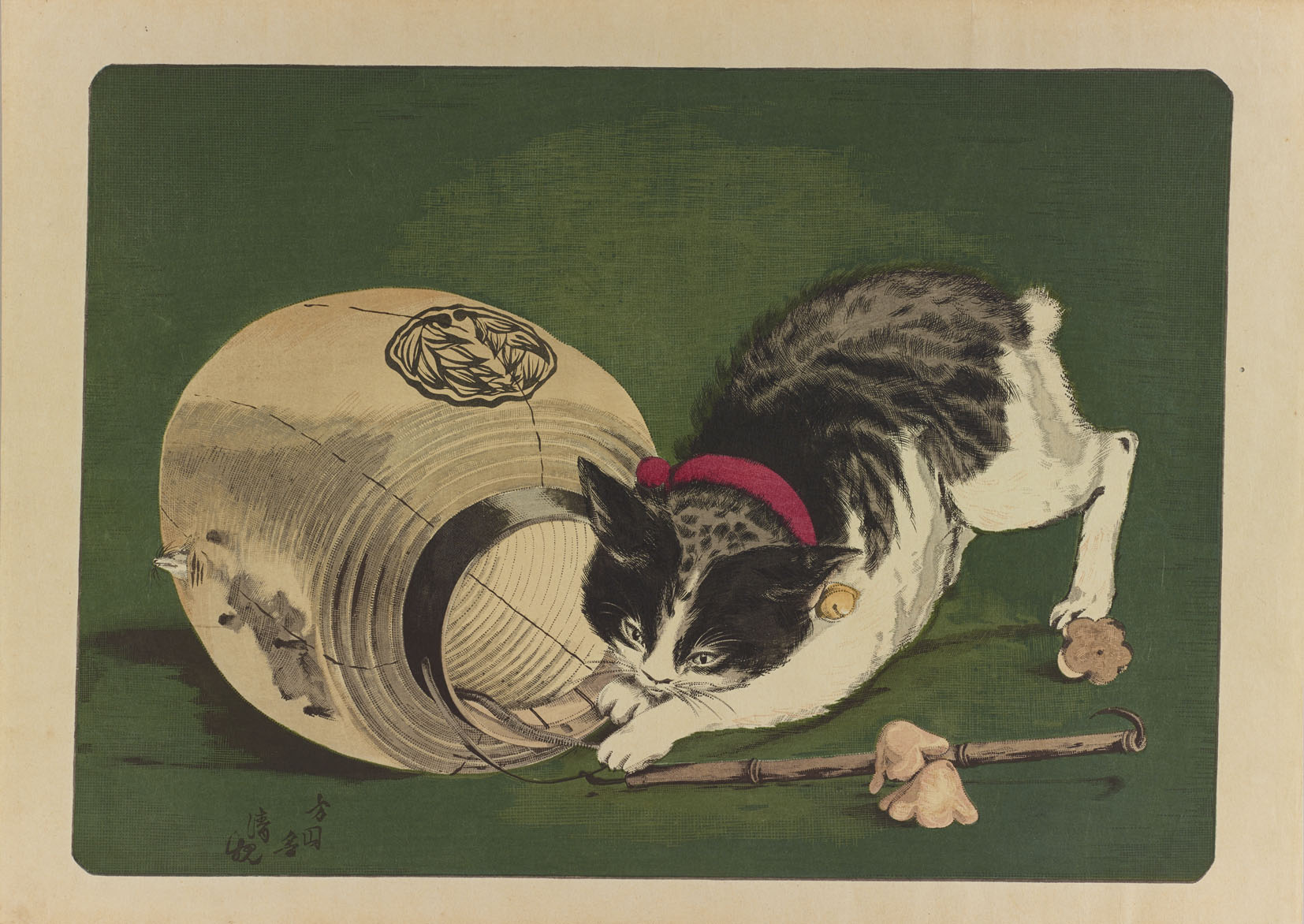
Cat & Lantern (1877) by Kiyochika Kobayashi

BACKGROUND: Issai Chozan’s Neko no Myōjutsu (“Eerie skills of the Cat”) was published in the book Inaka Sōji in 1727. It’s an example of dangibon, a light-hearted form of instructional short story, a form for which Issai Chozan is said to have been one of the originators. On the surface a story of rat-catching cats, in reality it’s a lesson in strategy and philosophy of combat.

SYNOPSIS: I’ll include citations and links below, so you can read the story in its entirety, should you choose to do so. But for now, a brief synopsis: A samurai, Shoken, has a rat in his house, and it’s driving him crazy. Shoken’s housecat is terrorized by the rat. The samurai brings in the best rat-catching cats from the neighborhood, and each is soundly defeated by the rat. Shoken decides to take matters into his own hands, chasing after the rat with a wooden sword (bokken,) but the rat evades each attempted strike and, ultimately, bites the samurai on the face. Finally, Shoken brings in a legendary elder cat from across the city, a cat who doesn’t look like much, but who effortlessly evicts the rat from Shoken’s house. The balance of the story is a conversation between the successful old cat and three of the skillful younger cats who’d failed to catch the rat (as well as with Shoken.) Each of the three explains its approach to achieving victory, and in turn the master cat explains the limitations of each one’s approach. The old master goes on to explain how when he was younger, he’d met a tomcat who slept all day, and yet no rat would come within miles of it. He asked how the tomcat achieved this, but the tomcat was unable to explain it.

THE LESSON: The first cat, a young black cat, explained that it was a master of technique. The black cat was agile and strong in movement of all kinds and practiced diligently to streamline and perfect all of its techniques. The old cat pointed out that focus on technique still left the black cat with too active a mind, thinking too much about how it would defeat its opponent. The master went on to say that there is value in technique, but it can’t be allowed to be the extent of one’s abilities. He emphasized that one’s clever actions must be in accord with the Way.

The second cat, a tabby, proudly proclaimed that all of its effort went into building its energy or spirit (ki, also called chi,) and that it could defeat most rats with a gaze (though not the one in question.) The old master explained that spirit is a fine thing but being too conscious of it hurt the second cat’s ability. The master went on to say that one can never be sure that the opponent won’t have more spirit than one, and so complete reliance on ki can lead one to a defeat.

The third cat, a gray one, said that its philosophy relied on yielding and never forcing a fight. The old master explained that this was a misunderstanding of the principle of harmony, and that this kind of yielding was a man-made contrivance that was not in accord with nature and often led to muddiness of the mind. While the old cat goes on to say that none of these elements (technique, ki energy, or yielding) is without value, it’s clear as he continues that the answer isn’t as simple as being a combination of them, but rather requires a completely new way of being, of experiencing and perceiving the world.

To Shoken, the old cat explained the importance of not thinking of swordsmanship as a means to defeat an enemy but, rather, a means of understanding life and death. The old cat went on to discuss mushin (i.e. “no mind,”) a serene state of mind that allows one to be flexible to whatever comes along. The old cat emphasized the importance of eliminating distinctions of object and subject through a process of self-realization and explained that the process of seeing into one’s being one can trigger satori (sudden enlightenment.)

CITATIONS:

Matheson Trust for Comparative Religion translation, available online at: https://terebess.hu/zen/neko.pdf

Ozawa, Hiroshi. 2005. The Cat’s Eerie Skill. Essence of Training in Japanese Culture: Technique Acquirement and Secret of Kendo. Online at: https://tenproxy.typepad.jp/recent_engagement/files/essence_of_training_in_japanese_culturee.pdf

Suzuki, D.T. 1959. The Swordsman and the Cat. Zen and Japanese Culture. New York: Pantheon Books. pp. 428-435

Wilson, William Scott. 2006. The Mysterious Technique of the Cat. The Demon’s Sermon on the Martial Arts. Tokyo: Kodansha International

BOOK REVIEW: Bruce Lee’s Fighting Method: Advanced Techniques by Bruce Lee & M. Uyehara

Bruce Lee's Fighting Method: Advanced Techniques, Vol. 4Bruce Lee’s Fighting Method: Advanced Techniques, Vol. 4 by Bruce Lee
My rating: 4 of 5 stars

Amazon.in Page

This book presents a collection of Jeet Kune Do [JKD] techniques, JKD being the martial art developed by Bruce Lee to rectify what he believed were fundamental problems in martial arts, such as: elaborate techniques that have little chance of working in actual combative situations and ignorance of large swaths of the combative domain (e.g. grapplers ignoring striking, and strikers ignoring grappling.) Interestingly, Lee has come to be viewed as a herald of the mixed martial arts (MMA) movement. That said, this book exclusively focuses upon a small collection of hand-strikes and kicks.

There are a few principles that recur throughout the book that are key to JKD and are where the value of the book lies. First, there is a focus on feints to trigger a reaction, the technique being applied as the opponent is reacting to a false attack. Second, the avoidance of complex and compound attacks whenever possible in favor of simple and direct tactics (if they will work.) Third, the use of direct, linear movements to stop attacks in progress.

The downside of this book is the author’s penchant for long, over-extended kicks. Lee emphasized the importance of speed, and speed would be essential for many of these techniques to have practical value. The reason one doesn’t see such techniques (as a fighter’s “go-to” tactic) much anymore is that the kicker’s foot has to travel a couple / few meters while the receiver only has to move centimeters to be offline and in position to catch the kick and dump the kicker. Ergo, one tends to only see widespread use of such techniques in Tae Kwon Do, where the rules and culture support huge kicks.

I learned a lot from reading this book, and I particularly value its emphasis on simplicity and avoidance of convoluted methods. That said, I think the reader needs to see the book as representing one stage in an evolution of martial arts.


View all my reviews

Jo-Ha-Kyū [Free Verse]

Eye-to-Eye.

circling
&
jockeying for position,

playing with the distance
through subtle shifts,

then testing the distance,
engaging in exchanges

Thrust - Parry - Retreat - Repeat

moving faster,
the interval of exchanges 
ever shortening

then --
in one instant --

it's done.

BOOK REVIEW: Enter the Dangal by Rudraneil Sengupta

Enter the Dangal: Travels through India's Wrestling LandscapeEnter the Dangal: Travels through India’s Wrestling Landscape by Rudraneil Sengupta
My rating: 5 of 5 stars

Amazon.in Page

Get Speechify to make any book an audiobook

Enter the Dangal offers a fascinating discussion of the sport of wrestling in India, be it the dirt-pit Kushti variety or on the mats in the highest stage the sport has to offer, the Olympics. Sengupta offers a glimpse into the fully formed subculture that exists around akhada, live-in wrestling academies. We see India’s wrestling world through both the tradition- and virtue-oriented training grounds that produced greats like Gama and Sushil Kumar, but the book also takes forthright dips into the darker reaches of the sport.

The book is divided into three parts. The first part both provides background and tells the story of one of the most profound experiences of modern Indian wrestling, Sushil Kumar’s match for the gold medal in the 2012 Olympics [he took silver.] The second part explores the long wave of the rise and fall of Indian wrestling, and the third part takes the reader back to the golden age of wrestling, telling of the international matches of Gama and the movement by some Indian wrestlers into both the legitimate and staged wrestling domains of Europe and America.

There are two discussions that I found particularly intriguing. First, there’s the matter of women entering this all-male domain. Historically, not only did women not wrestle, mothers and sisters didn’t even go to the akhada to see their son’s and brother’s training. Second, the book answers an interesting question: why is India such a non-contender in the Summer Olympic games? [India falls between Uzbekistan and Ireland for total Summer Olympic medals, not even making the top 50 – which, for a country of its size and talent pool across a range of body types, is pretty dismal performance.] The answer is rooted in patriarchy, corruption, and downstream problems resulting from those problems (i.e. lack of best practices vis-à-vis sports science and poor facilities.)

I found this book to be compelling read and would highly recommend it for those wishing to learn more about wrestling in India.

View all my reviews

BOOK REVIEW: Training and Conditioning for MMA ed. by Dias / Oliveira / Brauer & Pashkin

Training and Conditioning for MMA: Programming of ChampionsTraining and Conditioning for MMA: Programming of Champions by Stéfane Beloni Correa Dielle Dias
My rating: 5 of 5 stars

Amazon.in Page

Release Date: September 15, 2022 [It may already be out in some formats and markets]

Get Speechify to make any book an audiobook

This book provides an overview of fitness building for Mixed Martial Arts athletes. It covers program design, athletic assessment, nutrition, exercises and conditioning practices, and injury prevention methods. On the positive side, it’s not only comprehensive, but – also – presents some of the best and latest methods in combative sports training based on sound scientific research. On the other hand, the book does assume a certain level of understanding of sports science, and it gets pretty deep in the weeds with respect to technical detail and to scientific and specialty jargon. If one doesn’t have such background, one may find some of the content (particularly the early chapters) a bit daunting. That said, it offers an excellent reference for those who are interested in methods and sports science not just for MMA, but for combative sports, in general.

The book uses color photographs throughout. I found the photos to be clear, well-sized, and well-lit. While there is definitely an attempt to keep the number of photos to a reasonable level, they do offer multiple angles where necessary and – generally – give enough pictures to make the action clear. There are also tables after each of the methods sections to give a handy summary of sets, reps, and scheduling suggestions for various exercises. In the early chapters, the ones that convey more technical content, there’re charts, graphs, and diagrams as needed. There’s an extensive bibliography, though it should be noted many if not most of the references are not in English. (The team of editors and contributors is large and international.)

This book offers an excellent reference for coaches, trainers, and athletes. While it does get quite technical, it’s great that it offers insight into cutting edge science and training methods.


View all my reviews

BOOK REVIEW: Scientific Self-Defense by W.E. Fairbairn

Scientific Self-DefenseScientific Self-Defense by W.E. Fairbairn
My rating: 4 of 5 stars

Amazon.in Page

Fairbairn was a fascinating character, and I read this book largely out of historical curiosity. He was on the Shanghai Police force, where he was regularly involved in physical altercations. Then, during the Second World War, he taught close-quarters combat to Allied nation commandos. While this book is a self-defense manual (and, as such, is technique-centric,) it’s interesting to see what Fairbairn came up with when building his own self-defense system (which he called “Defendu,”) taking a background in Judo, Jiu-jitsu, and other martial arts and applying it to practical self-defense situations. The book includes a mix of techniques for countering grappling and weapon attacks as well as holds, take-downs, and some stick and truncheon techniques. There are a number of specialty items thrown in such as binding an opponent.

I wouldn’t recommend this book for individuals interested in learning self-defense. This isn’t a challenge of Fairbairn’s qualifications, which were impressive both on paper and in terms of real-world experience. There were three things I disliked about the book as a self-defense manual. First, Fairbairn did not seem to be a believer in the “don’t let your ego write checks you’re not willing to cash with your body.” He’s not much of an advocate for running away screaming, even when the situation would allow that option. To be fair, most of Fairbairn’s students were police officers and military personnel – i.e. not individuals with the same range of options as a civilian. Secondly, the book is loaded with statements about it being a “simple matter to do ‘x’” along side pictures of ragdoll (passive) opponents, and this could build a fatal misapprehension of what will happen against an opponent who is resisting and applying counter-techniques. Finally, a major point of building a self-defense system is to weed out the techniques from martial arts that are too complex for an individual who isn’t training daily and who isn’t used to commanding his body under intensely stressful situations. Therefore, one avoids complex techniques, or ones that require a high degree of precision. It’s hard to justify including techniques such as juji-gatame (a ground armbar technique that is challenging to apply, but especially as it’s demonstrated – i.e. from a standing takedown.)

If you want to know more about what was being taught in the early twentieth century with respect to self-defense based on jiu-jitsu, the book is interesting. However, I wouldn’t recommend it for those interested in knowing more about self-defense.

View all my reviews

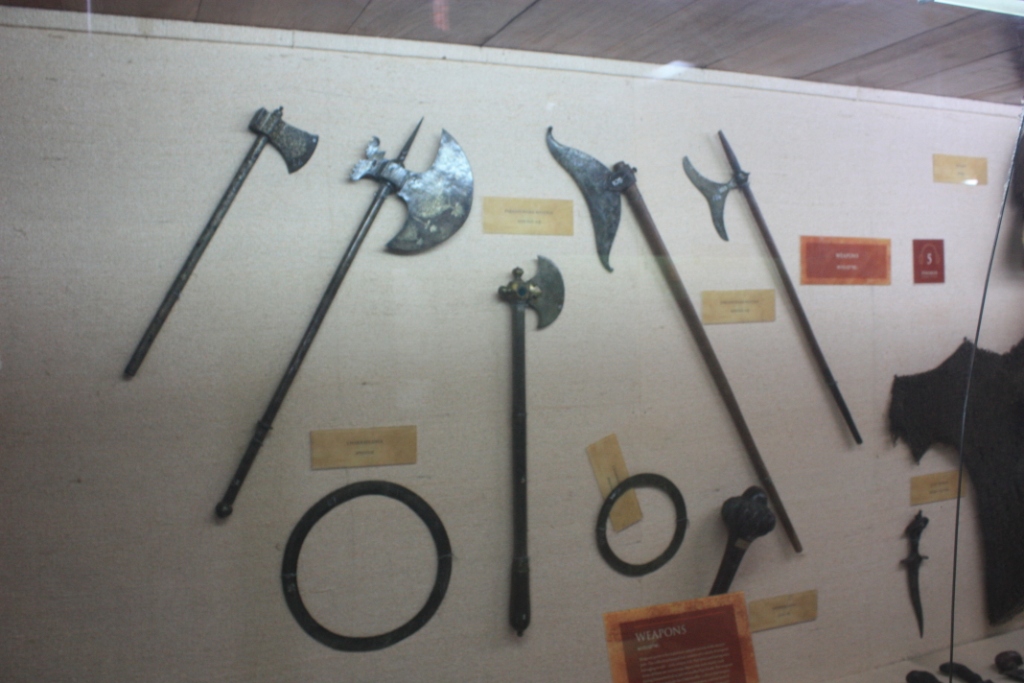
DAILY PHOTO: Indian Weapon Display

Taken in September of 2017 at the Government Museum of Bangalore

Ma-Ai: The Ideal Interval [Free Verse]

there is a ma-ai

-- an ideal interval --

the perfect gap
in space & time
& space-time

there's a ma-ai:

between setup and punchline
&
between punchline and laugh

between inhalation 
&
exhalation

between listening
&
speaking

between receiving
&
countering

between swinging
&
hitting

too rushed and momentum
is smothered

to slow and momentum
dissipates

there is a ma-ai
for all things that move.

BOOK REVIEW: Karate Science by J.D. Swanson

Karate Science: Dynamic MovementKarate Science: Dynamic Movement by J.D. Swanson
My rating: 4 of 5 stars

Amazon.in Page

When I picked up this book, I did so with the hope that it would be to striking as Jiichi Watanabe’s excellent book “The Secrets of Judo” [now sold as “The Art and Science of Judo”] is to grappling. That didn’t turn out to be the case. If Watanabe’s book has a fifty / fifty split between science and judo, Swanson’s book is about 80 percent Karate manual and 20 percent science. It’s a fine book about karate techniques, but if you want to understand biomechanics and how to optimize your movement, I think you can do better (particularly, if you would like insights that apply beyond Okinawan Karate.)

The book had two failings, keeping it from living up to its potential. First, it didn’t use graphics as well as it could have to help the reader visualize what is being said, or to point out the subtleties under discussion. Second, it generally presents the science at a shallow level. I’d been pleased to see that there was a chapter on breath, because I think that’s one of the most important and under-discussed factors in any system of movement (martial or otherwise.) However, I was disappointed to see that there wasn’t much to it besides some philosophizing about ki-ai.

There were a few valuable tid-bits here and there, points about which the book adds to one’s scientific / bodily understanding. The best example of this is probably the discussion of Intra-Abdominal Pressure (IAP,) which is where the book most shines with respect to offering some food for thought.

If you study Okinawan Karate and are looking for discussions about the difference between how various schools perform techniques, this may be the book for you. However, if you’re expecting some science in a book entitled “Karate Science,” I suspect you can do better.


View all my reviews