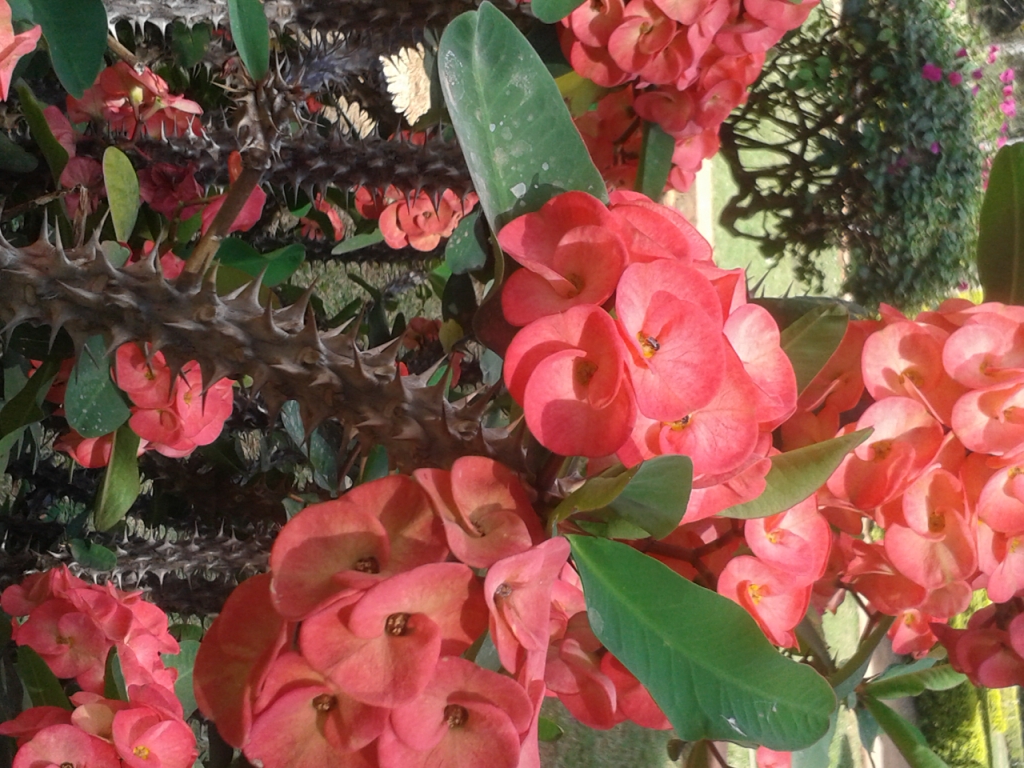
Like someone you may know, this plant is pretty at a distance but mean close up.
Tag Archives: India
Animals Forms and Poses in Martial Arts
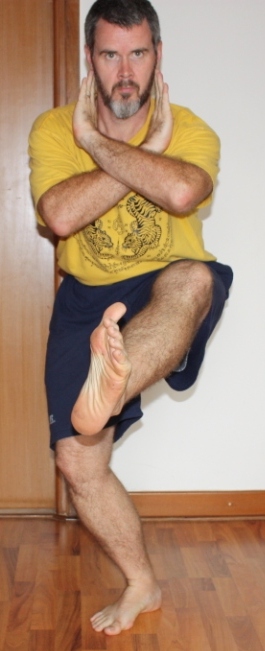
Part of the most basic of basics that I’m learning in Kalaripayattu class are 8 animal poses (Wild Boar, Elephant, Cat, Lion, Snake, Rooster, Peacock, and Horse.) While animal forms and postures are common enough in martial arts, this is an entirely new concept to me and one that I’m trying to wrap my head around.
Animal forms are most commonly associated with Chinese Kungfu. There are entire styles devoted to five animals (i.e. tiger, leopard, crane, snake, and dragon [yes, I realize dragons aren’t really animals.] Of course, from Kungfu Panda we know there are also Monkey style and Mantis style, but that’s only just the beginning. There are many different animals that play a role in martial arts, some–like tigers–are not unexpected and others–like peacocks–are harder to imagine.
As I’ve mentioned before, old style Japanese martial arts–at least the one’s I’ve studied–invoke nature commonly, but in a more subtle form. In Japanese budō one does not imitate animal movement or positioning–except in a very limited and general sort of way.
I’m interested in why one should imitate the postures or movement of animals. After all, it’s hard to argue that a human being can move more efficiently or effectively imitating a [non-human] animal. We are uniquely bipedal mammals, and to imitate–for example–a legless reptile (for example) doesn’t seem to make a lot of sense.
One explanation I’ve heard is that these animals are natural fighters, and are, therefore, to be emulated. I don’t put a lot of stock in this explanation. Don’t get me wrong, I do believe that humans are less naturally capable of close-quarters fighting than pretty much any other animal. But it’s got nothing to do with the nature of our bodies and everything to do with the condition of our minds. Humans are emotional beasts and have trouble living in the moment. That’s why we aren’t natural fighters compared to a tiger–which doesn’t get paralyzed by fear, doesn’t get plagued by guilt, and never walks through dangerous territory with iPod earbuds in its ear, thinking about how it needs to update its Facebook page. Humans excel at making weapons that allow us to stay as far away from the enemy as possible–preferably on another continent. But close-quarters combat is an uphill struggle all the way.
There is an explanation that I find to be more sound, and that’s that these postures are meant to facilitate a certain mindset. Just as people condition themselves to associate certain hand mudra with certain states of mind (I know that’s not necessarily how they see it), one may use these postures to invoke a certain state of mind. This is somewhat related to what I was discussing in the preceding paragraph. Human’s are challenged to get into the right frame of mind for combat, and animal forms and postures might be one way to hasten that state. For humans there are two aspects of the problem. First, people are naturally scared of being injured or killed, and for many this becomes debilitating. Second, except some psychopaths, humans really don’t like to kill. This is true of other species by the way, we are genetically hardwired against killing our own kind. However, other animals can’t worry about it like us. (Here I mean worry in the sense that W.R. Inge described, “Worry is interest paid on trouble before it comes due.”)
Another explanation that I think has some merit is that some of these poses and forms are more about the exercise than combat effectiveness. In essence, they are like yoga; they build range of motion and strength in core muscles. One can certainly see this in the exceedingly low animal stances that require a great deal of flexibility.
The only other reason that’s popped to mind is that animal imitation is used to try to create a feeling (e.g. fear) in one’s opponent. This is closely related to the first point. One wants to create a perception of ferocity (or otherwise) in the eyes of the opponent as well as internally.

DAILY PHOTO: Under the Flyover
DAILY PHOTO: Brigade Road
This is a section of Brigade Road in Bangalore–one of the city’s retail districts.
Fun fact: in India–for reasons I don’t know–franchisors don’t exercise control over or coordinate the locations of their stores. For this reason, one may have two Reebok stores in a given block and five within walking distance. It’s actually not unlike Waffle House is (or, perhaps, used to be) in the Atlanta metro area where one might have Waffle Houses catty-corner from each other. Usually, a company or franchisor wants to control the density of stores so that they don’t cannibalize each other out of business and leave their more disciplined competitors to snatch up market share.
If I had to guess why this seems to work here, I would say it has to do with high density of wealth and low labor cost for retailers. There are–in absolute terms–a lot of people in the city with disposable income but they are concentrated in certain areas so it doesn’t make as much sense to spread out your stores. Plus, with low labor costs, the price of keeping a store up is relatively low. Of course, it may have nothing to do with either of those issues, but rather be rooted in India’s bizarre regulatory environment.
DAILY PHOTO: Banana Flower
The other night, I ate banana flower for the first time–that I know of / remember–in two separate dishes. My wife and I were eating at the Oh! Calcutta on St. Mark’s Road in Bangalore, and we sampled banana flower croquettes as part of an assorted starter platter, and then I tasted some of my wife’s entrée, which was “dry cooked banana flower with coconut slivers.” The former was tasty, but so spicy that my undiscerning palate was incapable of learning anything about the flavor of this flower. The latter, much milder, dish tasted like a tasty take on mashed potatoes (again, to my unrefined palate.)
The picture above was taken in Malaysia, but banana flowers are present everywhere bananas grow (throughout much of tropics.)
Deceptively, the flower looks like it could be a deadly weapon–with its pointy, conical bloom.
Penguin India and The Hindus: Do Self-Imposed Bans Sell?
If anything sells a book more effectively than sex, it’s being banned. One knows that a book contains powerful ideas when someone goes to the effort to try to have it banned. Granted, the powerful ideas may or may not be good ideas–or true ideas, but thinking minds will demand to see for themselves. (I for one will be stopping by my local bookstore to see if they have a copy they’ll sell me for less than 1,000 rupee [$16USD], because I’ve got to know what has the thought Nazis up in arms.)
But does a self-imposed ban have the same effect? Penguin India settled a suit by agreeing to stop printing the book The Hindus: An Alternative History, and to burn outstanding copies. This, after a protracted legal battle against a Hindu nationalist group called Shiksha Bachao Andolan. However, there may be more to it than simply trying to build sales on the four+ year old book (that likely would have been long forgotten in an environment of free speech.) Indian law makes it a criminal offense to offend Hindu sensibilities, and thus puts the publishers in physical as well as fiscal jeopardy. Of course, it’s already come and gone as a best-seller in India, so it couldn’t hurt to restoke global interest.
It should be noted that there isn’t overwhelming support for banning the book in India. There has been outrage against Penguin’s fold by Indians who read, who believe in freedom of speech, and who are terrified of the idea of a crime of hurting someone’s feelings by discussing their religion’s history. (The latter being a direct route to tyranny if ever there was one. )
As I said, sex sells and bans sell double; the book in question has both. One might be inclined to think that it’s some sort of porn novel churned out on pulp. Actually, the author is a Professor of Religious History at the University of Chicago, Wendy Doniger. The book does apparently focuses heavily on the role of sexuality in Hindu mythology. What some readers might not know–and might be surprised to learn–is that hardcore Hindu nationalists are two steps to the right of Jerry Faldwell on issues of sex.
Here’s are accounts by the LA Times and Galleycat.
One of the most extensive discussions of the forces who succeeded in getting the book banned is in the NY Times.
DAILY PHOTO: Townhall in the Setting Sun
BOOK REVIEW: Vajramushti by Christopher Fernandes
Vajramushti; Martial Arts of India by Christopher Fernandes
My rating: 3 of 5 stars
There aren’t many English language books on Indian martial arts, and most that do exist address a single style (most commonly Kalaripayattu.) Christopher Fernandes’s book, therefore, fills a void by providing an overview of martial arts on the subcontinent, and for the most part the book does an admirable job. I do have a couple of criticisms of the book that I’ll get into further down in the review.
The 350 pages of this book are arranged into 17 chapters, with the front and back matter of a scholarly work (i.e. in addition to an introduction and epilogue there are appendices and a bibliography.) The first few chapters set the historical background, and the last few chapters address topics that are related to—or interconnected with—the martial arts, e.g. pranayama (breathing), Ayurveda (traditional Indian medicine), dance, and games of martial relevance. Chapters 6 through 11 form the core of the book, and this is where one gets the book one expected. These core chapters are organized by region, and each gives an overview of one of India’s martial arts in great detail. The arts covered include: Thang ta (northeast), Gatka (author classifies as Central, but it’s commonly associated with the Sikhs [i.e. Punjab, in the Northwest]), Yudhkaushalya che Talim (Central), Silambam (south, Tamil Nadu), Kalaripayattu (south, Kerela), and Marma Adi (South). It’s not all-inclusive, but that might not be possible in a single volume. It does hit the major arts and covers a range of weapons and unarmed skills, and I suspect offers a fair representation of Indian martial arts past and present.
I have two major criticisms, and a third mild criticism. The first is purely technical and likely only applies to the Kindle edition (that’s the only edition I’ve seen), and you can probably guess my gripe. The formatting on the e-version of the book is poor. While this book isn’t as graphics-intensive as a typical martial arts book (i.e. there aren’t long sequences of technique photos) there are many graphics—and necessarily so. It would be hard to convey all the information in textual form for this type of book (e.g. consider the value of a picture of a complex weapon over a description.) What happens in Vajramusthi where the graphics are inserted is that the captions get kicked in among text. At least they italicized the captions so one can get used to this oddity, but it’s a bit hard on readability when one is reading along and there is a fractional caption randomly inserted mid-sentence. The photos also cause odd white space and very narrow columns here and there.
The second major criticism is that the book often forgets its theme. By that I mean that the author goes into far too much depth on topics that are tangential to the subject at hand and sometimes fails to indicate how the subject at hand is relevant. I’m not saying that historical background and discussions of breathing and Ayurveda shouldn’t be included, they are both quite pertinent, as are the other chapters that are more tangential. However, at one point the author provides a mini-herbal field guide that seems a bit too much information for those specific herbs, but, because it’s not an Ayurveda herbal field guide, he only covers a few. This creates a book that sometimes doesn’t seem to know what it wants to be or who its intended audience is. It’s most confusing in the early chapters that begin with the dawn of humanity. Obviously, the development of martial arts is inextricably tied into the rise of societies and states, but the author doesn’t consistently do a good job at connecting these dots so the book can maintain a consistent theme. I should point out that history buffs, dance enthusiasts, or physical education nerds may find the bonus material fascinating—and it is; it just belongs in different books. It does indicate that the author has done his research. While I’m a neophyte on the subjects covered, I believe that the quality of the information is quite good. (Although myth and fact are sometimes equated as with the discussion of Bodhidharma—a myth that many historians now believe false.)
The third criticism is classified minor both because it only comes into play in the epilogue and because if I was going to criticize every martial arts book author for this sin, I’d rarely have anything nice to say about a martial arts book. At the tail end of the book the author suggests that all the other martial arts of the world are just superficial competitive endeavors and only the Indian martial arts have depth that can lead to bettering oneself in a broad sense. This is a complete oversimplification, and especially odd for someone (like the author) who has apparently trained in other systems. (At one point there is a photo of Bruce Lee, captioned “Epitome of a Warrior,” and I can only assume from his commentary in the epilogue that the author is mocking the founder of Jeet Kune Do.) I do understand the passion that inflames the author’s sentiments, which is sadness that young Indians who study martial arts overwhelmingly look to the East—just as those in Europe and the Americas do. In Bangalore, where I live, there are two places that I know of that teach Indian arts (both Kalari) and at least eight places one can learn Muay Thai—not counting the fitness centers that have no one qualified to teach MT but do so anyway. Still, one need not take cheap shots at other martial arts in attempting to encourage people to study the indigenous arts.
While my review may come across as critical, there’s really not much wrong that a skilled editor and formatter couldn’t fix. (For example, one could get blitzed playing a drinking game whereby everyone takes a shot whenever they read the exact words “Vajramushti the classical Kshatriya Lion’s skill.”) The book’s virtues tend to outweigh its vices. If there were as many books out on the Indian martial arts as there are about those of China, Japan, or Korea, I don’t know that this one would get my recommendation in its present state, but there aren’t and so I do recommended it. It’s well-researched, contains useful graphics, and it provides insight into how the martial arts fit into the history, yogic science, and movement arts of India—if sometimes a bit too much insight.