BOOK: “The Future of Humanity” by Michio Kaku

The Future of Humanity: Terraforming Mars, Interstellar Travel, Immortality and Our Destiny Beyond EarthThe Future of Humanity: Terraforming Mars, Interstellar Travel, Immortality and Our Destiny Beyond Earth by Michio Kaku
My rating: 4 of 5 stars

Author Booksite

As the title suggests, this is one of the books for which theoretical physicist Michio Kaku dons his futurist cap to speculate about what is to come. Other of his books that might be included in this “series” are: Visions, Physics of the Future, The Future of the Mind, and Physics of the Impossible. This particular book focuses on how humanity will spread beyond the planet (and, perhaps, beyond the universe) to survive the (probably distant, but – also – inevitable) threats to the species. While there are other topics discussed, such as the search for immortality and transhumanism, those topics are often framed as necessities of interstellar expansion.

As one would expect of a physicist, the book is highly focused on the physics of the subject. There is little discussion of the psychological difficulties, nor of biological issues such as the fact that humanity is not so lone wolf as we think, and taking off to other planets and living in space without the Earthly life we are interdependent on would involve challenges we have difficult fathoming. All of the challenges that are usually treated with handwaves in science fiction are also handwaved off here.

The book is fun and interesting reading. It’s probably more insightful of science fiction than of our future, but that doesn’t make it less compelling. The seven years since this book was published have seen a lot of change, and there may be a book on this subject that has more of a finger on the pulse, but I still enjoyed reading it. [The downside of writing about the future, even with a focus on the distant future, is that one risks becoming obsolete rather quickly.]

If you’re interested in how humanity might survive into the future, I’d recommend this book. If you enjoy popular science and / or science fiction, you’ll probably find it intriguing.

View all my reviews

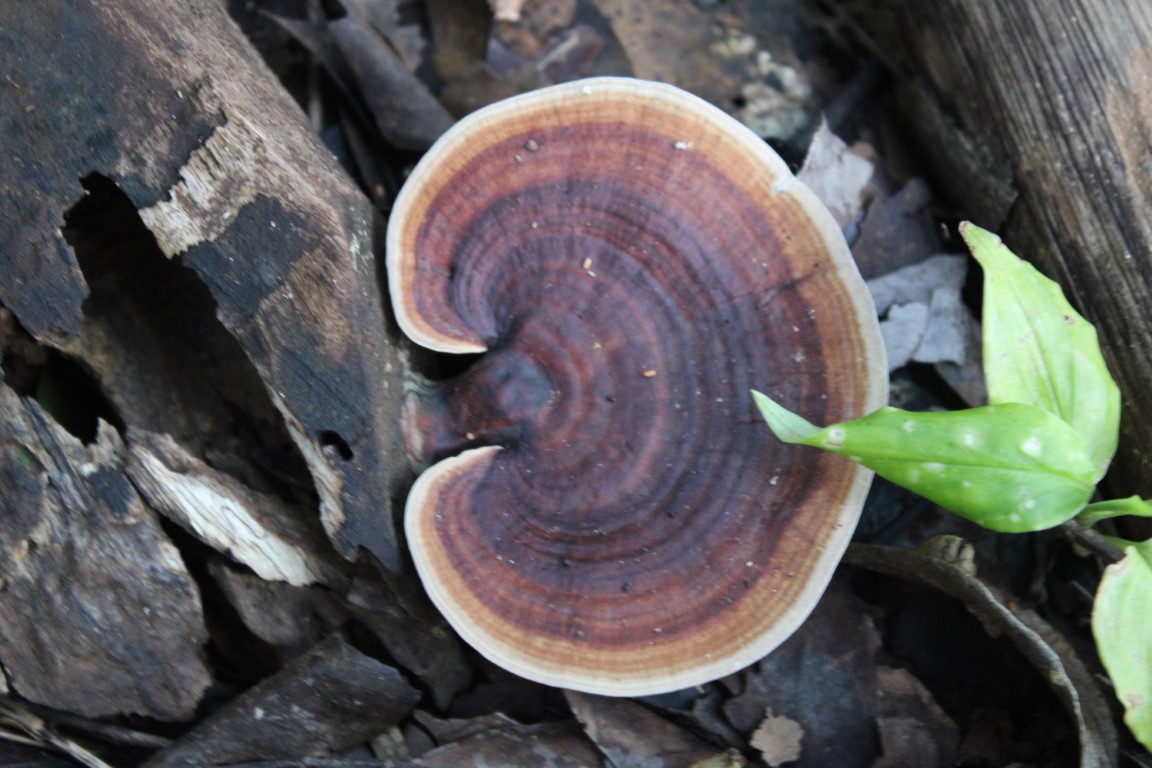
Lingzhi (灵芝) [Haiku]

Ge Hong's Elixir?
it does turn rotten wood
into comely art.

“Because I Could Not Stop for Death” (479) by Emily Dickinson [w/ Audio]

Because I could not stop for Death —
He kindly stopped for me —
The Carriage held but just Ourselves —
And Immortality.

We slowly drove — He knew no haste
And I had put away
My labour and my leisure too,
For His Civility —

We passed the School, where Children strove
At Recess — in the Ring —
We passed the Fields of Gazing Grain -
We passed the Setting Sun -

Or rather - He passed us -
The Dews drew quivering and chill -
For only Gossamer, my Gown -
My Tippet - only Tulle -

We paused before a House that seemed
A Swelling of the Ground -
The Roof was scarcely visible -
The Cornice - in the Ground-

Since then - ‘tis Centuries - and yet
Feels shorter than the Day
I first surmised the Horses’ Heads
Were toward Eternity -

For Those Seeking Immortality [Rondeau Triolet]

To stretch a life beyond the time of trees
be ready for a glacial shift of pace.
There'll be no undulation of the seas.
To stretch a life beyond the time of trees,
the tradeoff is what's quick will pass unseen.
So, what say you, Kings of infinite space?
To stretch a life beyond the time of trees
be ready for a glacial shift of pace.

BOOK REVIEW: The Old Guard: Tales Through Time, Vol. 1 by Greg Rucka, et. al.

The Old Guard: Tales Through Time, Vol. 1The Old Guard: Tales Through Time, Vol. 1 by Greg Rucka
My rating: 5 of 5 stars

Amazon.in Page

Out: December 21, 2021

This six-issue graphic novel collects twelve standalone short stories from “The Old Guard” universe. For those who’ve neither read the comic nor watched the Netflix movie, it imagines that a few immortals walk among us, or – if not immortals – at least extremely long-lived people. The oldest known among them, Andromache the Scythian (a.k.a. Andy,) is somewhere between six and seven thousand years old. (She appears in about half the stories in some capacity or another, ranging from cameo mention to main character.)

As the subtitle suggests, the dozen stories jump through time offering vignettes from the lives of the various immortals. The locales also vary, though primarily involving places that are known for their belligerency, intrigue, or noir ambiance — e.g. the wild west, samurai era Japan, 197o’s New York City, Berlin in 1932, etc. Some of the tales, e.g. “How to Make a Ghost Town,” “Zanzibar and Other Harbors,” and “Lacus Solitudinus,” are story-driven. Other pieces are more conceptual, focusing on an intriguing idea that comes with immortality. For example, “My Mother’s Axe” explores the Theseus’s ship idea of what it means for a thing to be itself when it’s replaced piece by piece over time.

I enjoyed this collection a great deal. The artistic styles vary to be apropos to the time and place in question, and the storytelling approach also shifts, owing not only to the different settings but also to the numerous authors involved. If you’re attached to having extended story arcs told over several issues, this might not be for you. The storytelling is necessarily terse and / or truncated, owing to space constraints. But if you go in expecting the two story-per-issue flash fiction format, you’ll likely find it compelling.


View all my reviews