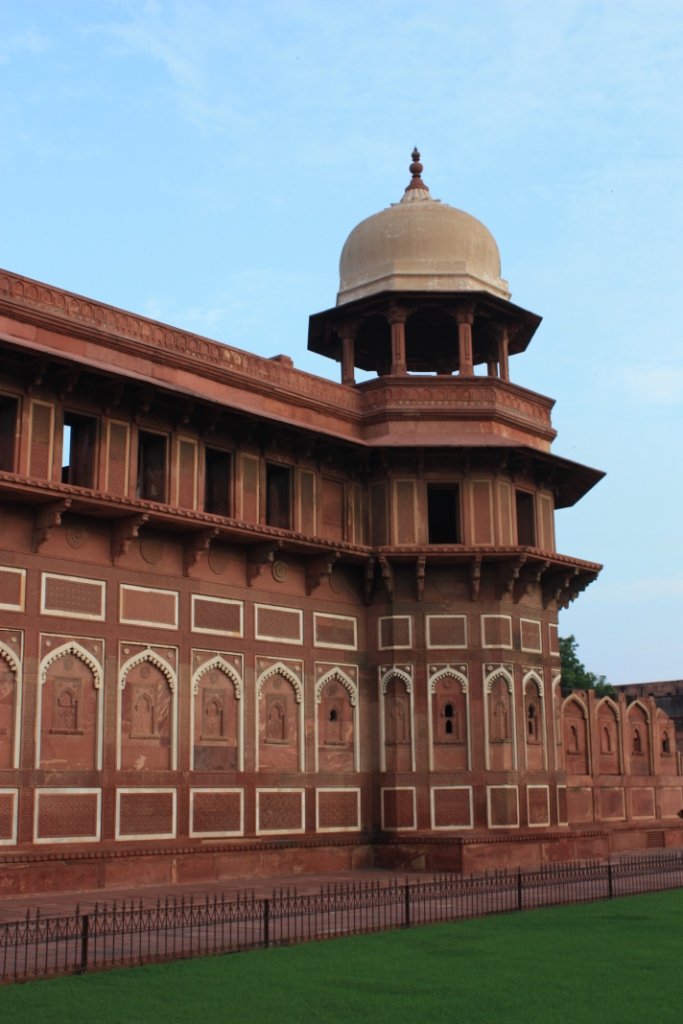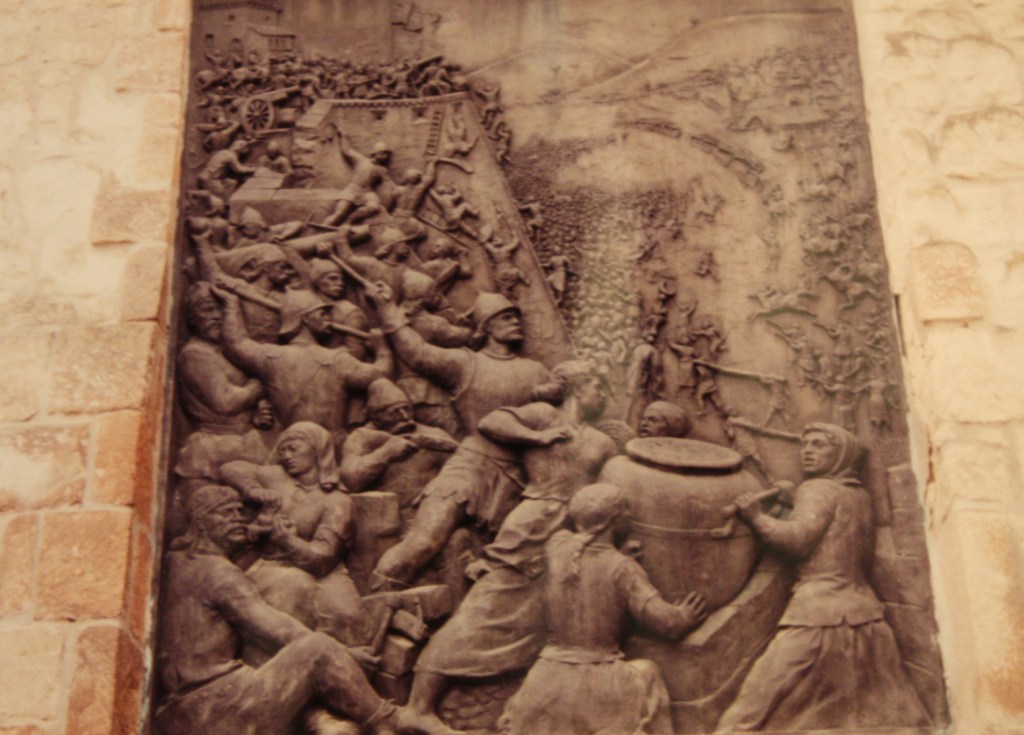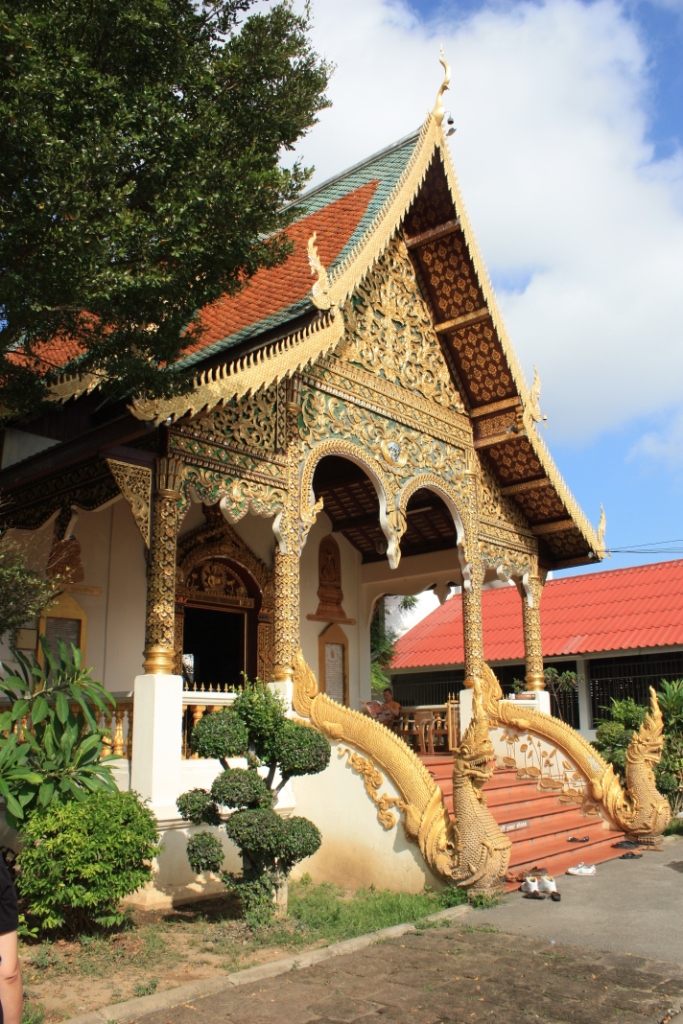
I just returned from a week-long trip to Agra and Delhi. (Hence my lack of posts of late.) The Taj Mahal dominates Agra’s tourist scene–and for good reason–but Agra Fort is an impressive site in its own right. Agra Fort is considerably more impressive than Delhi’s Red Fort, which I toured on the same trip. The fort offers some unique shots of the Taj Mahal from across the Jamuna River, but also has both marble and red sandstone buildings that have been impressively and meticulously maintained and restored.
Tag Archives: history
BOOK REVIEW: Ip-Man Portrait of a Kung Fu Master by Ip Ching, et. al.
IP Man: Portrait of a Kung Fu Master by Ip Ching
My rating: 3 of 5 stars
Ip Man led an interesting life. The master of Wing Chun Kung Fu lived through tumultuous times that included the Boxer Rebellion, the Sino-Japanese War, and China’s Communist revolution. After the Japanese occupation he served for a time as a police chief. Coming from a wealthy family, he experienced a riches to rags fall when the Communists took over. He had to move from his home in Foshan to Hong Kong. His use of kung fu was not restricted to the training hall, but, rather, included a few real world altercations. A couple of films have been made(loosely) about his life.
All that being said, this book doesn’t do a great job of capturing the life of this intriguing man. To be fair, the book isn’t really a biography proper–though the title might lead one to believe it was. However, it’s not entirely clear what the book is. Its fifteen chapters are each built around a principle and use vignettes from Ip Man’s life to illustrate how the Grandmaster lived virtuously. This makes the book seem more like treatise on martial arts philosophy and/or strategy. However, some chapters do a better job of making clear what the actual principle is and how the events of Ip Man’s life exemplify them than do others. In some parts it does a great job but in others it’s only lackluster.
There are some fascinating stories about the man’s life in the book, but they are generally told in a lifeless manner. In part this may be done on purpose as we are told that Ip Man eschewed embellishment and favored humility, but it makes the reading experience less than gripping. It’s also probably that some of the details were lost when Ip Man died in 1972. This lack of detail leaves one at times wondering. Throughout most of the book we get a picture of Ip Man as a virtuous warrior. However, there is one vignette in which we read about the Grandmaster picking a fight with a man by taunting him with humiliating insults about the man’s appearance. Ip Man does this to teach his student a lesson in courage. His lesson notwithstanding, this behavior paints Ip Man as anything but virtuous–rather than a humble martial arts master he becomes a pathetic bully. The author, Ip Man’s son Ip Ching, suggests that this might have been a setup for the student’s benefit, but with the prior assent of the bullied man. At any rate, there was no fight because the bullied man backed down–whether because it was staged or out of genuine fear remains unknown.
For some readers the most surprising omission will involve a lack of any mention of the man who was far and away Ip Man’s most famous student, namely Bruce Lee. There may be a number of reasons for this omission, including a desire to prevent the teacher’s story from being overshadowed by his student’s fame. However, most readers would probably like some inkling of how the ill-fated superstar came to train with Ip Man and what he learned from him. In fact, the only reference to the entertainment aspect of kung fu is a picture caption that shows Shek Kin, the villain “Mr. Han” from Enter the Dragon, at Ip Man’s funeral.
I would recommend this book only for those that have a particular interest in martial arts. It does offer tidbits of interesting events from Ip Man’s life as well as a few great life lessons. It benefits from being a concise book, and thus is not a major time investment to read. However, I don’t know that–short as it is–it would hold the interest of the general reader. Hopefully, someone will take on a more extensive English-language biography of this fascinating man’s life while there are some key people still alive to be interviewed about his life story.
The Good and Ugly of Olden Times
This was posted in my martial arts blog, Jissen Budoka, as well.
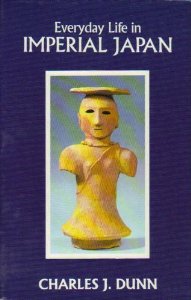
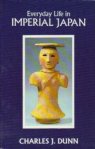
I’ve been doing a lot of reading about Japan’s past recently. In my spare time, I’m working on rewrites for a novel in which 14th century Japan features prominently. Being my first foray into historical fiction, I’m finding the need to go back and do a lot of research about the time because the quick and dirty draft I wrote needs a lot of gussying up. I just finished reading Charles Dunn’s Everyday Life in Imperial Japan, which is about a later period but one which would have shared much in common when it comes to everyday life. Presently, I’m reading The Taiheiki–which is about the 14th century, but which blends fact and fiction.
Doing such research encourages one to consider what it meant to live during that time. We all build constructs of the world to adjust for our limitations in knowledge. Some of these constructs hold up better than others, but they’re all simplifications. When one reflects upon a time before one’s experience–and particularly regarding a place with which one has limited familiarity–there are two major forms of fallacious reasoning that can take hold:
1.) The Golden Age Fallacy: This is the thought that everything was better back in the day–back before humanity started slouching toward craptasticness.
2.) The Outhouse Fallacy: This is the idea that any society that couldn’t manage indoor plumbing couldn’t possibly be worthy of emulation.
Of course, these simplifications are both true and false in some regard, and–as absolute statements–are absolutely false. The truth is something more like what Ralph Waldo Emerson suggested in Self-Reliance. Emerson described society as a wave, receding on one side as quickly as it advanced on the other. In other words, changes maybe seen as progress, but they also bring about the destruction of valuable knowledge. In martial arts terms, the spear becomes obsolete and the art of spear-fighting dies.
The movie entitled The Last Samurai revolves around this premise. Of course, in Hollywood fashion the forces of modernity are made entirely villanous and our heroes, the samurai, are entirely virtuous. In a way the movie is perverse in that it suggests we root for the medieval approach over our own.
When considering feudal Japan, Golden Agers point to it as a time during which virtue was paramount, craftsmanship was exquisite, and much culture flourished. They are right; but don’t set your time machine just yet because Outhouse Agers are also correct when they say that it was a time during which most of the population had no rights, wars ravaged the country, and in which farmers were not allowed to partake of many of the products they produced–but rather had to feed and cloth their families with inferior substitutes.
One should be careful to neither romanticize nor vilify the samurai. We should keep what is of value of the old ways without being a slave to the worst ways of our predecessors’ nature. One shouldn’t abandon everything old on the assumption that by definition everything abandoned to the past is refuse.
BOOK REVIEW: Everyday Life in Imperial Japan by Charles Dunn
Everyday Life In Imperial Japan by Charles J. Dunn
My rating: 4 of 5 stars
This interesting little book is invaluable for anyone researching what life was like for people in Japan before the Meiji Restoration. While it’s an essential volume for a writer of historical fiction, those interested in Japan more generally will find it readable and packed with interesting tidbits of information. For example, I would recommend it for those who study traditional Japanese martial arts (i.e. kobudō)to get a better insight into the art they study through knowing the society from which it sprang.
This type of work is relatively rare, but is a writer’s dream come true. It’s not a history book, but–as the title implies–tells one how people of various classes and occupations lived day in and day out. That is, its approach is more anthropological than historical.
The range of occupations in Japan’s pre-modern period were far fewer than in society as we know it, and so the book takes broad job classes as its primary unit of organization. It begins with the group that undoubtedly draws the most interest, the samurai. It proceeds to the occupation which is most numerous in any pre-modern society, the farmers. Beyond that, it covers the lives of skilled craftsmen, merchants, courtiers, priests, doctors, intellectuals, actors and outcasts. The concluding chapter looks specifically at life in the city, and–in particular–life in Edo. Edo is the city that would become known as Tokyō, and which became the capital of the Shogunate in 1603 and eventually the nation’s capital.
Japan’s relative isolation throughout its early history has made for many intriguing national peculiarities. It’s true that Japan’s literary, religious, and philosophical systems were greatly influenced by China, but–in all cases–these cultural elements were forged into a uniquely Japanese form. This uniqueness provides many “ah-ha” moments while reading.
One learns why warriors were required to wear extra long hakama (a very billowy form of pleated pants that look like a long skirt–though having individual pant legs.)One learns about how one got around on the early highway system in a time when infrastructure (e.g. bridges) were minimal, and who was allowed to use the roads–such as the famous Tōkaidō road. The book tells how police went about arresting armed samurai. The roles played by women in society are discussed. While this was obviously a patriarchal society, women weren’t locked entirely outside the domain of power.
This was a feudal society with the samurai owning the land and the farmers toiling in hopes of having a little left over to support their families. While farmers made silk, they were, by law, not allowed to wear it. Farmers sometimes resorted to selling daughters to brothels to make ends meet.
There were many types of craftsmen from saké brewers to carpenters to makers of lacquer-wares. Japan has a long history of appreciation for master craftsmanship as is most apparent in sword-making. The Japanese sword was the cutting weapon perfected. Its folded steel design offered a flexible spine with a hard edge that could be honed to razor sharpness.
Merchants were a class that was both looked down upon and increasingly powerful during this period. Samurai were often barely making a living then, but merchants were beginning to flourish. Japan’s first indigenous money wasn’t introduced until 1636. Prior to that Chinese coins were used, much in the same way that some present-day countries use US dollars for currency–thus avoiding inflation that would be inevitable if they had their own currency and governance. There is an extensive discussion of the early sea trade.
Some of the most interesting careers were those more peripheral. Doctors practiced something akin to Traditional Chinese Medicine. There were wandering street performers and holy men of a wide variety.
I’d recommend this book for anyone interested in Japan’s history, and would call it indispensable for a writer addressing pre-Meiji Restoration Japan.
Happy 237th, America
America is the product of a set of exceptional human beings. Some may wish to humanize the founding fathers and to deflate the mythology that has grown up around them, but deflate the myth and one still has impressive facts. Who turns down a salary for the most sleepless and thankless job in the universe? George Washington, that’s who. Who writes a political document so artfully that its turns of phrase still chime poetically in the ear 237 years after the fact? Thomas Jefferson, that’s who? Who can invent the lightening rod and bifocals, convince the French to move toward the sound of the guns (just kidding, France), and get the chicks despite the most hideous comb-over ever? Benjamin Franklin, that’s who.
Now this may be Golden Age fallacy talking, but today’s ruling elite seem a bit… well let’s just say “pathetic” by comparison. Sure modern-day rulers still have charisma out the wazoo, but Franklin had charisma plus a world-class intellect. Jefferson had charisma, and he didn’t need a speech-writing team and focus groups to craft his words for him. Washington had charisma, and–quite frankly–he could scare the shit out of a grizzly bear. It’s the rare modern-day leader who is qualified for any alternative career besides ambulance chasing.
Still, I will remain optimistic about the fate of the nation as long as great ideas prevail. Checks and balances is a great idea. The compromise to appease both populous and small states is a great idea. The Bill of Rights is a set of great ideas. I’m a little amused whenever I hear people say that America needs to revise its Constitution if it wants to keep up in the modern world. I heard this most recently from a scholar who said that because it was relatively difficult to make laws and spend money, America was going to fall ever behind the likes of Scandinavian countries? What? Really? Seriously?
BOOK REVIEW: The Bridge at Andau by James Michener
The Bridge at Andau by James A. Michener
My rating: 5 of 5 stars
In the fall of 1956, there was a revolt in Hungary against the Soviet-puppet leadership. While this revolution ultimately failed, it was a powerful underdog story that revealed the brutality of the USSR.
Novelist James Michener was one of the journalists at the border crossing for which the book is named. He collected the stories of those who were fleeing the Soviet crackdown. Michener found what he heard to be chilling, and this book had a profound impact on Americans.
The book begins with a typical story of a woman carted off by the ÁVO (Állam Védelmi Osztag), the Hungarian secret police. She was returned several weeks later, fundamentally changed and psychologically broken. It was this type of lawless injustice that led to the revolt.
The book recounts the many trials, tribulations, moments of hope, and moments of peril of the revolutionaries. It covers the opening salvos at the Magyar Radio building and then at the Kilian Barracks (located at a prominent intersection on the Budapest’s Grand Circle [Nagykörút]) and continues to the flight of the failed and hunted revolutionaries.
Throughout the book one is constantly reminded of how ingenuity and will can succeed in the face of severe disadvantage. The Soviets came with tanks, but the Hungarians had only the few small-arms that they could liberate from those military barracks that sided with the revolutionaries. The guerrillas would put brown dinner plates upside-down in the road. These looked roughly like anti-tank mines. When the tankers stopped to investigate, guerrillas would drop Molotov cocktails into the tank’s engine inlet.
The most heart-rending part of the book deals with the children that were actively involved in the fighting, and tank-killing specifically. The small and agile children could apparently move up to the tanks unseen more easily than adults.
This may seem like just another example of a true story with a sad ending. It’s true that the Soviets came back after a feigned withdrawal, tricking the revolutionary leadership into “negotiations” that turned out to be executions. Overall, thirty thousand Hungarian casualties resulted from this two-week battle. However, the story is not as simple as “the underdog got defeated.”
Michener quotes a revolutionary who summed it up best, “Russia won, but they’d better keep two of their soldiers in Budapest for every one Hungarian they give a gun. Let the Kremlin sleep on that.”
I’d highly recommend this book for those interested in history, military strategy, or even just a compelling human interest story.
My copy of Bridge at Andau is well-worn. As a Master of Science in International Affairs student, I did a thesis on Soviet/Russian asymmetric warfare. One of the three cases that I studied extensively was the Hungarian revolution. While the ’56 Revolution was arguably the least successful of the three (the others being Afghanistan and Chechnya), it wasn’t due to lack of Hungarian will so much as the still strong state of the Soviet Union.
BOOK REVIEW: The Lone Samurai by Wm. Scott Wilson
The Lone Samurai: The Life of Miyamoto Musashi by William Scott Wilson
My rating: 4 of 5 stars
[Note: this was previously posted in my martial arts blog, Jissen Budōka.]
This is a concise and well-researched biography of one of Japan’s most famous swordsmen. Miyamoto Musashi, however, wasn’t just a swordsman, he was also a writer, a painter, a sculptor, a Zen Buddhist, a poet, a philosopher, and a strategist. In short, he was a renaissance man. While The Lone Samurai focuses heavily on Musashi’s many duels as a traveling warrior, it also describes his artwork as it paints a portrait of a complex and beguiling character.
Musashi holds a curious allure among figures in Japanese history. The Japanese tend to be strictly bound by societal conventions, and being respectful and well-mannered is valued above all else. Musashi flouted convention whenever it served him. He used irreverence for strategic advantage. He was an astute reader of men. He often showed disrespect in order to get into his opponent’s head. This is most famously exemplified in his Ganryu Island duel with Sasaki Kojiro.
Musashi adopted a life of musha shugyo, or warrior errantry, though he could have been much wealthier and more comfortable had he chosen to be. He enjoyed simplicity, and only owned a few possessions. In his travels, he engaged in over 60 duels, and is usually credited with being undefeated [Note: I’ve heard some dispute the outcome of his second duel with Muso Gonnosuke. Wilson calls it a draw, but I’ve heard it called Musashi’s only defeat as well.] He fought as a samurai in battle at Sekigahara as well, but his adulthood was a relatively peaceful time.
One fascinating, but controversial, claim is that Musashi had no teachers–neither in swordsmanship nor in any of the fine arts he practiced. Musashi said this himself, but some historians dispute it. If true, it really takes being an extraordinary person up a notch. It should be noted that Musashi was only 13 when he had his first duel.
There is much about Musashi that is lost to the ages, but this book does a great job of pulling together what is known and weaving it into a portrait of the man.
There is an extensive series of appendices providing background information, notes, a glossary, and even a collection of pop culture (e.g. movie and novel) depictions of Musashi.
It’s well worth the read if you’re interested in strategy, history, or the biographies of incredible people.
BOOK REVIEW: Night by Elie Wiesel
Night by Elie Wiesel
My rating: 5 of 5 stars
Nobel Prize Winner Elie Wiesel’s book, Night, tells his story as a boy caught in the Holocaust. A Jew from Sighet in Transylvania, Wiesel was evacuated from the ghetto as a teenager and shipped off to Auschwitz–later to be moved to Buchenwald.
At little over 100 pages, this thin book is tragedy distilled and condensed.
A few of Wiesel’s experiences stick with one because they are just so gut wrenching. One such story is about a woman in the train car who hallucinates fire and flames. Her insanity no doubt spurred by hearing of the massive crematoria. Her delusions were prophetic for all too many of those packed in that cattle-car.
Another key moment came after their train rolled into Auschwitz. Both Elie Wiesel and his father followed advice to lie about their ages, he to make himself older and his father to become younger. This got them both directed to the left; the people who would live for the time being– though they didn’t know that at the time.
The climactic portion of the book deals with the boy’s attempts to cope with his father’s severe illness. On the one hand, his father was all he had. On the other hand, he feared that he would not survive if he had to keep looking after the ill elder. Wiesel is quite frank about the dilemma that clouded his mind. His father’s death would make his own survival more likely. The guilt caused by these thoughts tormented him. This kind of guilt is a prevailing theme in genocide literature. It reminds me of Viktor Frankl’s comment in Man’s Search for Meaning in which he says that the sad truth survivors must live with is that, “the best of us did not return.”
I will end my review by suggesting that you read this book. It’s quick and–while not painless–insightful. I’d intended to ramble on with some personal experiences and observations, but have decided to make that its own post entitled <em>The Bullets that Bore no Name: or, the Burden we all Bear</em>.
If you’re just here for the Night review, thanks for visiting and Godspeed in your journeys through cyberspace.
If you’re at all curious about what I have to say, grab your mint julep and join me on the veranda. The veranda is this way.
BOOK REVIEW: Eclipse of the Crescent Moon by Géza Gárdonyi
Eclipse Of The Crescent Moon by Géza Gárdonyi
My rating: 4 of 5 stars
This book is the English translation of a volume originally written in Hungarian and titled Egri Csillagok, i.e. “Stars of Eger.”
Historical fiction works best when the event it’s built around requires no fictitious embellishment to fascinate the reader. Eclipse of the Crescent Moon takes place during the 1552 siege of Eger. During this siege, 2,000 Hungarians held off at least 40,000 Turkish invaders for over one month. (In the book the Turks have a two order of magnitude advantage.) The Turks retreated despite having had superior armaments as well as a massive numeric advantage. It’s the perfect underdog story.
Reading a purely historic account would be interesting enough, but Géza Gárdonyi creates value-added by imbuing his characters with depth, particularly his lead Gergely Bornemissza. There wasn’t much known about Bornemissza. He was a minor character in history compared to Eger’s commander, István Dobó. However, his expertise in explosives did play a role in this Hungarian success story.
The book begins when Bornemissza is a young boy. He and a girl named Éva are captured by a Turk. The couple escapes and manages to free others. They later elope to avert Éva’s arranged marriage. They have a child who is later captured by the same Turk who had captured them.
A major subplot is a trip made to Istanbul in the heart of enemy territory to attempt to aid in the escape of Bornemissza’s adoptive father.
The book is well translated and an engaging read.