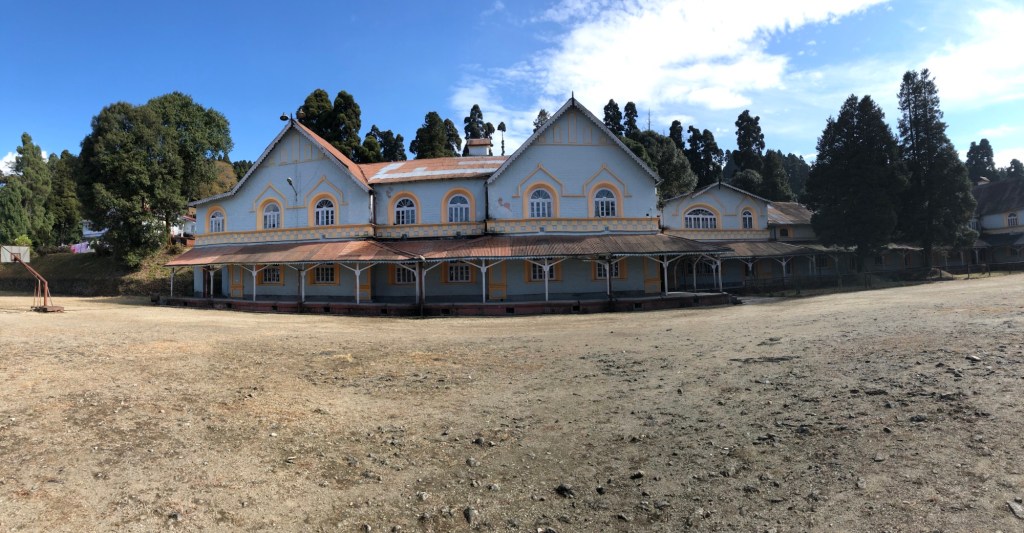
DAILY PHOTO: Reputedly Haunted School in Kurseong
Reply

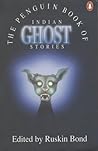 Penguin Book of Indian Ghost Stories by Ruskin Bond
I click on Google Maps;
 a pin highlights for a cemetery,
  and, here, I stumble upon
   graveyard reviews.

These reviews intrigue me because
 it seems to me that if one is capable
  of writing a cemetery review,
    then one is unqualified.

And, if one is qualified to comment
 on the caliber of an eternal resting place,
  then one is unlikely to be capable of
   posting a review.

I read one of the one-star reviews
 and see that the reviewer's principal complaint
 is an overabundance of "pocong."

"What is a 'Pocong?'" you may ask.
 It is a Javanese ghost that takes up
  occupancy in death shrouds.

Why is there a Javanese ghost
 infestation in a cemetery 4000 kilometers
  from Java, and -- as near as I can tell --
   with zero Javanese occupants?

The review does not say,
 but I love that someone panned
  a cemetery based on the presence
   of foreign ghosts

[and not because it is simultaneously
 phasmophobic and xenophobic.]

But because it shows an unbridled commitment
 to one's imagination that is usually
  only seen among children.
 Supernatural Shakespeare: Magic and Ritual in Merry Old England by J. Snodgrass
trees stand straight
in the woods they call "haunted;"
all i see are trees,
but maybe they're ghost trees
and I see nothing at all

I have walked in deep, dark places,
and crawled through darker, still --
gas-lit slums long after the dusk,
where lamplight failed to spill.

So surprised by fleeting faces
that faded in and out --
like visions from the sleep-drift, they
never loiter about.

They come, they see, and then they pass --
these alien observers.
They pass with just a fleeting glance,
like someone else's server.

They care not what you think you need,
or who you think you are.
You're just an automaton shopper
within the grand bazaar.
 Unbelievable: Investigations into Ghosts, Poltergeists, Telepathy, and Other Unseen Phenomena from the Duke Parapsychology Laboratory by Stacy Horn
My rating: 3 of 5 stars
For 50 years a laboratory operated at Duke University that studied extra-sensory perception (ESP), ghosts, and other paranormal events. Today one can’t imagine an academic laboratory devoted to paranormal activity surviving, especially at such a prestigious university. Horn’s book takes one through the life of this lab. It describes phenomena debunked as either fraud or poor methodology, but it also discusses events and outcomes that have remained unexplained.
The central character in the book is J.B. Rhine, Director of the Duke Parapsychology Laboratory. Rhine was a botanist by training, but he developed an interest in parapsychology– eventually becoming the foremost expert in the, albeit dwarf, field.
When the lab opened in 1930, the universe of unknowns was much greater than when it closed in 1980. This was exemplified by Albert Einstein’s correspondence with Rhine, and the author of relativity’s attendance at a séance on one occasion. By 1980, having recorded some unexplained phenomenon, but having produced neither well-validated results nor explanations, the lab was looking increasingly like a boondoggle.
The phenomena studied included some that could be systematically studied in the laboratory, as well as others that could only be observed in the field. The former being exemplified by the use of cards with shapes on them to study telepathy (as depicted by Bill Murray’s character in Ghostbusters.) The latter included the study of poltergeists or interviews of children about the lives of people who lived before their time (e.g. as Tibetan lamas are selected).
One of the questions confronting the investigators was whether those phenomena that could be studied in the lab were best studied there. While telepathy studies sometimes showed a weak but positive result, some thought that more robust results could only be attained under real world conditions.
In the 60’s, Timothy Leary came to call on Rhine. Leary, of course, thought hallucinogens were the key to unlocking the hidden powers of the mind. Rhine apparently took LSD on a couple of occasions before concluding that there was nothing but vivid chaos coming out of the experience. Still, there remained adherents to the notion that mind-altering drugs might unlock hidden potentials. Horn devotes several pages to the work of Sidney Gottlieb, the head of the CIA parapsychology program. It should be noted that the government programs were not stopped until the mid-90’s, fifteen years after Duke’s Parapsychology Lab shut down.
The last gasp of parapsychology was an attempt to determine if quantum entanglement might have any ramifications for ESP. Quantum entanglement is the situation in which two particles separated at great distance can influence each other instantaneously. Could the particles in two minds behave accordingly, and, if so, to what result?


 Tiger Riding for Beginners