Speakeasy Stained-glass [Free Verse]

The light of a streetlamp
Streams through the stained glass,
And colors spread stably
Over surfaces below.

Then car after car
Pass by that bar,
And the colors are
Climbing and crawling,
Shifting and sprawling,
As headlamp light, briefly,
Dances through the window --
Kaleidoscope swirling the
Shockingly bright colors
In short-lived arcs.

The window was designed
To evoke a cathedral,
And deny all debauchery...

Oh, how it's failed.

The Vine [Free Verse]

Grape leaves flutter 
and some catch the light
to glow with translucence.

I'm in an ancient place,
and this is such an ancient
endeavor.

Wine has been the king
of pursuits in these parts
for millennia.

Is that why I can become
lost in the play of light
on quivering leaves?

Or is it just that time of day?
The sun is low -- ready to set --
My mind is slow & ready to drink.

“Autumn” by T. E. Hulme [w/ Audio]

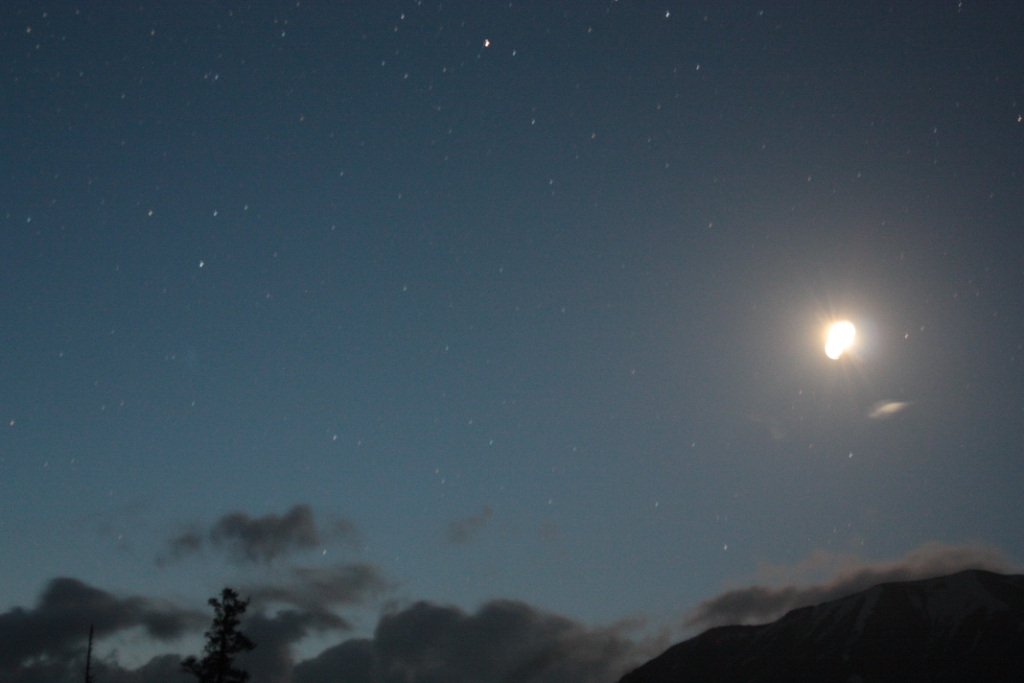
A touch of cold in the Autumn night --
I walked abroad,
And saw the ruddy moon lean over a hedge
Like a red-faced farmer.
I did not stop to speak, but nodded,
And round about were the wistful stars
With white faces like town children.

Countless Pieces of Hate [Free Verse]

Countless pieces of hate
Tumble through our days,
Clogging up our Flow --

Tiny bites of thought
Pit us against
Imagined adversaries...

But aren't all adversaries
Imagined adversaries?

Those who act badly against us
Are only adversaries
If we slide them into that
Mental basket.

Biblical Skies [Free Verse]

I can see the Bible stories 
writ in these skies
as I pass through
ancient parts.

Slant shafts of light spill
through the clouds,
angling toward some
blessed soul.

I can see distant clouds --
fringed in curls --
as if painted upon
a cathedral ceiling.

Clouds that display the depth
of an artist's skill and
eye for perspective,
but not true depth.
(They seem too distant for that;
they're too real to be real.)

And I look up again out of the window
and am blinded by light
that has pierced thick clouds,
and I wonder whether anyone is
seeing this light shaft bless me.

“Beginning My Studies” by Walt Whitman [w/ Audio]

Beginning my studies, the first step pleas'd me so much,
The mere fact, consciousness -- these forms -- the power of motion,
The least insect or animal -- the senses -- eyesight -- love;
The first step, I say, aw'd me and pleas'd me so much,
I have hardly gone, and hardly wish'd to go, any further,
But stop and loiter all the time, to sing it in ecstatic songs.

Unity [Free Verse]

Cogs without machines
Don't roll far.

And when they've settled,
They have no movement.
They are all existence,
And no process.
Their worldlines have
Flatlined.
They have no experience,
(And bliss lies in the
Experience of experience.)
They have only a longing
For non-existence...

Or to be reinstalled.

Harmony [Free Verse]

Tap the resonance
And vibrate at the rate
Of those eternal emanations --
The thrumming under-pulse
Of the Universe.

The ripples that can't be heard
Or felt haptically,
But must be tuned into
To feel, otherwise.

Downshift what is you --
Put your Self into idle.

Don't panic
As you start to slide --
Frictionlessly,
A lack of friction that's
Unfamiliar & Uncomfortable,

But which will be the way
One's worldline plays out --
Effortlessly -- to the end.

BOOKS: “How to Love in Sanskrit” Trans. by Anusha Rao & Suhas Mahesh

How to Love in SanskritHow to Love in Sanskrit by Anusha Rao
My rating: 4 of 5 stars

Amazon.in Page

As one can tell from the title and cover, this is an anthology of poems translated from Sanskrit to English on the subject of love, relationships, and eroticism. The source poems come from a diverse collection of writings.

The translators made an editorial / translation decision to place the translations in a modern context. By that I mean that the poems, most of which were written hundreds of years ago, have references to cell phones and dating apps, as well as many colloquialisms and expressions du jour. Some readers will love how this makes it readable and relatable in the present-day. Others will find that it distracts and takes one out of the experience of reading classical literature. I’m not saying the decision is good or bad, but it is something of which a potential reader should be aware. The only critical comment I have on the matter is that, if you should be reading the book ten years from now, there will likely be both language and technical references that have not aged well, and which you will probably have to go to your AI historian to figure out. (Some expressions are cliched now.)

I did enjoy how much ground the collection covered. The poems are grouped into categories sticking to the “How To” motif of the book, e.g. “How to Flirt,” “How to Yearn,” etc. I will say I went through a period early in the reading in which it seemed like poem after poem was confusing teeny-bopper lust for love, seemingly celebrating pathologies like jealousy and co-dependence. Throughout this phase of the book there were a number of poems that read like bad schoolboy poetry. However, in later chapters there were more poems that were dignified and reflected a more mature grasp of the subject.

There were some features of the book that I loved. First of all, most of the poems have explanatory notes at the end that can be very helpful both because (as mentioned) most of the poems were written long ago and because I am a foreign reader. Secondly, there is an appendix with romanizations of the original Sanskrit.

Ultimately, I’d say a major factor in whether this anthology is for you will be whether you enjoy the colloquial tone and free verse form or find it off-putting.

View all my reviews

Worlds, Inner & Outer [Free Verse]

Inside -- Outside...
Is there an outside?
I don't know.
I feel I can breathe into
Infinite space.

But how far beyond
My reaching fingertips
Must the cage walls be
For me to feel that I'm
In a cave of unknown
Circumstance?