BOOK REVIEW: A Confederacy of Dunces by John Kennedy Toole

A Confederacy of DuncesA Confederacy of Dunces by John Kennedy Toole
My rating: 5 of 5 stars

Amazon page


If you’ve heard of this book, but not read it, you’re probably aware of the troubled circumstance of its publication. Several years after having failed to be published, Toole committed suicide. The story of the book would have ended there, except Toole’s mother found the typescript and carted it around to people in the literary community. After much persistence and not taking no for an answer, she managed to get Walker Percy to read the manuscript, and the rest is posthumous Pulitzer Prize winning history.

It would be easy to dismiss the editors involved in rejecting this manuscript as grade-A lunkheads, or as the lead character (Ignatius J. Reilly) likes to verbally skewer his victims “Mongoloids.” However, one can see how said lunkheads would find this much-beloved novel risky. It’s a character-driven novel in which the lead character is obnoxious and unlovable in the extreme. Reilly is a pretentious and pedantic professorial type–verbally speaking– wrapped into the obese body of a man-child who is emotionally an ill-mannered five-year old with a bombastic vocabulary. Reilly has no impulse control, takes no responsibility, and is prone to tantrums, sympathy-seeking dramatic displays, and wanton lies. He’s the worst because he thinks he’s better than everyone despite the fact that in all ways except his acerbic tongue, he’s worse than everyone.

That said, the book—like its unsympathetic lead character—is hilarious through and through. What it lacks in a taught story arc and a theme / moral argument (the latter being why the editor at Simon and Schuster rejected the book after showing initial interest in it) it more than makes up in hilarity.

I should point out that when I say that this isn’t a plot-driven book, it doesn’t mean that it doesn’t have an interesting wrap-up at the end—which I will not discuss to avoid spoiling it. The plot revolves around events in the life of a lazy man-child forced to go to work. It’s not a journey of change, discovery, or adventure. While, in most cases, a character-driven story with an unmalleable lead would be a recipe for a book that flops, here it keeps one reading to the last page because it’s Ignatius’s failure to become a better man that ensures the book is funny to the end. Reilly is constantly making decisions that are both overly contemplated and yet ill-considered.

The book follows Ignatius Reilly through an event that results in a tremendous loss of money for Ignatius’s mother. This forces her to finally put her foot down and insist the man—who she still thinks of as her little boy—get a job. It should be noted that Ignatius’s mother’s eventual coming around to the monster her son has become is a major driving force in the story—though we can see a distinct lack of taking of responsibility that echoes that of Ignatius, himself. Ignatius gets a fine—if lowly, clerical–job at the slowly-dying Levy Pants Company, but gets fired after he encourages a worker protest that goes awry. He then gets a job as a hot-dog cart vendor—a job considered the lowest of the low by both his mother and New Orleans’ society-at-large. The latter is the job he has at the end when a final chain of events unfolds (not without tension and drama, I might add.)

On the theme issue, the Simon & Schuster editor was correct that the book isn’t really about anything except how to muddle through life as a lazy, cranky, emotionally-stunted, and overly-verbose doofus. (But he was oh-so wrong about that being a lethal deficit—according to the Pulitzer Prize committee as well as innumerable readers.)

I’d recommend this for any reader with a sense of humor. You won’t like Ignatius J. Reilly, but you’ll find his antics hilarious, and you’ll want to know what happens to him in the end even if he is irredeemable.

View all my reviews

A Dude’s Attempt to Master Pad Thai

On a trip to Thailand last fall, my wife and I did a one-day cooking class in Chiang Mai. That day I made the perfect batch of pad thai. (For the uninitiated, Pad Thai is “noodles Thai-style.” It’s one of the more popular dishes at your local Thai restaurant. If you don’t believe me, go check. I’ll wait.)

Anyway, I preceded at home to make 35 batches of pad thai that bore little resemblance to food. That’s not true. Only the first five dishes were fundamentally inedible, the next thirty were tasty enough– they just didn’t taste like pad Thai. A poor cook might blame the difference on the variation in ingredients between Thailand and home. However, I have a sneaking suspicion the cooking school staff was slipping good cooking into my dish while I wasn’t looking. They’d say, “Godzilla” and point, and I’d turn (because one can’t take a chance that close to the Pacific), and when I turned back around the contents of my wok would look and/or smell better.

If making mac-n-cheese from a box, microwaving a HotPocket, or grilling a burger aren’t counted as cooking, then you might say that my experience with cooking was nothing. However through an extensive process of error and error, I arrived at delectable pad thai.

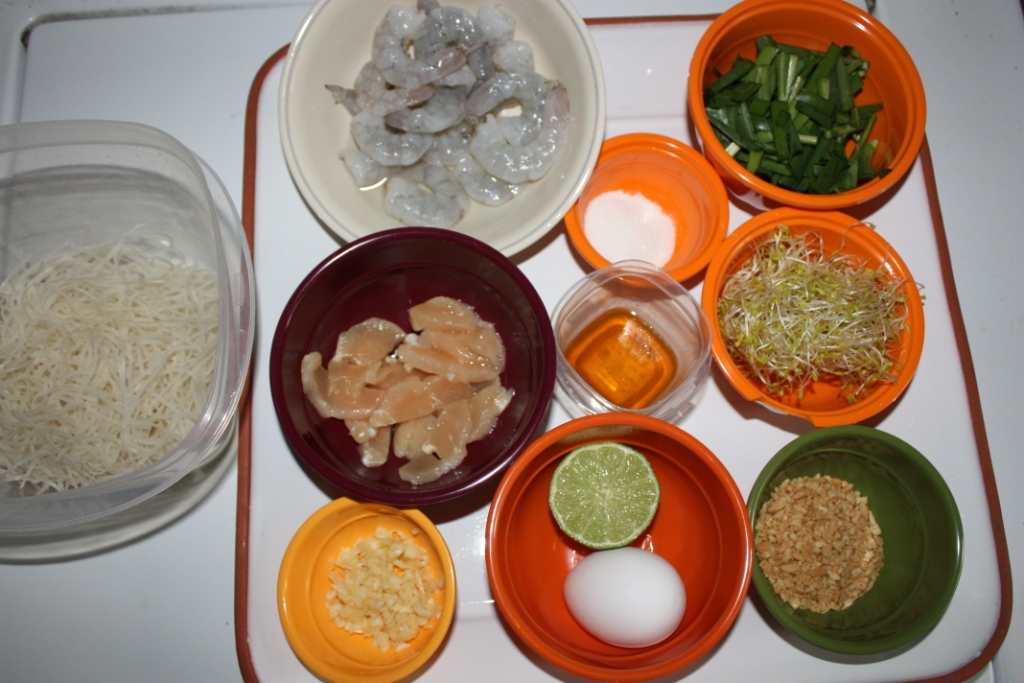
Below is what you’ll need.

Ingredients

Ingredients

First, for the anal retentive types who’ve noticed that I took this picture on top of the washing machine, that was solely for lighting purposes. This process in no way involves use of the washing machine. It’s not one of those clever recipes like cooking fish in the dishwasher. I’m serious, under no circumstances are you to attempt to use your washer in the making of pad thai.

In list form, what you’ll need is:
– 2 Tablespoons of oil (anything but olive)
– 4-ish cloves of garlic (more if you have a vampire-infestation problem)
– shrimp (several to many)
– chicken (one to two tenders’s worth; like the size of tender they give you at Applebees or Chilis– NOT McDonalds, i.e. a swanky tender)
(substitute tofu if you’re one of those quasi-vegetarians who count chicken as animal but don’t count shrimp/fish.)
– egg (1)
– 2 Tablespoons fish sauce
– 1-1/2 teaspoons sugar
– rice noodles (about 2 ramen packets worth, not that you should buy it that way)
– crushed peanuts (3 heaping Tablespoons)
– spouts (1 cup-ish. Normally this is soy or mung bean sprouts, but I’ve substituted Alfalfa sprouts because they work fine and last longer in the fridge.)
– spring onions or chives or something green and oniony (1-cup-ish)
– 1/2 a lime

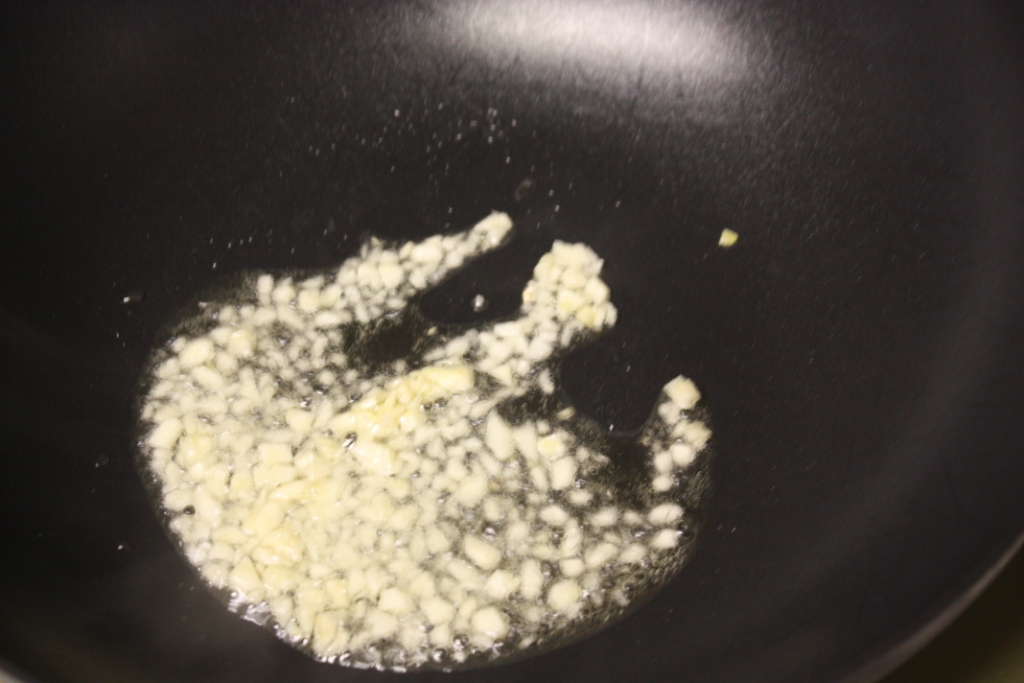
Step 1: Heat your oil in a wok. Get it hot enough so that when you throw the garlic in, it’ll sizzle. This will make you feel more chef-like.

Sizzling garlic

sizzling garlic

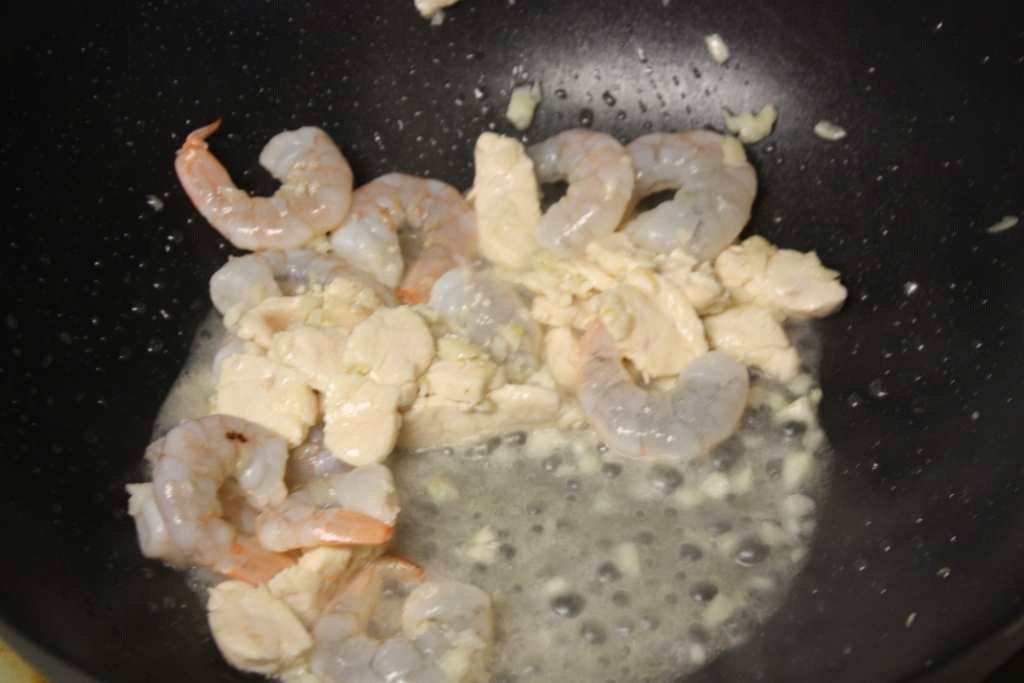
Step 2: Add the animal stuff. Put the chicken in first, it takes longer than the prawns.  If you’re using tofu, put it in after the shrimp (tofu won’t cause you severe debilitating diarrhea if it’s under-cooked. [I don’t think, but I have no idea what I’m talking about. Although I do suspect one shouldn’t refer to diarrhea at any point in a food blog post.])

chicken and shrimp (lamest superhero duo ever.)

chicken and shrimp (lamest superhero duo ever.)

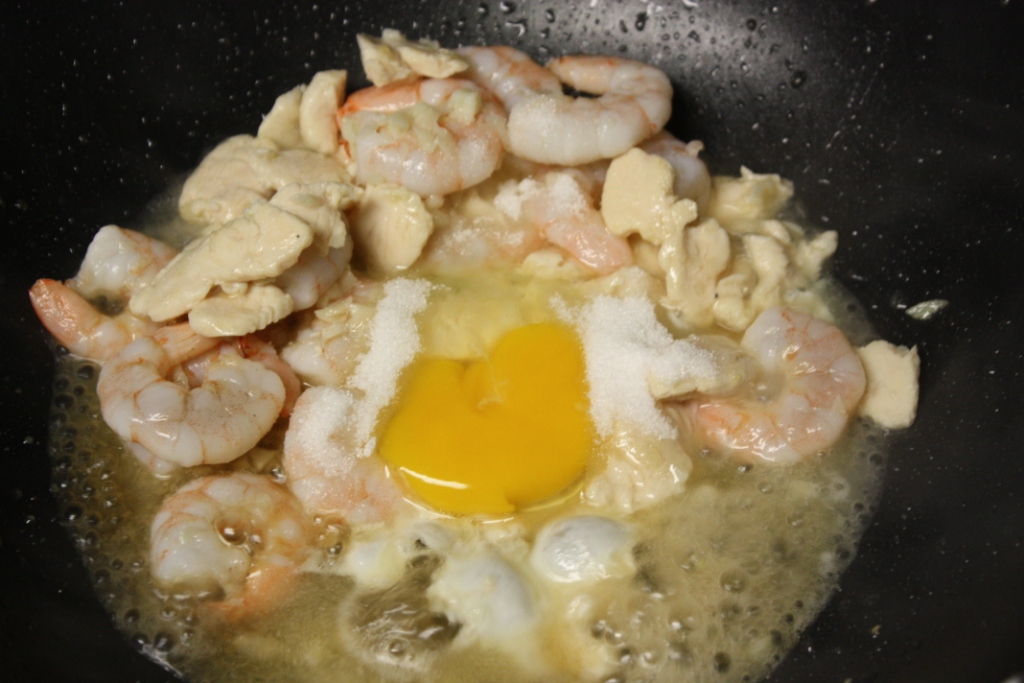
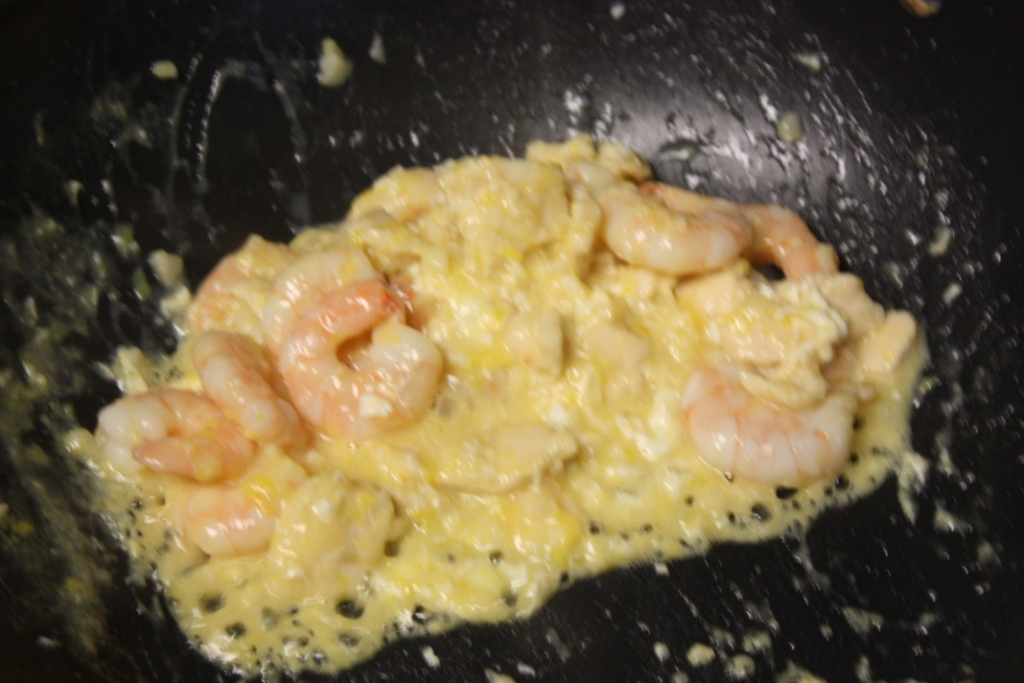
Step 3: Add the egg, fish sauce, and sugar. Scramble the egg up good, and mix everything together.

Egg, fish sauce, and sugar

egg, fish sauce, and sugar

prawn scramble

prawn scramble

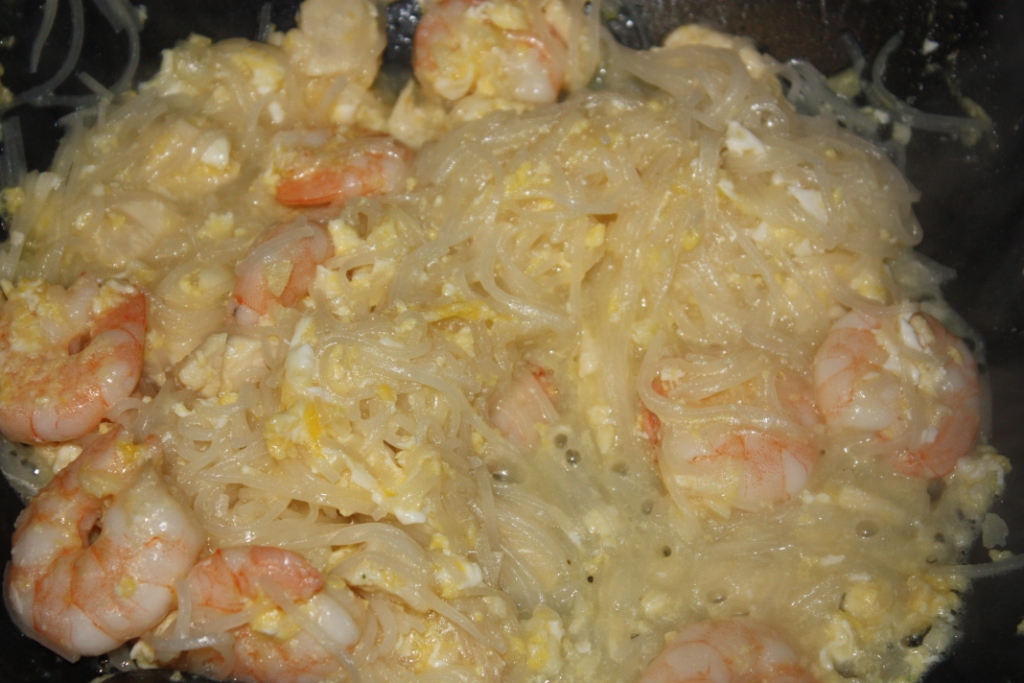
Step 4: Add the noodles. This is the trickiest part of all. First, they make a lot of different types of rice noodles in different dimensions and colors, and they all cook differently. I prefer thin noodles. I must admit the noodles are the weak part of my game. In the batch I’m showing, the noodles are overcooked, but I have done them just right. (You’ll have to take my word.) It’s preferable to have them slightly under-cooked when they’re mixed with the prawn scramble (There’s usually enough moisture that they’ll continue cooking.)

At the cooking school, we put pushed the prawn scramble up to the top of the wok and tilted the wok over and put dry noodles and a cup of water in the bottom of the wok. We then cooked the noodles, and then mixed them with the prawn scramble.  If you’re an octopus or a ninja, that method works great. I, however, pour boiling water over bowled noodles when I’m putting the chicken in the wok, then I tong them into the wok and mix them right together with the prawn scramble.

overcooked noodles this time

overcooked noodles this time, so sad

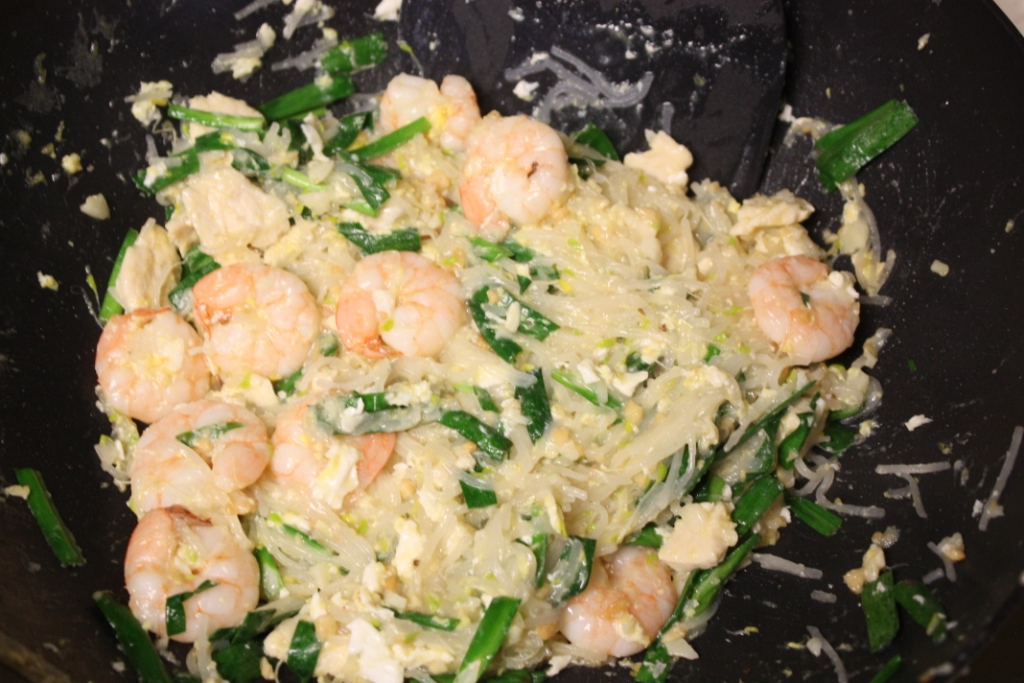
Step 5: Add the vegetable stuff. First, throw in the crushed peanuts. Then stir in the sprouts and the spring onion. (These are all done last, because you want them to provide a bit of crunch. i.e. You don’t want them thoroughly cooked.)

with the veges in

with the veges in

The penultimate step is to squeeze on the lime. This can be done into the wok after it’s removed from the heat or directly on top of one’s bowl.

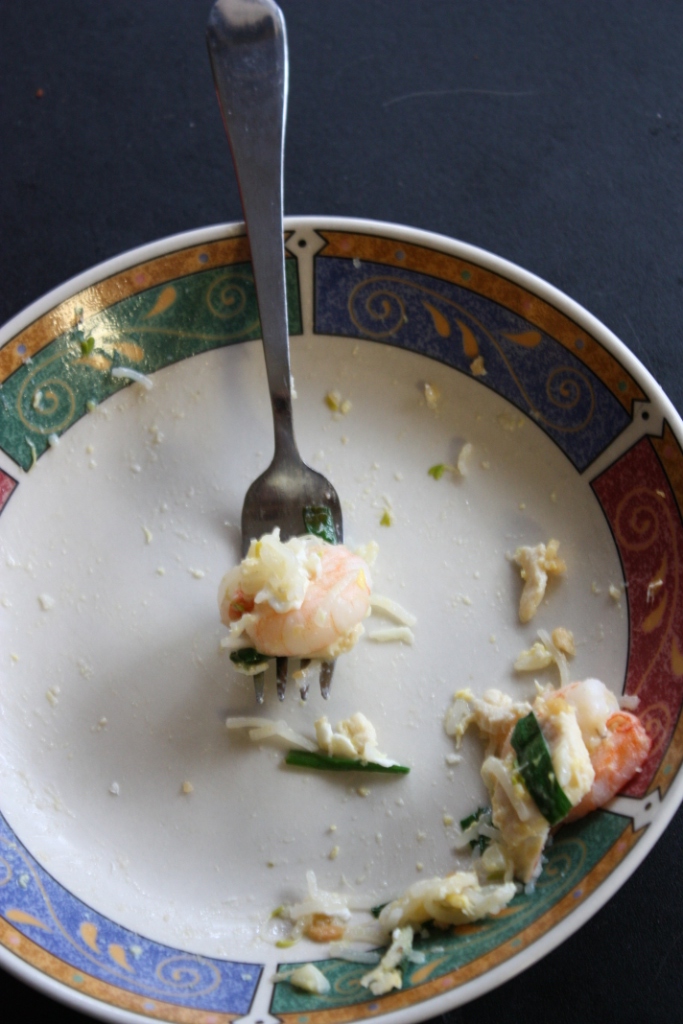
Step 6: Eat. I’ve included the following picture as proof that this was, in fact, edible.

last few bites

last few bites

TODAY’S RANT: Preferred Customer Cards

Today at the grocery store, the cashier asked whether I had a preferred customer card.

To which I, of course, replied, “No. Do you have one of my preferred cashier cards?”

I thought that she would be devastated when she realized that she didn’t have my card, but she apparently thought I was joking — which saddened me a little.

I don’t sign up for such cards for a number of reasons, most of which have to do with being a dude.

1.) Wallet real estate premium: As a man, any extra card has to be wedged under one of my butt cheeks where it will sit all day trying to cause scoliosis. While your firm’s card may seem thin, they add up. Therefore, the card had better offer great perqs, such as an option to cut to the front of the line any time I so choose or the knowledge that –should there be a maniac on the loose in the store– lesser favored customers will be shoveled in front of me as human shields.

2.) Commitment limitations: One idea behind these cards is to build customer loyalty. I’m a man who has been happily married coming up on 19 years. Every ounce of my capacity for commitment is spoken for. I have no excess loyalty to spare on a brand of canned corn or on a particular store (you all sell the same stuff.) Sorry Keebler Elves, but I am not above a midnight rendezvous with some freaky Nabisco Oreos. Don’t make me perpetrate a lie.

3.) The Fudgesicle Dossier: When thinking about who to confess my moments of greatest weakness to (as reflected in buying a gallon of “Chunky Monkey” ice cream): a friend, a loved one, a priest; oddly enough Acxiom Incorporated does not spring to mind. Acxiom is one of the big companies that collects information about when you buy tampons or condoms or gas station sushi. Somewhere in a massive server farm sits an e-file, an indelible record of a lifetime of bad decisions as reflected in my consumer purchasing history. I’m not going to feed that monster.

Any way, getting back to my story. The cashier said that without the card my total would come to $21.70, but with one it would only be $12.95. She then proceeded to “blip” a card that she had stored next to the register. It saved me a bundle, so I felt obligated to give her one of my preferred cashier cards.

How to Kill a Rogue Yard Gnome, Part 2

[Don't overthink the symbolism]Attribution: loannes.baptista

[Don’t overthink the symbolism]
Attribution: loannes.baptista

[Part I can be read here.]

Five nights ago, as the sun sank below the horizon and the glow of vibrant colors faded, we three were visited by a fourth from our world. It was the Hargo Chetti. Like us, he had a long flowing beard and a pointy hat, but, unlike us, his face was twisted into a menacing glower. His shell was monotone brown, it was just a temporary husk pulled together from the earth for our meeting. There was no point in a permanent shell; Master Hargo couldn’t stay in the world of humans for long. (Humans thought of the gnome’s shell as the gnome, but to us it was just a container for our noncorporeal selves.)  It’s the scowl. The shell must reflect the gnome’s nature, and no one wants a scowling gnome in their garden. Well, there may be demented people who would like such a gnome, but those people are already beyond our assistance.

In gnomish, a language that doesn’t register in human hearing organs, Hargo said, “I come bearing orders from the Council. They want you to be more active in your man’s dream state.”

I was impressed by Hargo’s ability to project his voice to us, given our wide spacing. We three can only communicate in close proximity, or in the man’s dream state. I was less pleased with the content of his message. I bristled in my response, “I assure you that we are intervening when necessary to keep the man’s dream world from falling into darkness.”

Hargo huffed, “The Council’s orders go beyond maintaining the status quo.”

I said, “We’ve seen nothing suggesting the man needs an injection of cheer into his dream state. Surely, you’ve read our reports.”

Hargo replied, “The Council, which I needn’t remind you has more vision and wisdom than a mere worker gnome, isn’t requesting an injection of good cheer. They desire shadow-mares.” Shadowmares were like nightmares but the ones that cannot be remembered in the waking state. Humans imagine that a nightmare that they can’t remember is inconsequential and has no impact on their waking lives. They are wrong.

Furk, one of my peers, just said, “Yes.” Furk was bored. He thought three gnomes for one man was excessive, particularly when that one man wasn’t important. I suspect because one of the neighborhood cats liked to wee on his shell, Furk had soured on our assignment. Though correlation not being causation, I couldn’t eliminate the possibility that the cats peed on him because he was such a jerk.

I was momentarily speechless. Hookl was also speechless, but that was his usual state.

After a long pause, I said, “I would like confirmation that this is the will of the Council.”

Hargo’s scowl seemed to tighten. Icily, he said, “Are you calling me a liar?”

I felt a shudder rise up through me, but still managed to reply, “No. I just think such a rare and unusual order demands great care.”

“You have your orders.” Hargo said, and then his shell collapsed into a pile of dirt, which was then caught up in the breeze and spread over the lawn. By morning there would be no trace of him.

I didn’t trust the Hargo Chetti. He looked like Santa, sans the jolly. What screams lie more than a scowling Santa. Yet, he is our only point of contact with gnome world while we are on assignment. I’ve always thought that was a weakness in our system.

As Furk began to plan and Hookl resumed being Hooklish (which is to say disinterested), I strained to propel my shell toward the driveway. I moved as swiftly as I could, but it was still a pace that would make a turtle proud by comparison.

A few hours later, I noticed lights stretching down the road toward the drive, the twin beams — with the car— decelerated. The car swung into the drive nearly crushing my shell. Had the shell been crushed, I would have been evicted back to our home world. Gnomes required a shell. I wasn’t powerful enough to summon a shell from the dirt, like Hargo had, not even for a short time. My plan had been to get onto the driveway and block access to the garage. In retrospect, it was not a well-thought plan, but it was the only warning I could give the man in his waking state. Once he went to sleep, it might be too late.

The man seemed to take note of my changed position, but he didn’t return my shell to its original position. He just shrugged and walked into the house.

I wanted to persuade Furk to hold off on obeying the order for now. Silently screaming gnomish across the lawn wouldn’t work, I didn’t have Hargo’s power of projection. The distance between us was too great.

I would have to subvert Furk in the man’s dream state. It would be difficult; Furk would have a plan by now, and I would have to improvise, injecting characters into the dream as needed to counter the shadowmare. In the dream state, I wouldn’t look dwarfish – unless that was called for. I could morph into any character that I could imagine. If you’ve ever had a dream and seen a face that looks totally unfamiliar, you’ve had a gnome dream. If you aren’t sure if you were the lead character in your dream, a gnome has probably been monkeying around in your noggin.

*

Four nights ago, I convened a meeting to the side yard. I wanted to be out of sight. Humans often won’t miss a gnome if it’s gone, but seeing three cavorting draws undue attention. I migrated across in front of the house, a two bedroom ranch, and nudged Hookl, who was positioned midway between my usual position and Furk’s. We then proceeded to meet up with Furk. This would put me at a disadvantage. Moving the gnome shell by force of consciousness is exhausting, and if I had to battle it out with Furk in the man’s dream state that night I would be weaker than usual.

For Furk, who was positioned near the corner of the house, the journey to the side yard and back would short. This was probably why he agreed.

I said, “As you well know, I want to hold off on initiating shadowmares.”

Furk said, “An order has been given by the Council. It may be unusual, but I’m sure they have a good reason, and it is not ours to challenge.”

Hookl said nothing.

I replied, “Maybe they do, and if they confirm their order I will comply. But this is serious, and if there is not an explicit order from the Council, then it is high crime against the Gnome Code of Conduct. You know what shadowmares can do to humans after a time. The humans might not consciously recognize the effects, but we know them well.”

Furk retorted, “If the Council didn’t give the order, then the Hargo Chetti is a liar. Are you prepared to make that accusation, because I’m not?”

Hookl said nothing.

I said, “I’m not calling anyone a liar. I’m just saying this is an extremely rare order and since there is only one gnome linking the Council to us, the possibility for miscommunication exists. If it were a less risky order it might not justify my concern. What if the man does something disastrous because of our mental mischief?” I was lying. I did think Hargo was a liar, but saying that would serve nothing.

Furk said, “It’s like Hargo said, you can’t see the whole picture.”

Before we could even begin our retreat back to our proper positions, we heard the car slow and turn into the drive. There was no use in moving now.

I said, “The man is home. Furk, it is clear that we will not be able to persuade each other. I want to hear where Hookl stands, and we will decide by majority.”

Hookl was not happy to be put in the role of tie-breaker. Making decisions was not his strong suit. “Gee, I’ll get back with you tomorrow.”

We three were well-attuned to the man’s brainwaves. We knew when he went into the house. We all knew that he noticed we were missing. We knew when he was about to come back outside with his flashlight. Soon he was shining the light on us. His forehead was crinkled and his lips pursed. It was an expression of puzzlement. He was trying to figure out how we had gotten into the side yard.

*

Three nights ago, one of us was ejected from this world. As darkness fell, in the feeble light, I approached Hookl to inquire about how he intended to vote. I had no intention of reconvening the group. Furk could come to us if he wanted. He did so.

Hookl said, “I mean, I don’t think we should be hasty. We should take our time, and figure things out. Rushing now won’t help any…” He just went on like that, noncommittally, for some time.

It must have sounded to Furk like Hookl was siding with me because Furk kept migrating, pushing into Hookl’s side. I don’t know if Furk just wanted to persuasively intimidate Hookl, or if his intentions were more nefarious. At any rate, there is a slope to the land in the front yard, and many loose rocks. This contributed to Hookl’s shell begining to tip; Furk did not let up. There was nothing I could do but watch as Hookl’s shell tipped.

There was a hole in the bottom of Hookl’s shell from the manufacturing process. It didn’t matter as long as the hole was sitting on the ground. If the shell tipped over, Hookl could maintain himself inside as long as there was only on hole in the container. It was the same principle as a bucket being inverted and pushed down into water. The bucket captures air inside. Add a second hole, and the water plunges in to push the air out. When Hookl’s shell tipped, its shoulder landed on a rock and the ceramic cracked. In a whoosh, Hookl was ejected and forced back to our world, to our dimension.

There would be at least one more night of battling it out with Furk

*

Two nights ago, my fight with Furk continued beyond the dream state and into the physical world. It ended with a gnome sumo match, and Furk was sent home much as Hookl had been.

I didn’t know how long it would be before someone showed up, Hargo or someone on the Council’s behalf. If I was right, and Hargo had gone rogue, it might be never. He might cut his losses.

I began to rest easy in the belief that I could protect this man’s dream state. And then the putz put a baseball bat through the side of my head.

TO BE CONCLUDED

TODAY’S RANT: Nukes and Ketchup

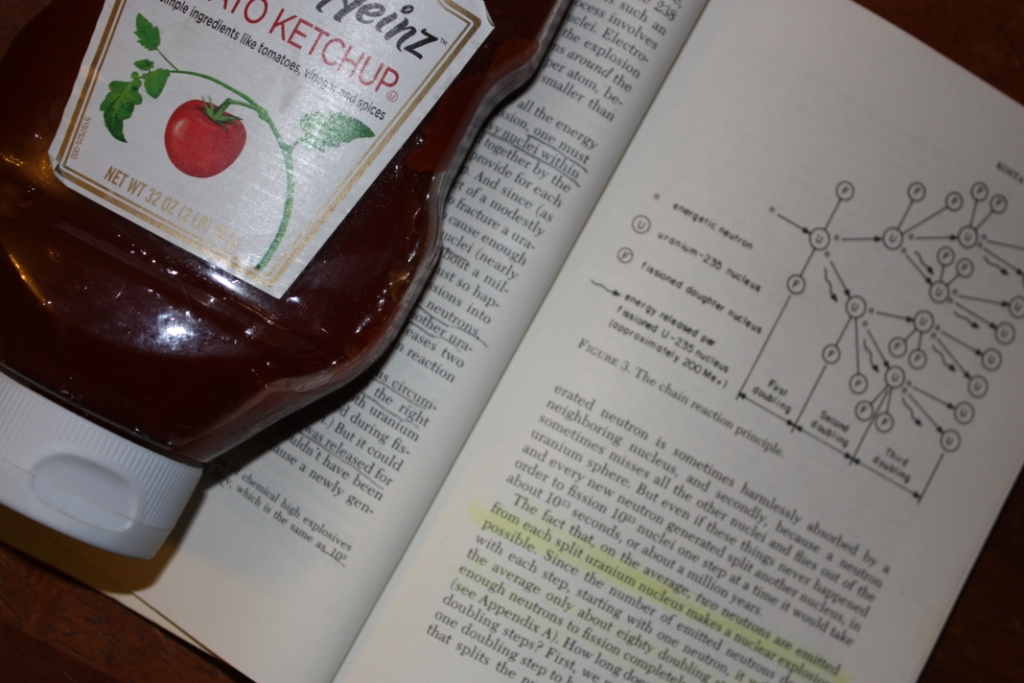
Why was there no Manhattan Project for Ketchup?

Why was there no Manhattan Project for Ketchup?

How come we mastered the thermonuclear warhead decades before we did the ketchup bottle?

Building a nuke took:

– the greatest scientific minds Hungary ever produced (You scoff, but Hungary’s claim to fame is driving out more Nobel Laureates and top-rate scientific minds than most countries will ever hope to produce. [e.g. Teller, Szilard, Wigner, von Neumann, etc.] If they didn’t let jackwagons run their country, they’d probably rule the world by now.)
– $42 billion in current-year US dollars
– the Project Manager who built the Pentagon
– and a whopping two or three years (for the fission weapon)

Building a decent ketchup bottle shouldn’t have even required an Algonquin Round-table  It could have been achieved by two morons sitting around at a barbecue.

Moron one says, “You knows what would be delightful, if this bottle was squeezable plastic, not glass.”

Moron two says, “Dude, you are so right, and what if they turned it upside-down so that all the ketchup stayed near the hole?”

Bob’s your uncle, the ketchup bottle is perfected.

Do you know what kind of Galactic douche-bags this makes humanity look like? It makes it seem like we don’t care about our condiments.
Oh, but we do. I’ve seen it. I’ve seen a man in Boise use no less than 42 packets of ketchup on his fries. I saw a rotund woman in Phoenix use half a jug of mustard on her hot dogs. I saw a canuck slather mayo on his burger (what is up with that, Canada.) From sea to that other sea, amid the prairie dogs, through the alligator-infested swamps, across those bruised mountains, I’ve seen a divinely inspired love of sauces throughout our great nation (and that ancillary nation to the north.)

No wonder aliens haven’t visited us; they probably haven’t received word across the light-years that we’ve mastered ketchup. Or maybe it’s the fact that we haven’t built a plastic fork whose tines could stick up to a sturdy gherkin. (But that outrage is for another day. Yes, manufacturers of disposable flatware, you too will taste my wrath.)

Book Review: JOHN DIES AT THE END by David Wong

John Dies at the End (John Dies at the End, #1)John Dies at the End by David Wong

My rating: 5 of 5 stars

If the movie Alien was “Jaws in space,” then John Dies at the End is “Bill and Ted’s Excellent Adventure in the Nether World.” Except that, unlike Bill and Ted’s, Wong’s book is hilarious.

The gist of this book is that two likable anti-heroes ingest a drug, “soy sauce,” that gives them the ability to pass into an alternate universe. They’re inexorably drawn down the rabbit hole (so to speak, there is no actual rabbit hole in this book.) What they find is not what they expected. It’s not what anyone expected, because it’s so mind-boggling ridiculous and richly complex.

The title character, John, oddly enough is not the main character. The author, David Wong, uses a self-named protagonist as narrator and lead. The book unfolds as Wong (the character, not the author) tells a skeptical journalist about the strange goings-on in his small, Midwestern hometown.

We see John mostly through the lens of the narrating Wong. We know that John is a storyteller. Which may sound a lot like “liar,” but that’s not the case. Have you ever known a person who would never deceive you for personal gain, but will never fail to engage in hyperbole to make a story funnier or more interesting? That is John. He has one of my favorite lines of the book:

“We’re talking about a tentacled flying lamp fucker, Dave. What are you prepared to call unlikely?”

Despite the fact that John is a booze-hound and exaggerator, he remains an endearing character. As Wong gets to know Amy, a classmate who lost her hand after they knew each other in school, we get an insightful testimonial about John:

“Let me tell you something about John. The reason I was surprised by your hand was because John never once described you as, ‘the girl with the missing hand.’”

As for Wong’s character, he is hapless but hilarious. When he gets to know Amy, he is shocked to find that she’s not retarded or crazy. They had vaguely known each other from a “Special Needs” school, but it never occurs to him that she might be at least as sane as he.

The book is a pan-genre mélange. While it’s mostly a combination of horror and humor, there are points at which it feels like action/adventure and towards the end it seems largely like sci-fi. Horror and humor are not easily mixed, but this book does it about as well as one can imagine it being done. John Dies at the End is campy, of that there can be no doubt, but Wong writes descriptions of creatures and murderous events in a way that offers grim clarity. As a lover of humor more than horror, I was obviously not put off by this dark comedy.

Throughout the book, one suspects that the whole surreal bag of events is just a bad hallucinogenic trip, and that the “soy sauce” is just LSD on steroids. Happily this is not the case… or is it?

Don’t worry; John dying is not the intriguing twist at the end of this book. There are a couple such twists though.

If the movie that comes out today (January 25, 2013) is not awesome, it’s not Wong’s fault. The trailer shows us the quirky horror, but not the humor of the book. Much of the humor is in the language – i.e. the word choice. Some of that will likely come out in dialogue and narration, but who knows how much.
View all my reviews

The Maai of Jokes

From my martial arts blog Jissen Budōka.

間合い

A duck walks into the dōjō for his first session. He’s awkward and seems to be getting everything wrong.

The Sensei calls out, “Duck!”

The duck snaps to attention and says, “Yes, Sensei” — boot to the head.

Maai often gets boiled down to “distancing.” Understanding distancing is simple, understanding maai is challenging. First, maai understood in three dimensions is maai misunderstood. The fourth dimension, time, is critical. Second, maai is always interactive. Rules of thumb will only get one so far because the peculiarities of the opponent matters. Third, the interval between recognition and response that occurs in the mind is as important as the physical distance.

It behooves the martial artist to see the maai  existing in exchanges outside the dōjō. Thinking of maai solely in terms of kenjutsu, for example, can encourage one to focus on the physical distance. The distance gap is what we can see, and that is what is most easily analyzed. However, another area in which maai is critical is joke telling, and in jokes one has to optimize for intangibles –timing and audience response to the joke.  Not that this should be an intellectual exercise (that slows everything down); I presume it’s intuitive for people with the skill. 

A joke has a two-part anatomy: 1.) a set up that is straight, plausible, and –perhaps even– factual; 2.) a punch line that must turn expectations on their head with punch. The interval between parts 1 and 2 separates masterful joke tellers from horrible ones. If one runs the punchline into the setup, one risks the joke falling flat. If the recipient doesn’t recognize the transition they may start thinking about what was said (ugh –analysis is the nemesis of humor.) However, if one pauses too long, one risks the recipient anticipating the ending. Some jokes are easier to tell than others. The one that opened this post is easily anticipated. Recognition of the dual-use of “duck” happens quickly.

For a more user-friendly joke consider the one that a scholarly survey suggested was the world’s funniest joke:

A woman gets onto a bus with an infant. The driver vomits in his mouth a little and says, “Lord, that is the ugliest baby I’ve ever seen.”

The woman is appalled and speechless. She scowls, pays the fare, and proceeds to the rear of the bus.

Sitting down, she says to the woman next to her, “I’m outraged; I can’t believe how insulting the bus driver was.”

The woman says, “Well go give him a piece of your mind. Don’t worry. I’ll hold your monkey.”

The elaborate set up makes it difficult to anticipate the ending, and the twist between kindness and cruelty is readily apparent. (“Monkey” is very visual.) The punchline is really a punchword, the very last word.

Other jokes have more balance between set up and punchline, and that increases anticipation risk.

I was in the bookstore the other day and I asked the clerk for the self-help section.

She said that if she told me it would defeat the purpose.

Here one starts getting clues much earlier.

Other joke concepts are so well-known they invite anticipation.

Blonds all want to be like Vanna White, they yearn to know the… alphabet.

As for rushing the punch line, consider the joke:

I’m thoroughly familiar with 25 letters of the alphabet. I don’t know “Y.”

While in writing the joke is clear, this is the type of joke that can easily be missed and fall flat. It’s not just because it’s not exactly hilarious, but because the recipient may have to reconstruct the joke or, worse yet, have it explained to them –both of which are death.

The other thing that one must recognize is that there are always specific exceptions that work. “Interrupting cow” is the perfect example of a rushed punchword that works.