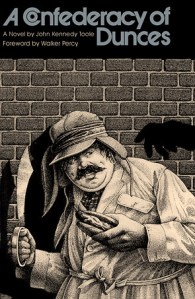
BOOK REVIEW: A Confederacy of Dunces by John Kennedy Toole

A Confederacy of DuncesA Confederacy of Dunces by John Kennedy Toole
My rating: 5 of 5 stars

Amazon page


If you’ve heard of this book, but not read it, you’re probably aware of the troubled circumstance of its publication. Several years after having failed to be published, Toole committed suicide. The story of the book would have ended there, except Toole’s mother found the typescript and carted it around to people in the literary community. After much persistence and not taking no for an answer, she managed to get Walker Percy to read the manuscript, and the rest is posthumous Pulitzer Prize winning history.

It would be easy to dismiss the editors involved in rejecting this manuscript as grade-A lunkheads, or as the lead character (Ignatius J. Reilly) likes to verbally skewer his victims “Mongoloids.” However, one can see how said lunkheads would find this much-beloved novel risky. It’s a character-driven novel in which the lead character is obnoxious and unlovable in the extreme. Reilly is a pretentious and pedantic professorial type–verbally speaking– wrapped into the obese body of a man-child who is emotionally an ill-mannered five-year old with a bombastic vocabulary. Reilly has no impulse control, takes no responsibility, and is prone to tantrums, sympathy-seeking dramatic displays, and wanton lies. He’s the worst because he thinks he’s better than everyone despite the fact that in all ways except his acerbic tongue, he’s worse than everyone.

That said, the book—like its unsympathetic lead character—is hilarious through and through. What it lacks in a taught story arc and a theme / moral argument (the latter being why the editor at Simon and Schuster rejected the book after showing initial interest in it) it more than makes up in hilarity.

I should point out that when I say that this isn’t a plot-driven book, it doesn’t mean that it doesn’t have an interesting wrap-up at the end—which I will not discuss to avoid spoiling it. The plot revolves around events in the life of a lazy man-child forced to go to work. It’s not a journey of change, discovery, or adventure. While, in most cases, a character-driven story with an unmalleable lead would be a recipe for a book that flops, here it keeps one reading to the last page because it’s Ignatius’s failure to become a better man that ensures the book is funny to the end. Reilly is constantly making decisions that are both overly contemplated and yet ill-considered.

The book follows Ignatius Reilly through an event that results in a tremendous loss of money for Ignatius’s mother. This forces her to finally put her foot down and insist the man—who she still thinks of as her little boy—get a job. It should be noted that Ignatius’s mother’s eventual coming around to the monster her son has become is a major driving force in the story—though we can see a distinct lack of taking of responsibility that echoes that of Ignatius, himself. Ignatius gets a fine—if lowly, clerical–job at the slowly-dying Levy Pants Company, but gets fired after he encourages a worker protest that goes awry. He then gets a job as a hot-dog cart vendor—a job considered the lowest of the low by both his mother and New Orleans’ society-at-large. The latter is the job he has at the end when a final chain of events unfolds (not without tension and drama, I might add.)

On the theme issue, the Simon & Schuster editor was correct that the book isn’t really about anything except how to muddle through life as a lazy, cranky, emotionally-stunted, and overly-verbose doofus. (But he was oh-so wrong about that being a lethal deficit—according to the Pulitzer Prize committee as well as innumerable readers.)

I’d recommend this for any reader with a sense of humor. You won’t like Ignatius J. Reilly, but you’ll find his antics hilarious, and you’ll want to know what happens to him in the end even if he is irredeemable.

View all my reviews

BOOK REVIEW: Complete Calisthenics by Ashley Kalym

Complete Calisthenics - The Ultimate Guide To Bodyweight ExerciseComplete Calisthenics – The Ultimate Guide To Bodyweight Exercise by Ashley Kalym
My rating: 4 of 5 stars

Amazon page


“Complete Calisthenics” delivers an overview of body-weight exercises, as well as the information needed to begin a calisthenic workout program. It covers advanced exercises such as planches, levers, and flags, but it also provides simplified modifications and progressions for said advanced exercises for those who aren’t ready to leap into gymnast level practice. I’d say this book is ideal for an intermediate level practitioner or, at least, someone in sound physical shape who can knock out several push-ups and at least a few pull-ups. It offers one the information necessary to gradually progress toward the most advanced levels. While there are simplified modifications, a beginner who is out of shape may need more content on capacity-building and simplified modifications to get started.

The first six chapters form an introduction and give essential background information on equipment, nutrition, rest / recovery, warming up / mobility, and flexibility. The warming up and stretching sections provide many photos and explanations of key points, just as the latter exercise sections do.

Chapters seven through twenty describe and demonstrate the various exercises. These chapters can be divided into the first five chapters (ch. 7 through 11) that cover upper-body push and pull exercises (i.e. push-ups, pull-ups, dips, muscle-ups, and handstands.) Each of the aforementioned exercises has a range of variations offered–some easier and many harder than the basic. Chapters 12 through 16 explore levers (planche, front lever, back lever, half lever, and human flag) and these offer progressions, variations, and various approaches to entering the pose—since most practitioners will not be able to proceed straight to the full expression of the technique. Chapters 17 through 20 delve into the core, lower body, and full-body exercises. These are: floor core exercises (17), leg raises (18), lower body / leg exercises (19), and conditioning exercises–i.e. the full-body exercises that get the heart pumping (20.)

The last two chapters suggest an approach to building a training program and offer an FAQ, respectively. The approach suggested involves four levels. The first is called “the fundamental five” and it is built around push-ups, pull-ups, dips, hanging knee raises, and squats. The next builds upon the first and prepares one to transition to the third, which focuses on learning to do the levers. The final is called “complete calisthenics” and it incorporates all the advanced. The author also describes how one might approach optimizing one’s program to one’s needs and abilities.

The one thing that I missed is a discussion of intervals. Even if the author doesn’t use or recommend such an approach (timed work/rest), I expected he would discuss his rationale. In the FAQ, he does mention that the reason that he doesn’t discuss periodization (having occasional light spells for long-term recovery) is because they must be tailored to the needs / fitness level of the individual. At any rate, the role of time in workouts was conspicuously absent.

That said, I found this book to be quite well done overall. The pictures are explicit. The write-ups mention important points of consideration—e.g. safety challenges. There’s a thorough coverage of progressions and modifications. I’d recommend this book for anyone who practices calisthenics. Again, it’s probably a little more suitable for someone who either has an existing practice that they’d like to ramp up, or at least someone who has a reasonable level of fitness starting out.

View all my reviews

BOOK REVIEW: The Way of the Bodhisattva by Shantideva

The Way of the Bodhisattva: A Translation of the BodhicharyavataraThe Way of the Bodhisattva: A Translation of the Bodhicharyavatara by Śāntideva
My rating: 4 of 5 stars

Amazon page


A bodhisattva is one who achieves enlightenment but sticks around to help others pursue the path. Shantideva was a Buddhist monk who lived [mostly] in the 8th century in the part of India that is today in the state of Bihar. Shantideva’s lesson on how to be a good bodhisattva is delivered via 10 chapters of verse, mostly in four-line stanzas. This instructional poem makes up almost 240 pages of the edition of the book put out by Shambhala as translated by the Padmakara Translation Group, and the rest is front matter, appendices, notes, and a bibliography.

The chapters of Shantideva’s poem are: 1.) The Excellence of Bodhichitta (lit. “enlightened mind”); 2.) Confession (fear is a major theme in this statement of modesty); 3.) Taking Hold of Bodhichitta; 4.) Carefulness (discussion of what to avoid.); 5.) Vigilant Introspection (on the need to keep one’s attention concentrated, and to not let the mind roam.); 6.) Patience (on not being focused on self, but on all those suffering.); 7.) Diligence (on avoiding hedonism and being industrious.); 8.) Meditative Concentration (avoidance of getting caught up in the material / physical world.); 9.) Wisdom (karma, illusion, and, particularly, the illusion of self.); 10.) Dedication.

As mentioned, there’s a lot of ancillary matter in this edition of the book. There’s a forward by the Dalai Lama, an extensive introduction (which is helpful as even a modern translation requires background), three appendices (a brief biography, a discussion of equalizing self and other, and a meditation on exchanging self and other), notes (which are also necessary give the nature of a 21st century global reader spoken to by an 8th century Indian monk), and a bibliography. There are no graphics (except a single line-drawn panel) but none are needed.

I had mixed feelings about this work. There was a great bit of wisdom, and the meditation described in the final appendix (based on Shantideva’s discussion) seems to be tremendously valuable. One the other hand, there was a lot of degradation and abasement of the physical body. Granted, I know that Shantideva is talking to an audience of primarily monks and he’s trying to keep them from being horn-dogs or otherwise being distracted by physicality. However, I’m always turned off by those who fail to recognize the tremendous awesomeness and beauty of the human body. There’s also the pessimism. Buddhists are often accused of being pessimistic. Starting with an opening statement of “life is suffering,” this might not be a surprise. Of course, Buddhists counter by saying that they aren’t pessimistic because they are offering a solution to the fact that life is misery, to which non-Buddhists tend to say, “Yes, but the defining characteristic of life need not be agony in the first place.” I won’t weight in on that debate, but the reader should be prepared for a certain dismal tone here and there.

I found this book to be loaded with food for thought. The introduction and notes are extremely beneficial, and this is one of those few cases in which they don’t just feel like padding to hit a desired page count. The verse is readable, and can be understood by a general audience.

I’d recommend this for those interested in Buddhist philosophy.

View all my reviews

BOOK REVIEW: Modern Buddhism: Vol. 1 (Sutra) by Geshe Kelsang Gyatso

Modern Buddhism: The Path of Compassion and Wisdom - Volume 1 SutraModern Buddhism: The Path of Compassion and Wisdom – Volume 1 Sutra by Geshe Kelsang Gyatso
My rating: 4 of 5 stars

Amazon page


This is the first book in a three-volume overview of Buddhism that is available for free (or for the minimum Kindle book price on Amazon.) The book is written by a Tibetan Buddhist scholar-monk, and, therefore, emphasizes the Mahayana approach and specifically that of the Gelug school. (I’m a neophyte, but I don’t think this book goes into so much detail as to be controversial among Tibetan Mahayana Buddhists, but if you are thinking you’ll learn about, say, Zen or Theravadan Vipassana, not so much.) The theme of this volume is an overview of the Limram, which is a sutra describing the path to enlightenment.

The book is divided into four sections. The first offers a broad overview of Buddhism with particular discussion of the Kadam Lamrim (the specific sutra discussed) and Kadampas (which is the name for an individual who pursues practice of the Kadam Lamrim.) The other three sections describe the information needed by an initiate, middling practitioners, and advanced practitioners, respectively.

The section on persons of initial scope (i.e. initiates) emphasizes the need to recognize the limited scope of a human life, to reflect upon one’s imminent death, and to consider the importance of avoiding lower rebirth.

The section on persons of middling scope echoes the four noble truths. They are discussed by way of the four questions: 1.) What one should know? 2.) What one should abandon? 3.) What one should practice? And 4.) What one should attain? In essence, it suggests one understand suffering, the path to is cessation, and that one follow that path.

The largest section, by far, is the portion on individuals of great scope. It is divided into four parts. The first part describes the need to revise one’s approach to love by taking oneself out of the center and practicing loving-compassion for those that one doesn’t know. The second subsection outlines the six perfections (giving, moral discipline, patience, effort, concentration, and wisdom) and the importance of each. The third section is about emptiness and truth. The final section is a brief description of the Lamrim practice.

There are a small number of line drawn illustrations of important figures in the tradition. There are no notations, citations, or ancillary material.

I found this book to offer a concise overview of the subject of Buddhism—specifically from the perspective of the Gelug tradition of Tibetan Buddhism. While there are some historical stories, such as those drawn from the life of Milarepa, the book is not designed to be entertaining reading. It’s a straightforward transmission of knowledge. In that regard it does a fine job, it’s clear and concise.

I’d recommend this book for one who’s interested Tibetan Buddhism, but one should be aware that it’s not a nonsectarian overview of Buddhism as the title might suggest to a reader.

View all my reviews

BOOK REVIEW: Crazy for Alice by Alex Dunn

Crazy For AliceCrazy For Alice by Alex Dunn
My rating: 5 of 5 stars

Amazon page


Ben has a secret and keeping it sends him into a depressive spiral. He’d had almost everything going for him. With his high IQ, he was sailing through school on his way to a top-tier college. He was also an athlete of local renown on the swim team. The only source of consternation in his life was a deadbeat drunk of a father, and the fact that said father recently passed away. Ben was in the car accident with his father, and was the last one to see him alive. Fortunately, Ben has an older brother who’s a cop, Gavin, who looks out for him and tries to keep an overbearing mother at bay.

After an attempted suicide via wrist slashing, Ben is institutionalized. It’s during this time that he drops into a coma. While he’s not conscious of the real world, his consciousness takes up residence in a place he calls “Gray World.” Besides being monochrome, Gray World exhibits the characteristics of a dream. The laws of physics, cause & effect, and consistency of space and time are all freely violated. Ben soon meets a girl named Alice who is initially cautious about him. Over time, the two develop an increasingly close relationship. Then Ben comes out of his coma.

In the real world, Ben is obsessed with getting back to the Gray World to rescue Alice. It seems that all the residents of Gray World are individuals suffering severe depression. The problem is that Ben only has a first name and a probable city of residency. Of course, to his mother, brother, friends, and doctors, this obsession is a sign that Ben’s depression has migrated into a full-blown delusional psychosis. His mother, terrified of losing him, treats Ben as a prisoner. Gavin, while well-meaning, feels the need to prove that Alice was just a dream.

I enjoyed the story and also found it to be thought-provoking. The characters are well-developed enough to care about, and the reader can see how each of the key players is trapped in his or her behavior—behaviors that are sub-optimal. At one point, I thought that it strained credulity that Ben took so long to realize he needed to play along to get some space for his search. He kept being forthright about his intentions to find Alice, and this just made his mother more nervous and smothering–and made Gavin more insistent. But it occurred to me that Ben’s ego as a genius kept him in that state. He wasn’t used to being challenged in his understanding of the world, and reacted to it poorly. He had a need to be right that overrode his capacity to recognize what those around him wanted to hear. His mother was trapped by fear into an increasingly suffocating form of love. Gavin, the most emotionally stable of the trio, thinks he can force Ben to accept an understanding of reality through the brute force of reason—missing that being right might not be as important as being compassionate.

I’d recommend this book for fiction readers. It’s written for the YA (young adult) market, but is intriguing for adults as well.

View all my reviews

BOOK REVIEW: The Men Who Stare at Goats by Jon Ronson

The Men Who Stare at GoatsThe Men Who Stare at Goats by Jon Ronson
My rating: 5 of 5 stars

Amazon page


Ronson investigates the US military intelligence community’s forays into extrasensory perception (ESP) and mind control. Those who’ve seen the movie loosely based on this book will be aware of the quirky-humorous tone it takes. (If the title wasn’t enough to convey that the author was aiming for quirky humor.) Ronson’s style, favoring punchy simple sentences, offers a kind of deadpan delivery that supports the tone of the book.

That said, the book also has a sad edge as it can be seen as a commentary on military officers who came back from the war in Vietnam damaged and grasping at straws as to how to prevent history from repeating itself. It’s as if what these men experienced made some eager to believe because they so wanted to believe they could win with the mind and avoid the carnage of war.

While the book’s sixteen chapters are not divided by the author, they can be roughly divided into three parts. The first is the pursuit of ESP starting in the late 1970’s. This includes remote viewing and the titular psychokinesis (i.e. starring goats to death.)

The middle section is the resurgence of these esoteric approaches in the late 90’s and, especially, after 9-11 (also speaking to how dire blows to the psyche lead to wild approaches.) Much of this section is about mind control rather than ESP. One may remember the news story of the “I Love You, You Love Me” song from Barney [i.e. the purple dinosaur] being played over and over again to break terror suspects. The question remaining unanswered is whether there was anything else going on besides torture by Barney song (i.e. subliminal messages or sonic / ultrasonic frequencies [as used in non-lethal weapon technology.])

The latter section deals with the famous case of a scientist who jumped from a hotel room window to his death. It was later admitted that the scientist had been the unwitting victim of hallucinogen experimentation as part of the famed MKUltra project, and his death was written off as a trip gone bad. Ronson presents the story of the scientist’s son, a man who firmly believes that the story copped to was neither the full story nor the true story.

This book is interesting and entertaining, despite the fact that many of the questions that Ronson sets out to answer remain unanswered and probably always will. While the author got several key people to talk to him, the projects discussed are highly classified and the possibility of disinformation is ever-present.

Ronson manages to walk a fine line throughout the book. He presents all this quirky and bizarre activity in a way that neither comes across as mocking nor even particularly skeptical. (His punchy delivery does hint at this intention on occasion.) He lets the reader do the mocking and be the skeptic. At times he comes across as a believer. That is, while many of the happenings of the book reflect bat-shit crazy behavior / decisions, he suggests that all but the most hardened skeptics would believe that some of the people involved had inexplicable gifts.

I’d recommend this book. If you’re interested in government sponsored esoteric activities like psi and mind control and related scandals / conspiracies, you’ll find it fascinating. On the other hand, even if you’re not, it’s still an entertaining read that provides a sort of commentary on the effects of war on the psyche.

View all my reviews

BOOK REVIEW: A South Indian Treatise on the Kamasastra ed. by Swami Sivapriyananda

A South Indian Treatise On The KamasastraA South Indian Treatise On The Kamasastra by Swami Sivapriyananda
My rating: 4 of 5 stars

Amazon page (note: they have a different edition, I can’t comment on its commentary and art.)


This book was originally entitled “Rati Ratna Pradipika.” It’s an unfinished manuscript penned by a member of the Wadiyar (Wodeyar) Kingdom over 350 years ago. The Wadiyars were a south Indian royal family that ruled out of Mysore from 1399 to 1950. Like the “Kamasutra,” which heavily influenced this text, it’s a sex manual. Readers of the “Kamasutra” will not find anything new herein. This book serves more as a window into sexuality, culture, and their overlap for the place and time written. That said, it’s a quick read to appease one’s curiosity. The edition I read was only slightly more than 100 pages and that includes extensive commentary, artworks, and front and back matter.

This treatise consists of seven chapters. Chapter one is largely about astrology and what sex acts are most auspiciously practiced on which days of the month, but it starts with a brief classification of women with regards sexual promise. There’s not much content in this chapter that has any validity outside of the culture and times of its writing, and one wouldn’t want to consider this information to be a relevant guide to one’s behavior in the present day.

Chapter two delves into greater detail in classifying women and men (by body type, demeanor, and genital size / characteristics.) Women are classified as gazelle, mare, and elephant and men as hare, bull, and horse. There’s a brief discussion of which classes are ideally paired. The influence of dosha (i.e. kapha, pitta, vata)–a three-fold classification scheme broadly referenced in yoga and ayurveda—is also described herein.

Chapter three describes “outer play” which—as the name suggests—consists of acts that don’t involve bodily penetration (at least not beyond the so-called “French kiss.”) There are subsections for embracing, kissing, nail marks, and bite marks. The nexus of pain and pleasure is seen in the discussion.

Chapters four and five both concern the practice of “inner love.” The first of these chapters discusses 27 styles of intercourse. The 27 ways of intercourse are functions of genital size, time to orgasm, and level of passion. Chapter five elaborates on the subject that most people think of when they think of Indian sex manuals, and that is the physical positions. As with the “Kamasutra,” these postures range from simple and straight-forward to contortionistic.

Chapter six describes sixteen varieties of oral sex (i.e. eight female to male, and the same number vice versa.) Perhaps reflective of the misogyny of the times, the male to female varieties reflect different physical approaches, whereas female-on-male oral includes varieties such as “post-quarrel.”

Chapter seven is sort of a miscellany chapter that describes approaches to “love blows,” sounds, and a tour of the traits of women of various regions of India. As with the rest of the book, there are some entries that read comedically. (e.g. “While the woman is either sitting on his knee or on a bed the man lovingly punches her with his fist.”… “In response to this cruel violence she will cry like a goose, cuckoo, or duck.” However, the commentary clarifies and reduces confusion over what is presumably an attempt to translate as literally as possible.

The edition that I read (ed. by Swami Sivapriyananda with art by Raghupati Bhatta) was well done. The commentary did a great job of elaborating on confusing elements in the text as well as clarifying points which are incongruous with what we’ve come to know about sex and sexuality through the lens of modern science.

As mentioned, the edition I read had artworks to help clarify the text. These paintings / drawings are exaggerated (not unlike Japanese erotic artwork) and stylistic, but give one the gist of what the author was trying to convey. Most of the pictures are in chapters five and six where they are most helpful, but a few are placed for aesthetic purposes in other chapters. There’s also a brief bibliography in the edition that I read.

I’d recommend this book for anyone who’s interested in the nexus of sex, culture, and yogic / ayurvedic thought.

View all my reviews

BOOK REVIEW: Lumbar Herniated Disc by Veritas Health

Lumbar Herniated Disc: The Essential Guide to Finding Back Pain ReliefLumbar Herniated Disc: The Essential Guide to Finding Back Pain Relief by Veritas Health
My rating: 3 of 5 stars

Amazon page


I picked up this 60 page guide when I was having low back problems involving a slight nerve impingement. The good news is that it provided enough information to eliminate lumbar herniated disc as cause of my particular problem. That’s not saying nothing because low back problems are notoriously difficult to pinpoint and a cause often remains undiagnosed. The bad news is that this, inexpensive but not free, guide didn’t offer anything that couldn’t be found at respectable online sites like WebMD or The Mayo Clinic for free.

The guide is organized into 11 brief chapters that run from understanding what a lumbar disc is and how it becomes herniated through various treatments (self- and doctor-administered.) It also explains when the situation warrants seeing a doctor.

There are plenty of graphics in the book from computer-generated anatomical imagery to simple line drawings. They are beneficial to understanding the nature of the condition.

My recommendation would be to consider whether you need to have access to this information at times when you don’t have access to the internet. If that’s the case, it’s worth the small cost. If not, you’ll probably feel it didn’t really offer any value-added over free online sites.

View all my reviews

BOOK REVIEW: Jabu and the Lion ed. by Tanya Munshi

Jabu and the lion (Folktales)Jabu and the lion by Tanya Munshi
My rating: 4 of 5 stars

Amazon page


This is a simple children’s book about the virtues of keeping one’s word and the nature of karmic justice.

Jabu is a boy, a cowherd in Africa. One day he’s taking his cattle to the river to drink when he comes across a lion in a trap. The lion implores Jabu to let him go. While the boy doesn’t trust the lion at first, he ultimately agrees. The lion decides to renege, but Jabu reasons with the big cat that it would be wrong to go back on the promise not to make a meal of the young boy. Jabu, recognizing he’s not an unbiased party, asks two animals—a donkey and a jackal—to give their view. The sly jackal helps Jabu.

This is book for young children. It has colorful graphics, and the entire book is less than 30 pages. It has a simple story that conveys a moral.

If you’re teaching kids about being true to one’s word, this simple tale will help illustrate the point.
This folktale also nicely conveys something of life in Africa, which may be of value to students living elsewhere.

View all my reviews

BOOK REVIEW: How to Read a Poem by Edward Hirsch

How to Read a Poem: And Fall in Love with Poetry (Harvest Book)How to Read a Poem: And Fall in Love with Poetry by Edward Hirsch
My rating: 5 of 5 stars

Amazon page


If one were to judge solely by the mundane title, one might expect this to be a different book—i.e. more along the lines of “Poetry for Dummies.” That’s not what Hirsch is offering with his book. There’s plenty of opportunity to learn to differentiate pentameter from tetrameter or a lyric from an epic poem, but the book isn’t arranged according to such fundamentals. It might even take one a few pages (or chapters) to realize there is an organizing structure. But you’ll get there because of the author’s contagious passion for poetry and his presentation, and an analysis, of many beautiful poems by masters such as Keats, Yeats, Whitman, Dickinson, Frost, Neruda, and many others–more ancient or modern and equally or less well-known. In the end, you’ll think of poetry in a new light.

The book is arranged into 12 chapters, each of which looks at poetry from a different dimension. Chapter 1 considers the poem in two ways. First, it emphasizes the importance of the reader, i.e. the poem is presented as an interaction rather than an act of transmission. Second, the author considers how various poets have defined poetry, and what we can learn from said definitions—besides that poetry is defiant in the face of definition. (Like a wet bar of soap, the tighter one tries to grasp it, the less one succeeds.) Chapter 2 continues to investigate the nature of a poem using the framework of the word’s etymology, coming from the ancient Greek word meaning “to make”–thus the chapter title: “A Made Thing.”

Chapter three delves into the making of connections (or lack thereof) as a theme in poetry. As with most of the book’s chapters, it’s built around a small number of poems that elucidate the author’s point. In this case, poems by Keats, James Wright, and Baudelaire are used to describe cases in which a human connection is sought, in which it momentarily exists, and in which it is shunned. As is true of other chapters, this doesn’t mean that these three poems are all that are mentioned. It’s just that they are given in-depth analysis, while other poems and fragments are referenced to help illustrate points.

Chapter four is entitled “Three Initiations” and it introduces three types of poetry through quintessential examples. The three types of poems are: 1.) poetry of trance; 2.) poetry of praise; and 3.) poetry of grief. The latter two may be more easily grasped than the first, which are poems that convey an altered state of consciousness.

Chapter five examines the subject of authenticity and vividness in poetry and how poets convey such genuineness—even by way of surrealism. The classic example is Shakespeare’s sonnets that mock Petrarchan sonnets in suggesting a less hyperbolic form of love letter (i.e. Sonnet 130, “My mistress’ eyes are nothing like the sun”)

Chapter six is entitled, “5 Acts,” and, as such, it covers five different subjects through the motif of a play. This first act is about opening poems or introductory soliloquy. The second act is about drama and its role in verse, and is heavily influence by a quote from Robert Frost (i.e. “Everything written is as good as it is dramatic.”) Act three is about what might be called “character” in the scheme of a play, but is really about the personhood of a poem. Act four delves into the topic of dialogue as a poetic tool. The last act is about concluding poems / death poems—as exemplified by Bashō’s deathbed poem and the postcard poems written by Miklós Radnóti on a Holocaust death march.

Chapter seven considers desolation as a theme in poetry. The next chapter places poetry in the context of history, using Polish poetry of war and Holocaust to convey the emotion and numbness of tragic events. Chapter nine proposes a nexus between art and justice, and looks at how this is displayed through jeremiads and political poems. The two core examples of this chapter are a work song by Sterling Brown and an ode by Pablo Neruda.

Along with chapter four’s “poetry of trance,” I found chapter ten’s discussion of poems that transport the reader to a moment of epiphany–or ecstatic / transcendental experience–to be particularly fascinating. There are a couple modern pieces that Hirsch presents herein, but some work by Dickinson introduces the topic and truly shows how it’s done. Chapter eleven presents the soul as a poetic theme. The poem gives substance to that which is inherently insubstantial, but which is somehow essential and beyond refute. Walt Whitman’s references to the soul offer particularly vivid insight on this question.

The last chapter is a brief echo of the first, reiterating the role of the reader and the need for poetic definitions for poetry because any definition that tries to capture the medium in precise prose loses it as it’s reinvented countless times over. If one prefers a simple and direct definition of poetry—e.g. writing that displays meter and rhyme–this is may not be your go-to book. (You might prefer a book such as Fry’s “The Ode Less Traveled” that is more dogmatic about prosody as the sine qua non of poetry.)

As for ancillary material, there is a huge glossary. It’s huge not by virtue of containing a vast number of words, but rather because it goes into considerable detail on most of the entries. There is also an extensive and thoroughly organized “recommended reading” section. The book also offers discussion questions for those who want to review or used the book for a book club or whatnot. There’s not much by way of graphics, except for one or two displays of visually oriented forms of poetry, but there’s no need of more than that.

I found this book to be insightful and I welcomed the unique way in which the author divvied up and evaluated the topic of poetry. If you enjoy poetry, or if you write it, there is much to be garnered from reading this book.

View all my reviews