BOOK REVIEW: Dead Mountain by Donnie Eichar

Dead Mountain: The Untold True Story of the Dyatlov Pass IncidentDead Mountain: The Untold True Story of the Dyatlov Pass Incident by Donnie Eichar
My rating: 5 of 5 stars

Amazon page


The Dyatlov Incident is one of the most fascinating mysteries of the 20th century. In 1959, a crew of nine seasoned hikers headed into the Siberian wilderness in late January for an intense but vigorous trek. When they didn’t return in early February as planned (and after a bit of prodding from family members) a search was conducted, and what the searchers found was so bizarre that it would be fodder for conspiracy theorists and readers of tales of the weird for decades. It wasn’t so much what killed the hikers, almost all of them died of hypothermia — though three of the members had severe blunt force trauma injuries that contributed in varying degree to the speed of their deaths.

Instead, it was that the bodies were found on the order of a mile from their tent, none of them was wearing boots or adequate attire. There were also a range of smaller anomalies, such as one individual wearing two watches, several of the team having shredded clothing, one of the hikers missing her tongue, and some of the hiker’s clothing testing positive for radioactivity. Lest one attribute the hiker’s strange and fatal behavior to drink or other mind and mood altering substances, the hikers were known teetotalers, and the little medicinal alcohol they had was all accounted for by the search party (who admittedly drank it.) So the question wasn’t what killed them, but what drove these skilled, sober, and well-led hikers out of the comfort of their tent improperly attired in the middle of the night on the night of February 1, 1959, and what explanation could account for this range of bizzarities?

I won’t get into Eichar’s well-developed and scientifically supported theory to avoid spoilers, but it’s fascinating to consider the range of theories that people came up with over the course of the investigation (and subsequent years) to explain the odd incident. The explanations run the gamut from the otherworldly (i.e. Siberian Demon Dwarves) to a range of theories that were less provocative but which also lacked explanatory power or were inconsistent with known data (e.g. avalanche or high winds literally blowing them off the mountain.) Of course, another fact played heavily into people’s conspiracy building and that was that this was the height of the Cold War Soviet Union. While life had eased a bit since the demise of Stalin (such a trek would have been prohibited under his rule) it was still an authoritarian state, plus the memory of Stalin was fresh. This led to the most widely accepted theories involving the hikers being killed because they saw a covert weapons test or stumbled into an area where the KGB was getting up to some shenanigans. (As a sign of the times, it seems that there was some attempt to thwart the investigation and /or limit the interest in the case from low-level party apparatchiks who probably assumed shadowy elements of the government were involved [though there seems to be no evidence that they were.]) Another theory proposed that the hikers were killed by a group of escapees from the Gulags that were numerous in that part of the country. (Of course, that assumes that the poorly fed and clothed prisoners would have survived the freezing temperatures better than the fit and relatively well-equipped college students.) As evidence mounted, however, it suggested outsider involvement less-and-less. For example, the side of the tent was cut open, but rudimentary forensic investigation readily proved that it must have been cut from the inside and not from the outside by a KGB agent, Gulag prisoner, local tribesman, or a Siberian dwarf claw.

The book intersperses accounts of the happenings in 1959 with chapters that describe the author’s trips to Russia to investigate, including his visit to “Dead Mountain” and the “Dyatlov Pass” in 2012. (The former name predates the Incident and has to do with the fact that the mountain is devoid of vegetation. The latter name, i.e. “Dyatlov,” is the last name of the leader of the group of hikers.) The penultimate chapter describes Eichar’s conclusion about what caused the mysterious incident and his visits to experts that lent it credence. The last chapter offers a retelling of events that takes into account both the evidence and scientific speculation about the cause of the hikers’ panicked flight from the safety of their tent into a desolate landscape on a sub-freezing night.

There are graphics throughout, mostly black and white photos from the cameras of the hikers, which were recovered and became part of the case file. Other than the photos, there is a graphic or two to help explain the theory put forth by Eichar and others. (It should be noted that there was a group of Russians simultaneously considering the same possibility.)

I was enthralled by this book and couldn’t put it down. The mystery was fascinating and the hypothesized solution was at least as much so.

I’d highly recommend this book to readers of nonfiction, though much of it has the taut structure of fiction.

View all my reviews

DAILY PHOTO: Scenes from Khardung-la

Taken in August of 2016 at Khardung-la


Taken on the route from Leh to Khardung-la


Ominous warning at Khardung-la

DAILY PHOTO: Immaculate Conception Church of Oslob

Taken in December of 2017 in Oslob


DAILY PHOTO: A Minaret Framed

Taken at Daulatabad Fort in October of 2014

POEM: Dream Time

Persistence of Memory by Salvador Dali


i saw a faceless clock tower

it lacked a mouth to shout the hours

and so it was that time stood still

precariously perched upon a hill

ready for some unsteadying force

to send it on a careening course


with the hapless village below

DAILY PHOTO: Coorgi Bugs

Taken in May of 2017 in Coorg, near Madikeri


BOOK REVIEW: The Healer Within by Roger Jahnke

The Healer Within: Using Traditional Chinese Techniques To Release Your Body's Own Medicine *Movement *Massage *Meditation *BreathingThe Healer Within: Using Traditional Chinese Techniques To Release Your Body’s Own Medicine *Movement *Massage *Meditation *Breathing by Roger Jahnke
My rating: 4 of 5 stars

Amazon page


This book examines how four techniques – movement, massage [specifically, self-applied], breathing exercises, and meditation — can be used to facilitate a robust immune system and to stimulate the body’s innate healing capacities. Jahnke, as a Doctor of Oriental Medicine, specializes in Traditional Chinese Medicine (TCM,) but he acknowledges that these activities aren’t the exclusive domain of that system. The book is designed to be one-stop shopping for an individual seeking to build their own self-healing practice either as preventive medicine or as a part of one’s treatment regimen for an ailment or infirmity.

The thirteen chapters of the book are divided into five parts. The first two chapters form the book’s first part, and they discuss the body’s innate healing capacity and the literature on the roles of mind and self-applied activities on health outcomes.

Part II forms the heart of the book, and it consists of chapters three through seven. Chapter three offers insight into the process of building a personal practice from the four key activities including guidelines for how to organize disparate parts into a whole and how to fit it into one’s life overall. The other four chapters provide examples and techniques for each of the four components of the system: gentle movement (e.g. qiqong), self-applied massage, breathing exercises, and meditation and deep relaxation techniques.

Part III expands on the issues touched upon in Chapter 3. That is, it explores in greater detail the nature of building and deepening a personal practice.

Part IV, entitled “The Way of Nature,” provides a philosophical context for a global self-healing movement and describes how a community can be built around this endeavor. There are three chapters in this section. The last part consists of only one chapter and it describes a potential future self-healing regime. Throughout the book there is a recognized that, while modern medicine is invaluable, it’s also developed a dysfunction by undervaluing the role of the body’s innate healing factor, while not only removing the patient from of the driver’s seat but also stuffing them in the trunk as a sort of cargo in the health and healing process.

The book has line drawings to help clarify the techniques. There are several pieces of back matter (an appendix, a bibliography, and a resources section) to help make the book more useful. [The appendix is a little strange and unfocused for an Appendix. It’s almost more of a Reader’s Digest Condensed Version for someone who wants to get to brass tacks, but it does offer some interesting insight into how a community built around these ideas has formed.]

I found this book to be informative and believe it offers a great deal of valuable insight into how to not only develop one’s own preventive medicine activities, but also how to situate those activities within a community of like-minded individuals. I thought the author did a good job of presenting scientific evidence for building a self-healing practice while not becoming too bogged down technical detail and offering a way of thinking about it for those who look at such activities in more metaphysical or spiritual terms. I’d recommend this book for anyone who is considered engaging in health enhancing activities.

View all my reviews

BOOK REVIEW: Pilgrimage: A Very Short Introduction by Ian Reader

Pilgrimage: A Very Short IntroductionPilgrimage: A Very Short Introduction by Ian Reader
My rating: 4 of 5 stars

Amazon page


Reader compares and contrasts the ways and motives of pilgrims around the world, from Muslims on hajj to Elvis fans going to “Graceland, Graceland, in Memphis, Tennessee” [name that tune.] The author’s specialization is Japanese pilgrimages and so trips such as the circuit around Shikoku’s eighty-eight Buddhist temples are well-represented among the examples used. However, he also visits and revisits popular Hindu pilgrimages such as Kumbh Mela and Amarnath, Christian pilgrimages to Lourdes and Santiago de Compostela, and even secular pilgrimages to locations such as the Vietnam War Memorial.

The book consists of six chapters. Chapter one offers a fly-over of the topic in the context of it being a worldwide phenomena. Cultures from around the world engage in similar behavior when it comes to spiritual travel. Chapter two investigates forms, themes, and meaning in pilgrimage, and how they vary across different religions. This helps one define the topic and differentiate pilgrimage from similar activities – to the degree that that can be done. Chapter 3 delves into the pilgrimage as a search for the sacred, and it uses many examples from around the world to consider the varying perspectives.

Chapter 4 reflects upon the differences in modes of transport, motivations, and how the latter influences the former. Obviously, technology has radically changed the face of pilgrimage. There usually remain purists who wish to continue in the old ways (i.e. traveling mostly on foot) and others who’d just as soon use jet airplanes and air-conditioned buses. This leads to conflicts in the pilgrim community where walkers see those who travel in comfort as lacking commitment, and those who travel in comfort may see the old-schoolers as hikers who are more interested in walking than praying.

The penultimate chapter examines pilgrimage as a form of tourism. While it may be considered sacrilegious to some to equate the two activities, they certainly share in common not only the activity of travel but also such behaviors as the collection of souvenirs (e.g. relics, scrolls, and amulets.) The final chapter looks at how pilgrimage has spread into the secular domain with war memorials, nature trails, and the birth or death homes of popular personages from politics or entertainment.

The book contains many monochrome photos and a “further reading” section in the back.

I found this book to be interesting. As a secular traveler who often crosses paths with pilgrims, I was fascinated to gain insight into their head-space and to reflect upon the role that religion and spirituality played in the dawn of travel.

View all my reviews

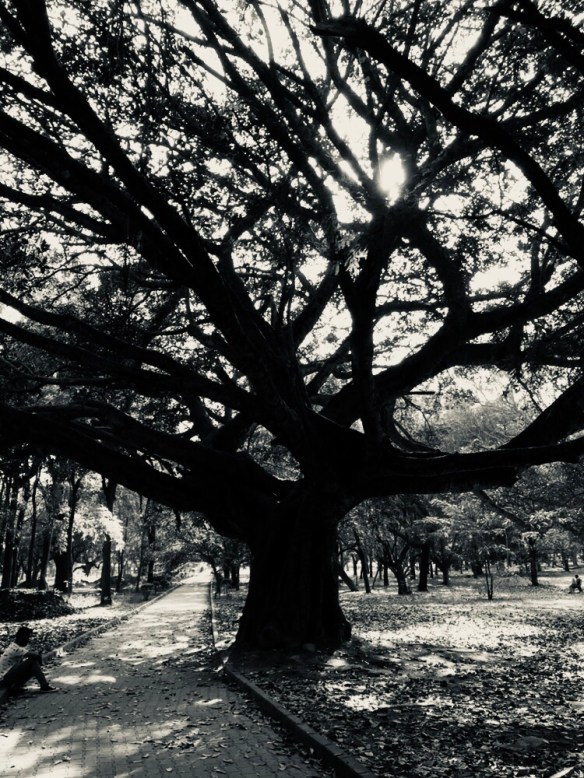
DAILY PHOTO: Cubbon Park Tree in Silvertone

Taken on February 8, 2018 in Cubbon Park, Bangalore.

DAILY PHOTO: Halászbástya Monochrome

Taken in December of 2016 in Budapest