POEM: Park in Motion

Three sights seen on my run in the park:

1.) a pup trotting in yaw as its nose and spine aligned on another dog while its neck followed the vector of the leash

2.) a slim-wristed, kurta-clad woman marching with such vigor of arm swing as to make it appear that her arms were rubber from the elbows down

3.) pairs playing net-less badminton such that making one’s “opponent” take a step would be considered bad form

DAILY PHOTO: Valley, Annapurna

Taken in May of 2018 in Nepal

BOOK REVIEW: Circe by Madeline Miller

CirceCirce by Madeline Miller
My rating: 5 of 5 stars

Amazon page


Circe is a minor goddess / sea-nymph in Greek mythology. While her father is the powerful Titan sun-god, Helios, she is the runt of the litter. She has a weak voice by godly standards, has few and limited powers, and is sympathetic to the fates of humans in a way that is considered ungodly. (The latter was strengthened by her affinity for Prometheus, the god who introduced fire to humanity and was subsequently punished by having his liver eaten each day by an eagle.) Circe’s underdog status would only go so far in producing an interesting story, but things become more intriguing when she begins to develop her skill as a witch. This makes her more powerful, and the increasing power of a minor deity threatens greater gods. Some of her abilities as a witch may result from her divinity, but it’s made clear that even mortals can practice witchcraft. Her gift for witchcraft is especially prominent in her abilities of transformation.

Circe’s adverse reaction to the Cinderella treatment she gets at home in addition to the increasing and unexpected threat she presents as a witch – seen when she turns a mortal into a god and another nymph into a monster — gets her exiled to an island. While it would seem that her story would get uninteresting while she’s exiled to a remote island, she’s visited by a number of mythic figures – mortal and god alike – who keep her tale fascinating, these include: the master craftsman Daedalus, the messenger deity / trickster god Hermes, and – most crucially to her story – the heroic king of Ithaca, Odysseus. She also makes a couple of trips off the island, such as when her sister, Pasiphaë, gets a special dispensation to temporarily break the exile in order for Circe to attend to the birth of Pasiphaë’s child. (This might make it seem that the siblings were close, or at least liked each other, but that’s not the case at all. The only family member she has a decent relationship with is her younger brother, Aeëtes, but he is not so much warm to her as he is tolerating of her affections, and even that alliance of convenience is doomed.)

Miller presents readers with a Circe who is both sympathetic and intriguing because she’s no match for the forces arrayed against her and can only survive by her wits and self-knowledge. Circe’s diligence in practicing her craft and her knowledge of her strengths and limitations allows her to persevere in the face of great dangers. She faces hordes of horny sailors, familial dysfunction, and, most crucially, a dire threat to the child who results from her dalliances with one of her most prominent visitors. The story features the many twists, common in Greek Mythology, resulting from gods and men trying to outwit the Fates, but it’s also the straightforward story of a mother who’ll do anything to keep her child safe against a hostile world.

I’d highly recommend this book for all readers of fiction, regardless of whether they have a specific interest in Greek Mythology. It’s a great story, well written, readable, and featuring characters who one can love and others who one can loathe.

View all my reviews

BOOK REVIEW: Beowulf Translated by Seamus Heaney

BeowulfBeowulf by Unknown
My rating: 5 of 5 stars

Amazon page


“Beowulf” is a narrative poem, originally composed in Old English (Anglo-Saxon), telling the story of the hero, Beowulf, and his battles against monsters. In a sense, it’s an early superhero story. Mere mortal men are no match for the warrior Beowulf; he battles the monster Grendel who’s been terrorizing the banquet hall of a Danish king, that monster’s mother, and – later in life, back in his homeland – a dragon. While the poem isn’t formally broken up into subparts, these three battles and the events leading up to each can be thought of as the three sections of the poem. It reads as the highlights of a warrior-hero’s life.

Heaney’s verse follows a form reminiscent of the Anglo-Saxon approach to verse without sticking to the form it so rigidly that it becomes difficult to read. The Anglo-Saxon lines consist of two halves balanced with two stressed syllables each and alliteration across the caesura (the line’s midpoint break.) Heaney often alliterates across a line’s mid-point, but sometimes the alliteration is packed into one half, and sometimes it’s non-existent. That’s not a criticism. It’s actually beneficial because it’s incredibly easy for the reader to follow Heaney’s translation. The more dogmatic one is about form, the more hoops one makes a reader jump through to understand. Heaney also doesn’t restrict himself to a single approach to meter, and his lines tend to be longer than the original. This translation doesn’t require complex decryption of cryptic or archaic language. Besides, for those who want to read to hear the meter and precise proper alliteration, the Anglo-Saxon version is included. (As is typically of bilingual editions, the original is on the left-hand page and the translation is on the right. This also makes it a short work as half of the 200-ish pages are the Anglo-Saxon version.)

It’s a straightforward book. There’s an introduction in which Heaney explains how he got involved with this project as well as providing some translation notes, there’s brief exposition on how names work in the story, and there are family trees to help keep the characters straight (the latter is important because of the nature of naming addressed in front matter.) Otherwise, it’s just the poem and its translation.

I enjoyed reading this translation. It is easy to follow while offering some beautiful use of language. I’d recommend this book for just about anyone, whether a reader of poetry, heroic tales, or historical fiction.

View all my reviews

POEM: Rush

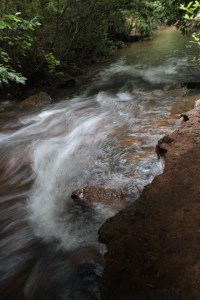
Rushing water carves rock and clay away,
gouging out a statement in nature’s hand.
Water spatter creates a misty spray,
stinging sharply as pelted with wet sand.

A foamy ridge takes a serpentine form
on the glassy warp field glazing brook stones.
This wild water isn’t born of savage storm;
it’s the effortless effort of Zen koans.

My camera fails to capture the calm scene,
but blurs it into a tiny tempest,
transforming a mundane forest stream
into a world scarring menace.

In these rapids I see a tsunami
washing over isles of Izanami.

DAILY PHOTO: Waterfall & Ruins in Monochrome

Taken on March 16, 2013 at Arabia Mountain Park

DAILY PHOTO: Cloud Gate

Taken in August of 2018 in Chicago.

1510A010-EDF8-4A66-9ECE-B6C3D9C90FBDF49ACD54-D96E-4AC3-B83E-F41C69580F77

DAILY PHOTO: Chicago Lakefront

Taken in August of 2018 in Chicago.

A70F42F4-A12C-4017-88B7-31BEE6CFC344B4966D49-15CC-4050-ACEA-A1920E553DD24CE14F87-7AFF-4F41-A1FD-712FA48482CAA2EDFBD5-6C5C-4C1B-84EE-7865142BF5E0


DAILY PHOTO: Buckingham Fountain by Night

Taken in August of 2018 in Chicago.0B89F794-410D-44BD-AFF5-D2979584B83D8543A1B8-3C78-4A19-9214-FF270453207D1389CEF2-6A53-46C2-87F1-4036A45F86C5

DAILY PHOTO: Citadel Gates, Huế

Taken in December of 2015 in Huế, Vietnam