DAILY PHOTO: Jain Temples of Khajuraho
1
I’m living proof that introversion and love of travel are not at odds. That said, introversion is all about managing stimulating situations before they red-line to stimulation overload, and travel is packed with novel sensory experiences. There’s an art and science to getting the most out of travel as an introvert. Here are a few tips.
5.) Exploit the quiet spaces: No matter how clamorous the city one is visiting, there are always little zones of solitude, including: places of worship as well as parks and gardens. In travel beast mode, our minds are often focused on getting photos, seeing everything there is to see, and planning our move to the next site, and one can miss opportunities to recharge.
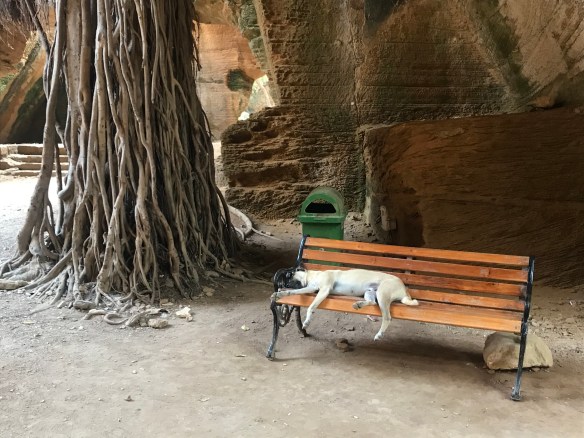
One might not feel comfortable taking up a meditative / reflective stance at a place of worship of some sect not your own. However, if you can shed worries about being seen as a poseur-gone-native, the nice thing is that people everywhere tend to be respectful of your quietude in such places. Unfortunately, the same cannot always be said about parks and gardens, which may require scouting for a hidden enclave. In some countries, sitting on a bench in the park is taken as an invitation to engage in conversation — mostly in places that don’t see many foreigners. [Which can be great, unless one is specifically trying to turn inward for a few moments.]
4.) Meals aren’t just about nourishment: For a long time, I thought I had a pretty harsh tendency to go hypoglycemic. But I’ve come to notice that if it’s 3 o’clock in the afternoon and I haven’t eaten since breakfast and I’m hiking the Annapurna sanctuary in Nepal, I’m hungry and will let you know it, but it’s still possible to stand being around me. However, if it’s 3pm and I’ve been walking around New Delhi all day, I’m probably on the verge of going full-Hulk at the slightest provocation. [The other evidence that it’s the lack of peace and not the lack of glucose causing my problem is that a granola bar seldom makes a dent.]
Of course, a peaceful place to take a meal break isn’t always sitting right in front of one — even in big cities. It sometimes requires some thought before one is on the verge of a melt-down.
3.) Know thyself: If you are the kind who absolutely must see every site in the guidebook, you need to allow yourself extra time in a given city or village above and beyond just what is required to move from place to place. You need to factor in quiet time. In some travel destinations, solitude is built in by virtue of the locale, but in other places, it can be elusive.
Alternatively, if you are the kind who doesn’t mind missing temples 8 through 12 on the “best of” list, the whole issue becomes a bit easier.
2.) Vary your cycles: In practice this can be a challenge because of where sites are relative to other sites. However, if you can have a mix of more and less stimulating locations within a day, and then again over the course of the week, that will help a great deal.
Also, if you are a morning person and can hit the more intense sites when you have that burst of energy, that’s for the best. Alternatively, if you’re a night-owl, match your high energy periods with your high stimulation happenings.
1.) Recognize the upside: Don’t believe the hype that being an introvert is all downside with respect to travel. Most discussions of this subject would focus on how helpful introversion can be in the planning process, and in anticipating problems that might derail your travel itinerary. However, let me mention another advantage that you may not have been as likely to consider. I have found that a lifetime of feeling myself an outsider has desensitized me to instances in which I am really, truly, and vastly outside my culture. So to me, sitting with ex-head hunters in Nagaland isn’t particularly more awkward than attending a party in my hometown.
What the Buddha Taught by Walpola Rahula
My rating: 5 of 5 stars
It might seem like any book on Buddhism would — by definition — be a book about “what the Buddha taught,” but, no. Buddhism, like all religions that I’m aware of, has experienced the drift that occurs as part of the religification process – though some sects and sub-sects remain truer to the Buddha’s original approach than others. I was happy to stumble onto this book because whenever I’ve read the ideas attributed directly to the Buddha, I’ve always found them to be brilliant in elegance and simplicity.
Walpola Rahula’s book is a summation of what the Buddha actually taught, presented in a way that makes sense for today’s English-language reader. The book is just eight chapters, plus appendices comprising ten texts (excerpted or in whole, depending upon the document’s length and contents.) The first chapter explains the Buddhist conception of the mind, and gives the reader a context for much of the rest of the book. Chapters two through five each link to one of the four noble truths: i.e. dukkha (suffering-ish — the controversy of that translation is addressed in detail), the arising of dukkha, the cessation of dukkha, and magga (the path to the cessation of dukkha – i.e. the eight-fold path.)
Chapter six addresses one of the most controversial and unique of Buddhist ideas, the doctrine of no-soul (anatta.) This is the idea that the idea of a permanent self or soul that is ever-present and that lives on past the body is an illusion. The Buddhist conception imagines the self as being more like a river. It only appears to be a permanent entity, but, in reality, it is different every moment and what appears permanent is more an emergent property than a thing or entity. I found this chapter to be the most interesting, because it is such a unique idea (though one a number of neuroscientists seem to be converging on this way of thinking), it appeals to my sense of simplification versus needless complication, and it was interesting to read Rahula’s challenge of those who have tried to deny Buddha argued thus (presumably seeking to make Buddhist doctrines converge with their belief systems.)
Chapter seven discusses meditation, mindfulness, and misconceptions about the two. When I took the Vipassana ten-day course, it was emphasized to us repeatedly that in the Buddha’s conception is that one needs to do two things in pursuit of enlightenment, live ethically (as per the eight-fold path) and practice (meditation and mindfulness.) While Rahula doesn’t put it exactly like that, that message comes across. (Rahula presents the eight-fold path categorized in three divisions of ethics, practice, and wisdom.) Whereas the doctrine of no-soul is controversial on metaphysical / philosophical grounds, the necessity of practice is passively objected to on the grounds that people really don’t want to practice because it’s challenging and it keeps them from getting the most out of all the apps on their phones.
The last chapter ties things up by bringing what the Buddha taught into present-day in order to ask questions like how it can be applied and what it means to be a Buddhist.
Besides the appendices of texts and text excerpts, there are photos throughout the book, mostly of Buddhist sculptures from around the [Buddhist] world.
I found this book to be very informative. It’s concise and readable, and seemed to me to be very consistent with those beautiful ideas I’ve come to associate with the Buddha. I would recommend this book for anyone who’s looking to learn what the Buddha actually told his students back in the day.