Witch & Skeleton [Free Verse / Senryū]

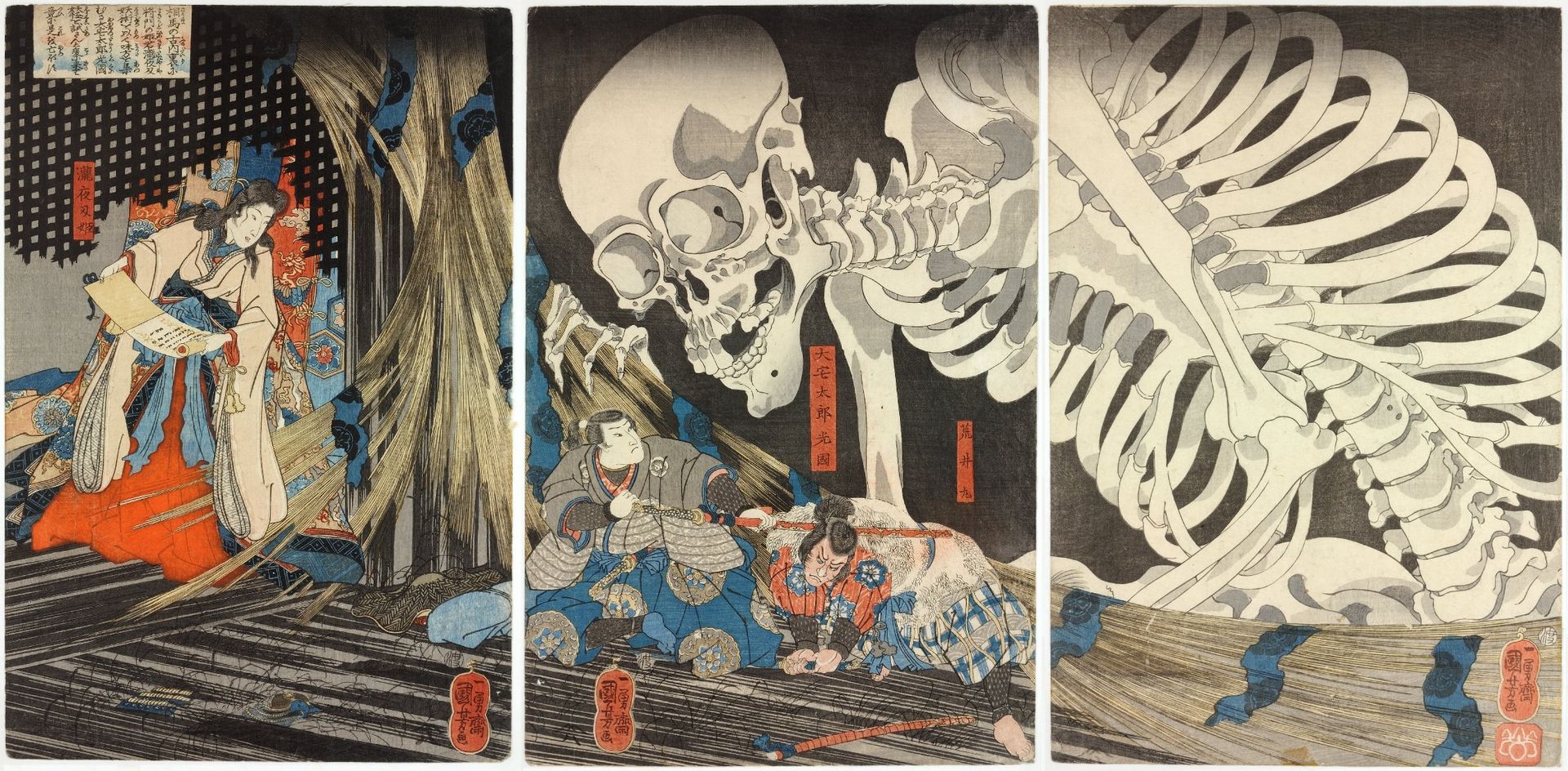
Takiyasha the Witch and the Skeleton Spectre; Utagawa Kuniyoshi (1844)
PREMISE:
Princess Takiyasha
 summoned a skeleton to
  kill a samurai.

MORAL?:
"Don't bring swords
 to a giant skeleton-ghost 
  fight!"

CONCLUSION:
Yet, in settled dust,
 the world was less one
  Princess-witch.

Faun by Moonlight [Haiku]

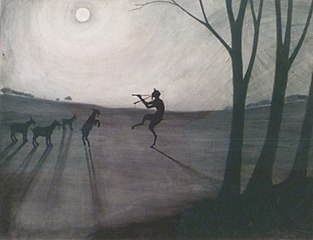
Faun by Moonlight (1900); Léon Spilliaert
what shenanigans
 goes on in milky moonlight,
  unseen by sleepers?

Mermaid [Lyric Poem]

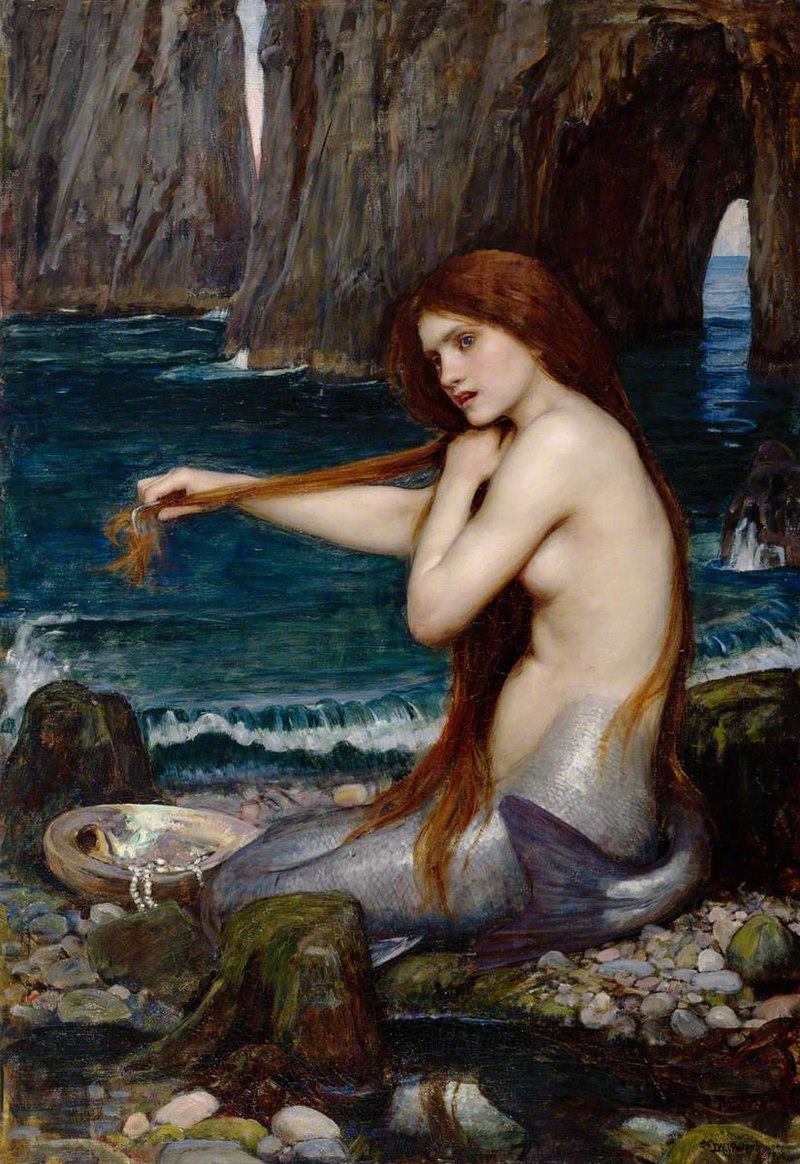
Waterhouse, John William; A Mermaid; Royal Academy of Arts
So many miles of coastline,
   of rocky coves and outcrops.
 Where none can see a straight line,
   and water sloshes and slops.

Oh, might one miss a mermaid
    hidden among the inlets,
 so snug in stone palisade -
    a lair of shells and torn nets?

If you say that you've seen one,
    I'll not call you a faker.
 I rather think it's great fun
    to flirt with claims, wiseacre.

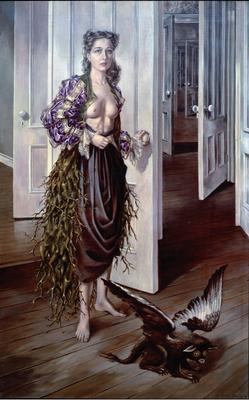
Dorothea Tanning’s Birthday (1942) [Free Verse]

Oh, I've been in that dream:

     door upon door to nowhere,
     inexplicable nudity,
     elements that seem fine 
          from a distance, but -
          from up close - make no sense.

And then I saw the creature at her feet,
      and knew I'd never been in that dream.

   I can't fathom the genetic cocktail 
      that would need to be cooked up
          to create such a monstrous pet. 

   And then it hit me that the winged badger-mutt
       is not nearly the most disturbing aspect...

   What are they looking at?

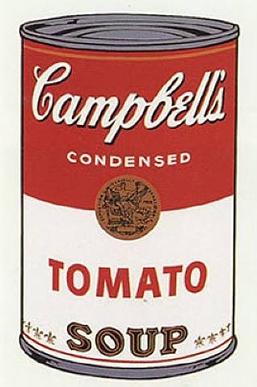
Andy Warhol Limerick

There was an artist named Andy Warhol
whose paintings sure enough weren't for all.
Like a flimflam man
he copied soup cans,
and viewers saw [not Campbell, but] Warhol.

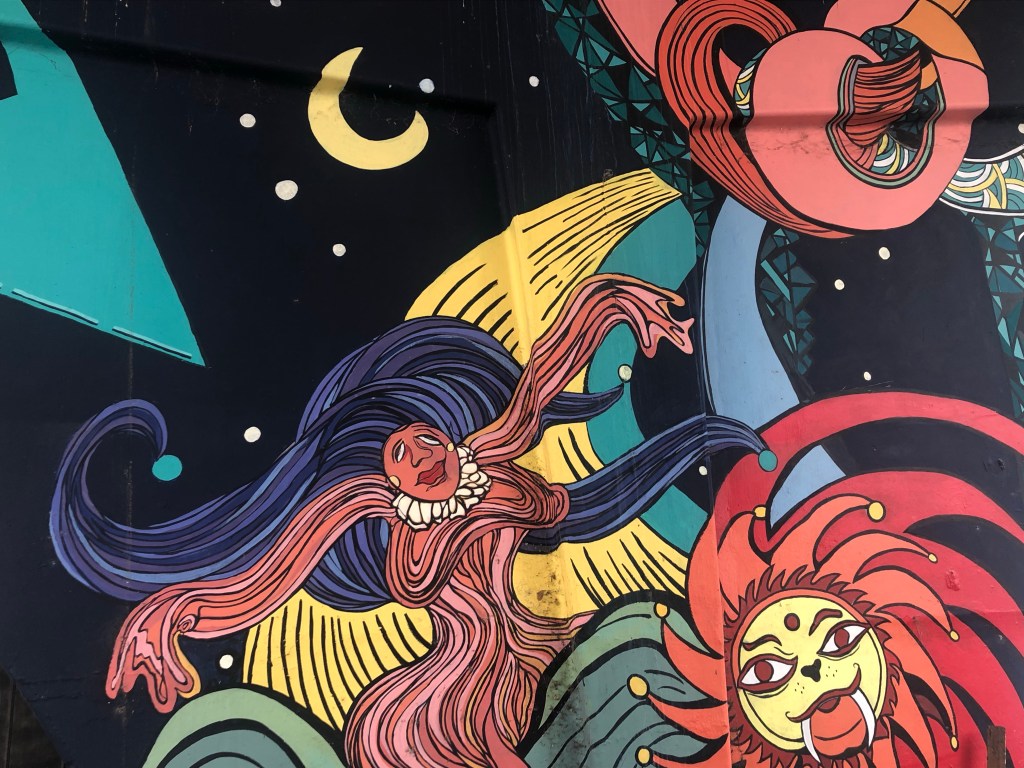
DAILY PHOTO: Trippy Graffiti, Bangalore

Taken on October 2, 2022 in Bangalore

BOOK REVIEW: Making a Masterpiece by Debra N. Mancoff

Making A Masterpiece: The stories behind iconic artworksMaking A Masterpiece: The stories behind iconic artworks by Debra N. Mancoff
My rating: 5 of 5 stars

Amazon.in Page

Release Date: November 1, 2022

Get Speechify to make any book an audiobook

In this book, Mancoff discusses a dozen works of art considered masterpieces, explaining how the paintings came to be, what influenced the artist, and what influence these paintings had on art or culture that contributed to their widespread designation as masterpieces. This background information is presented by way of helping to understand what it is about these paintings that made them stand out.

It’s an interesting selection. There are paintings, such as Botticelli’s “Birth of Venus,” da Vinci’s “Mona Lisa” and Hokusai’s “The Great Wave,” that one would imagine being on any short list of artistic masterpieces. There are others that one could imagine making the cut or not, but which are certainly iconic (e.g. Grant Wood’s “American Gothic.”) But there are also painters who one would expect to see included on the list, but whose most well-known or iconic work isn’t the one presented – e.g. Klimt’s “Woman in Gold” is discussed instead of “The Kiss” and Van Gogh’s “Fifteen Sunflowers” is included rather than “Starry Night.” The most controversial inclusion is the last, “Michelle Obama” by Amy Sherald – not because it’s not a beautiful painting and interestingly arranged for a portrait (which are usually pretty boring to a neophyte such as me,) but because it hasn’t been around for sufficiently long to know whether it will lodge itself in the collective conscious the way all the other entries have, so earning the designation of masterpiece. [It’s also owned by the Smithsonian’s National Portrait Gallery, and thus hasn’t had the commercial distinction by which masterpieces are usually determined – i.e. being auctioned for insane sums of money – e.g. Warhol’s soup cans (which are included in the book.)] That said, I liked that there were some “outliers,” as it was more opportunity to learn something new.

The book not only includes pictures of artworks as well as closeup details, but also pictures of works that were influenced by each and sometimes photos relevant to the story behind the paintings.

I enjoyed reading this book and learned a great deal about these important works of art.


View all my reviews

BOOK REVIEW: Black Water Lilies by Michel Bussi; Adapted by Fred Duval

Black Water LiliesBlack Water Lilies by Fred Duval
My rating: 5 of 5 stars

Amazon.in Page

Release date: October 11, 2022

This is a murder mystery novel by Michel Bussi adapted into a graphic novel. It’s a bold move to transform it into a graphic novel because the story is so setting-dependent, that setting being the timeless tourist village of Giverny in France, a village that served as the model for many of the paintings of Monet. That said, the book worked for me. I found it engrossing from cover to cover.

A trio of police detectives arrives in Giverny to investigate the death of a man who was stabbed and subsequently bludgeoned, his corpse found in a picturesque stream. So, one has this small town where everyone knows everyone else — and the secrets and the rumors, except these outsider detectives who must learn what they can from questioning locals who are used to keeping things to themselves. The detectives aren’t even clear about whether the victim was done in by his womanizing, his attempts to acquire rare paintings, or some unknown cause. Therefore, they have to purse multiple lines of investigation at the same time.

I found the story to be well-crafted in terms of how information is concealed and revealed and how the loose-ends and anomalies are tied up in the end. The art is beautiful and green, and captures the scenic appeal of Giverny. Though I should note that I don’t read many mysteries and those who do and who have intense attention to detail might find problems that I missed altogether.

I’d highly recommend book. Those with an interest in art will find the book particularly intriguing.


View all my reviews

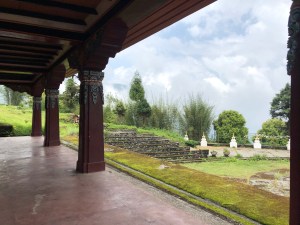
Clouds & Bamboo [Haiku]

cliffside bamboo
becomes a sumi-e
when clouds roll in

BOOK REVIEW: Ways of Seeing by John Berger

Ways of SeeingWays of Seeing by John Berger
My rating: 5 of 5 stars

Amazon.in Page

This book challenges one to not just look at what’s in a picture, but to reflect upon the nature of seeing and what it tells one about the deeper meaning of a painting or photograph. For example, who is seeing – i.e. whose perspective would the picture be from and what might the artist be saying about such a person? Also, what are the subjects looking at, and what does that convey (e.g. come-hither, lost in thought, etc.)

The book’s seven chapters alternate text + picture chapters (the odd chapters) with ones that are only pictorial (i.e. the even chapters.) The first chapter lays out the concept of ways of seeing, and subsequent chapters consider how those ideas can be applied to specific questions. Chapter three, for example, discusses what the differences between how men and women are depicted says about inherent societal biases. Chapter five explores the relationship between possessing and seeing, and also how everyday people begin to be rendered in art. Chapter seven investigates what the author calls “publicity” and how pictures are used to evoke dissatisfaction with what is and desire to be something else. Here one sees how advertising and marketing exploits these concepts.

The picture-only chapters are intriguing. One can see the commonality in the pictures and practice discerning what the author is trying to convey. One of the book’s central ideas is that seeing precedes reading, and that we learned to extract information from images before we did so from words.

The book has strange formatting, employing bold text and thumbnail art. The font didn’t bother me. I don’t know whether it was used to raise the page count on a thin book, or what. I will say that the thumbnail art can be a little hard to make out, even in the Kindle edition where it can be magnified somewhat. Most of the paintings can be internet searched quite easily, but the advertisements that are used to show how art is applied to marketing, not so much.

I found this book to provide excellent food-for-thought, and would recommend seeing / reading it.


View all my reviews