Rat’s Ass ≠ Flying Fuck

I get that nobody cares about the backside of a rodent. It’s clearly the toothy, gnawing front end that’s on people’s minds. So how is a “rat’s ass” synonymous with “flying fuck?” This isn’t a rhetorical question, people. I’d really like an answer.

So the fact that it’s preceded by “Who gives a…” makes me assume that a “flying fuck” isn’t anything that anyone much cares about. It’s like a rat’s ass, a goat’s gonads, or politician’s promise–no one cares. But wait. It seems to me that a flying fuck would be something that all parties concerned would take great interest in. Alright, I’m not  hip to all the maneuvers of the Kama Sutra, but I imagine  a flying fuck to be when a man with a woody gets a running start,  leaps up in the air in a horizontal configuration, and comes down so as to impale his partner’s lady bits. That’s like throwing a javelin to land a whole-in-one in the cup on the green of the 9th hole.

Is this a flying fuck?

Is this a flying fuck?

Even if I was a thrill-seeker, unconcerned about the threat of a sprained penis (it’s a real thing, look it up), I think my wife would care enough to be firmly opposed. If people weren’t scared of the flying fuck, it’d be all the rage.

Alright, let’s assume I’ve misinterpreted the term. Let’s say that a “flying fuck” really refers to being a member of the Mile High Club. Everybody cares about that. The man wants to celebrate it. The woman doesn’t want to be caught in a slutwalk of shame back to her seat. You can be damn sure the guy who’s locked out of the lavatory after having eaten a vending machine tuna salad sandwich from Concourse B cares greatly. Everybody cares about the flying fuck.

I can’t even imagine what else a flying fuck could be, but whatever it is I have trouble believing that nobody cares.

It can’t just be the alliteration.  Acrobat’s accountant, billionaire’s bunion, crooner’s cookie-jar, etc… are all alliterations that we care less about than a flying fuck.

So if you can shed some light, I’d be happy to hear an explanation. I do, truly, give a flying fuck.

The Puzzling Sexuality of India

India, land of the Kama Sutra, is prudish. America is known for being pretty puritanical–at least if you don’t compare it to Muslim countries. In the U.S., for some reason, we would rather a child see a human cleaved into eight individual pieces with a machete than to be witness to a nipple slip. Well, India censors the innuendo and sexual references  that sailed right past the FCC.

On the street, my wife and I can expect odd looks for holding hands and worse for a smooch. In the city, this rarely amounts to more than a sidelong glance, but we’re told in the countryside the people can be more vocal. (We’ll see, we’re planning our first trip into the countryside for next weekend.) On the other hand, young men routinely hold hands with other men, and the same is true of pairs of young women. Same-sex hand-holding is par for the course, but hand holders of the opposite sex are breaking mores. Some may say that the difference is same-sex hand holding isn’t sexually-charged, but I think it strains credulity to think both that different-sex hand holding is always inherently sexually charged and same-sex hand holding is never sexually charged.

Anyway, one would expect that a country that was so comfortable with same-sex public displays of affection (PDA) would have liberal views about homosexuality. No. Until 2009 homosexuality was a crime, and there is still rampant Ahmedinejad-style denial that homosexuality exists in this country. (Ahmedinejad is the Iranian president who– in an act of denial that was stunning, though in character–stated that homosexuality doesn’t exist in Iran.) To add another wrinkle, I’ve read that some men, who would be fighting-mad to be described as anything other than straight, routinely engage in behaviors that most would find indicative of homosexuality or bisexuality (we are talking well beyond hand holding or a kiss on the cheek here.)

There are a couple of reasons why young people who vehemently identify as straight might engage in sexual behaviors that are not. First, there are those who are homosexual and are either in the closet or in denial. One expects that there are many people who fit into this category in India because of the tremendous pressure to live a traditional family life–whatever else one may do on the side. In many countries, “denial” and “the closet” might cover the gamut of explanations for such anomalous behavior. However, in India there is a second reason that one might associate with places where men and women are strictly segregated over long periods of time (think a prison.) That is some of these the aforementioned people presumably are heterosexual, but have no sexual outlet because they don’t have any private interactions with people of the other sex who are not their blood relatives. So in an ironic twist, in society’s attempt to rigorously enforce and control a “traditional” paradigm of heterosexual familial units, more unions that do not fit that model are created than otherwise would be.

So you may be wondering whether I’ll be explicit about what I find “puzzling” about Indian sexuality. It’s a little puzzling that the culture that brought us the Kama Sutra and vast orgiastic bas reliefs on the temple at Khajuraho would have a problem with a couple hugging in the park or who choose for themselves with whom they are intimate. The overwhelming trend across most of the world is to become more tolerant of consenting adult’s freedom to exercise their sexuality as they see fit. Granted, there are certainly other examples where there has been a countervailing trend. Caligula’s Rome versus the Rome of today. Also, it should be noted that over a recent time span India seems to becoming more tolerant, and thus following the trend—if slowly.

Another thing I find puzzling is that by some measures the Indian approach seems to work. Following the incentives, I’d expect the Indian system of arranged marriage and limited premarriage intergender interaction to result in nothing but heartache. Indians will point out that their divorce rate is infinitesimally low. However, one then has to then consider other questions such as whether it results in more spousal murders, marriage related suicides, and vow-breaking. In other words, are there other means of marriage terminations that take place in a society that for all intents and purposes doesn’t allow divorce?

There is something particularly pernicious in Indian society called dowry murders. This is when a man and his mother set the man’s bride on fire so that they can erase the marriage and start all over in search of more bling. (That’s got to max out the bad karma.) Dowries were made illegal because of this, but both dowries and dowry murders continue. India does have a high suicide rate (though not as high as the US’s), but I have no idea whether any studies have been done to try to isolate the role of a bad marriage. I also can’t say whether there is evidence that “stepping out” on the marriage is higher in India. While there is plenty of evidence that this goes on, like anything related to sex, few Indians talk about it.

The Deferential Calculus of Being an American in India

Every time I come home, the security man at the desk at our apartment building jumps to his feet and proceeds to stand at attention until I pass. This makes me uncomfortable, as do the many other ingrained acts of deference that occasionally border on obsequiousness. I’ve considered stopping to tell him he can be permanently “at ease” with me, but given the language barrier I’m afraid I’d just confuse the issue–plus have him standing at attention that much more longer. So, when in Rome…

If you’re an American, but not, say… General Pershing, you’d probably find this makes you uneasy as well. I think one of the reasons that Americans have historically excelled at technological development  is that we were in a hurry to have machines do our laundry, wash our dishes, or trim our nose hairs so that we wouldn’t have to have some other human apparently kowtowing to us. (This may be why the 19th century North was considerably more technologically advanced than its Southern counterpart, which had successfully rationalized a subclass of human being.)

There’s a guy who stands at the end of the lane and lifts a swing arm up and down every time a car (or, oddly, a pedestrian such as myself) comes down the lane. The first couple times I walked around the end in hopes of indicating to him that, “Hey, see you don’t really need to swing that thing up, I can just walk right around it, easy as pie.” I think I hurt his feelings, or–perhaps worse–undermined his reason for getting up in the morning. My point is that operating a swing-arm barrier is a perfect example of the type of job that has been completely mechanized in America.

I’m sure that cultural differences are the root of my discomfort. India is coming from the caste system, whereby who you were born to determined your status in a rigidly hierarchical structure. While Indians may have dropped the caste system, the underlying thought process dies hard. I, on the other hand, come from a culture which believes that on a fundamental level we are all equal. Americans are often stymied as to why we are viewed as being arrogant by other cultures. This may be a failure to see things in the same light. It’s not so much that we project that we are better than the average Joe, it’s that we don’t accept that the kings and holy men those cultures hold dear are above us. This is true. I don’t think I’m better than the door man, but I also don’t think the King of [Fill in the blank] is better than me. [OK, the perception of arrogance is also partly that we’re loud and expect a ubiquity of comfort that is simply not available in much of the world. There is that. And the fact that our leaders often think they can fix every problem everywhere, and–given this is not actually true–we have left a lot of chaos in the our wake since our rise to hegemony.]

So the whole culture thing is part of it. However, I also worry that the man who brings my food with a warm smile and a bow is spitting in it. I wonder if the lady who launders my clothes, and then goes the extra mile by ironing them (though they mostly consist of T-shirts and jeans), might be preparing an itching powder attack. I wonder if the security guy standing at attention is just waiting for me to lock myself out of my apartment so that he can exercise some passive aggressive payback. [I suspect this is why Indian bureaucracy is notoriously slow and prickly. It’s a desire to exercise the leg up on has while one is in other ways part of an underclass.] I heard a comedienne of Indian origin say that her mother always flew British Airways just for the delight of bossing a Brit around. All of this consternation is because I worry that they think that I think I’m superior to them, which I don’t.

Yesterday I was eating at an Indian fast food joint called Kaati Zone. It’s one of those places that you order at the counter, get your food at the counter, and take it to one’s table. (FYI- this set up is much less common here except for little holes in the wall where one stands to eat.) When I was done, I pitched my trash in the trash can and put my tray on top, just like one would at a Wendy’s. When I turned around there was a young woman with her jaw agape and eyes wide looking right at me. My first thought was that I had pitched my wallet or my journal in the trash. I did a pat down and found I was alright. As I left, it dawned on me that her surprise may have had something to do with my handling of my own garbage.

Are Action Movies Dazzling Us Stupid?

AvengersJust like everyone else, when I first watched The Avengers, I was awed. As I digested the experience, however, I realized how appallingly flawed the story was. Can a film that is visually impressive enough dance over the hard parts of story?

Alright, it’s not just being visually impressive. If it were, then the Transformers movies (I’m thinking particularly of the second one) wouldn’t be so sucktacular. No. Filmmakers also need clever quips. This feeds an inexplicable urge of young people to repeat the witty remarks of movie characters ad infinitum. (Confession: I’ve always longed for an excuse to say, “I’m your Huckleberry,” as per Doc Holliday’s words to Johnny Ringo in Tombstone.) It’s not just that the Hulk bashes a marble floor to dust using Loki’s lanky frame, but that he delivers that witty, two-word rejoinder. Together the CGI and the quip seal the scene in one’s mind.

[Spoilers ahead] If one looks up deus ex machina in the dictionary, one learns that it means: “someone or something that solves a situation that seemed impossible to solve in a sudden and unlikely way, especially in a book, play, movie, etc.” If one’s dictionary is online, one would then probably be treated to a video clip of the scene in which Professor Selvig is knocked on the head, becomes unenslaved, and consciously realizes that his subconscious built a backdoor that will allow him to shut down the portal that were previously told can’t be shut. The clip could then continue through the end of the movie (minus the post-credit shawarma scene.)  The following are key incidents of deus ex machina in this film:

-a bump on the noggin releases one from the mind-control of a god (A “puny god,” indeed.)
-a conscious mind (in a waking and non-meditative state) knows in great detail what happened in the subconscious
-an attack on the mothership disables all troops on the ground, Independence Day style (worst command and control ever.)

One may be thinking that I’m just one of those douches who picks nits, but I’m really not. These flaws are fundamental to how the story is resolved. They are cheats that make everything that happened leading up to the climax irrelevant. Think about it; if the Professor had gotten knocked on the head 20 minutes earlier, the massive Avengers battle through Manhattan would never have been necessary. They could have called the movie “Professor Selvig’s Magical Mind” and left the Avengers out of it all together.

I’m willing to sustain disbelief about the small things. There are plenty of critics who get into the minutiae of continuity gaffes and the like. A couple of my favorites are below.

Lest one think that I’m picking on The Avengers, that’s only because it’s the third highest grossing film ever and first in the superhero genre. If you’re spending hundreds of millions on a film, you’d think you could throw some chump change into good story-building.  I realize that filmmakers have a jaded audience to contend with, and that they have to ramp up the peril to impossible heights to impress. Maybe they are forced to then throw away the resolution of story. Those who read my recent review of The Wolverine, will know that my criticism isn’t restricted to The Avengers.

Well, I’ve got nits to pick.

Sharknado: or, the Rock Band or Cheesy Movie Game

Somebody on Facebook made an offhand reference to Sharknado the other day.  I had no idea what a “Sharknado” could be, except the mind-numbingly stupid idea suggested by the phonetics of the “word.” It turns out that is exactly what it was. Despite the fact that sharks exist in places like Florida and tornadoes exist in places like Oklahoma (not a lot of overlap there), the movie is about tornadoes that pick up sharks and throw them through the air at unsuspecting people. (The sharks are, of course, still alive and hungry contrary to everything we know about biological entities that get picked up in twisters.)

I once wondered why the “Sci-fi” channel changed its name to the “Syfy channel.” I now know that it must have been the threat of false advertising lawsuits that spurred this change. (Of course, this doesn’t explain why the “History channel” isn’t the Sasquatch Alien channel.) Sci-fi is short for science fiction. Let’s break that down. First, the reference to “science” means one would expect some speculative universe which is constrained by scientific laws–either the laws of physics as we know them or some reasonable set of scientific principles by which a universe could be held together. It is not a magic universe, as required by Sharknado. The target demo for science-fiction is geeks and nerds (said in the most complimentary sense of those words)–in other words, people who overthink (or, at least, think.) The target demo for Sharknado seems to be pubescent boys failing science and in need of an opportunity to masturbate to Tara Reid.

Second, fiction is a creatively-engineered story, and I’m not even sure Sharknado qualifies on this front either. The creative component seems to be limited to cramming two things that terrify people together into one word or phrase. This may work in some cases, such as with the term “divorce lawyer.” However, the two concepts that one smashes together have to have some credulity as a unified threat. The fact that motherf#$%ing Samuel L. Jackson couldn’t save Snakes on a Plane, should have made this apparent to all.

As a thought exercise, let’s try some examples:

1.) Which of the following terror-inspiring dualities are devices around which a movie plot could be built, and which are just awesome rock band names?

a.) Clown-Pirates

b.) Hobo-Scorpions

c.) Black Mamba-Teen Driver

d.) Bear-Proctologist

e.) Spiders in a Tuk-tuk

f.) Karaoke-Mugger

g.) Robo-gynecologist

h.) Newborn-Arsonist

i.) Mother-in-Law / Attorney-at-Law

j.) Anthrax-blizzard

By the way, if the Syfy channel comes out with any of the above movies or series, please shoot me an email so I can claim my Executive Producer credit. It’s more likely this will be the starting line up for Lollapalooza 2025.

Bear with bubbles

Snowden’s Muddled Message

Also posted in my blog, Strategic Ramblings.

Edward Snowden is once again the headline leader. The man some consider a whistle-blower and others think a traitor is trying to gain temporary asylum in Russia. His U.S. passport having been suspended, Russian asylum seems to be his only immediate path out of the transit lounge of Sheremetyevo International Airport in Moscow. A few countries in Latin America have agreed to offer Snowden asylum and he has expressed interest in taking Venezuela up on the offer, but without a passport he is stuck like Tom Hanks’ character in Terminal Man.

The request for Russian asylum is problematic in that Russian President Vladimir Putin has said that asylum wouldn’t be considered as long as Snowden was still leaking. While Snowden said he has no interest in hurting the U.S., he is still talking about U.S. intelligence activities and seems unlikely to give up giving up information.

When the revelations of this story initially broke in the Guardian, I was outraged by the allegations being put forth by Snowden. In essence, Snowden suggested that Americans’ electronic communications were being spied on without warrants and without specificity. While lawyers and politicians love to play word games, the Fourth Amendment is clear and concise. Where there is a reasonable expectation of privacy, searches require a warrant that says who is involved and what’s being sought. In short, the Constitution doesn’t allow fishing expeditions.

The damage control by the Administration and the Intelligence Community in subsequent days was even more infuriating. The message seemed to be, “We want to have an open debate about all these nifty protections that are in place to make this all legal, but, alas, that’s all classified.I’m not saying you should just trust us, but–yeah–just trust us, ya-da-ya-da-ya-da.” I’m suspicious of a government attempting to expand its power; I abhor a government that tries to do it under the cover of darkness.

Director of National Intelligence, James Clapper, had been asked the following question by a Senator during his testimony, “Does the NSA collect any type of data at all on millions or hundreds of millions of Americans?”

Clearly the answer to this question, in light of the Verizon revelation was, “yes.” However, Clapper answered in the negative, and then added a qualifier “not wittingly” that didn’t help improve the truthfulness of statement, but should have been a red flag that the Director was trying to play some type of semantic game. Clapper later went on a Nixon-esque / Clinton-esque defensive about how his answer was the “least untruthful.” Of course, to suggest that the Verizon data was “unwittingly collected” strains credulity.

When General Keith Alexander of the NSA (among others) testified, he said that he had three points. First, that the programs had yielded positive results, or–in other words–the ends justified the means. Second, that the programs in question were “limited, focused, and subject to rigorous oversight.” Third, privacy and civil liberties are protected by the programs. However, he seemed to only want to talk substance about the first point–that is, what ends justified these means. I found it disconcerting that Gen. Alexander could tell us something about which cases had positive outcomes as a result of these programs, but not about the processes and protections required to draw specific information from the vast pools of data being collected on Americans. The former being the kind of information that could have negative security ramifications, the latter could only embarrass politicians. Secrecy is needed to protect assets and methods, but shouldn’t be a tool of protecting dubious legal practices. Al Qaeda doesn’t get a leg up by knowing the legal process required to access data generically.

The testimony was full of what would be objected to as “leading questions” in a court of law. For example, Alexander was asked if there was “any switch that could be flipped to allow analysts to eavesdrop on communications.” This makes for nice ass-covering when it turns out that they, in fact, have to type a command into a command line. “No, we never lied. We were as truthy as can be, there is no switch– we had the switches replaced with buttons decades ago.” Alexander repeated the “flip a switch” phrase back in his reply so that they were all on the same page.

As sad as any comment made was when Alexander said, “Further, as the Deputy Attorney General noted, virtually all countries have lawful intercept programs under which they compel communications providers to share information about individuals they believe represent a threat to their societies.” At the risk of sounding nostalgic, I remember when America prided itself in being a leader in liberty rather than saying, “look we aren’t doing anything that Russia and China aren’t!”

Telling me that you had success due to these programs isn’t enough for me. If you said, “hey, we put everyone of a particular religious persuasion in jail, and we foiled x-number of plots,” should I be reassured or outraged. I would argue the latter.

Telling me that other countries have such programs doesn’t satisfy me. I think the U.S. should seek to be on the leading edge of freedom and not happy slouching around the middle of the pack.

Telling me that a given database has only phone numbers and metadata and no identifying information doesn’t really inspire confidence. It turns out that there’s this nifty thing called “the internet” that allows one to look up people’s names from a phone number. You’re going to tell me that no one is going to google the number they’re looking for information about?

If the government wants to reassure the public, they need to have transparency in legal processes and not hide behind a veil of classified information.

Of course, part of the disagreement is that the law as it now stands only suggests only the content of messages incurs a reasonable expectation of privacy. That Mr. A talked to his therapist for two hours one Sunday evening as (according to cell tower triangulation data) he was sitting in the parking lot of a hospital is–in the eyes of many–completely unprotected information that no one could reasonably expect to be their own damn business.

I’m not comfortable with the collection of vast stores of information on citizens. Even if there are some protections that are working for the moment, all that information will just be waiting for some moment of weakness, some rally-around-the-flag moment, during which people are willing to flush all they hold dear down the crapper in exchange for a promise of security.

Having said all this, I’ve had a bit of trouble retaining sympathy towards Snowden as he’s muddled his initial message about unconstitutional actions. When he started releasing information about how the U.S. was spying on China, his message became lost. Of course the U.S. is spying on China, and they upon us. That’s the nature of the game in an anarchic international system. Yes, it’s a political embarrassment; coming as it did when the President was attempting to give China “the old what for” over the issue, but spying on other countries in order to keep one safe is part of what is expected of a government. (Yes, even on allies. You can be certain Israel, Japan, and the United Kingdom are spying on the U.S.) I take as a given that other countries might try to read my email if they think it has any potential benefit to them. However, they haven’t been granted a monopoly on the legitimate use of force against me. I expect my government to serve to protect me from any dire consequences of other country’s snooping. In fact, I have held jobs where other countries may have eavesdropped on me (not because of the work I did, but because of with whom I was in contact.) The potential for nefarious activities by a foreign country are just not the same as they are for domestic shenanigans–for most of us at least. There is less incentive to try to manipulate a random Joe for political or material gain across borders than there is within.

If Snowden is driven by his love of freedom, why has he headed in the direction that he has. Even if everything he says is absolutely true, the U.S. is still vastly more free than either Russia or Venezuela (e.g.Freedom House ranks the former as “not free” and the latter as “partially free.”) (There is some doubt about whether what Snowden says is true, but as the government hasn’t really delved into details or engaged in any contradiction that is not riddled with carefully censored qualifying words, one cannot tell.)

The Snowden Dilemma

[This was previously posted in my blog, Strategic Ramblings.]

As I–and everyone else– follow the slew of articles on Edward Snowden, I saw the following quote from Lord Acton:

Every thing secret degenerates, even the administration of justice; nothing is safe that does not show how it can bear discussion and publicity.

I agree wholeheartedly with Acton’s statement. The debate revolving around the former Booz Allen Hamilton contractor raises some intriguing questions. Once upon a time, I held a security clearance–not a particularly high one–but nonetheless a promise to keep the secrets I was exposed to in the process of my job. I took that clearance deadly serious and recognized its value and importance. However, I had it easy. I never faced any great moral dilemma over keeping my promise. Snowden’s situation was quite different.

What does one do when one sees one’s employer engaging in behavior that is illegal and/or unconstitutional under the normal definitions of words as we commonly use them. That is, the government has creatively taken words like “facility” and “targeting” and put an Orwellian twist on them to make a wild violation of U.S. citizens’ reasonable expectation of privacy in order to lawyer the program into one that some might define as “technically” legal. (e.g. the Washington Post article said that huge sets of information data were labeled “facilities” [suspected involved in terrorism] in order to justify all that information being handed to the government.) Of course, the national security leadership has been singing a refrain of “we don’t target U.S. citizens.” What is left unsaid is that while they don’t “target” U.S. citizens they come into a lot of information on citizens because: a.) they have a very low standard for determining likelihood of foreignness, and b.) they are collecting information on individuals regardless of whether they are suspected of anything.

So if you are Edward Snowden, you are a low-level employee. Your superiors don’t give a damn what you think about the legality of the program. You can’t complain to anyone because no one who cares is cleared to hear it, and those who are cleared to hear it have a vested interested in maintaining (if not expanding) the intrusions.  What would you tell Snowden if you were his friend, and not a complete stranger with your own feelings on the subject? That’s a tough one.

Secrecy may be necessary in some cases, but I’m uncomfortable writing the government a blank check. Officials will say, “it’s not a blank check, we have internal and external oversight.” First of all, the idea of “internal oversight” is not particularly confidence inspiring. That’s a little too much like “Otis” from the Andy Griffith Show letting himself in and out of the drunk tank as he saw fit for my taste. Second, how can any of us know that a judge acting on a FISA warrant treats it with the same seriousness as a case in which their decision will be open to public scrutiny? I don’t know, but I don’t hear of a lot of warrants in, say, bank robbery cases in which the phone records of millions of people unsuspected of a crime are to be handed over for a period of months.  Yes, finding and uncovering terrorists is more difficult than building a case against other criminals, but I remain skeptical because–as Lord Acton said, “Every thing secret degenerates, even the administration of justice…”

Teachable and Unteachable Lessons

[Note: This is posted in my Jissen Budōka blog as well.]

Source: Wikipedia; Status:  Public Domain

Source: Wikipedia; Status: Public Domain

Miyamoto Musashi, who was undefeated in over 60 duels, claimed that he never had a teacher. Some historians refute this claim. Whether one accepts it or not, the statement astonishes.

Musashi wasn’t talking only about martial arts, but about the many areas in which he was accomplished. Not being a painter or a sculptor, I can’t say how important a teacher is in such domains. But it’s easy enough for me to imagine a successful writer who never took a formal class in writing; someone who read profusely and practiced his (or her) craft relentlessly could do it. (Certainly, one can easily imagine successful writers whose formal education was in some area other than writing because there are so many of them–probably at least as many as those whose education was in writing. Examples include: Vonnegut [Chemistry], Crichton [Medicine], Zane Grey [Dentistry], Ursala LeGuin [Anthropology], and J.K. Rowling [French]. That’s not even to start on the many literary legends who dropped out all together– e.g. Dickens, Faulkner, Twain, H.G. Wells, and Jack London.) This isn’t to say that writing teachers don’t make writing better, but just that there is a path to this skill that doesn’t involve being fed lessons.

However, I struggle to imagine a martial artist achieving so much without a teacher. Boiled down to its most workaday definition, a martial art is a collections of lessons about what works in a combative situation. This is what separates the importance of a teacher in martial arts from that of a discipline like writing. In writing, one has the leisure to make one’s mistakes, learn from them, and self-apply course corrections. Musashi was in life or death duels; he couldn’t learn lessons at such a leisurely pace and in such an iterative fashion.

A martial arts teacher has a number of roles, such as preventing inertia (slacking) from taking hold in the training hall. However, the most fundamental purpose is to pass along the collection of lessons so that a student doesn’t have to learn them all by way of personal experience. Most of us aren’t Miyamoto Musashi; we can’t survive the process of learning all our own lessons.

Needless to say, I am a firm believer in the value of a good teacher. I’ve had several over the years, and I received valuable lessons from all of them–all with different, but no less valid, points of emphasis and flavor.

Having said all that proceeds, there’s much that cannot be taught. Such lessons may be described or discussed, but they cannot be learned except through the initiative of the student. I said that most of us can’t survive the process of learning all one’s own lessons, but I’ve increasingly come to believe that one can’t survive learning none of them either. In the beginning, one must be fed the lessons from a teacher in order grow. However, as the decades pass, one increasingly needs the space to learn one’s own lessons. If one lacks said space, one will stagnate and eventually the wheels will roll off one’s training altogether.

So what are the unteachable lessons? Knowledge can be conveyed, but not everything that a martial artist must learn is knowledge. Confidence cannot be taught. A teacher may explain–or even show–how he or she became confident, but that won’t translate one iota into the student being more confident.  This is like a Buddhist monk telling one that “desire is the root of suffering.” One may understand that statement. One may believe the statement. However, one’s suffering won’t decrease because one has the knowledge.  One’s suffering will only decrease if one conscientiously does the hard work of reducing one’s desires.

Another area of unteachable lessons are the lessons that the teacher has never learned. Loyalty is a great virtue, and so there may be a tendency to restrict one’s learning to the lessons of one teacher. However, even if one has an outstanding teacher and are practicing a great lineage, blind spots happen. The only way to learn whether there is anything of value obscured in those blind spots is to throw off one’s blinders and have a look for oneself.

What blinders? An excellent and tricky  question.  It’s like when someone says, “it’s not what you said, but the way you said it.” We all understand that there is some intangible character in language that is commonly understood but not easily seen or defined. In any culture (and a dōjō contains a culture, believe me) there’s always a collection of norms, rules of thumb, ideas, beliefs, mores, credos, etc. that come to be taken so much for granted that they become an invisible filter through which one sees the world. This isn’t an inherently bad thing, and it’s probably necessary to produce sufficient order in a chaotic world in which to learn and grow. Having said that, some of the ideas and beliefs in our cultural filter may be arbitrary, or at least not universal, but yet we don’t necessarily see the potential for error because we are seeing the world through the cultural filter. We take for granted that grass is green, but what if we see it through a yellow filter? Then it’s blue. Right?

Is India More Rape-prone Than Other Countries?

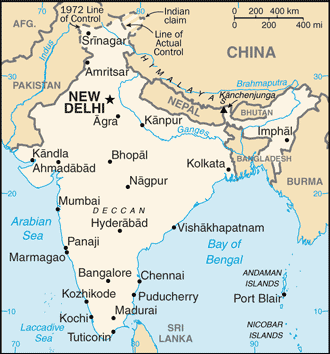
india_sm_2012As I prepare to move to India with my wife, the string of high-profile rapes that have taken place in recent months in India have not gone unnoticed. This past week two such cases were in the news. An American tourist was gang-raped in Himachal Pradesh, and a businessman in West Bengal was charged with the rape of an Irish NGO worker. Other recent cases include a Swiss cyclist in the countryside south of New Delhi and that of a British woman who jumped out of her hotel window because a group of men were trying to force entry into her room in the middle of the night.  While one might argue whether these cases should be given particular prominence just because their victims were foreign, they do speak to a certain level of boldness. In these cases, the criminals didn’t know anything about their victims, and while this makes the act no more or less reprehensible, it does suggest the attackers were particularly audacious.

Of course, the case that has garnered the most attention and outrage was the brutal gang-rape and beating of a young Indian physical therapy intern and the thrashing of her male friend last December. This case gained particular attention both because the victim later died, but probably also because the circumstances seemed like those that anybody could fall into. This wasn’t a drunk girl hitchhiking through the countryside at witching hour. The girl and her friend were going home from a movie at 9:30pm and were lured aboard a bus that was said to be going their way. In some sense, the victim was doing most things right. She was not traveling alone. It was not particularly late. She was not in an isolated area.

However, it turned out that the private bus was under the control of six joyriders. All six men, including the driver, participated in the violence. It may seem odd that the victims would get on this bus that was not  a normal city bus. However, for those used to traveling in the developing world, private buses and collectivos are not that out of the norm–and sometimes are the only way to get the place you’re going.

So the question remains, is rape more common in India than elsewhere? It turns out that this question is hard–if not impossible–to answer. If one takes the statistics at face value, then one should be more worried living in America. The U.S. had almost four times as many police-reported rapes in 2010 as India. When one normalizes this for population (accounting for the fact that India’s population is over 1 billion and America’s is only 300 million), this disparity becomes even more exacerbated.

However, it’s impossible to know what these numbers really tell one. While it is a sad fact that many rapes go unreported in the U.S., there is reason to believe that unreported rapes are even more prevalent in India. In absolute  terms, India has one of the highest numbers of police-reported rapes, but it also has one of the biggest populations in the world–and the biggest for a democracy. When one normalizes for population, India drops way down the list. However, up toward the top of the population-normalized list is Sweden, which would seem to speak to how important the incidence of reporting is. (I don’t imagine Sweden to be home of a disproportionate hostility toward women, but I could be wrong.)

I would also say that India is likely not as bad as many countries which institutionalize misogyny, e.g. theocracies. However, one of the breaks of being a democracy is that one gets held to a higher standard. Yes, there is a lunatic fringe in India. This was most vocally personified by Asaram Bapu, a Hindu guru who shifted blame to the victim by saying that she should have fallen to her knees, held her tormentors hands, and invoked their common religion; and, in doing so, she could have prevented the attack. Another break of democracy is having to accept that you’ll have ass-clown douche-bags with the power of the microphone. As much as most Indians might like to ship Asaram Bapu off to an island with the likes of Todd Akin (the Missouri candidate for Senate who said that women don’t get pregnant if they are really raped [presumably because, “it’s devastating to my case, Your Honor”]), that’s part of liberty–the freedom to say really stupid stuff.

As I’ve been reading about these cases, there are a number of explanations that I’ve heard that hold varying degrees of sway. Some have suggested that alcohol is the culprit. Wrong! Yes, alcohol makes one stupid, but this stupidity is usually restricted to the making and accepting of ill-considered marriage proposals. Millions of people get drunk every week without perpetrating violence other than badly sung karaoke.

There are a few cultural arguments. One is that there’s a bodice-ripping theme in Indian entertainment. This sounds like the alcohol argument and a few other arguments that shift blame away from the attackers–in this case by suggesting that they were just confused about what women want by pop culture depictions.  Speaking as a man, we are all perpetually confused about women want, but knowing that a person doesn’t want to be beaten up or lose control of her body is a no-brainer.

Another argument is that Indian tendencies towards rape reflects the vestiges of ingrained power dynamics. While India may have abandoned the caste system, the idea that some class of people have the right to exert power over others may not be entirely dead.

I don’t know if India has a more extreme problem than other countries in this domain, but I’ll take the recent outrage as a good sign. If there is some societal proclivity that contributes to the problem, perhaps it is about to go down.

Most importantly, be careful out there.

The IT Revolution & Crises of Self-Importance

Source: Ed Poor at Wikipedia.en

Source: Ed Poor at Wikipedia.en

If you’re as old as I (no, I’m not Wilford Brimley old by any stretch), you remember the days when you couldn’t count on getting a hold of another person instantaneously. Incidentally, the phrase “get a hold of” is apropos. Think of other times one might use those words. If one were a practitioner of judō (i.e. a judōka), one might use that phrase when talking about seizing an opponent in anticipation of throwing them.

Herein lies an intriguing irony. The person calling is dominating the called. That is, they are writing a check on one’s time that they believe to be cashable whenever the hell they please. Therefore, one might expect the person receiving random calls at random times to suffer a diminution of self-esteem. They are, after all, at the beck-and-call of some localized bit of humanity. However, on the contrary, the perfection of the electronic-leash has spawned a growing field of narcissists.

The reasoning that drives this plague of narcissism is as follows, “I am so important that some–albeit tiny–part of the universe is at risk of collapse if I’m not ready to spring into action at a moment’s notice. In other words, I am a localized superman[/superwoman.]”

The thing is, you’re really not. The deflating truth is that none of us is so important that any portion of the universe will collapse if we are unplugged from the hive for a few hours– try it.

Now, you may be saying, “Look, I have my phone on all the time, and I talk on it much of the day, but I’m not one of those loud people whose conversation lays waste  to the solitude of people around me everywhere I go.”

The thing is, you really are. Those annoying bastards that you “hurrumph” at when you’re not on the phone–that’s you when you are on it. You make a connection at a distance and, like all others, become oblivious to your immediate environment. At best you are a destroyer of solitude; at worst you are a danger to yourself and others.