BOOK REVIEW: Light on Pranayama by B.K.S. Iyengar

Light on Pranayama: The Definitive Guide to the Art of BreathingLight on Pranayama: The Definitive Guide to the Art of Breathing by B.K.S. Iyengar
My rating: 4 of 5 stars

Amazon page


This is B.K.S. Iyengar’s A-Z guide to breath and breathing exercises (pranayama.) It’s meant to do for pranayama practice what “Light on Yoga” did for asana (postural) practice. That is, it presents all the classic techniques, offers variants to meet individual needs, and provides the background necessary to put pranayama into the context of a balanced yoga practice.

Let me begin by discussing the book’s organization, and this book is organized to the n-th degree. There are parts, sections, chapters, and even the paragraphs are numbered (though–near as I can tell–the latter serves no purpose for a typical reader and may be more for the help of the writer and his assistants. It does create a somewhat biblical scheme, so maybe it was assumed there would be a need to quote this guide “chapter and verse,” as they say in Bible study.)

The bulk of the book consists of the first of two parts, and Part I is divided into three sections. The first of those sections is “The Theory of Pranayama,” and it puts pranayama in the context of yoga’s entirety. If you’ve read other B.K.S. Iyengar titles, much in these nine chapters will be familiar (e.g. discussion of the eight limbs.) However, chapter 4 offers a nice description of the anatomy and physiology of respiration. There are many anatomical drawings and diagrams in it to help convey the complex information. There’s also additional information about the traditional Indian notions of breath encapsulated in the concepts of prana, nadis, and chakras.

Section II is entitled “The Art of Pranayama” and it covers those topics necessary regardless of what technique of breath exercise one is practicing. It includes seated postures, mudras, bandhas, inhalation, exhalation, retention, etc. This section, too, has nine chapters. The final section of Part I describes the various techniques of pranayama. The chapters of this section are arrayed in lists, and they systematically build from the basic technique towards more advanced variations (e.g. by inserting retentions.)

Part II covers meditation (dhyana) and the corpse pose (savasana.) With respect to the former, it suggests how one’s body, mind, and sense organs should be conducted in the act of meditation. In the case of the chapter on corpse pose (after cross-legged seating position, this being the most common position for practice) there’s an extensive look at the details of that pose.

There are a number of helpful features incorporated into the book. In addition to the drawings mentioned in Chapter 4, there are black-and-white photos throughout to clarify the textual instructions. There is also a glossary of Sanskrit terms and an Appendix of courses of pranayama (i.e. recommendations as to how to sequence breathing techniques for optimal results with guidance as to how many sets or repetitions of each to use.)

My major criticism is one I’ve offered about previous books from this author and others. There’s a muddle of science and mythology that makes it hard to know how much weight to give particular instructions. It may be that a given piece of advice (e.g. a contraindication) is based on repeated observations of the physical or mental effects, or on a sound understanding of anatomy & physiology. In which case, it makes sense to heed such advice. However, advice can also be based on myths and the desire to preserve a way of thinking about the human body which is wholly unsupported by evidence. In which case, if one has no dog in the fight to preserve egos, it makes sense to disregard said advice. I suspect the vast majority of statements of what to do (or not to) fall into the first category, but some may fall in the latter, and it’s not easy to tell which is which.

I would recommend this book for students and teachers of yoga. It’s a good reference for one’s pranayama practice.

View all my reviews

BOOK REVIEW: Let Every Breath by Scott Meredith

Let Every Breath: Secrets of the Russian Breath MastersLet Every Breath: Secrets of the Russian Breath Masters by Vladimir Vasiliev
My rating: 3 of 5 stars

Amazon page


This book presents an introduction to breath exercises employed by the Russian martial art called Systema. Systema is one of a number of drill & spar-centric (as opposed to technique-centric) martial arts that have developed in modern times in an attempt to cast off the unrealistic and needlessly complicated elements that tend to grow within traditional martial arts (e.g. Krav Maga is a well-known exemplar of such a martial art.) Among the unique aspects of this system is its focus on, and approach to, breath—and breath is crucial in the martial arts, in a fight, and in life.

I had mixed feelings about this book. I’ll begin with positive aspects and then get into what I found off-putting. First, the book offers a clear explanation of principles and drills that are straight forward and will increase one’s awareness of breath. That is laudable. Are these particular principles and drills the end-all-be-all that will take one to heights that no other approach to breathing could (as the book suggests?) No. But is it a solid approach to breath that will yield benefits by making you more aware of breath while helping you to use it more effectively? Yes. Second, the book doesn’t have a lot of competitors in the “breathing for martial arts” space, and so it fits into a substantial void. (Note: the book doesn’t get into martial arts / self-defense drills or techniques, and doesn’t claim to.)

Now, here’s the other half of the open-faced shit sandwich. You’ve likely already gotten a hint of my problem with the book. This will seem like a two-part criticism, but it condenses into one problem with the book’s attempt to sell the reader on Systema. The starting point, as another reviewer noted, is that this system isn’t as completely novel and unmatched as is presented. Is that a damning indictment? It wouldn’t be. Just because this approach shares concepts applied elsewhere and is constrained by the nature of the human body doesn’t mean that it can’t offer its own unique value-added. The problem is that we are told how unique and completely peerless this system is so often that it becomes a bad info-mercial.

I get it. Systema is a product that has to compete in an intense market place with the likes of Krav Maga, MMA, Total Combat Systems, Defendu, and a ton of other self-protection oriented martial arts. It’s Pepsi, and it has to carve out a market share by convincing us of the unlikely fact that Coke products aren’t even in the same ballpark. The problem is that when it dismisses systems like yogic pranayama and Taoist chi gong, it does so in a way that shows virtually no understanding of those systems. When the author is telling us how the Systema approach to breath is superior to pranayama, he describes an asana (posture-oriented) class. If you’re going to convince us that the several thousand year old yogic tradition completely missed an approach to breath so groundbreaking that it will take one on an e-ticket ride to self-perfection, at least have some idea of the scope of what the yogis learned and how they present those lessons to their students.

The second half of this rant is that there is a lot of hagiography to delve through before one gets to the meat of the subject. Now, in general, authors of martial arts books tend to pay homage to their teachers and lineage. It’s not unreasonable that there is some near-deification of teachers in this book. However, at some point it becomes hard to tell whether the book exists to inform readers or as a monument to someone’s ego. This book gets disconcertingly close to the line. (The arrogance issue is made worse by confusion about authorship. It’s said that Meredith wrote the book, but Vladimir Vasiliev takes the by-line. This creates an odd situation because the book tells us how Vasiliev is both an exceptional human being, and humble as well. You can see my problem. Without evidence to the contrary, I can easily accept that Vasiliev is exceptional. I can also believe that he is humble. But when a book with his name on it tells me both of these things, I’m forced by the dictates of logic to reject at least one of them [and doubt is cast upon both.])

If you are looking to expand your understanding and awareness of breath, you may want to give this book a try. I certainly wouldn’t endorse every claim it makes, but there are some interesting ideas presented.

View all my reviews

BOOK REVIEW: Death in the Andes by Mario Vargas Llosa

Death in the AndesDeath in the Andes by Mario Vargas Llosa
My rating: 5 of 5 stars

Amazon page


Three men disappear from a small mining village in the Peruvian Andes. The army sends two investigators, Corporal Lituma and his adjutant Tomás, to get to the bottom of the apparent murders. Suspects include Sendero Luminoso (“Shining Path”) guerilla-terrorists and a number of locals. For some of the locals, there’s another possibility, the various demons and deities attributed to each of the mountains in the Andes.

“Death in the Andes” follows the time that the investigators spend in this remote village. There are two major story lines taking place at once. One narrative arc revolves around the investigation and day-to-day living in a tiny town under primitive living conditions. The second story line comes by night as the deputy, Tomás, recounts his love affair with a girl who was out of his league in almost every way—except, perhaps, with respect to virtuous living. The girl was in a relationship with an abusive gangster at the start, a condition that Tomás found untenable. His love-driven reaction creates all manner of drama, and that drama serves as the only entertainment to be had in this remote village.

The book is literary fiction, but it’s not purely about the characters. As suggested, there’s a strong narrative element. While the book is in a realist genre, i.e. nothing in it feels like it couldn’t happen in our universe, the fact that the story takes place in an area of the Andes where the Shining Path is strong and mother nature is harsh means that there’s plenty of tension and suspense.

This is book is translated from Peruvian, and it seemed to me that the translator did a fine job of capturing the feel of the rural Andes. A few Spanish terms are used for terms like terrorists and avalanches to create a feel of a unique character of these concepts relative to this place. However, there are only a couple of these terms and so context is sufficient for the reader to readily keep them straight even if one is not gifted in picking up foreign terminology.

In general, the book is quite readable. The most challenging part of reading it is when Tomás is telling his story because you have a three-way conversation going on over two time periods at once. (i.e. Tomás voices himself and his girl as he tells their story, but then Cpl. Lituma chimes in periodically with questions—or, more commonly, commentary.) However, the author uses dialogue tags throughout to avoid confusion. One just needs to be attentive in one’s reading of these sections.

I enjoyed this story. I picked up this book both because Llosa won the Nobel Prize in Literature in 2010 and I like to read something by winners, but also because I’ve trekked in the Peruvian Andes and translated literature often offers one a unique form of insight into a place. This was no exception.

I’d recommend this book for readers of fiction. If one is looking to broaden one’s horizons into literary fiction and /or translated fiction, this book is a good place to start. It offers humor and intrigue as well as deep characters and an infusion of geography and culture.

View all my reviews

BOOK REVIEW: Hindu Myths by A.L. Dallapiccola

Hindu MythsHindu Myths by Anna L. Dallapiccola
My rating: 3 of 5 stars

Amazon page


Having moved to India, we picked up this book to try to wrap our heads around the vast Hindu pantheon and the myriad myths involving them. There are a huge number of tomes on the subject of Hindu mythology, but far fewer concise commentaries that look useful. We were always on the lookout for a book that would offer a sort of “Hindu Mythology for Dummies” –the quick down-low, if you will.

I can’t say that this book clarified the topic. However, I’m not sure any book could. Hindu mythology is a subject of enormous scope, while being defiant against reducibility. I was about to compare it to the challenge of writing a concise book for neophytes on quantum mechanics, but then I realized that such a book could probably be done much more effectively. For as strange as the world behaves at a subatomic scale, there’s a means to order the story and to simplify it in a way that leaves intact the gist. Along with dry descriptions of ordinary sounding events, one reads stories like that of the deity that popped out of another’s belly-button on giant lotus flower. That’s when the myths become hard to imagine–if one hasn’t been hitting the psilocybin.

That said, I did learn some interesting elements of myth from reading Dallapiccola’s book, and I think it has as effective an organizational scheme as one can hope for. After an Introduction that exposes the reader to Vedas, Puranas, and the Hindu trilogy (Vishnu, Shiva, and Brahma), there are three chapters that revolve around creation, preservation, and destruction. [For those unfamiliar, those three deities map to those processes—Brahma the creator, Vishnu the preserver, and Shiva the destroyer.]

After those three, there are another three chapters. Chapter four deals with myths about delusion, and in addition to describing Vishnu’s role in delusion (maya) it tells a couple of tales (the story of Madhu and Kaitabha, and the story of King Harishchandra.) Chapter 4 discusses the topic of grace and describes the birth of the Ganga, tells the tale of Arjuna and the Hunter, the story of Vishnu and Prahlada, and then offers a bit of insight into Shaiva saints, temple myths, and animal devotion. The last chapter is a brief overview of Hindu Mythology in modern times—especially its inclusion in popular culture.

There is a map (i.e. an India map showing major cities and crucial historical sites) and many pictures throughout the book. The pictures include photos of sculptures as well as reproductions of paintings that are of the deities and key mythical events. As far as ancillary features go, there is a half-page “Further Reading” section and the book is indexed.

This book is only 80 pages, and offers a quick overview. Whether it hits the most crucial material, I can’t rightly say. As I mentioned, there are some interesting tidbits in the book. I’d recommend it for someone looking for a quick overview. However, one should note that there are books that are more oriented toward story and less toward a scholarly level of precision in language that may be more useful for one—depending upon one’s needs.

View all my reviews

BOOK REVIEW: Khajuraho by the Archaeological Survey of India

KhajurahoKhajuraho by Krishna Deva
My rating: 3 of 5 stars

Amazon page


Khajuraho is one of India’s most legendary historical sites; despite the fact that it’s located in a quiet, rural town that’s not so easy to travel to—at least, relative to many of the popular tourist sites of India. I could tell you that it’s so well-known because of its exquisite carvings. However, while it’s true that the sculptures are beautiful, the fact that almost no one outside of India has heard of Belur or Halebidu—sites which also have magnificent carvings—puts strain on the credulity of that explanation. It’s also not a major pilgrimage site like Varanasi. I’m afraid the explanation that remains is a touch lascivious. Imagine the Kama Sutra played out in 3-D on bas-reliefs and sculptures, and you have the scenes for which Khajuraho is most well-known. Which isn’t to say that the temples are nothing but “hein’ and shein’,” there are many of the same types of devotional imagery that one sees at other Hindu temples, and I’m sure some people go out of their way to see those devotional images.

This is one in a series of guide books put out by the Archaeological Survey of India. They are mostly sold at various historical sites and museums run by the Indian government, but can also be found at used bookstores and for sale online (e.g. Amazon.com.) This isn’t the first book of this series that I’ve read. I first stumbled upon them when I traveled to the caves of Ajanta and Ellora in Maharashtra.

The text for this book is based on a manuscript by Krishna Deva, and it’s organized to move from general to specific. After a one page Forward by the Minister of Tourism [at the time, 2002], there’s an Introduction that describes the historical and political context in which these temples were built. Then there are chapters that examine the art and architecture of the Chandella era, then the general approach to sculptures, and, finally, a look at the specifics of various temples ordered by groups. Those who’ve traveled to Khajuraho will know that the most extensive and impressive temples are in the Western Group—that’s the only group for which there is an admission fee. There is also an Eastern Group, a Southern Group, and a couple independent temples that don’t conveniently group with any others.

Almost as important as the text are the pictures. There are many color photographs that serve to illustrate the explanations being offered and which will help travelers to link up the textual discussion to what they are seeing. There are photographs on every page excepting the ancillary material.

These books also have a number of nice ancillary features. The book has a brief “Practical Information” section that provides guidebook style information (getting there, where to stay, where to dine, etc.) This includes a couple pages that are about traveling to / in India generally, and then a couple that are specifically about Khajuraho. I wouldn’t count on any of this information to not be out of date, though in little ole Khajuraho it might change less rapidly than in the cities. There is also a brief glossary and a “Further Reading” section, both of which may be of use. The book is indexed. There is also a general map of the part of India containing Khajuraho on the inside flap (both front and back.) A map of Khajuraho town might have been nice, but they do have an outlay of the Western Group, which is helpful.

I found this book (and the other books in the series that I’ve used) to be useful and informative. Furthermore, one can’t beat the price. The list price was 99Rs, but I see there’s a stamp inside mine that they’d discounted it to 50Rs. (That’s less than $1 USD.)

I’d recommend you pick up one of these guides—particularly if you are traveling to one of the more extensive sites. If you like to use guides [human guides,] you may find that there’s not a lot of new material to be gleaned from these concise guides, but they may help you organize your photos after your travels—and they don’t take up much space (a flat 12 X 23.5 X 0.5cm.)

View all my reviews

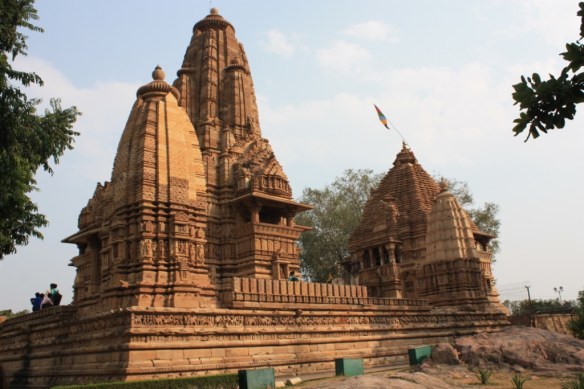
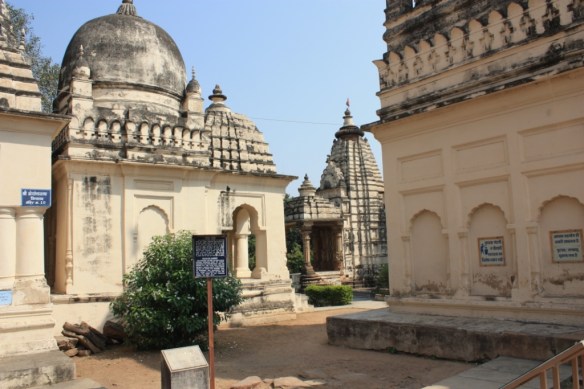
Since they don’t have a cover photo up for this book, I’ll include a couple illustrative pics that I took at Khajuraho:

In the Western Group

In the Western Group

In the act

In the act

Jain Temples of the Eastern Group

Jain Temples of the Eastern Group

BOOK REVIEW: The Hidden Life of Trees by Peter Wohlleben

The Hidden Life of Trees: What They Feel, How They Communicate—Discoveries from A Secret WorldThe Hidden Life of Trees: What They Feel, How They Communicate—Discoveries from A Secret World by Peter Wohlleben
My rating: 5 of 5 stars

Amazon page


I picked up this book because it was on one of those “Best Science Books of 2016” lists, and it turned out to be the most important book I read last year. Like most of humanity, I’ve been guilty of thinking about trees largely as objects. Don’t get me wrong. Like others, I never forgot the basics of biology and always remembered that trees are alive because they grow, reproduce, and whatnot. I’ve also never failed to realize that without trees to suck up carbon dioxide and exude oxygen, we couldn’t exist—though I’ve probably not been sufficiently grateful. Still, because of the molasses-like time flow of trees, their immobility, and the fact that many can live for decades after someone chainsaws off a limb, it’s possible to feel they have more akin with rocks than with we members of the animal kingdom. (Note: trees don’t always respond as well as people think to random “trimmings.” As will be a recurring theme, our misunderstanding of this has a lot to do with time perception. If your dog’s head was in the way of the TV screen, and you cut it off with a chainsaw. You’d immediately realize that you’re a homicidal maniac and an idiot because the dog would be dead right then and there. When there’s a branch in front of your window and you hack it down, the tree may stay green for a couple of years [a blink on its time scale] and by the time it dies you’ll have completely forgotten that it was your action that lead to its demise.)

The author, Peter Wohlleben is a German forester, and this book was originally released in German before being translated to English (as well as other foreign languages.)

Wohlleben systematically dismantles the barriers between trees and us by showing the many ways in which they’re more like us than we could possibly fathom at a mere glance. The subtitle’s dual question of “What They Feel, How the Communicate” reflects just a couple of aspects of how trees are more like us than we realize. There are also chapters that investigate how trees share from strongest to weakest, and how the tough love parenting strategy of trees produces robust offspring. (Experience of time may be the way in which humans have the most trouble relating to trees. We believe there is benefit in virtually everything coming to us faster, whereas trees benefit greatly from growing slowly. Slow growth makes for sturdier trees.)

Moving back to that question of communication, one may be dubious that trees communicate because we can neither hear them nor see their gestures. But not only do trees communicate with other trees, some species communicate with members of the animal kingdom as when a tree under attack from insects releases a scent that attracts birds that feed on the attacking insects.

Wohlleben does a great thing by showing us how trees should be more relatable to us than we imagined. However, the lesson needn’t stop there. One might also take away a broader lesson that we shouldn’t assume that our frame of reference maps to the sum of reality. That maybe we should have sufficient humility to recognize the impressive intelligences of species we view too simplistically. There have been a number of books that have come out in recent years that have noted the ways in which monkeys, ravens, owls, and even octopi are much more astute than we give them credit for. Seeing this extended to the plant kingdom takes the discovery to a new level of mind-blowingness.

This book consists of 36 short chapters, each of which deals with a specific topic of interest (e.g. forest etiquette, social interdependence, climate effects, hibernation, illness, and how trees survive under challenging conditions—droughts, introduction of competitors, etc.) There are a few graphics throughout the book, mostly line drawings of trees with the species identified. The book does have notes. However, it’s really set up more like a book of short essays by a naturalist than it is your usual work of popular science.

I’d highly recommend this book for anyone who breathes oxygen.

View all my reviews

BOOK REVIEW: The Devils of Loudun by Aldous Huxley

The Devils of LoudunThe Devils of Loudun by Aldous Huxley
My rating: 5 of 5 stars

Amazon page


In 1634, a parish priest named Urbain Grandier was tortured to exact a confession that he’d engaged in sorcery and made a pact with the devil. There was plenty of reason to believe that Grandier was a less than virtuous fellow (e.g. that he knocked up the teenage daughter of his best friend in Loudun), but no evidence of the crimes that he was actually accused of–and that the Church insisted he cop to despite his steadfast denials. However, there was some potent circumstantial evidence in the form of a case of mass hysteria by members of a convent of Ursuline nuns that was attributed to demonic possession at the time.

Huxley tells this fascinating story in great detail. At some points, perhaps too much detail. The writing style can come across as pretentious, needlessly complicated, and slow-moving at times. (For example, there are frequent quotes and snippets of poetry in French–and a few in Latin—and many of these were not translated to English in the edition that I read. Apparently, the assumption was that the reader would have a basic competency in these languages.) However, when it comes to the climax of the story, the book is as gripping as they come. Having been presented with great insight into Father Grandier, we know him to be a deeply flawed man. He’s like the priests and bishops of a Marquis de Sade novel, lecherous and libertine. Yet, he manages to become a sympathetic character as he shows virtue of sticking to his guns in denial of being in league with Satan long after the truth of his vices has been admitted. In essence, when juxtaposed to his inquisitors, he becomes the lesser of two evils.

I also don’t fault that Huxley delves into analysis, because there is a fascinating question at the heart of the event—one that deserves to be batted around. What made this group of nuns behave in such an un-nun-like fashion? There was writhing, foul language, wardrobe malfunctions, etc. Today, it’s impossible for a rational skeptic to write these events off as demonic possession. However, while the Mother Superior, Sister Jeanne of the Angels, clearly had an axe to grind against Grandier (for issues regarding organizational leadership and not so much for womanizing the townies), that also seems unsatisfactory as a cause for these sisters to behave as they did. There have been a number of cases of pretended possession, but generally these were individuals—e.g. Martha Broissier. There seems to be some fascinating psychology at work in this case.

The book is arranged in 11 longish chapters, largely following a chronological progression of events. The edition that I have has some interesting appendices as well as a bibliography. There isn’t much in the way of graphics, but as the book reads like a novel one doesn’t expect there to be.

I’d recommend this book for those who are interested in history or psychology. It’s fascinating in both domains. While I thought the book could have been a little clearer and more concise, it’s still quite readable and the heart of the story is highly engaging. I was also reading the book as a general interest reader. A scholarly reader might appreciate Huxley’s thoroughness more.

View all my reviews

BOOK REVIEW: Askew: A Short Biography of Bangalore by T.J.S. George

Askew: A Short Biography of BangaloreAskew: A Short Biography of Bangalore by T. J. S. George
My rating: 4 of 5 stars

Amazon page


Bangalore (properly, now Bengaluru) has been my home for the past 3+ years, and I can tell you that it’s a strange and unique city. It has a population of about 10 million, but the surprising part is not the population but rather that half of those millions came over 10 to 12 years. On one hand, this makes Bangalore a chaotic place. I live in the area near the centers of both the Karnataka and the city government, but it can’t be called a city center in the sense that most cities have a central business district. I suspect that residents of Indiranagar, Kormangala, Jayanagar, and many other neighborhoods feel they have as much claim to call themselves the city center as does my neighborhood.

On the other hand, the reason that there has been such an influx is because this is India’s Silicon Valley and that means that Bangalore is (or at least seems) more affluent, well-educated, and cosmopolitan than much of India. I’ve often termed it “India Light” in that all the problems that one associates with India (soul-crushing poverty, rampant disease, etc.) are of a lesser scale in Bangalore. People often ask me whether I get sick a lot living in India, and I can honestly say that Bangalore has never given me a case of intestinal distress more substantial than I got from any given trip to Taco Bell in America, and I’ve delighted in the street food of VVpuram on several occasions. [Whereas a two-day trip to New Delhi nearly killed me.] And, of course, Bangalorean weather is perfect year-round (if you’re saying, “No, it’s not!” that means you’re a Bangalorean who has never spent an extended time period anywhere else in the world–excepting maybe San Diego or parts of the Mediterranean.)

That explanation of my Bangalorean credentials aside, even living in the city for several years, one can feel like a stranger to it. An ex-pat’s insight is much more in-depth than a tourist’s, but remains much less than a local’s. That’s one of the reasons I found this book intriguing. There are a number of books on Bangalore that present sunny travelogues of the city, but not so many that investigate the grittier underside of life. If anything, George inflates the ugly side of the city. He devotes a lot of space to topics like racial violence and gangsters. It’s nothing personal. His theory, suggested by the Introduction, is that any city that grows too big has the wheels roll off in one way or the other—though he also suggests other cities have proven better at fixing the problems of [over-]growth. Still, the author occasionally he comes across as curmudgeonly, with a “back in my day everything was sunshine and roses” kind of attitude.

As the subtitle suggests, this is a short book—less than 100 pages divided among five chapters. The organization of the chapters is not chronological but thematic. The first chapter explores Bangalore from the perspective of the influx of newcomers and the pull and push factors that bring them. This includes both the educated middle-class who’ve come to advance professional careers as well as the less fortunate immigrants who’ve sometimes found themselves victimized as outsiders. (You may wonder how I—as a foreigner—could remain unaware of the extent of racial and xenophobic violence in this city. To understand this one has to understand the long-shadow of biases rooted in colonialism and caste hierarchy. You may get a clue by looking into the reaction to Nina Davuluri winning the Miss America title in 2013. While most Indians, I suspect, were proud of her by way of connection to ethnic heritage [she’s American by birth—much to the confusion of the American nimrods commenting on her victory], it spawned a whole debate about whether she could have one Miss India if she were an Indian citizen given her darkish skin tone. Of course, those Indian dimwits don’t even hold a candle to the American dimwits who ranted against her victory.)

Chapter 2 investigates the role of defective governance in Bangalore’s plight. In many ways this is the heart of the argument that Bangalore is uniquely dysfunctional. Corruption in the presence of huge wealth has created ideal conditions for myopic and self-serving activities that often bite the citizenry square in the backside.

Chapter 3 focuses largely on the culinary history of the city, which means a lot of discussion of MTR, CTR, Koshy’s, and some of the longstanding hotel [restaurants] as well as the individuals behind these institutions.

Chapter 4 contrasts the life of two of the privileged heirs of Bangalore. The two men in question are Siddhartha Mallya and Rohan Murty. The former is of the family of the United Brewing and the later of Infosys. Mallya is the presented as the outsider who could never make roots in Bangalore or the family business and Murty is the insider whose roots are grown into Bangalore and who managed to make a place for himself despite a pact by the Infosys founders that they wouldn’t become a nepotistic venture.

The last chapter is about the intellectual and artistic dimensions of Bangalore, including discussion of bookstores and theaters of note.

As I mentioned, this book doesn’t give one a complete picture of Bangalore. Pardon for appropriating the title to my own purposes, but if this is one’s only introduction to Bangalore than one’s view will be askew. However, when read in conjunction with other sources of information, “Askew” can offer balance as well as nuanced insight into specific issues that might not be covered elsewhere (e.g. food and bookstores.)

There is a conservative-old-man-of-India viewpoint that skews the book’s discussion that will make it seem quite right to that same demographic but off-kilter to others. One example of this is that there seems to be a suggestion that alcohol is a major source of Bangalore’s problem. However, one sees all manner of vice in cities that are both better governed and less dysfunctional as cities—e.g. Amsterdam and Bangkok. For that matter, alcohol is a more prominent fixture in pretty much every European city than it is in Bangalore. So I had trouble buying that viewpoint, which also seems to inform the vilification of the Mallya family (as opposed to the much vaunted Murty family.) Another example is that while an entire chapter is devoted to comparing those two sons, the daughters barely merit a line or two.

All and all, I’d recommend the book as a balance point to other sources of information.

View all my reviews

BOOK REVIEW: A Burglar’s Guide to the City by Geoff Manaugh

A Burglar's Guide to the CityA Burglar’s Guide to the City by Geoff Manaugh
My rating: 5 of 5 stars

Amazon page


This is a book about how people exploit the architecture and infrastructure of cities to abscond with other people’s property. Manaugh shows us both how the masterminds of burglary think outside the box “Ocean’s Eleven” style, as well as how the dim dull-wits and junkies botch burglaries in hilarious ways. In the process, the author also shines a light on the ways in which the law enforcement community has had to update its technological and tactical capabilities to counter these threats.

The book contains seven chapters. The first chapter lays the groundwork, particularly through discussion of the aforementioned extremes. On one hand, there is George Leonidas Leslie, an architect turned bank robber who would build accurate mockups in order to accurately rehearse robberies, and–on the other hand–there is the guy who used a ghillie suit disguise in a rock and mineral museum (which, not unsurprisingly, featured barren rock displays [down-playing vegetation] such that the guy stuck out like a guy in a ghillie suit in a rock display.)

Chapter 2 details what Manaugh learned about burglary and the fight against it through his interviews with law enforcement, and—in particular—the Los Angeles Police Department (LAPD) helicopter unit.

The next chapter focuses on how different types of buildings are violated by burglars, and apartment burglaries are prominent in the discussion. This isn’t just about how they breach the building, but how they discover when no one will be home.

Chapter 4 is entitled “tools of the trade” and it reflects upon the skill-set that Hollywood suggests is associated with burglars—i.e. lock-picking and safe-cracking–but which constitute a less common set of tactics than one might think. Burglars usually favor the messier / quicker approach of busting walls and locks.

Chapter 5 deals with a number of issues under the rubric of “inside jobs” but one of the most intriguing is its discussion of those who don’t break in at all, but rather who hide inside the target building awaiting closing time.

The penultimate chapter is about that ever-present concern of burglars, the getaway. And sometimes the secret is what Black Widow says in “Captain America: Civil War”: “The first rule of being on the run is walk, don’t run.” The final chapter is a wrap-up, including a conclusion to the George Leonidas Leslie story that was brought up in the first chapter.

There are notes and citations at the end of the book. There are no graphics. I think this book could have benefited from graphics. However, the author displayed such skill with language and story-telling that I didn’t seem to notice (or care) at the time of reading. I suspect Manaugh didn’t want to present too much detail for fear of being seen as an actual manual for crime, which this clearly is not.

I found this book fascinating, and think you would enjoy it if you have any interests in cities, security, civil engineering, architecture, or just have a healthy curiosity about how buildings and cities work.

View all my reviews

BOOK REVIEW: Body Heat by Mark S. Blumberg

Body Heat: Temperature and Life on EarthBody Heat: Temperature and Life on Earth by Mark S. Blumberg
My rating: 4 of 5 stars

Amazon page


I picked up this book for an odd–and potentially disconcerting–reason. I sweat when I work out. I know that everyone sweats while active, but for me it’s preternatural. It’s at a level that has the potential to be a superpower, if I had any control of it. I’ve finished muaythai sessions with the ring floor looking like it’d rained inside—granted Thailand takes humidity to its heights, but still. I was hoping to gain some insight into what this anomaly was all about. After reading the book, I can’t say I have any greater insight on the issue. However, having lived in the tropics for over three years now, I’ve recently begun to notice that my level of sweating seems normal—at least within a range acceptable for our species.

There are nine chapters. The first examines the basics of heat. While the examples are zoological, the substance is largely what one would study in an introductory physics class—sans the math. Chapter 2 dips more into the biology, considering the various ways in which organisms achieve an ideal temperature. The third chapter explores the role that temperature plays in impregnation, gestation, and genetic information transfer.

Chapter 4 explains how various creatures work internally to create a comfortable temperature. It’s related to chapter 2, but the second chapter deals more with external regulation, i.e. animals’ interaction with their environments. Besides explaining the human need to control the brain’s temperature, chapter 4 explores how birds who keep their feet in chilly water manage to keep from getting hypothermia. In the next chapter, Blumberg considers various ways in which animals fight the cold. There’s an extended discussion of Brown Adipose Tissue (BAT)–a fat that is particularly useful in generating heat–that was interesting.

Chapter 6 raises an intriguing question: should one take fever reducer when one develops a fever? Obviously, a fever can become so high that one needs to combat it, but here we’re talking about a fever of a level that won’t cause any long-term harm. Chapter 7 discusses a range of heat related topics including the connection between spiciness and the feeling of heat and the evolution of language related to heat, but the chapter is mostly about the thermal dimension of sex.

Chapter 8 is about how our body regulates fat so that it can be used both as an energy reserve and as insulation, and what can go wrong with the process. The final chapter addresses the thermal dimension of sleep. If you’ve ever woken up soaked in sweat or chilled, it may have occurred to you that our thermal regulation doesn’t work as usual through sleep.

There is a point in the Introduction that reads as though the author is calling Tibetan Buddhists monks charlatans, and that seems both harsh and offensive. However, I’m willing to give him the benefit of the doubt that he used an example in unfortunate juxtaposition to his charlatan comment—which is well taken. He’s referring to monks who wrap themselves in wet sheets in subfreezing conditions. His point is that it’s not a suspension of the laws of physics that the monks don’t end up with hypothermia—true enough. The monks’ point is likely that it’s a tremendous challenge to be able to maintain a tranquil mind under such conditions, which I would argue is true as well.

There are only a few graphics, and they consist of tables, line drawings, and photos. There is an extensive bibliography that is organized by chapter.

The Kindle version of the book that I have has some formatting irregularities. However, they didn’t really detract from the reading experience, and will probably be corrected in newer editions. [But it wasn’t an ARC, so the formatting should have been finalized.]

I found this book to be interesting, and I learned a lot from reading it. It’s an important topic, but for many it won’t be a subject that one thinks of learning about in isolation. If you are interested in finding out more about the many ways in which animals (humans included) are influenced by temperature, I’d recommend you give this book a look.

View all my reviews