The Bullets that Bore no Name: or, the Burden we all Bear

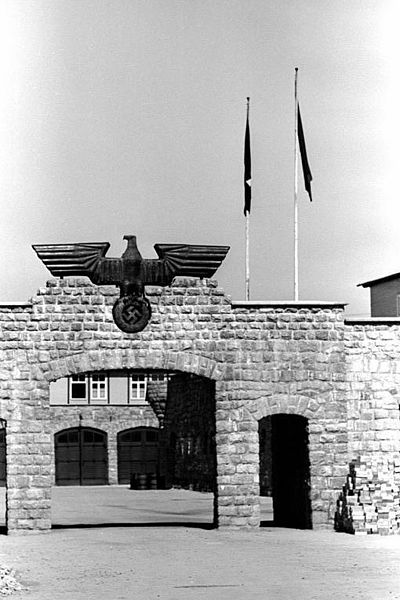
Attribution: Bundesarchiv, Bild 192-334 / CC-BY-SA

Mauthausen                     Attribution: Bundesarchiv, Bild 192-334 / CC-BY-SA

Thanks for joining me on the veranda. If you don’t know what I’m talking about, this post flows from a book review I did on Elie Wiesel’s Night, which can be seen here. But don’t wander off just yet.

I married into a family of holocaust survivors.

Being sufficiently narcissistic, I haven’t been able to avoid thinking of the profound impact this had on my life.  I am married to the most extraordinary woman in the universe [my apologies to all other women, I’m sure you’re someone else’s most extraordinary woman] by virtue of the strength of a man who wrestled his way to the top of a pile of corpses, bleeding profusely from multiple shrapnel wounds, clawing his way out of a pit, and cleaning the gashes with his urine. That man was married to a woman, tiny of body but colossal of mind, who was in the group force marched from Budapest to Mauthausen. After the war, they had a child–my mother-in-law. Yada-yada-yada. I have marital bliss.

Not being completely narcissistic, I’m reminded that every one of our lives have been shaped by strong people who lived through close calls. Each of us comes hither as a gift from men and women who passed through a hail of bullets that bore no name. Some, like my wife’s grandfather, were riddled by bullets bearing their name, and still refused to heed their deadly whisper.  Every holocaust survivor survived by a thin margin. Every battlefield veteran’s life is an execution order rescinded. Every prisoner of war was one germ away from an unmarked grave.

No pressure or anything, but that sounds like a heavy debt we  all bear.

Telling this story in greater detail is one of my bucket list tasks. It’s a project I’ve had on the back burner for far too long. There are several reasons for this. The most feeble of which is a hope to find the right timing. Sadly, there are so many such stories that I fear it will be lost amid a sea of sorrow.  Then there is my need to develop grace with language sufficient to do the story justice. In a way the two novels I have drafted, and whose mess I am now painstakingly trying to dance into shape, are practice exercises.  Wish me luck.

On the plus side, my wife’s uncle had the foresight to have her grandfather speak his story onto about 20 tapes before he died. With today’s technology, there’s no excuse for anyone’s life-altering story to go untold.  So I guess if there is a moral to my rambling post it’s this: don’t let anyone in your life with a spectacular story pass from this world without it being heard.

BOOK REVIEW: Night by Elie Wiesel

Night  (The Night Trilogy #1)Night by Elie Wiesel

My rating: 5 of 5 stars

Amazon Page

Nobel Prize Winner Elie Wiesel’s book, Night, tells his story as a boy caught in the Holocaust. A Jew from Sighet in Transylvania, Wiesel was evacuated from the ghetto as a teenager and shipped off to Auschwitz–later to be moved to Buchenwald.

At little over 100 pages, this thin book is tragedy distilled and condensed.

A few of Wiesel’s experiences stick with one because they are just so gut wrenching. One such story is about a woman in the train car who hallucinates fire and flames. Her insanity no doubt spurred by hearing of the massive crematoria. Her delusions were prophetic for all too many of those packed in that cattle-car.

Another key moment came after their train rolled into Auschwitz. Both Elie Wiesel and his father followed advice to lie about their ages, he to make himself older and his father to become younger. This got them both directed to the left; the people who would live for the time being– though they didn’t know that at the time.

The climactic portion of the book deals with the boy’s attempts to cope with his father’s severe illness. On the one hand, his father was all he had. On the other hand, he feared that he would not survive if he had to keep looking after the ill elder. Wiesel is quite frank about the dilemma that clouded his mind. His father’s death would make his own survival more likely. The guilt caused by these thoughts tormented him. This kind of guilt is a prevailing theme in genocide literature. It reminds me of Viktor Frankl’s comment in Man’s Search for Meaning in which he says that the sad truth survivors must live with is that, “the best of us did not return.”

I will end my review by suggesting that you read this book. It’s quick and–while not painless–insightful. I’d intended to ramble on with some personal experiences and observations, but have decided to make that its own post entitled <em>The Bullets that Bore no Name: or, the Burden we all Bear</em>.

If you’re just here for the Night review, thanks for visiting and Godspeed in your journeys through cyberspace.

If you’re at all curious about what I have to say, grab your mint julep and join me on the veranda. The veranda is this way.

View all my reviews

BOOK REVIEW: Bones of the Master by George Crane

Bones of the Master: A Journey to Secret MongoliaBones of the Master: A Journey to Secret Mongolia by George Crane

My rating: 4 of 5 stars

I’m a sucker for a tale of the sage next door. In an unwise world, it’s nice to believe that the wise exist, and that they walk among us. That they are not relegated to secluded retreats, but live in suburban subdivisions. In Bones of the Master a quirky Asian man drops in on his neighbor. The neighbor turns out to be the author of this book, poet George Crane. The visitor is Tsung Tsai, a Cha’an monk who trekked from Inner Mongolia to Hong Kong in 1959 in order to ensure the teachings of his monastery would survive.

The two men strike up a friendship, collaborating on poetry translation and eventually making a journey together back to Tsung Tsai’s home. The first part of the book tells of their meeting and describes Tsung Tsai’s 1959 journey to freedom. The second part deals with the two men’s mid-1990’s return trip. The monk’s ambitious plan is to find the bones of his master, cremate them, and relocate them in accord with the dictates of his religious tradition. He also wants to rebuild the temple that was razed by the Red Guard during the cultural revolution. As this is nonfiction, it’s not all happy endings. Not everything works out as they’d like it to. A brief third part tells of their return to the states with an interesting stopover in Hong Kong.

Much of the appeal of the book stems from how the monk’s worldview rubs off on the author. The monk assumes matter-of-factly that they will be able to sell the book for a sufficient advance to pay for the trip and a monument to his teacher. As one can imagine– particularly anyone who knows a bit about publishing– Crane is suitably skeptical, but ultimately buys into the plan. The monk often tells Crane that he worries too much. However, most of us would worry about these daunting challenges. For example, how to get a one ton statue from New York to Inner Mongolia, or–more importantly–whether the aged and ailing monk will be able to complete the trip alive.

There are tidbits of insight as well as poetry scattered throughout the book.

View all my reviews

BOOK REVIEW: Eclipse of the Crescent Moon by Géza Gárdonyi

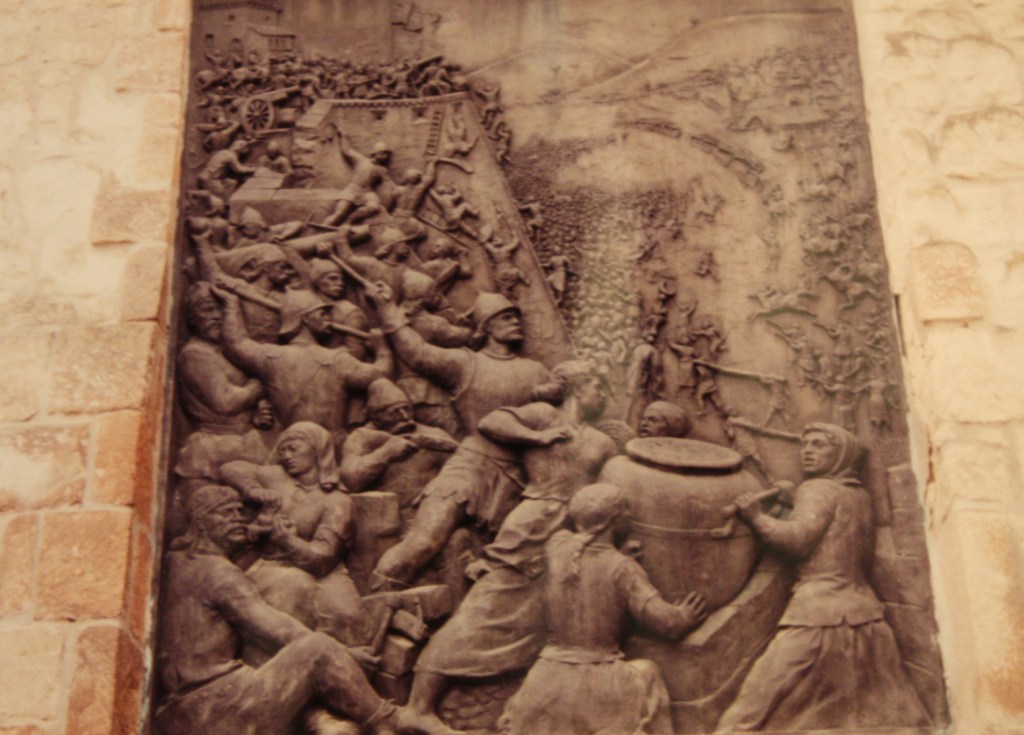
Bas relief of Siege of Eger

Bas relief of Siege of Eger

Eclipse Of The Crescent MoonEclipse Of The Crescent Moon by Géza Gárdonyi

My rating: 4 of 5 stars

This book is the English translation of a volume originally written in Hungarian and titled Egri Csillagok, i.e. “Stars of Eger.”

Historical fiction works best when the event it’s built around requires no fictitious embellishment to fascinate the reader. Eclipse of the Crescent Moon takes place during the 1552 siege of Eger. During this siege, 2,000 Hungarians held off at least 40,000 Turkish invaders for over one month. (In the book the Turks have a two order of magnitude advantage.) The Turks retreated despite having had superior armaments as well as a massive numeric advantage. It’s the perfect underdog story.

Reading a purely historic account would be interesting enough, but Géza Gárdonyi creates value-added by imbuing his characters with depth, particularly his lead Gergely Bornemissza. There wasn’t much known about Bornemissza. He was a minor character in history compared to Eger’s commander, István Dobó. However, his expertise in explosives did play a role in this Hungarian success story.

The book begins when Bornemissza is a young boy. He and a girl named Éva are captured by a Turk. The couple escapes and manages to free others. They later elope to avert Éva’s arranged marriage. They have a child who is later captured by the same Turk who had captured them.

A major subplot is a trip made to Istanbul in the heart of enemy territory to attempt to aid in the escape of Bornemissza’s  adoptive father.

The book is well translated and an engaging read.

View all my reviews

DAILY PHOTO: Grand Plaza, Tikal, Guatemala

Taken from Temple II

Taken from Temple II

The Grand Plaza comprises two temples towers that face each other, Temples I and II, the manicured courtyard between them, and these buildings off to the side. This photo is taken from atop Temple II.

I like to visit Mayan sites. As with Angkor, I feel that this is a good way to mentally prepare myself for the day our own civilization collapses.

Tikal was one of my favorite Mayan sites, mostly because it was the only large-scale site we could visit in peace. When we were at Chichen Itza, the hawkers were ubiquitous and weren’t above following one around. I don’t recall being bothered at Tikal at all.  Of course, it’s been a many years since I visited.

BOOK REVIEW: The Book of Five Rings by Miyamoto Musashi

A Book of Five Rings: The Classic Guide to StrategyA Book of Five Rings: The Classic Guide to Strategy by Miyamoto Musashi

My rating: 5 of 5 stars

Miyamoto Musashi is probably the most famous swordsman in Japan’s history. Oddly enough,he’s not known for his experience in battle(he lived at the tail end of the Warring States period and was only in a couple of battles), but for his time spent in musha shugyo (warrior’s errantry), during which he engaged in over 60 duels. It is The Book of Five Rings that largely accounts for his continued fame. That being said, Musashi was quite the renaissance man, a painter and sculptor of note. He also left behind a school of swordsmanship, Niten Ichi-ryū.

The Book of Five Rings is divided into five parts: earth scroll, water scroll, fire scroll, wind scroll, and void scroll.

The earth scroll provides an overview of martial science and an introduction to Musashi’s school, which is noted for its simultaneous use of both the large and short sword. A section is devoted the rhythm of martial arts, a crucial topic. It also includes what might be considered Musashi’s 9-point budō kun (a list of warrior precepts.)It’s worth mentioning a couple of these.
#7 Become aware of what is not obvious.
#9 Do not do anything useless.

The Water scroll describes Musashi’s approach to swordsmanship. It covers a range of elements of a martial art including footwork, the focus of one’s eyes, physical posture, mental posture, techniques,kiai (spirit shout), and approaches to cutting and thrusting.

The Fire scroll deals with the strategic or interactive aspects of the battle. Among my favorite quotes from this scroll is, “If your own power of insight is strong, the state of affairs of everything will be clear to you.”

The Wind scroll teaches us about other martial arts. Musashi discusses martial arts that use an unusually long sword, an atypically short sword, that focus on powerful strikes, and those that focus on many rapid strikes. He contrasts other martial arts with his own on subjects such as their focus with the eyes and their footwork.

The void scroll deals with, well, emptiness.

Musashi had great insight into strategy from his career of dueling. His book is worth being read and reread.

View all my reviews

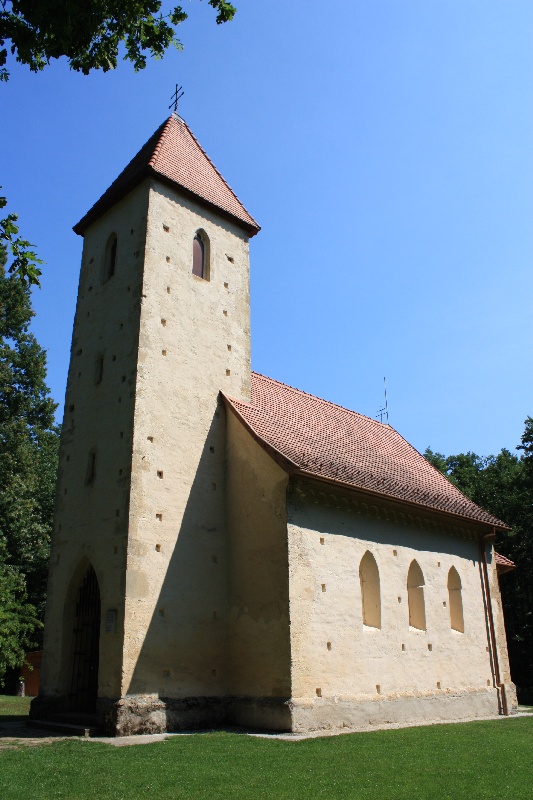
DAILY PHOTO: Chapel in Velemér, Hungary

Árpád era chapel

Árpád era chapel

This chapel sits on a solitary plot at the edge of a woods near Velemér. Velemér is a tiny village in the Őrség, which is a region on Hungary’s western border. The church dates back to 1360. The inside is covered with murals that have been restored after having been plastered over due to religious restrictions in the 18th century. The church had to be extensively repaired in the 19th century as a result of deterioration from the late 18th to early 19th century, but is now well-maintained.

DAILY PHOTO: Old Town of Tallinn, Estonia

Looking over the old town toward the Gulf of Finland

Looking over the old town toward the Gulf of Finland

The Estonian capital is a study in contrasts. The old town is medieval, yet fully wired for wi-fi. While it’s historical, it’s not one of those highly homogenized historical districts. The colors are varied and vibrant. One can see the iconic, silo-shaped towers and the steeples from many churches. In the background sit the cruise ships at port. The port is one of the vestiges of the Soviet era, a concrete monstrosity that will be built over soon enough– if it hasn’t been already. Outside the historic district, modern glass and steel buildings are shooting up all over. In the old town one spies the trappings of wealth; just outside it one witnesses poverty.

Where in the World Photo Game #10

WitW #9 (Stockade marker) was at Andersonville, Georgia (an infamous Confederate Civil War Prison.)

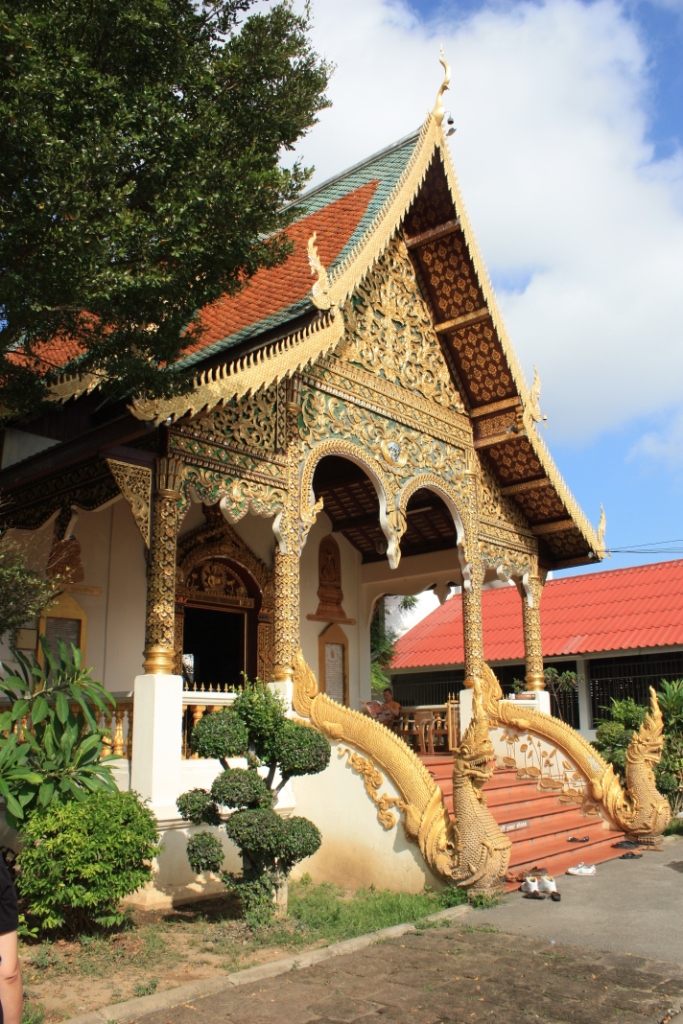
Here’s one for those who know their religious architecture.

Where Was I?

Where Was I?