BOOK REVIEW: Superhuman by Rowan Hooper

Superhuman: Life at the Extremes of Our CapacitySuperhuman: Life at the Extremes of Our Capacity by Rowan Hooper
My rating: 4 of 5 stars

Amazon page


There are mounds of books out on the science of maximum human performance, be they on mind-hacking, sports & exercise science, or some combination thereof as applied to a particular pursuit. Hooper creates his niche by way of a broad and varied selection of topics, including: language learning, singing, running, achieving longevity, and sleeping. For the reader who is interested in the topic of how top performers in a given domain achieve that supernormal performance, it makes for an interesting read. However, it may leave some readers scratching their heads as to who the book is aimed at. It should be noted that several of the topics addressed are of much more broad-ranging appeal than those I mentioned (e.g. focus / attentiveness, bravery / courage, and resilience.)

The book is divided into three parts on “thinking,” “doing,” and “being,” respectively. The four chapters in the first part investigate the heights of intelligence, memory, language, and focus. The chapter on language deals with how some people are masterful polyglots, speaking many languages, as opposed to the harder to investigate question of how someone becomes William Shakespeare. Throughout the book, there is a mix of stories and interview insights from those who are peak performers as well as discussion of what scientific studies have found. The former makes up the lion’s share of the discussion, and the central question with of science is how much of peak performance is genetic and how much is built.

Part II, on doing, has three chapters, exploring the topics of bravery, singing, and running. This is where one really sees the book’s diversity. Books like Amanda Ripley’s “Unthinkable” address the question, among related questions, of why some act heroically, and there are a huge number of books on how to be the best runner or singer one can be, but not a lot of books take on all three questions in one section. The book on singing focuses on opera singers who belt out their tunes largely sans technology – i.e. there’s no Milli-Vanilli-ing L’Orfeo. The chapter on running gives particular scrutiny to endurance running.

Part III investigates why some people live longer, are more resilient, sleep better (or do well with less sleep,) or are happier. Since Buettner’s “National Geographic” article on “blue zones” (i.e. places where a disproportionate percentage of the population live well beyond the average human lifespan,) there’s been a renewal of interest in what science has to say about longevity. As mentioned, the chapter on sleep covers the topic from multiple vantage points. Everyone needs sleep, but some perform best with ten or more hours of sleep while others are extremely productive on four hours a day, and some can cat-nap periodically through the day while others need a single extended and uninterrupted period of sleeps. Wisely, Hooper doesn’t simply take on the question of why some people are happier than others in the book’s last chapter, but rather he asks the more interesting question of why some people who have every reason to be morose (e.g. paralyzed individuals) manage to be ecstatically happy.

The book has a references section, but there isn’t a lot of ancillary matter (i.e. graphics, appendices, etc.) It’s a text-centric book that relies heavily on stories about Formula-1 racers, opera stars, ultra-marathoners, and other extraordinary individuals while investigating the subject matter.

I enjoyed this book. I am intensely interested in optimal human performance across a range of skills and characteristics. So, I guess when people inevitably ask who the book is directed at, it’s directed at me and others with this strange fascination. If you have that interest, it’s for you as well.

View all my reviews

BOOK REVIEW: Psilocybin: Magic Mushroom Grower’s Guide by O.T. Oss & O.N. Oeric

Psilocybin: Magic Mushroom Grower's Guide: A Handbook for Psilocybin EnthusiastsPsilocybin: Magic Mushroom Grower’s Guide: A Handbook for Psilocybin Enthusiasts by O.T. Oss
My rating: 4 of 5 stars

Amazon page


This booklet, at around 80 pages, offers step-by-step guidance about how to grow mushrooms – specifically psilocybe cubensis, which are referred to as stropharia cubensis throughout this book. (The book was published in the 1970’s and the mushroom has since been reclassified.) This species is known to induce hallucinations, euphoria, and altered perception in those who ingest it because of the presence of psilocybin, which – converted to psilocin — interacts with serotonin receptors. Most of the information presented could be applied to cultivation of any mushroom (excepting information about identification in Ch. 1, which applies to that one species, and the information about dosage in Ch. 5 that doesn’t matter for edible mushrooms.) The authors did specifically develop this process, but I think that had more to do with the need for a process in between the vagaries of foraging and the large-scale agricultural approach that couldn’t be exploited for the “hobbyist,” than it had to do with the specific needs of this fungi.

The body of the book is divided into five chapters, which follow the progression of steps required to cultivate mushrooms. The first chapter covers locating and identifying psilocybe cubensis as well as how to collect and germinate the spores. The second chapter is about growing mycelial cultures on sterile agar. One of the major challenges presented in the book is keeping mold and other undesirable species from growing on or amongst one’s mushrooms. In the third chapter one learns how to grow the mycelia on sterilized rye. The penultimate chapter explores covering the mycelia infused rye with soil in a process that commercial fungi agriculture calls “casing,” which ultimately results in the generation of the fruiting bodies that we traditionally think of as mushrooms (though in the wild most of the organism is below ground.) The last chapter is about harvesting the mushrooms, preserving them, and determining dosage.

There is a substantial amount of front and back matter book-ending the aforementioned chapters. The front matter gives the reader some history of psychedelic mushrooms as well some insight into their effects. (The Preface and Forward are explicitly written by Terrence McKenna, but it’s said that the entire book is written by McKenna and his brother, Dennis.) The Forward and Introduction are where the book feels less like an agricultural how-to manual, and more like a guide to psychedelics, but the reader should be aware that this book is – first and foremost – a how-to guide. The back matter includes a range of helpful appended sections including a glossary, a bibliography, a timeline of psilocybin mushroom happenings, and a section to help one make conversions — particularly between volume and weights for various materials that are used in cultivation.

There are many graphics employed throughout the book. Most importantly, there are several series of black-and-white photos that help clarify the process being described textually. There are also some line-drawn artworks that depict psychedelic mushroom in their cultural context – both in the ancient shamanic tradition and the more recent wave of use.

This is a quick read that gets into all the processes needed to cultivate mushrooms. The authors compare it to canning preserves in terms of the degree of complexity. (That rings true as both processes rely heavily on sterilization.) It is a how-to guide, and if one isn’t interested in the process of cultivation, one might find the book a bit dry. I found it interesting to learn about the cultivation process as well as the information from the Forward, Introduction, and Chronology about psychedelics, specifically. If you’re interested in cultivating mushrooms or are very curious about fungi, I’d recommend this book.

View all my reviews

BOOK REVIEW: The Sonnets of William Shakespeare by Wm. Shakespeare

The Sonnets of William Shakespeare (Wisehouse Classics Edition)The Sonnets of William Shakespeare by William Shakespeare
My rating: 5 of 5 stars

Amazon page


This book consists of 154 sonnets that were published in a quarto dated 1609. It’s not all of the sonnets written by Shakespeare because there were a few stashed in his plays. It’s also not the entire contents of that 1609 quarto, which also included a long-form narrative poem entitled “The Lover’s Complaint.” However, these are the poems typically included in collections of Shakespearean sonnets.

For those unfamiliar with the sonnet, it’s a 14-line poem that’s metered and rhymed. In English language sonnets (and Shakespeare’s, in particular) that metering is iambic pentameter (five feet of alternating unstressed and stressed syllables.) Shakespeare’s sonnets follow a rhyme scheme that is often named for him: ABAB CDCD EFEF GG. (It’s also called English Rhyme, and is differentiated from Petrarchan Rhyme which has an octave of ABBA ABBA and a sestet that can vary, e.g. CDCDCD.) As with all rules of poetry, there is the occasional exceptions taken here and there.

Love, beauty, and death are common recurring themes in the sonnets, but there are occasional forays into tangential topics like lust, infidelity, and immortality through poetry. There are also humorous twists on the expected approach. The most famous Shakespearean sonnet is probably 18 “Shall I compare thee to a summer’s day?”, but we see in another popular contender, Sonnet 130 (“My mistress’ eyes are nothing like the sun;”), Shakespeare mocking hyperbole. Of course, he’s not just mocking hyperbole; he’s also saying that he can still love his lover despite the fact that she isn’t in all ways more beautiful than the most pleasing elements of nature (and might even have halitosis.)

There’s no division or formal organization of the sonnets. However, scholars do divide them up in various schemes. One simple way that they are divvied up is to put the first 126 in a category in which Shakespeare addresses a young man. The first 17 sonnets are a subgroup in which the poet attempts to convince the young man to be fertile and multiply. Sonnets 127 – 154 are sometimes called the “Dark Lady” (a.k.a. “Black Mistress”) sequence as they frequently refer to a brunette woman (i.e. the woman whose lips are not as red as coral in Sonnet 130.) One can see the difference in tone extremely contrasted in the two poems mentioned in the preceding paragraph – Sonnets 18 and 130.

Besides the aforementioned sonnets, a few others stand out as personal favorites:
– 55 “Not marble, nor the gilded monuments”
– 27 “Weary with toil, I haste me to my bed,”
– 1   “From fairest creatures we desire increase,”
– 65 “Since brass, nor stone, nor earth, nor boundless sea,”

But you should read them and find your own favorites. It’s Shakespeare, of course they are highly recommended.

View all my reviews

BOOK REVIEW: The Electric Kool-Aid Acid Test by Tom Wolfe

The Electric Kool-Aid Acid TestThe Electric Kool-Aid Acid Test by Tom Wolfe
My rating: 5 of 5 stars

Amazon page


This book offers an account of the activities of Ken Kesey and the Merry Pranksters during the mid-1960’s. Kesey is best known as the author of “One Flew Over the Cuckoo’s Nest,” a best-selling novel that was adapted into an Oscar-winning film starring Jack Nicholson. The charismatic Kesey led a group of nomadic hippies who came to call themselves “the Merry Pranksters.” There were many counter-culture strains during those years. Some looked East, and pursued spiritual traditions like yoga and Zen. Some were academics who sought to maintain scholarly rigor in adventures through the doors of perception. Kesey and the Merry Pranksters occupied more whimsical territory. As the “prankster” name suggests, taking things seriously wasn’t their way. Their mythology was in comic book superhero tales, and their moral code hedonistic. The titular prank had to do with spiking Kool-Aid with LSD (a.k.a. Acid) – not to be confused the Jim Jones cult which poisoned Kool-Aid and engaged in collective suicide over a decade after the events described in this book took place.

LSD plays a major role in the events of this book. While it’s not mentioned in Wolfe’s book, an interesting thing to note is that Kesey was introduced to hallucinogens through a program funded by the CIA’s nefarious MK-Ultra program. Kesey was working as an Aide at the Menlo Park Veterans’ Hospital, and he volunteered for a study on the effects of a number of psychoactive / hallucinogenic drugs. It seems that Kesey took a shine to these substances (most notably LSD) because he kept pursuing psychedelic experiences long after the study was over and even after he’d run afoul of the law (though his arrests were marijuana-related and not about hallucinogens.)

Tom Wolfe used beat-poetic prose to convey the feel of Merry Prankster life. There are even a few free verse poems in the book as well. And, of course, the dialogue conveys the tone of this community. The language is often fun and trippy in a way that contributes to the story. Wolfe put an author’s note amid the book’s back matter that explains his desire to not only tell people about the events but to convey the atmosphere, and I felt he did a nice job in that regard.

The central story hinges on Kesey faking his death (not skillfully) and fleeing to Mexico to evade punishment on his initial marijuana charges, and then — after some time in Mexico — he returned to the US, ultimately doing his time. Over the course of the book, the Pranksters develop a rapport with the Hell’s Angels, they cross paths with the likes of Beat giant Allen Ginsberg and the founders of the Grateful Dead. While it’s nonfiction, and thus not meant to follow a story arc approach beat for beat, Wolfe does tie things up with a nice bow, ending with the Prankster “Graduation” which would see the end of that group before Kesey went off to serve time on his combination of marijuana and evading justice charges. We see a change in Kesey in the last couple chapters as he’s advocating pursuit of the psychedelic state of mind without the use of drugs. It’s hard to say how much of this is trying to cooperate to get better terms, how much it was just growing up, and how much it was a true change in his core beliefs.

I enjoyed this book. It’s fun to read and offers insight into an era with which I wasn’t particularly familiar. I’d only known Kesey from his blockbuster book and a vague reference to his being a participant in a MK-Ultra funded program, and so it was interesting to learn about the intriguing life of this author.

View all my reviews

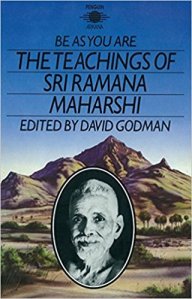
BOOK REVIEW: Be As You Are ed. by David Godman

Be As You Are: The Teachings of Sri Ramana MaharshiBe As You Are: The Teachings of Sri Ramana Maharshi by Ramana Maharshi
My rating: 4 of 5 stars

Amazon page


In the early days of yoga, before there was Power Yoga or Yin Yoga — or even Hatha Yoga or Raja Yoga, there were three approaches to yoga. Bhakti yoga was devotional yoga, the yoga of the believers who pursued the path through worship. Karma yoga was the yoga of action: practiced by doing selfless deeds. Jnana yoga, often said to the hardest, was the path of knowledge, and it involved intense study and – in particular – introspective study of the jnani’s own mind. Sri Ramana Maharshi was one of the most well-known Jnana yogis of modern times (he lived from 1879 to 1950.)

This book presents Sri Ramana’s teachings in a question and answer format. The editor, David Godman, begins each chapter with an overview of Ramana’s views on the subject at hand, and he then launches into the Q&A exchange that makes up most of each chapter. The preludes are beneficial not only because they set up the topic, but also because they help separate Ramana’s core beliefs from the way he occasionally explained matters to non-jnani’s or those who weren’t ready to grasp what he believed was the fundamental teaching. (There’s a fair amount of, “Until you realize the self, X is true, but after you achieve self-realization Y will be true.)

Sri Ramana’s central teaching is that the jnani must actively inquire about the nature of the true self (a practice called atma-vichara, or self-inquiry.) As such, the book is organized as a guide to building a practice of self-inquiry.

The book’s 21 chapters are divided among six parts. The first part investigates the self as Sri Ramana refers to it. This isn’t the individual self that one is normally referring to in common speech. Part II is entitled “Inquiry and Surrender” and three out of the four chapters, herein, discuss the process of self-inquiry. Three chapters may sound like a lot, but this practice really is the core of jnana yoga. These chapters not only explain how self-inquiry is done and what it’s supposed to achieve, they also contrast the practice with others that bear a resemblance to atma-vichara, such as reciting “Who am I?” as a mantra, as well as, neti-neti — an exercise in negation in which one considers all the things that aren’t the self (e.g. “I am not my body.” “I am not this thought,” etc.)

Part III is about Gurus and transmission of teachings. It takes on such questions as: is a Guru necessary, and what constitutes a Guru (i.e. must it be a living human? Can it be a book?) The second chapter in this part is about sat-sang, which may be literally translated as “sitting with the guru,” but refers to a kind of transference that flows from being together.

Part IV is on meditation and yoga. Sri Ramana differentiates self-inquiry from meditation, though superficially they seem to be similar activities. He discusses dharana (concentration) and mantras in these chapters as well. One inclusion that may seem unrelated to the general theme is chapter 12, which is about the four-stage model of life called the asramas (student, householder, hermit, ascetic.) The chapter on yoga is about the eight limbs of yoga described by Patanjali, and their relevance to the practice of Jnana yogi. It should be noted that Ramana downplays the importance of these practices to the jnana yogi (a.k.a. Jnani) with the exception of pranayama (breathing exercises.)

Part V discusses samadhi, siddhi (supernormal psychic powers that some yogis believe can be achieved), and other challenges and phenomena that may be experienced during one’s practice of self-inquiry. While superpowers sound cool, Sri Ramana (as well as Patanjali) warned against he pursuit of these abilities as they become distractions from obtaining self-realization.

That last five chapters are grouped under the title of “Theory.” These chapters deal in the big “meaning of life” kind of philosophical questions. Much of these chapters consist of Ramana telling the interviewer to stop over-intellectualizing about obscure philosophical matters and start asking oneself who is asking the question (in other words, get back to self-inquiry and forget about abstract navel-gazing.) At any rate, the questions include: was the universe created, and – if so – how? is reincarnation real? what is the nature of god? is karma real? is free will real? etc. They are fascinating questions, and Ramana offers a few intriguing ideas, but mostly discounts the value of philosophizing.

There are no graphics in this book, but there is a glossary, notes, and a bibliography.

I found this book to be thought-provoking. At times it can be a bit repetitive. The key point that Ramana sought to get across is (in theory, not practice) straightforward. At times it seems like the questioner is badgering the witness because he doesn’t like the answer, such as when Godman wants Sri Ramana to elaborate on the nature of suffering and the need for compassionate acts. Ramana keeps telling Godman to just go back to self-inquiry and all will take care of itself. That said, Sri Ramana offers some fascinating thoughts, and generates beautiful food-for-thought.

I’d recommend this book for anyone who wants to know more about jnana yoga or to get a different take on the philosophy of yoga in general.

View all my reviews

BOOK REVIEW: Edgar Allan Poe: The Fever Called Living by Paul Collins

Edgar Allan Poe: The Fever Called LivingEdgar Allan Poe: The Fever Called Living by Paul Collins
My rating: 4 of 5 stars

Amazon page

Edgar Allan Poe is one of the most intriguing writers in American literature. His short life (he died at 40) was productive and inventive. He’s often credited with the invention of the detective story (i.e. “Murders in the Rue Morgue”), and was prolific as a writer of stories, poetry, and criticism. We know him for macabre tales like “Tell-Tale Heart” and the poem, “The Raven.” Few authors invoke such a benighted image.

Yet the popular image of Poe is a bit of a dark caricature, reflecting truths but exaggerating features for effect. Part of this exaggeration probably owes to our collective desire to romanticize the tortured artist – and Poe is as tortured as they come. However, some of the exaggeration of Poe’s faults owe to the fact that he was a harsh critic, and at least one of the authors who felt the sting of his pen found an opportunity to amplify the “drug-addled lunatic” aspect of Poe’s nature in a biography after the great author’s death. That’s not to deny that Poe had an addictive personality. He was both an alcoholic and prone to gambling away whatever funds graced his pockets.

This short biography (less than 150pp.) gives one insight into Poe’s life from birth to death in five chapters. The first of these chapters describes Poe’s childhood, which was marred by the death of his mother, abandonment by his father, and being taken in — but not adopted — by a foster couple. Granted the foster couple was wealthy, but Poe’s foster-father could be a harsh man and the uncertainty of not being formally adopted seemed to have weighed on Poe’s mind.

The middle chapters give special attention to Poe’s life as a writer, noting under what circumstances he was published, starting with a self-published chap book and moving through to becoming one of America’s great men of letters (though he never made enough money to live in comfort.) Poe famously married a cousin who was very young (though of legal age) at the time, and we get some insight into that relationship, which ended not terribly long before his own death. The last chapter gives the details of Poe’s demise.

I found this book interesting and educational. Collins neither gets lost in the minutiae nor give’s Poe’s life short shrift, and it feels as though he reveals the true Poe and not the T-shirt version. I would recommend this book for fans of Poe’s work and for those who are interested in the literary history of America.

View all my reviews

5 Books About the Mental Side of Yoga


5.) Be As You Are: The Teachings of Sri Ramana Maharshi: This book, which is presented in Q&A format, explores Sri Ramana’s approach to Jñāna yoga, and explains atma-vichara, the exercise of self-enquiry that Ramana proposed was the key to self-realization.


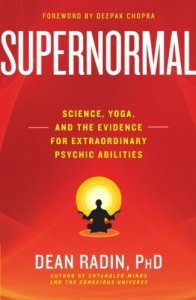
4.) Supernormal by Dean Radin: Okay, this is an unconventional choice for the list but bear with me. (I mostly included it because I like to have an under-the-radar entry in these lists, and this seems like one that could have been missed readers of works on yoga.) Radin is a paranormal researcher who, in this case, has investigated the topic of siddhi, which are the controversial powers that Patanjali discusses in the third section of The Yoga Sutras, but which many deny are real.


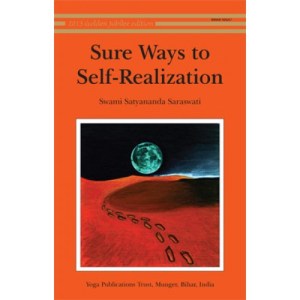
3.) Sure Ways to Self-Realization by Swami Satyananda Saraswati: This is the Bihar School of Yoga guide to meditation, and it covers both yogic meditation methods and those from other disciplines (e.g. Buddhism, Taoism, Western / scientific [e.g. biofeedback], etc.) By “meditation,” here I mean more than dhyana. This book uses the word in a broader and more colloquial sense that includes some practices that are normally considered pratyahara (withdrawal of senses) or dharana (concentration.)


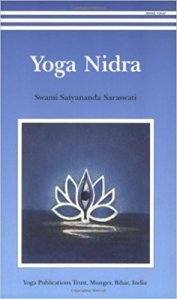
2.) Yoga Nidra by Swami Satyananda Saraswati:  Yoga Nidra (yogic sleep) is a sustained hypnogogic state — i.e. the state of mind on the edge between wakefulness and falling into sleep. It is used both as an intense relaxation exercise as well as to access the subconscious to plant seeds therein.


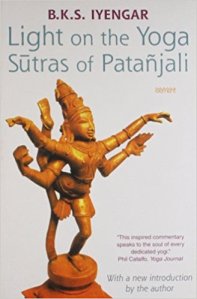
1.) Light on the Yoga Sutras of Patanjali: (Sutras by Patanjali with commentary by B.K.S. Iyengar): This isn’t — strictly speaking — only about the mental side of yoga, but, in the Sutras, Patanjali makes clear that yoga is a tool to advance mental calm and clarity. There are many translations and commentaries available. Commentaries are useful because the 196 sutras are extremely sparse. Iyengar’s book is probably one of the most approachable translation / commentaries for a modern reader.

BOOK REVIEW: Notes from Underground by Fyodor Dostoevsky

Notes from UndergroundNotes from Underground by Fyodor Dostoyevsky
My rating: 4 of 5 stars

Amazon page


This novella is divided into two uneven parts. The first part consists of eleven chapters of floating head philosophizing by an old man about all manner of topics loosely connected by a cynical outlook. The most prominent topic is consciousness and how it’s a curse upon mankind – for the more one has of it the more one is trapped in a dead-end life. (Presumably what Dostoevsky meant by “the underground.”) One really has to be interested in philosophy to get through the first part, which is about 1/3rd of the book, because there is no story and nothing in particular to make one interested in the monologuing old man’s life or thoughts. However, it’s considered the first existentialist novel, and is considered important on that grounds, and the philosophy is thought-provoking now and again.

It’s in the second part that the book gets interesting. In this part, we get a flashback to the narrator’s life as a young man and the events that presumably shaped the cynical philosophy that he’d rambled on about in the first part.

One can subdivide the second part into three subsections that each get more extensive and more interesting in turn. In the first section, the narrator tells about how he became irritated that there was an alpha male military officer who would walk boldly down the sidewalk and everyone would get out of his way. The narrator is ashamed that he consistently got out of the man’s way, himself. Since there was no rule that this man was owed the right-of-way, the narrator devises a plan to play chicken with the man. This may seem like a silly and sad little story, but it gives insight into the man’s state of mind. There are shades of “Fight Club” in this book, as the narrator feels emasculated by society and modernity. He’s a coward, but a proud coward who believes the world is ruled by fools, while men of intellect – such as himself – are trapped in the underground. He also has a masochistic ambivalence about pain and suffering.

The second and third sections flow together from a solitary event. The narrator runs into an old acquaintance from school, Zverkov, and invites himself to Zverkov’s going-away party dinner. However, neither Zverkov nor his chums particularly care for the narrator. There is a tension not only because they are of a higher status, but because the narrator has a chip on his shoulder about it. The narrator feels himself the superior man, and his self-invitation to the party is in a way another act of playing a game of chicken with those who are de facto superiors. His low-income post, combined with his feelings of superiority, compels him to assert himself to no good end.

When Zverkov and his pals slip away, in part to continue their festivities and in part to get away from the narrator, the narrator pursues them to the brothel they’ve taken their boy’s-night-out to. This is where the third part begins when the narrator ends up sleeping with Liza, a young prostitute. After the deed, the narrator rambles on about how she should get out while the getting is good, engaging in moralistic diatribe. Before leaving, he gives her his address card. Over the next several days, he swings between fears that she’ll actually show up to his shabby abode and fears that she won’t. His feelings for Liza bounce between whipping post and object of affection. And, being a classic unreliable narrator, the reader is left to guess as to the weight of those competing feelings.

Once one gets into the second part, this book becomes intriguing. The lead character would, at best, be classified and anti-hero. There’s nothing likable about him, but still one wonders how events will unfold. The first part offers the occasional bit of food-for-thought, but isn’t a compelling read for those who didn’t major in Philosophy. Even most Philosophy majors will find it needlessly cynical – if interesting. Still, it’s worth reading, and, hey, it’s really short.

View all my reviews

BOOK REVIEW: Bodyweight Strength Training Anatomy by Bret Contreras

Bodyweight Strength Training AnatomyBodyweight Strength Training Anatomy by Bret Contreras
My rating: 4 of 5 stars

Amazon page

This book combines a calisthenics manual with the anatomical drawings and descriptions necessary to explain the muscle activations involved in each exercise. It takes a very straightforward approach, being organized by body part. Each chapter discusses the component muscles of said part and their unique features, and then gives a series of exercises to work said part. For each exercise, at least one anatomical drawing is provided, showing the primary and secondary muscles being worked in the exercise. In some cases, more than one drawing is needed to convey the full range of motion of the exercise, but in many cases one drawing is sufficient. Each exercise also receives a brief bullet-point description of the action, a textual list of muscles utilized, and notes on issues and cautions to keep in mind to get the most out of the exercise.

Chapter 1 sets the stage for the rest of the book. It discusses general principles to be kept in mind like the need to balance opposing muscle groups, and it also lays out the advantages and limitations of calisthenics, or bodyweight, workouts over other approaches to fitness. Like a number of other calisthenics’ books, this one emphasizes the advantage of not necessarily needing any equipment. In other words, with a little creativity and some quality doors, robust furniture, or park access, one can do all of these exercises without either a gym membership or costly trips to the sporting goods store. Of course, one does need sturdy stationary objects to pull against, particularly to maintain a balanced upper body. What I like about this book more than some others I’ve read is that it emphasizes the need for safety in taking the equipmentless approach. I’ve cringed before in seeing some of the improvised set ups that have been jury-rigged as examples in other calisthenics manuals, but this book uses stout furniture and rafters to get the point across.

Chapters 2 through 9 each focuses on a particular body part, including (respectively): arms, neck and shoulders, chest, core, back, thighs, glutes, and calves. Each chapter starts with some general information on muscle action before launching into the exercises. If you have a particular interest in developing your glutes (i.e. your butt, your backside), then this is definitely the book for you. The author specializes in glutes, and while there are about a typical number of exercises for that musculature, the background information up front is more extensive than for most of the other chapters. For many of the exercises, the author proposes regressions and progressions — that is, easier and harder variants of a fundamental for those who either aren’t up to the basic yet or who need a harder version to challenge them.

The penultimate chapter, Ch. 10, presents whole-body exercises (e.g. burpees, mountain climbers, etc.) and discusses the benefits of including such exercises in one’s workout regimen. Included in this chapter is an introduction to both high-intensity interval training (HIIT) and to Metabolic Resistance Training (MRT.)

The final chapter offers an overview of all the factors to keep in mind when arranging exercises into a program (e.g. number of sets, repetitions per set, and how such considerations are varied depending upon one’s goals.) There’s a lot to consider when putting together a workout regimen, including: the necessary rest periods, balancing one’s workouts to avoid structural imbalances, and how to vary one’s approach depending upon one’s individual goals. A section on exercise for fat loss is included, which is important not only because there are so many people interested in that subject but also because there is so much misinformation out there.

As mentioned, most of the graphics are anatomical drawings showing the muscles in cut-away as the action of the exercise is being performed. There are a few other graphics to help clarify information, as well as tables in the last couple chapters to present information in an organized and easy to use fashion.

I found this book to be informative and well-organized. It’s a straightforward presentation of the skeleto-muscular action involved in various calisthenics exercises. If that’s what one is looking for, or even if one is just looking for a guide to bodyweight exercises, this book will meet your needs.

View all my reviews

5 of my Favorite Banned / Challenged Classics

Banned Books Week runs from September 23 to 29 in 2018, offering a nice reminder about all of the books that are so awesome that some doofus doesn’t want you to read them.

Here are five of my favorites:

5.) One Flew Over the Cuckoo’s Nest by Ken Kesey: Randle McMurphy conducts a con to convince authorities that he’s insane and belongs in an asylum rather than doing hard time in a prison. It’s a commentary on how free-spirits are viewed by society and the pressures put upon them to conform. It’s been challenged many times on the usual grounds of sex and language, as well as for the “glorification of criminal activity.”

4.) A Clockwork Orange by Anthony Burgess: In a dystopian England, the head of a small band of thuggish teenagers is imprisoned and convinced to undergo operant conditioning that will make any future attempts to engage in violent behavior personally painful. The book is a critique on social engineering, though it should be pointed out that there are two different versions of the book in circulation, one with the final chapter written by the author and one without it, and the inclusion or deletion of that chapter has serious implications for the book’s message. Instances of sex and violence are the usual basis for challenges to this novel.


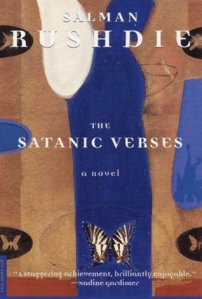
3.) The Satanic Verses by Salman Rushdie: Two men fall from a plane and survive, one archangel and one demon. The title of the book, and much of its controversy, is owed to a plot point about the Islamic prophet Muhammad (Mahound, in the book) receiving both angelic and demonic guidance and prophecy. This is the most explicitly banned book on the list with at least a dozen countries explicitly banning it — most of them were Islamic countries offended by the portrayal of events when Islam was first coming into existence, but a few banned it out of public safety fears over extremist activity. The author is under Fatwa, religious approval of Rushie’s execution, by Iranian authorities.

2.) Brave New World by Aldous Huxley: In this soft dystopia, people are kept in line by readily available drugs and promiscuous sex. Among the American Library Association (ALA) list of challenges to this book was one suggesting the book be banned because it: “makes [promiscuous] sex look like fun.” Which made me laugh a little.

1.) The Grapes of Wrath by John Steinbeck: A family, bankrupted by the one-two punch of the Dust Bowl and Great Depression, packs up and heads out to the promised land of California, only to discover that it wasn’t all that it promised. Objection to language is the most prevalent cause for challenges to this book.