BOOK REVIEW: Why We Sleep by Matthew Walker

Why We Sleep: The New Science of Sleep and DreamsWhy We Sleep: The New Science of Sleep and Dreams by Matthew Walker
My rating: 4 of 5 stars

Amazon page


For a long time, the questions of why we sleep and dream remained unanswered — or answered speculatively in ways that proved without merit. One presumes the reasons are potent because there seems to be little evolutionary advantage in spending a third of one’s life unconscious of one’s environs and paralyzed (literally in REM sleep, but for all intents and purposes in NREM sleep as one can’t respond to changes in the environment without some part of one’s brain taking note of said changes.) The good news is that Matthew Walker’s book offers insight into what scientists have learned about why we sleep, why we dream, why we become so dysfunctional without doing both, and what it is about modern life and its technologies that has created an apparent crisis of sleep loss. Walker goes beyond the science to discuss what individuals and institutions can do to reduce the harmful effects of sleep deprivation.

The downside of this book is that it’s a bit alarmist, and in contrast to many books of this nature one doesn’t get a good indication of the quality of studies reported. Some pretty brazen claims are made and the reader doesn’t necessarily know if they are preliminary and unvalidated or if they are well established. Here, I’m speaking about the studies that try to isolate out the effect of sleep loss versus all other factors (which is a notoriously messy affair,) and not so much studies that report on the physiological effects of sleep and sleep loss (which I see less reason to not take at face value.) At any rate, any reader who doesn’t fall asleep as soon as his head hits the pillow and sleep straight through 7 hours and fifty-five minutes — waking 5 minutes before the alarm — is likely to feel doomed if they take this book too seriously. And if you ever engaged in shift-work (as I have) or had an intense travel schedule, you are likely to feel that your life is permanently and irretrievably wrecked.

I know this is a book on sleep, but I think it went a little too far in marginalizing all other elements of health and well-being. Walker said that he used to tell people that sleep, nutrition, and exercise were the trifecta of good health, but he ultimately concluded that sleep was more important because diet and exercise were adversely impacted by sleep loss. I don’t disagree that diet and exercise are harmed by sleep loss, but – of course – sleep quality is harmed by lack of proper diet and exercise as well. The author later discusses research confirming this two-way street. I, therefore, have no idea why he changed his initial balanced and reasonable view with one that suggests sleep is the 800-pound gorilla of health and well-being.

The book’s 16 chapters are divided into four parts. Part I (Ch. 1 – 5) lays out what sleep is, how rhythms of sleep are established / disrupted, how much sleep one needs, and how one’s sleep needs change throughout the course of one’s life. Part II (Ch. 6 – 8) explores the benefits of sleeping as well as describing the nature of the damage caused by lack of sufficient sleep. Part III (Ch. 9 – 11) shifts the focus to dreams, and delves into what they appear to do for us. The final part (Ch. 12 – 16) investigates the many ways in which modern life disrupts sleep from blue light in LED’s to arbitrary school and work schedules to cures that are worse than the ill (i.e. sleeping pills.)

There is an appendix that summarizes twelve key changes that an individual can make to get more and better sleep. There are graphics throughout the book, mostly line-drawn graphs to provide visual clarity of the ideas under discussion.

I found this book interesting and informative. I would recommend it for anyone interested in the science of sleep or how they might sleep better, with the exception of anyone who has anxiety about the state of his or her health and well-being. While I understand that Dr. Walker wants to drive changes regarding views and policies that have been wrong-headed or deleterious regarding sleep, I feel he went too far toward suggesting the sky is falling for anyone who gets less than a perfect night’s sleep every night of his life.

View all my reviews

BOOK REVIEW: Collected Poems by W.B. Yeats

Collected PoemsCollected Poems by W.B. Yeats
My rating: 5 of 5 stars

Amazon page


This collection gathers about 300 poems from 12 poetry collections by Yeats. Most of the dozen collections are included in their entirety.

Yeats is considered by some to be the best poet of the 20th century and by most to be among the best. Most poetry readers will be familiar with Yeats’ more commonly anthologized poems such as: “The Lake Isle of Innisfree,” “The Second Coming,” “Leda and the Swan,” and “Sailing to Byzantium.” However, many readers may not be familiar with the full scope of his work. Some may believe that Yeats work is antiquated, not because it isn’t approachable, but because Yeats favored traditional forms (i.e. rhymed and metered poetry) [though he did engage in experimental approaches.] By the time he was writing, there had already begun to be a shift toward free verse, and so his work may seem of a more bygone era than it was. Of course, as will be mentioned below, Yeats work included a lot of political poetry, and political poetry doesn’t tend to age well.

On subject matter more than form, Yeats was progressive and experimental. Yeats poetry drew heavily on mysticism and the occult. In his earliest collection, “Crossways,” he does as many 20th century poets and writers with mystic ambitions or interests did, and turned his attention eastward to India. However, Yeats soon decided to focus on his homeland of Ireland. Hence, one will see references to faeries and Christian mystic notions rather than appeals to Hindu mythos. Many will find Yeats’ appeal to mysticism intriguing.

Yeats’ poems were also often political in nature. He viewed himself as Irish to the core, but was among the Protestant minority. While he was an Irish nationalist who wanted an independent Ireland, he wasn’t so keen on the fact that the full expression of that would mean that his sect, whose power outsized its numbers — would suffer a shift from the ruling to the ruled. “Easter, 1916” is among his most well-known and potent political poems. His feelings about Ireland being yoked into Britain’s affairs can most vividly be seen in “An Irishman Foresees His Death.”

I enjoyed experiencing the full breadth of Yeats’ work from tiny amusing poems like “A Drinking Song” to clever lessons such as “Beggar to Beggar Cried” to more extensive commentary on social issues like “Lapis Lazuli.” I’d highly recommend this collection for poetry readers.

View all my reviews

BOOK REVIEW: Selected Poems, 1957-1981 by Ted Hughes

Selected Poems, 1957-1981Selected Poems, 1957-1981 by Ted Hughes
My rating: 5 of 5 stars

Amazon page


This is a collection of 150+ poems extracted from 15 works from Ted Hughes’ early career. Note: there is a second volume that picks up where this one leaves off and continues to 1994, as well as another volume entitled “New Selected Poems” that covers his entire poetic career from 1957 – 1994.

The selected poems are largely free verse. However, particularly among his early works there are many examples of rhymed and near-rhymed verse. As would be expected of a collection of selections covering more than two decades, the topics and themes are varied. However, naturalistic symbolism is the dominant approach across the collection, as seen in one of Hughes’ most famous poems, “The Jaguar.” There are poems that take Shakespeare’s “Tempest,” Greek mythology, or other human-centric subjects for their subject matter, but imagery from nature is the most common means used by Hughes to achieve his aim – even when that aim is commenting on human subject matter.

There are a couple pages of explanatory notes, but – otherwise – the book is all poems, and no forwards, conclusions, graphics, or other ancillary matter. It’s 222 pages packed with poetry.

I enjoyed Hughes’ poetry and am fond of his use of natural imagery. That imagery is vivid and evocative, but some readers may find it a bit arcane or obscure for their tastes. One has to ride it like a river, rather than excavating like an archeologist. I would highly recommend this book for poetry readers.

View all my reviews

BOOK REVIEW: The Art of Living by Epictetus; ed. by Sharon Lebell

The Art of Living: The Classical Manual on Virtue, Happiness and EffectivenessThe Art of Living: The Classical Manual on Virtue, Happiness and Effectiveness by Epictetus
My rating: 4 of 5 stars

Amazon page


This thin volume is packed with the wisdom of Epictetus. Epictetus was a freed slave who made a name for himself as a philosopher in Rome about a century after the birth of Christ. While small-s “stoic” conjures an image of a dour automaton, the Stoics were philosophers who believed [he oversimplified] that there’s nothing worth getting broken up about. If you can do something to influence the outcome of an event, you just need to pick the virtuous course. And if you can’t do anything about it, getting mopey is futile. In many ways, Stoicism is the Western philosophy that is most in-line with Eastern philosophies in that it emphasizes that your internal mental state is independent of what is happening outside you; so, if you can rule your mind you can find your bliss. Lebell, the editor of this volume, heavily accentuates that similarity.

When I called this thin, I didn’t mean “thin” as a derogatory comment. That said, this book is even thinner than it’s 113-page count would suggest because (as with most poetry collections) there’s a lot of white space left under a few lines of text. I actually think it’s kind of nice that the publisher didn’t do what is usually done with such short books, which is to pad them out with various unnecessary ancillary material. That said, if you can get the e-book, you’ll save some trees from dying for blank space. If they would have placed more than one maxim per page, it would probably have been cut to about 60pp.

I found this book to be well-written and nicely presented, and would recommend it for someone who wants a simple and concise overview of Stoicism.

View all my reviews

BOOK REVIEW: Much Ado About Nothing by William Shakespeare

Much Ado About NothingMuch Ado About Nothing by William Shakespeare
My rating: 5 of 5 stars

Amazon page


[Spoiler-laden summary: To be fair, you’ve had almost 400 years to read it or watch it.] The “nothing” that there is much ado about in this play is the [non-existent] hanky-panky of Hero, daughter of Leonato and the female lead. As it happens, a couple young and studly bachelors (Claudio and Benedick) roll into town after valorous service in the war. This causes some angst in Don John, bastard (Shakespeare’s word, not mine) brother to the Prince of Arragon, because his stock just plummeted. Don John, thus, devises a plot exploiting one of his minions and one of Hero’s attendants to make it look like Hero is flirting about with a strange man. This is a problem because it’s 1623 and Claudio wants his bride to be able to wear white.

When Hero is accused by some credible [but misled] witnesses including her fiancé, Claudio, she passes out from incredulity. Claudio takes off without knowing her condition. A Friar with a devil on his shoulder suggests Leonato tell everyone that Hero’s heart gave out and she died. Friar Francis is one of a handful of steadfast fans of Hero (as well as her cousin and best-friend Beatrice and – by extension – the man courting Beatrice, Benedick – who’s not so much sure of Hero’s virtue as he is sure that Don John is a jerk.) Sad as it is, Hero’s father and her fiancé are ready to relegate her to skanks-town, but her smart-aleck bestie / cousin Beatrice and the priest each have her / his own idea of how things can be set straight. As mentioned, the friar thinks that if Claudio believes Hero died, the better angels of his nature will make him come and atone for his accusations. Beatrice’s approach is to whip Benedick into challenging Claudio to a dual. (Which Benedick is not keen on because he’s war buddies with Claudio, but he plays it strategically by giving Claudio an opportunity to do the right thing while still challenging him.)

This is one of Shakespeare’s comedies, and so in the end everything works out after the twists and turns. Unfortunately, things even work out for Don John – for the time being, at least. The bastard (Shakespeare’s word) goes on the lam knowing the jig is up on his plot. His man, Borachio, rolls on him, and with Hero “dead” things are about to get serious. So, if you were expecting the villain to get it Shylock-style, you’ll be sadly disappointed.

Of course, it’s brilliant; it’s William -frickin- Shakespeare.

View all my reviews

BOOK REVIEW: Prana and Pranayama by Swami Niranjanananda Saraswati

Prana And PranayamaPrana And Pranayama by Swami Niranjananda
My rating: 5 of 5 stars

Amazon page


This is the Bihar School of Yoga manual on pranayama, or yogic breathing exercises. The book is a one-stop reference for yoga students and teachers wishing to review the philosophy and physiology of breathing practices, as well as to put together lessons or a plan of action for practice that consists of both preparatory exercises and classical pranayama.

Students in the West may be more familiar with B.K.S. Iyengar’s “Light on Pranayama,” which offers a similar set of material and is this book’s main competitor for most readers. In my view, Swami Saraswati’s book is a bit more pragmatic and gets caught in the weeds less, but offers fewer detailed photos and is a little bit less precisely organized. If one is considering between the two books, I’d say the advantage of Iyengar is a 200-week course plan that some individuals may find a handy way to systematically advance their practice pranayama. The disadvantage of Iyengar is that he goes into vastly greater detail than most people will be able to take advantage of via book. (For example, there’s 22 pages of precise explanation of closing off one’s nostrils for digital pranayama.) In short, both books give the reader everything they’ll need in a pranayama reference, Swami Saraswati’s book is a bit more laid-back, and Iyengar’s a bit more oriented as a step-by-step instruction manual.

The twenty-one chapters of this book are organized into three parts, but we’ll call it four because the last part is divided in two sub-parts. The first part of the book is entitled, “Philosophy of Pranayama” and it dives into the definitions of prana, kosha (sheaths), chakra, nadi (channels), pranic fields, and discusses the connection between prana and chanting.

The second part of the book (ch. 8 – 13) explores the physiology of breath. This section explains the anatomy of the musculature that drives respiration (e.g. the diaphragm, intercostals, etc.), the processes of respiration and circulation, and the importance of the nose in breathing (which is more extensive than the average person could imagine.) This section also discusses the classical distinction between pranayama and rudimentary breath practices (i.e. whether there is breath retention, or kumbhaka), and has a separate chapter explaining retention. It also has a couple chapters that present the research on the benefits and effects of pranayama practice. (Full-disclosure: this isn’t up-to-date in the edition I read, and that was the 2016 — first digital — edition. So, I wouldn’t go here looking for information on the state of research because there’s been a virtual explosion of research that’s more recent than what is covered in the book. However, it will give one a gist what has been known for a while.)

Part III consists of two sub-parts. The first is called “Pre-Pranayama” and it includes many exercises to help one become familiar with one’s breath as well as to develop the foundational breaths (e.g. abdominal / diaphragmatic verses chest breathing) that are built upon in the final section. Part III.B presents the classic pranayama. The four chapters of this section are conveniently organized into: guidelines for practice (e.g. contraindications and general concepts to keep in mind), nadi shodhana (alternate nostril breathing), tranquilizing / calming breaths, and vitalizing / excitatory breaths.

There are five appendices as well as a glossary and two indexes (an index of practices and a general index.) The five appendices provide instruction on practices that are employed in pranayama, but are not pranayama themselves. These include supplementary practices, asana (seated postures for doing pranayama more than asana for opening the rib-cage, etc.,) mudra (“seals” postures of specific body parts), and bandha (locks). The presence of the first four appendices mean that one doesn’t have to buy other books (e.g. the APMB) to access this information. The fifth appendix gathers the sutra from “Hatha Yoga Pradipika” that deal with pranayama and provide an English translation. (HYP is a 15th century manual of Hatha Yoga that is much more detailed than Patanjali’s sutras.) There are graphics throughout the book as needed to convey information, mostly line drawings.

I found this book very useful and well presented. If there is one change that would improve the book it would be less crow-barring of science and traditional / philosophical beliefs about the body to be consistent with one another. I see the value of presenting both sets of information as both this book and the Iyengar book do, but a muddle is created by trying to force the explanations into consistency when they aren’t. (I think this book does it a bit more than Iyengar, but only because Iyengar puts much less emphasis on science than does this one.) The problem is that one ends up with low-quality pseudo-science amid the strong studies, and most readers won’t be able to tell scientific consensus and from the lunatic fringe. (e.g. The belief that kirlian photography is evidence of pranic fields or qi is far from scientifically supported.) That said, for most practitioners it doesn’t much matter as it doesn’t affect the nature of the practices, which are sound and well-described.

If you’re looking for a pranayama reference, this is a great option.

View all my reviews

BOOK REVIEW: Candy by Terry Southern and Mason Hoffenberg

CandyCandy by Terry Southern
My rating: 5 of 5 stars

Amazon page


The protagonist of this story, Candy Christian, is a caricature of a flighty, young beauty with daddy issues. Candy’s personality mixes cringe-worthy naivete with an endearing – if unjustified – optimism about the virtue of men. This, combine with her laudable but exploitable desire to render assistance, leads to a chain of events in which her trusting nature is repeatedly manipulated, usually without her ever becoming aware she’s been duped (or, at least, without it being admitted to the reader.)

This book claims to be a satire on Voltaire’s “Candide.” While readers may find varying degrees of commonality between the books, they do share some common ground. Both start with the protagonist being educated by a philosopher. In Candide’s case, it is Pangloss (i.e. “all talk”) who insists that Candide lives in the best of all possible worlds. In Candy’s case, it’s Dr. Mephesto (i.e. presumably derived from the Germanic demon “Mephestopheles” whose name means something like “scatterer of lies,”) and Candy’s philosophy teacher harps on the point that a person must find meaning in service, and to be willing to demonstrate that service as – of course – an attempt to bed Candy.

The books are also both episodic, jumping from location to location with adventures occurring at each locale. However, this episodic nature starts late in “Candy,” with the first two-thirds or so taking place in her hometown (Racine, WI) and – only then going on the move. Despite the availability of air travel, Candy doesn’t get around as much as Candide, though she does finish her journey at a Tibetan monastery. Both books have also been classified as being of the “education of a youth” (i.e. Bildungsroman) variety. However, they both have also been criticized on the basis that there wasn’t much of value learned by the lead. That said, Candide offers a clear moral to end the story, whereas Candy’s takeaway is in a more ambiguous twist ending.

“Candy” (the book) hinges on more than one absurd turn of events, but given that the genre is humor, I had no problem with that. [Even Shakespeare, in works like “The Comedy of Errors,” asks one to suspend disbelief in exchange for a laugh and some solid entertainment.]

I will point out one last similarity between “Candide” and “Candy,” they have both frequently been banned on the basis of moral arguments. Which brings me to to a couple warnings. If it’s not been made clear to this point, this book is sexually graphic, and individuals troubled by that may want to avoid it. The other class of reader who may be offended by the work are those disturbed by the book’s frequent victory of exploitative characters. In some ways, the book shares as much in common with Marquis de Sade’s “Justine” as it does with “Candide.” While the tone isn’t at all dark like Sade’s book, the story does suggest that world order is such that the weak and naïve will repeatedly be exploited by the strong and amoral.

I found the book to be humorous. The story is intriguing and well-developed, and – if one can suspend one’s disbelief regarding a few of the more absurd events – the reader will find it engaging. It’s not always a comforting read, but if you don’t mind (or enjoy) that condition, then you’ll likely to find it a pleasant read.

View all my reviews

BOOK REVIEW: The Complete Works of Edgar Allan Poe

The Complete WorksThe Complete Works by Edgar Allan Poe
My rating: 5 of 5 stars

Amazon page


There are quite a number of volumes entitled “the complete works of Edgar Allan Poe,” or something to that effect. It’s almost always inaccurate, but most include more than the casual Poe fan would enjoy reading. The book I read included Poe’s one novel (some include a partially written 2nd novel,) many of his essays, all of his short stories, and all of his poems (in that order.) Note: I’m not complaining that the book didn’t include every single piece that Poe published. That would include a large amount of literary criticism of writing that has long been forgotten (in most cases, for good reason.) It does include a biographical sketch of Poe’s life and a “History of Horror” essay by an unnamed individual as ancillary matter.

The ideal reader for such a work has an interest in Poe as a person or an interest in literary history (and, particularly, the history of stories of the weird, dark, or surreal.) That isn’t to say that there is no value in reading beyond Poe’s greatest hits (i.e. stories: “The Tell-Tale Heart,” “The Gold-Bug,”“The Pit and the Pendulum,” “The Fall of the House of Usher,” “Murders in the Rue Morgue,” and “The Cask of Amontillado” and poems “The Raven” and “Annabel Lee.”) I found some treasures among the lesser known works (e.g. for story “The System of Doctor Tarr and Professor Fether,” for beautiful writing “Landor’s Cottage,” and for insight into Poe as a writer “How to Write a Blackwood Article.”) That said, such “complete” works include pieces that: a. have not aged well; b. are experiments that didn’t turn out spectacularly; or c. beat to death one of Poe’s obsessions (e.g. being buried alive.) This is particularly noticeable regarding his essays, which largely violate item “a.” If you just want to read the very best of Poe’s stories and poems, you can probably find a more selective volume. (Though I would recommend reading his novel.)

Poe only completed one novel, entitled “The Narrative of Arthur Gordon Pym of Nantucket.” It’s my contention that this book would be much more widely known and read if it had a title that was less wordy and more exciting. It’s the gripping tale of a young man who stows away on a ship that suffers a mutinous and ill-fated journey. It can be broken into two parts. The first part, which I found the most intense, covers the period from when the ship launches until it becomes unseaworthy after a storm. The second part takes place after the protagonist is rescued, and the rescue vessel eventually experiences its own dire fate involving crossing paths with indigenous people.

The essays are – as one might expect – the least engrossing part of the book, but there were only eight of them. There is an article on a chess machine hoax and other happenings that might have been quite well received in Poe’s time. There are also some pieces on philosophy and theory of literature that might be of interest to literary historians, but few others. There’s an essay on “Philosophy of Furniture” that I have a hard time imaging was of interest to any one in the past, or in the present, but I could be wrong.

Poe is most well-known for his short stories (even the poem “The Raven” tells a story,) so unsurprisingly this is the biggest section with about 67 stories. Besides his many spectacular macabre and strange tales, Poe is known as the inventor of detective fiction. Poe’s Dupin predates Sherlock Holmes by about a half a century, and the two sleuths are veritable twins – excepting the former is of Paris and the latter from London. It’s not only that Dupin has the whole, “from the flour dust on your cuff I can tell you were near the La Vie en Rose bakery last night at nine o’clock” thing going on, the two stories are told in a similar fashion (Dupin has his own less well-developed Watson to tell his tales and serve as a foil.)

The final section of the edition I read was Poe’s poetry. As was the norm at the time, the poems were rhymed and metered. (Whitman didn’t publish his first edition of “Leaves of Grass” until about six years after Poe died, so “free verse poetry” was still considered a nonsensical oxymoron.) Many of Poe’s poems are intermediate in length, though “Al Aaraaf” is fairly long and there are several that are sonnet length or thereabouts.

Apropos of his time, Poe’s writing can be wordy and needlessly complicated. You’ll find a lot of untranslated quotes that assume any reader will be fluent in French, Latin, and German. I enjoyed reading the “How to Write a Blackwood Article” in part because I learned that Poe’s pretentiousness wasn’t just his preference. In that article, he rails against some of the practices that he uses copiously because it was the only way to get his work published. I don’t necessarily buy that Poe was completely opposed to pretense (he wrote a “Philosophy of Furniture” for heaven’s sake.) He was no Mark Twain. But at least he recognized that greater simplicity was possible ideally, and he was by no means one of the more ponderous or plodding writers of his day.

If you decide to read the complete works, you might want to pay attention to the book’s organization. As I said, the version I read was organized: novel, essays, stories, and poems, and, within each category, alphabetically. I have no problem with the macro-organization (though I would have shunted essays to the back.) However, there are more useful ways to micro-organize than alphabetically (chronologically by publish date, for example.)

I have bizarrely eclectic tastes and interests, and Poe is one of my favorite authors, so I enjoyed this volume immensely and found it well worth reading (enough to read a “Philosophy of Furniture.”) If you just enjoy Poe as a storyteller and weaver of dark tales, you may want a more selective volume.

View all my reviews

BOOK REVIEW: Seven Samurai Swept Away in a River by Jung Young Moon

Seven Samurai Swept Away in a RiverSeven Samurai Swept Away in a River by Jung Young Moon
My rating: 5 of 5 stars

Amazon page


Full-disclosure: I enjoy writing that’s quirky and rambling as long as it jettisons pretension and brings in some whimsicality. This book by Jung Young Moon plays into that wheelhouse. If you’re expecting a novel with a story arc and character development, you may not like what you find. Personally, I wouldn’t call this a novel (though the author does,) but it’s one of those books that defies neat categorization. I’d call it creative nonfiction, and – more specifically – an “essay of essays,” which is to distinguish it from an essay collection. [Comparing it to fiction, it would be more like a novel-in-short stories than a collection of stories.] The author’s own words about how the book was composed are more insightful than my own, he called it, “… a mixture of stream of consciousness technique, the paralysis of consciousness technique, and the derangement of consciousness technique…” [As far as I know, the latter two are his own designations.]

Saying the book is rambling (and “pointless” in the best sense of that word) isn’t to suggest that the book lacks a theme. It’s a Korean’s take on things Texan after having spent a substantial amount of time there. But that Korean take on Texas is given an added twist into interesting territory by this particular Korean’s off-beat worldview. So, while many writer’s have considered the psychology, motives, and possible conspiratorial links of Jack Ruby (the assassin of JFK assassin Lee Harvey Oswald), Jung focuses on the issue of Ruby leaving his dogs in the car while he went to shoot Oswald. The author discusses the book as though it – like the sit-com “Seinfeld” – is about nothing, but I think it’s more about a chain of somethings turned on their heads and viewed through a fun-house mirror.

While the Seven Samurai are referenced in the title and are discussed at various points throughout the book, it’s more as a reminiscence than a throughline. That is, if one is expecting any great insight into Akira Kurosawa’s masterwork – either its story or as a film – that’s not how Jung uses the reference. He does talk in detail about cowboys and cowboy-ness. That may seem like a rough segue, but film fans may see a connection. Kurosawa’s film was famously the basis for the Western, “The Magnificent Seven.” I think there’s a connection in the broad appeal of machismo that both samurai cinema and Texas draw upon. [But maybe it was just some sweet alliteration for use in the title.]

I enjoyed this book immensely and would highly recommend it – except for readers who require order or who insist a book make a point. It’s humorous by way of strange lines of thinking and an alien outlook on a singular culture.

View all my reviews

BOOK REVIEW: The Gothamites by Eno Raud

The GothamitesThe Gothamites by Eno Raud
My rating: 5 of 5 stars

Amazon page


While the English translation of this children’s book just came out this summer, the original book (in Estonian) dates to 1962. I don’t point that out because it’s incomprehensibly dated, but because some readers may find the basis of the story to be misogynistic by today’s standards. There is a nation of people (the Gothamites) that is so known for their great wisdom and erudition that all of its men are hired abroad as counselors and advisers. The women find it untenable to have their men gone all the time, as well as finding their own nation is falling into shambles, and so they call all the men back home for a pow-wow. It’s decided that as long as their reputation for wisdom precedes them, the Gothamite men will always be called away to serve other nations, and so the only solution is to immediately give up their clever ways. Which they do.

The opening chapter lays out the backstory I discuss in the previous paragraph. Each chapter thereafter shows the Gothamites bumbling through a simple problem for which they are now unable to find solutions because they’ve given up being contemplative. It’s a bit like the movie “Idiocracy” but set in an ill-defined past instead of in the future, and geared toward children rather than adults. If it was meant as a jab at the Soviets for the bumbling ineptitude in which their system of governance resulted, it seems to have escaped the wrath of the USSR and – in fact – the author seems have done well for himself.

This is one of those children’s books, where I believe the age of the child matters greatly. Let’s consider just one of the stories from the book. Facing a salt shortage, the foolish Gothamites plant a field with little crystals of salt. When weeds begin to sprout, as will happen in a fallow field, the Gothamites are sure they are on the right track. There is an age at which this story is humorous and / or provides a teachable moment, but an older age at which the recipient of the story finds it boring and cringe-worthy. I think at the sweet-spot, the stories are funny and may offer ways to encourage judicious thinking. It’s certainly not laugh-out-loud funny for an adult reader, but it’s all about finding the right audience.

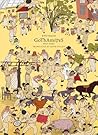
There are whimsical artworks throughout, depicting scenes from the various misadventures of the Gothamites. As far as how individuals are drawn, it reminded me of the old Popeye cartoons, but most of the plates show a chaotic scene with many silly things going on at once.

As l said, I think one has a limited window for an ideal readership, but within that window I think children will find the stories amusing and playful, and parents will find it to be wholesome humor. For that readership, I’d highly recommend this book.

View all my reviews