BOOK REVIEW: Zen in the Art of Archery by Eugen Herrigel

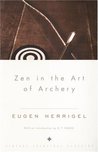
Zen in the Art of ArcheryZen in the Art of Archery by Eugen Herrigel
My rating: 4 of 5 stars

Amazon page

Herrigel’s book is part autobiography of his experience learning Japanese archery (kyudo) from the distinguished master archer Kenzo Awa (and through archery, Zen,) and it’s part philosophical treatise on how archery can help one achieve a Zen state of mind.

The book is less than one hundred pages and has a Zen feel itself. Exemplary of this, the book’s divisions aren’t labeled or numbered into chapters—i.e. there’s a general trimming away of the extraneous features of a book. That said, there’s a clear organization to the book, and most of it follows the chronology by which the author (and others) progress in developing deep insight into the mind through the practice of archery.

There are nine sections:
The first section helps the reader understand why one might consider Zen and archery in the same thought–something that will by no means be obvious (even to many Zen Buddhists.)

The second section explains why Herrigel took up Zen and decided to use archery as his vehicle to understand it.

Section three describes the early learning process, and focuses heavily on the importance of breath.

Section four takes place after Herrigel has been practicing about a year, and the theme of purposeless action is at the fore. This idea is one of the recurring central ideas in the book.

Section five is Herrigel’s introduction to withdrawing from attachments, and—in particular—letting go of the ego. It’s not the point at which Herrigel masters this difficult practice, but he’s made aware of it.

The next section is one of the longer chapters and in it Master Awa tries to teach Herrigel the importance of letting “it shoot” rather than making the shot. This is clearly a challenging idea.

In the seventh section, Herrigel has been practicing for five years and Master Awa recommends that he take a test to help him move on to the next stage in his practice.

Section eight is a brief elucidation as to why kyudo is still relevant and how its relevance has long been tied to what it teaches about the mind.

The final section shifts gears into the relation between Zen and swordsmanship. There have been many works written on this subject, and Herrigel’s purpose may have been to convince the reader that kyudo isn’t uniquely a vehicle for Zen. One can engage in many activities (arguably any activity) with the mind of Zen, be it flower arranging, tea ceremony, calligraphy, or spearmanship.

I’d recommend this book for those interested in the mind / body connection. It’s short, readable, filled with food for thought, and is a classic on the subject.

View all my reviews

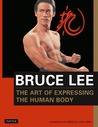
BOOK REVIEW: Bruce Lee: The Art of Expressing the Human Body by John Little

Bruce Lee: The Art of Expressing the Human BodyBruce Lee: The Art of Expressing the Human Body by Bruce Lee
My rating: 4 of 5 stars

Amazon page

Even by today’s standards in which movie stars have personal trainers and scientifically formulated diets, Bruce Lee’s physique compares favorably to the most buff of leading men. In the 70’s there was no one even close. Consider “Way of the Dragon” in which Lee fights a character played by Chuck Norris. At the time Norris was the World Middleweight Karate Champion, a top-ranked athlete, but he looks comparatively doughy set across from Lee. What makes Little’s book intriguing for those interested in fitness is that it answers the question of how Lee achieved such a physique without the benefit of the last few decades of exercise and nutrition science. Sure, he had favorably genetics, but he also had—by all accounts—a sterling work ethic and a conscientious approach to fitness.

I wouldn’t recommend that one follow the programs described in this book wholesale without careful evaluation of the details. While Lee was impressive, he wasn’t free of athletic injuries. Best practices have shifted here and there with regard to the science of human performance. This isn’t meant to denigrate Lee’s approach. In fact, Lee, himself, followed the science of his time and recommended his students do the same. (For those unfamiliar with Lee’s martial art, Jeet Kune Do, its central tenet is to take what is of value and let go of what is not—i.e. never rigidly hold onto set notions.) It should also be noted that Lee—perhaps because of this philosophy—was often ahead of his time on issues like cross-training. I don’t want to leave the impression that there isn’t a lot that holds up well in this book. I’m saying that this is a book about how one man achieved spectacular results, but shouldn’t necessarily be taken as one’s one-and-only guide to fitness (though it does cover much of the relevant territory.) Intermediate and advanced fitness practitioners should know what to take and what to leave, but beginners should proceed with caution.

The book addresses Lee’s approaches to isometrics, weight training, calisthenics, flexibility, nutrition, cardio, and what would today be called functional training (i.e. fitness activities designed to better one’s performance of movements of the sort that one will use in one’s intended activity—in this case martial arts.) It’s important to note that Lee’s approach was optimized to the martial arts. For martial arts one needs a balanced approach to fitness, and it’s not all about aesthetics like it is for bodybuilders. One must be flexible as well as strong and be mobile more than muscly.

The books 24 chapters and ancillary matter are logically arranged. The chapters at the fore provide general information on weightlifting and related topics, the middle of the book is gets into specialized exercises by body part as well as special topics like stretching and nutrition, and the final few chapters get into sequencing and other information about how Lee arranged his fitness activities. Little draws heavily on Lee’s notes, often using his words verbatim.

The one way in which I think the book could be substantially improved would be more relevant photos and graphics, particularly in the sections that deal with specialized exercises. Don’t get me wrong, there are many photos in the book. However, they are all of Lee, and, of course, he had a great deal more photos taken either in action sequences (e.g. flying kicks, etc.) or in candid moments. There are few photos of Lee engaged in “sausage-making” activities like lifting weights or doing calisthenics. However, the subject in the photo need not be Lee. Photos would also allow the author to make the text in those chapters a little less heavy and more readable, and—therefore—it wouldn’t necessarily add to page count as much as one might think.

I’d recommend this book for fitness enthusiasts and martial artists. From beginner to advanced, there’s something for everyone to take away from this book.

View all my reviews

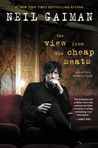
BOOK REVIEW: The View From the Cheap Seats by Neil Gaiman

The View from the Cheap Seats: Selected NonfictionThe View from the Cheap Seats: Selected Nonfiction by Neil Gaiman
My rating: 4 of 5 stars

Amazon page

Not every writer—not even many literary greats—could pull off a book like this. It’s a collection of random speeches, front matter from books (not his own), liner notes, and the occasional eulogy for individuals living and dead. While the book is organized into sections on topics like other authors, comic books, films, and music, it seems that organization derives organically from the topics on which Neil Gaiman is asked to comment–rather than a desire to tighten the book’s theme.

If you’re a Neil Gaiman fanboy/girl, you’ll need no excuse to read anything that he puts out (even though–if that is the case–you’ll probably have read much of this before in separate outings.) So the question is why the rest of us—who may enjoy Gaiman’s writing tremendously but who don’t qualify as fanboys / fangirls—should read this. The reason that it’s worth reading is that Neil Gaiman is funny, has a way of framing ideas that makes them thought-provoking and interesting, and frequently writes quotable bits of text that are essentially brain candy.

The book’s title comes from an essay on Gaiman’s experience attending the Oscars from the upper balcony. As mentioned, the book is divided into thematic sections–ten of them to be precise. The book starts with “Some Things I Believe,” which presents speeches on the virtue of reading, libraries, books, and bookstores. The next section discusses people he has known and worked with—largely writers and graphic artists. Then Gaiman offers thoughts on the nature of science fiction, again mostly through book forwards on seminal works from the genre. There is a section on films and Gaiman’s experience with them—several of his works have been made into films and many others have been considered. The next part is on comic books and the works and artists that influenced Gaiman. The next section bears the title “Introductions and Contradictions” and it offers introductions for various books (not Gaiman’s but those written for other writers.) There’s a musical section about a few recording artists including They Might be Giants, Lou Reed, and—of course—Gaiman’s wife Amanda Palmer. Next, Gaiman presents some introductions and forwards for works of fantasy. One section includes only a solitary entry–a commencement speech entitled “Make Good Art.” The final section is sort of a catchall of essays that includes the title piece and one on events in Syria.

I’d recommend this book for those who enjoy reading (or writing) in the genres for which Gaiman is known. His comments offer interesting insight, and you may learn about some books and authors that you’d never heard of before.

View all my reviews

BOOK REVIEW: Good Omens by Terry Pratchett & Neil Gaiman

Good Omens: The Nice and Accurate Prophecies of Agnes Nutter, WitchGood Omens: The Nice and Accurate Prophecies of Agnes Nutter, Witch by Terry Pratchett
My rating: 5 of 5 stars

Amazon page

Nature or nurture? That’s the question at the core of this funny take on the coming of the apocalypse, written by two masters of humorous speculative fiction—the late Terry Pratchett and Neil Gaiman. The end of days is coming. What if the Antichrist responsible for seeing it through had been switched at the hospital and was raised as a normal kid? Would he be evil enough? If not, how would the apocalypse play out? After a chapter that shows the reader the mix up at the hospital, the bulk of the book takes place over a few days that are supposed to be the last few days of humanity.

There’s an extensive cast of characters including the “gang” of Adam the anti-Christ, the four horse-persons of the apocalypse, angels and demons, witches and witch-hunters, and other sundry characters. However, the characters that most carry the tone and message of the book are Crowley (a demon) and Aziraphale (an angel.) With these two, the authors inject some Taoism into an otherwise Biblical world. That is to say, pure evil and pure good are rarities; there’s always a bit of good amid the bad, and vice versa. Aziraphale can be grumpy, and Crowley’s proclivity to be mischievous has its limits. Being in similar positions, the two bond as low-level managers working for Coke and Pepsi might get on because they face similar demands and have similar complaints about management.

Running through the book are mentions of a book called, “The Nice and Accurate Prophecies of Agnes Nutter, Witch.” This witch’s prophecies are quite unusual in that they are invariably correct, and yet are specific. That is, the prophecies aren’t “right” in the sense that astrologers are often “right” by making vague statements that offer no disprovable propositions. This might lead one to believe that the book would be a marvelous guide for making predictions. However, there is still the issue of having been written centuries ago. Items like automobiles and cellphones, that play a major role in life today, were unfathomable. Furthermore, it’s usually not clear who, exactly, a given prophecy applies to. In short, the medieval writing style results in the fact that the prophecies usually only make sense after the fact.

I’d recommend this book for readers of humorous speculative fiction.

View all my reviews

BOOK REVIEW: The Yoga of Max’s Discontent by Karan Bajaj

The Yoga of Max's DiscontentThe Yoga of Max’s Discontent by Karan Bajaj
My rating: 4 of 5 stars

Amazon page

Max is a making a good living in New York City, but feels an inexplicable void that leads him to give it all up to travel to India in search of wisdom. This novel is a hero’s journey in which the quest isn’t for adventure (not in the usual sense) but for insight into his mind and a path to bliss. Along the way he finds a teacher and is assisted by others, but must ultimately find his own path. As is appropriate to such a quest, he faces hurdles within and without and it’s not always clear whether he will find what he’s searching for—or even whether it exists.

This book kept me reading. It had humor (particularly in the first part) and maintained awareness that it was a novel throughout. What I mean by the latter statement is that there is temptation for books that deal in spirituality to devolve into a muddle between story and self-help book. However, I think the author avoids that error and keeps advancing the story in a readable fashion. The descriptions of yogic practices don’t bog down the story. Those experienced with yoga will breeze right through said descriptions and know what’s happening, and those without such knowledge won’t lose much by grazing over such segments.

The book consists of 38 chapters divided into three parts. The first part covers the period during which Max moves from the US to India and seeks out a teacher. The second part describes his time studying yoga in a south Indian ashram. The final part is the period after which he’s achieved enlightenment, which he spends in the Himalayas.

I found the first two parts to the most interesting and enjoyable. The first part has all the humor and emotional turmoil one would expect from a well-developed and relatable human character. The descriptions of an austere life amid the harsh landscape of a south Indian ashram that comprise the second part make for a visceral read. Where the third part falls flat for me is that supernatural abilities are introduced, and that makes it more difficult to care about Max anymore. It’s a problem inherent in writing this type of story. While Max becomes wiser in the second section, that part doesn’t fall so flat because the life he’s living is so challenging. It’s certainly not that Max’s life is easy when he moves to the Himalayas, but by then he can speak languages he never learned and create sparks with his mind and as far as the reader knows he may be able to leap tall buildings in a single bound and other superman type magic. I suspect the author was aware of the risk of this because he backs away from having Max start a fire with his mind early in the third part and the last part unfolds much more quickly.

I’d recommend this book for anyone who’s interested in a story about personal transformation. Those who’ve spent time in India will find much that resonates and those who are considering (or curious about) such a quest will glean many insights from this book.

View all my reviews

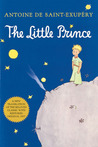
BOOK REVIEW: The Little Prince by Antoine De Saint-Exupery

The Little PrinceThe Little Prince by Antoine de Saint-Exupéry
My rating: 5 of 5 stars

Amazon page

A pilot crash lands in the middle of the desert and meets a little traveler who came from a tiny planet. As this “Little Prince” tells of his travels, he shares his child-like (not to be confused with “childish”) wisdom on friendship and how adults misunderstand what are “matters of consequence.” While the Little Prince takes a child’s perspective, one’s responsibility to others is an important theme. Of course, that may just be the theme intended for children. At the same time, the lesson for adults may be to reevaluate what one considers important. (The reader may be familiar with the controversy as to whether this is really a work of children’s literature.)

The book is humorous and light-hearted, but with some serious themes and moments. There are many though-provoking ideas in this classic. Some quotes that struck me as profound are:

“The thing that is important is the thing that is not seen.”

“One runs the risk of weeping a little, if one lets oneself be tamed.”

“’Then you shall judge yourself,’ the king answered. ‘That is the most difficult thing of all.’”

“For it is possible for a man to be faithful and lazy at the same time.”

It’s a tiny book—less than 100 pages, including the many color drawings that feature throughout the book.

I’d highly recommend this book for anyone who hasn’t read it at least once. (There may be a couple of you out there.)

View all my reviews

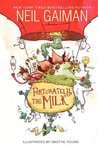
BOOK REVIEW: Fortunately, The Milk by Neil Gaiman

Fortunately, the MilkFortunately, the Milk by Neil Gaiman
My rating: 5 of 5 stars

Amazon page

It’s “The Usual Suspects” for kids, but with Gaiman’s humor and imagination. A father goes out to buy a carton of milk for his kids’ cereal. When he comes back after being long delinquent, he’s got a rather extraordinary explanation for why the short run to the corner c-store took so long.

I read in a Gaiman’s new nonfiction collection, “The View from the Cheap Seats,” (due out May 31, 2016) that even he got grief for writing a children’s book in which the lead isn’t a child. But, he’s Neil Gaiman; so they wisely published it anyway. While the book is aimed at the children’s market, there’s enough humor and absurd happenings to keep an adult reading. So the risky choice of protagonist may prove useful. It certainly helps Gaiman’s argument against narrow definitions of children’s versus adult books (also discussed in detail “The View from the Cheap Seats.”)

Apropos of a youth market book, it’s only about 140 pages, but that’s with extensive illustrations (on almost every page, and many are full-page) and large font. Chris Riddell’s black and white drawings match the whimsicality of the text well.

I’d recommend the book for anyone who reads kid’s books (whether they’re a kid or not.)

View all my reviews

BOOK REVIEW: Applied Tai Chi Chuan by Nigel Sutton

Applied Tai Chi Chuan (Martial Arts)Applied Tai Chi Chuan by Nigel Sutton
My rating: 4 of 5 stars

Amazon page

This book distinguishes itself from the pile of books on tai chi chuan sitting on the shelves of your local bookstore. Most tai chi books are large-format, glossy books with full-color photographs of the various moves of the solo forms–usually the Yang-style short form (also called the Beijing Standard Form [or the like.]) Sutton’s book, on the other hand, is mostly text about the history, philosophy, tactics, and lesser-known dimensions of tai chi chuan. In short, while most books give little indication that there’s more to tai chi than the solo form, Sutton builds his niche in focusing on everything other than the solo form. Those who’ve practiced tai chi will be familiar with the on-going debate about whether the art is primarily chi gong (energy work for health purposes) or a martial art. Sutton comes down on the latter side.

The book consists of 32 short chapters (mostly 2 to 4 pages.) It isn’t written as a how-to manual, but rather as a series of meditations on various aspects of tai chi. As I mentioned, the book deals more with “push hands,” the “san shou” fast forms, and weapons than does most books on tai chi. It doesn’t try to teach these methods, but instead tries to offer insight on them. The book would be of most value to someone who has some experience with the art, but who isn’t an expert. The latter might find it boring, but those without minimal knowledge might have trouble visualizing what the author is attempting to convey.

There are some black & white graphics in the book. They are static photos in a section at the middle of the book. The pictures don’t convey a sequence or details of any particular movement, but instead capture various masters within a movement so as to give the reader a taste of the art. There are also a few line drawings used to show items such as weapons and the yin-yang symbol.

The oddest part of the book is the last chapter (which is far longer than the others and is out of character with the rest of the book.) It consists of extended bios on a number of teachers under which the author has trained. I understand the value of paying homage to one’s teachers, but the bios in this section are long and are inconsistent with the general approach of the book. In essence it’s like a 15 page dedication on a 125 page book. The teachers covered seem to have nothing particular in common other than that the author trained with each of them as some point in his life (i.e. they cover different styles and are from different locales.) That said, there are some interesting nuggets about some of these individuals.

I’d recommend this book for anyone wanting to learn more about tai chi. However, if you’re purely interested in learning the solo forms for chi gong (i.e. you don’t want to know about tai chi as a martial art) then one of those other books may serve you better.

View all my reviews

BOOK REVIEW: A Guide to Chinese Martial Arts by Li Tianji & Du Xilian

Guide To Chinese Martial ArtsGuide To Chinese Martial Arts by Li Tianji
My rating: 3 of 5 stars

Amazon page

This is a brief guide to the martial arts of China. The bulk of the book (about 150 pages of the book’s 178 pages) tells the reader about three major branches of Chinese martial arts: Chang Quan, Tai Chi Chuan, and Shaolin Kung fu at a general level. (The book devotes space to those arts in the same order–i.e. the largest number of pages discuss Chang Quan, then Tai Chi, and the smallest number to Shaolin. This may be surprising as your average non-Kungfu practitioner is least likely to have heard of Chang Quan—by name anyway. Chang Quan is a general term that encompasses several Northern Styles—some of which might be more familiar to general readers [of martial arts books.]) The book also has a brief chapter that describes the history of martial arts in China from ancient times through the modern era, and one that talks about the many schools of martial arts of China (in no great detail because there are so many of them) as well as the various strengths and purposes of these arts.

The bulk of the illustrations are line drawings used to show typical sequences for each of the three major branches of martial art mentioned above. However, there are some black and white photographs and copies of relevant art works and documents as well.

I found this book to be interesting and informative. There’s a bit too much space devoted to describing techniques for my taste. However, I realize that I may be in the minority in that regard. I don’t believe that martial arts can be taught via books or media, and, therefore, there’s a diminishing value to detailed descriptions of technique. In this sort of book one only needs to get a feel so as to be able to see how the martial arts compare and contrast with others.

I’d recommend this book for someone who wants to learn a bit about the nature of Chinese martial arts. It may not be of much value for an expert, but for a kungfu neophyte it provides some interesting information about the history, tactics, and training methods of Chinese martial arts. It’s originally published by Foreign Languages Press in Beijing, but I don’t suspect there is any more bias than there would be if it was published by anyone else (i.e. it’s the rare martial arts book that doesn’t present the martial art under discussion as the ultimate fighting art.)

View all my reviews

BOOK REVIEW: Võ Dân Tộ Martial Arts by Hữu Ngọc & Lady Borton

Vo Dan Toc / Martial Arts (Handbooks of Vietnam Culture)Vo Dan Toc / Martial Arts by Hữu Ngọc
My rating: 3 of 5 stars

Amazon page

This book is part of a series that is subtitled “Vietnamese Culture: Frequently Asked Questions,” and that tells one a little about both the content and the format of the book. It’s better described as pamphlet than a book. At about 75 pages, it’s in bilingual format (i.e. one page is in Vietnamese and the adjacent page is the English translation.) So it’s about 38 pages in English that answer 11 questions about Vietnamese martial arts.

The 11 questions addressed by the book are:
1.) How have martial arts developed throughout Vietnamese history?
2.) How were training and examinations for martial arts organized by the court?
3.) What are the schools of Vietnamese martial arts?
4.) What are the main sects of Vietnamese martial arts in France?
5.) How did Liễu Ðôi become a village with a great wrestling tradition?
6.) Who killed a ferocious tiger in 1770 in Sài Gòn’s Tân Kiểng Market?
7.) How did the famous school of Lady Trà-Tân Khánh martial arts begin and develop?
8.) How did President Hổ Chí Minh keep himself fit?
9.) Who played a key role in the success of Thúy Hiển, the world wushu champion?
10.) What do foreigners think of Vietnamese martial arts?
11.) How did the female master Hổ Hoa Huệ impress the Europeans?

The listed questions tell the reader what the book is about. It starts with some general history from centuries past, and then goes on to discuss specific events. I have no idea to what degree propaganda / myth has seeped into the text—maybe not at all or maybe a lot. I purchased the book in Hue, and am not sure if it’s available outside Vietnam. As one can see from the questions, this book won’t give one much insight into the details of Vietnamese martial arts tactics or philosophy. Instead, one gets a bit of history that some readers will find interesting and others will not. There are black and white photos (about 8) that show static instances of Vietnamese martial arts practice, and there is a glossary.

I picked this book up because I was curious about Vietnam’s martial art history—knowing that it must have had an impressive one. There isn’t much English-language information available about Vietnamese martial arts other than Vovinam. Vovinam is a martial art that allegedly developed in the modern era utilizing pieces of other martial arts and arranged to be ideal for the typical Vietnamese body type. However, what one sees of Vovinam on-line is just a poor-man’s version of that signature move of Black Widow from the MCU movies, so I don’t know whether there is any substance there or if it’s just for show.

Considering that it’s only about $0.67 USD in bookstores in Vietnam, I’d say it’s worth picking up this little book if you want to learn something about Vietnam’s martial history.  [If you buy pay alot for a copy on-line, you’ll probably be disappointed.]

View all my reviews