Lost in blowing snows.
Ahead they’ll make their cannibal stance,
hoping for a voice to pierce their snow-blind minds,
and rescue them from dread days
that will haunt those lucky enough to live to contemplate their unluckiness.
The Drum That Beats Within Us by Mike Bond
My rating: 5 of 5 stars
This collection of short form poems touch on themes of nature, Americana, and the Native American experience, but it covers a lot of ground and is, ultimately, a reflection of Bond’s experience and philosophy in poetic form. Among the 80+ poems, there are some as short and sparse as haiku, but most run between a page or two.
In the prologue, Bond takes up the eternal argument of whether free verse is poetry, and the antithesis of whether rhymed and metered poetry is “serious poetry.” His view, not dissimilar to my own, is that there is room for the coexistence of these two poetic forms. That said, he overwhelmingly favors free verse in practice – as do most poets in the modern era – though not exclusively so.
I enjoyed this collection. It offers food-for-thought, beautiful language, and doesn’t wallow in a view of the world (or the poet’s life) as a fetid morass (as is a common theme in poetry collections these days.) It’s worth reading as an exemplar of a personal poetic statement. The collection offers examples of verse that is evocative without sopping with sentimentality. In the prologue, Bond urges expression through the poetic form, and this is him putting his money where his mouth is.
Venus in Furs by Leopold von Sacher-Masoch
My rating: 4 of 5 stars
This novella revolves around the relationship of Severin and Wanda. Severin is obsessed with Wanda (the titular “Venus in Furs”) to the extent that he seeks to deify her and to submit to her as a slave. The problem arises that Severin can only take this proposition to a middle ground. He isn’t contented with a traditional spousal arrangement, but yet he is unable to submit to the fullest extent of what it means to be enslaved. He, as have many others, believes that if he submits himself fully, he will become the center of Wanda’s world and she will have no need of other relationships. And, as it has for many others, this “domination through submission” scheme frays and fails in time.
Wanda, for her part, recognizes this disparity and is conflicted about the idea of having a slave. Her rational mind thinks it’s a bad idea, her own cravings are for a man with a more commanding personality, but her hedonistic pleasure centers find it a not altogether objectionable state of affairs. After an extended period of spurning the proposition, she goes all in and agrees to test the proposition. If she is reliable, she does this in order to teach Severin a lesson – though one can never tell about the reliability of claims on motive, particularly when made by a character who is conflicted. What is clear is that Severin’s desire to be both her man and her slave is untenable because what she wants in the former is not seen in the latter. As the story unfolds, Severin is exposed to greater and greater challenges to his ability to maintain the façade of slave.
This novella, first published in 1870, is a bit slow-moving, particularly in the early part of the arc. However, it is an interesting study in psychology and how mismatched motives kill relationships. If it seems intriguing, read it, but it’s not a premise everyone will find intriguing. Some will find it disturbingly kinky, though — it should be noted — others will find it far too tame and lacking in explicit sexuality for a book about an intimate relationship.
All Systems Red by Martha Wells
My rating: 5 of 5 stars
This novella’s protagonist is a security cyborg that is corporately-assigned to protect a survey team of human scientists. What makes the story intriguing, not to mention humorous, are the features that we consider human frailties that are witnessed in the thoughts and behaviors of this cyborg. There is his discomfort in interacting with humans. He refers to himself as a “murderbot” and displays some of the awkward mannerisms that are familiar to me as an introvert, though — in this case — they aren’t so much about being easily overstimulated as being uncomfortable with the fact that humans see him as giant robot with great capacity for violence. (Hey, it dawns on me that maybe it is the same with me.) The Murderbot also displays the human traits of laziness and desire to be entertained, and is often watching serial shows when an ordinary robot would either be doing work-a-day tasks like downloading protocols or would be off-line.
The most salient human trait is that he bonds – if awkwardly — with part of his team, and – even though he’s lazy by nature – he goes to great lengths to make sure they survive. Because the Murderbot is notably lazy, the reader must consider whether his willingness to put his life on the line comes from something beyond his protocols. The reader doesn’t know to what degree the cyborg is free, though we do know it has hacked the governor unit that overrides autonomous functions, and so one knows it’s freer than most units in its line of work. [Of course, “putting it’s life on the line” isn’t necessarily as solemn a matter as with humans because murderbots are notoriously difficult to kill, and can suffer severe damage and be quickly repaired / healed – provided they have access to the requisite facilities.]
I won’t get into specifics of story except to say that it takes place on a remote planet that is newly being charted, and the Murderbot’s team is one of a couple teams independently surveying different parts of the planet. Things go wrong and the Murderbot’s team of humans must find out who is the culprit, why said culprit has done what they did, and get out alive.
I enjoyed this novella. The subversion of expectations that comes from the cyborg being perhaps the most neurotic of the characters provides plenty of opportunity for humor, not to mention light philosophizing about the nature of being human and how trust forms. Readers of sci-fi will certainly enjoy this story, non-genre readers should give it a try as well.
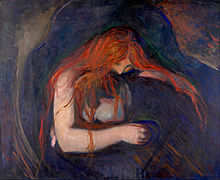
They say a Vampire can’t enter your house unless you invite them inside.
I don’t know whether it’s true, on account of I don’t know if Vampires are a thing.
But I recognize a rule that is good and true when I hear one.
I always hear this or that person complaining about how such-and-such is,
“…living in my head, rent free.”
Well, who invited them?