Unknown's avatar

About B Gourley

Bernie Gourley is a writer living in Bangalore, India. His poetry collection, Poems of the Introverted Yogi is now available on Amazon. He teaches yoga, with a specialization in pranayama, and holds a RYT500 certification. For most of his adult life, he practiced martial arts, including: Kobudo, Muay Thai, Kalaripayattu, and Taiji. He is a world traveler, having visited more than 40 countries around the globe.

BOOK REVIEW: Prana and Pranayama by Swami Niranjanananda Saraswati

Prana And PranayamaPrana And Pranayama by Swami Niranjananda
My rating: 5 of 5 stars

Amazon page


This is the Bihar School of Yoga manual on pranayama, or yogic breathing exercises. The book is a one-stop reference for yoga students and teachers wishing to review the philosophy and physiology of breathing practices, as well as to put together lessons or a plan of action for practice that consists of both preparatory exercises and classical pranayama.

Students in the West may be more familiar with B.K.S. Iyengar’s “Light on Pranayama,” which offers a similar set of material and is this book’s main competitor for most readers. In my view, Swami Saraswati’s book is a bit more pragmatic and gets caught in the weeds less, but offers fewer detailed photos and is a little bit less precisely organized. If one is considering between the two books, I’d say the advantage of Iyengar is a 200-week course plan that some individuals may find a handy way to systematically advance their practice pranayama. The disadvantage of Iyengar is that he goes into vastly greater detail than most people will be able to take advantage of via book. (For example, there’s 22 pages of precise explanation of closing off one’s nostrils for digital pranayama.) In short, both books give the reader everything they’ll need in a pranayama reference, Swami Saraswati’s book is a bit more laid-back, and Iyengar’s a bit more oriented as a step-by-step instruction manual.

The twenty-one chapters of this book are organized into three parts, but we’ll call it four because the last part is divided in two sub-parts. The first part of the book is entitled, “Philosophy of Pranayama” and it dives into the definitions of prana, kosha (sheaths), chakra, nadi (channels), pranic fields, and discusses the connection between prana and chanting.

The second part of the book (ch. 8 – 13) explores the physiology of breath. This section explains the anatomy of the musculature that drives respiration (e.g. the diaphragm, intercostals, etc.), the processes of respiration and circulation, and the importance of the nose in breathing (which is more extensive than the average person could imagine.) This section also discusses the classical distinction between pranayama and rudimentary breath practices (i.e. whether there is breath retention, or kumbhaka), and has a separate chapter explaining retention. It also has a couple chapters that present the research on the benefits and effects of pranayama practice. (Full-disclosure: this isn’t up-to-date in the edition I read, and that was the 2016 — first digital — edition. So, I wouldn’t go here looking for information on the state of research because there’s been a virtual explosion of research that’s more recent than what is covered in the book. However, it will give one a gist what has been known for a while.)

Part III consists of two sub-parts. The first is called “Pre-Pranayama” and it includes many exercises to help one become familiar with one’s breath as well as to develop the foundational breaths (e.g. abdominal / diaphragmatic verses chest breathing) that are built upon in the final section. Part III.B presents the classic pranayama. The four chapters of this section are conveniently organized into: guidelines for practice (e.g. contraindications and general concepts to keep in mind), nadi shodhana (alternate nostril breathing), tranquilizing / calming breaths, and vitalizing / excitatory breaths.

There are five appendices as well as a glossary and two indexes (an index of practices and a general index.) The five appendices provide instruction on practices that are employed in pranayama, but are not pranayama themselves. These include supplementary practices, asana (seated postures for doing pranayama more than asana for opening the rib-cage, etc.,) mudra (“seals” postures of specific body parts), and bandha (locks). The presence of the first four appendices mean that one doesn’t have to buy other books (e.g. the APMB) to access this information. The fifth appendix gathers the sutra from “Hatha Yoga Pradipika” that deal with pranayama and provide an English translation. (HYP is a 15th century manual of Hatha Yoga that is much more detailed than Patanjali’s sutras.) There are graphics throughout the book as needed to convey information, mostly line drawings.

I found this book very useful and well presented. If there is one change that would improve the book it would be less crow-barring of science and traditional / philosophical beliefs about the body to be consistent with one another. I see the value of presenting both sets of information as both this book and the Iyengar book do, but a muddle is created by trying to force the explanations into consistency when they aren’t. (I think this book does it a bit more than Iyengar, but only because Iyengar puts much less emphasis on science than does this one.) The problem is that one ends up with low-quality pseudo-science amid the strong studies, and most readers won’t be able to tell scientific consensus and from the lunatic fringe. (e.g. The belief that kirlian photography is evidence of pranic fields or qi is far from scientifically supported.) That said, for most practitioners it doesn’t much matter as it doesn’t affect the nature of the practices, which are sound and well-described.

If you’re looking for a pranayama reference, this is a great option.

View all my reviews

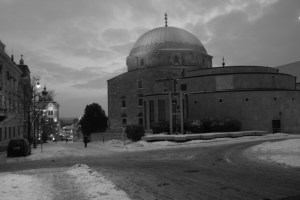
DAILY PHOTO: Mosque of Pasha Qasim

Taken in December of 2014 in Pécs

5 Winter Night Haiku


snowy woods
glows in the moonlight
fox tracks


silent hour
smoke, a farm nearby?
who knocks?


barren woods
morning light will pass through
night’s void


who huddles?
a roadside silhouette
hitcher? boulder?


cloud & moon
paint different homesteads
from same scene

POEM: Blemished

divoted wall

bullet-pocked in a war long past

blemishes kept in remembrance

when foul winds blow from the past

we’re reminded how imagined catastrophes steer history

DAILY PHOTO: St. Mary’s Minor Basilica

Taken on September 29, 2019 in Bangalore.

B941B8A2-BE9C-4838-B8BF-0E733859682E


DAILY PHOTO: Chicago River

Taken in August of 2018 in Chicago

DAILY PHOTO: The Road to Boris Yeltsin Peak

Taken in August of 2019 near Jeti Oguz

DAILY PHOTO: Cloudy Mountains

Taken in January of 2019 near Vang Vieng, Laos

My Year of Discovering How Weird the Mind Gets, Pt. IX [Streaming Poetry]

As I continue to look at variations in consciousness, it occurred to me that poetry writing (or at least pre-writing) often involves an altered state of consciousness. Often, I do an exercise akin to freewriting. Freewriting is an exercise that has been popular for a long time for beating writer’s block. You just write: fast, without judgement, and without concern that you’re taking a reader to any particular place. (It’s somewhat like “brainstorming” in process, but usually solitary and producing sentences or phrases and not bullet-point lists.) The point is to break the grip of self-consciousness and lay waste to the idea that every word has to be pure brilliance to be worthy of your time.

My process begins by quieting my conscious mind, typically with long exhalation breathwork (pranayama.) For those unfamiliar with yogic pranayama or other forms of breathwork, drawing out one’s exhalations (in conjunction with relaxing the body) slows the heart rate and otherwise activates the rest and digest functions of the body. (The curious or dubious can look up “cardiac sinus arrhythmia” or “respiratory sinus arrhythmia,” which is the same thing alternatively labeled by the cause [respiration adjusted] or the effect [heartbeat changes])

After my conscious mind is tranquil, I set pencil to paper and just start writing quickly — without looking back or forward, but just trying to be present with whatever my mind vomits forth. Usually, there is an understandable grammar, but no understandable meaning (at least not beyond the granularity of a phrase.) But building meaning isn’t the point, and I don’t care. Sometimes, I fall into a rhythmic sound quality, but other times I don’t. To give an idea of what the raw feed of this looks like, here’s an example from this morning:

Turn ten, run the nines. I found a fever down the line and could not bend the wall to weep, but heard the conveyor line… beep – beep – beep. Oh, so some fucking wisdom says let live the demons that I dread, but there’s a cold magnolia leaf on the ground and I can hear it skid at the break of dawn, but what sign is that to feel it out. I killed a monk and stole his doubt, but you’ll never blame away the triple frame…

So, it’s a collection of words and phrases that has no discernible meaning collectively. Once and a while, I go through some of these flows of verbiage and underline words, phrases, or ideas that have some spark or merit, and then — if I can — unshuffle and word-cobble until I have a poem.

However, my point in this post isn’t to describe how a poem gets its wings. Instead, it’s to discuss the process by which the consciousness “presents” us with something from out of nowhere. (The conscious mind would claim it “created” it, but I have my doubts. I’ve learned the conscious mind routinely takes credit for many things that are not its doing.)

It’s not like I have an idea (stolen or otherwise) and then I think it through, and then I order those thoughts into an outline. (The usual writing process.) On the contrary, I go to great lengths to make my conscious as quiet as possible as a precursor. I think about the term William James coined, “stream of consciousness” which became a prominent literary device. Is it streaming into consciousness, from consciousness, or through consciousness? Where does it come from? 

You might say, “Why worry about where it comes from because it’s a garbage heap?”

But once in a while there are epiphanies and flashes of insight amidst the rubble and dung. Sure, maybe I grant detritus post-hoc gold status, but there’s something there I feel I have yet to understand.

In consciousness, we seem to have awareness of [something] and meta-awareness (i.e. we are aware of what we are aware of [something.]) Sometimes that meta-awareness is a grand and beneficial tool, but sometimes it’s just another word for self-consciousness. Sometimes having a one-track mind is a beautiful thing.

I said that my practice was “akin to freewriting,” and it might seem exactly freewriting, but the main difference is that it’s purposeless. Sure, once and a while I go back through and rag-pick, but mostly I do the practice just to revel in the experience of being completely with whatever words are streaming. The writing and being consciousness of what is surprising me on the page takes enough of my mental faculties that I have none left to be self-conscious.

Who knows where this journey will take me next month? There’s still a lot of territory left in the altered states of consciousness. Fasting, dance, shamanic drumming, tantric sex, psychonautics, etc. Who knows?

DAILY PHOTO: Yawning Bear

Taken in the summer of 2011 at Veresegyház, Hungary