Out for Meditation

IMG_2445


I’m doing the Vipassana Meditation 10-day course starting tomorrow. I’ll be out of contact (and thus not posting) until September 11, 2016.

For those unfamiliar with the course: no phones, no books, no notebooks, no interaction with anyone but the staff and teacher, and no exercise.  If it’s not meditation, it’s probably not allowed.

Wish me luck.

DAILY PHOTO: Mosques in Leh

Taken in August of 2016 in Leh

Taken in August of 2016 in Leh

IMG_1826 IMG_1837

BOOK REVIEW: Touch by David J. Linden

Touch: The Science of the Sense that Makes Us HumanTouch: The Science of the Sense that Makes Us Human by David J. Linden
My rating: 5 of 5 stars

Amazon page


“Touch” is a neuroscientist’s perspective on the human sense of touch, and the profound impact it has on life in our species.

It’s a short book, only about 200 pages of substantive text, arranged into eight chapters. The first chapter considers the role that our sense of touch plays in our lives as social animals. There are a number of studies described in this chapter, but I’ll cite only two that I think give an idea of what the chapter is all about. The first considers why a person holding a cold coffee is likely to be viewed more negatively than if that same person was holding a hot coffee after a handshake. The second reports that survey takers in a mall were more likely to gain compliance if they engaged in gentle, casual, and non-creepy touch—e.g. fingers to forearm.

The second chapter explores the combination of sensors we have in our skin—particularly in our fingers–that allow us to conduct feats of dexterity that (while we take them for granted) are phenomenally difficult. For all the billions put into robotics research, robots are nowhere close to being able to complete tasks that any five-year old can do. The third chapter examines how humans are uniquely geared to be able to give and recognize a particular type of touch sensation, the caress. Throughout the book there are a number of interesting stories, some of them are scientific case studies and others… not so much. This chapter begins with the story of a man on trial for flying into a rage because his girlfriend couldn’t get the pressure right when engaging in manual stimulation. (The author was actually on the jury.)

The fourth chapter delves more deeply and explicitly into sexual contact. Whereas chapter 3, dealt largely with hand against random skin, this chapter deals in genitals and erogenous zones more specifically. There are also a number of fascinating cases / stories herein. A lot of the chapter deals in how we experience and interpret pleasure.

Chapter five explains a specific type of sensation, that of temperature. It considers why crushed chili feels hot but crushed mint feels cool to the skin. While the focus of the book is on human anatomy, physiology, and social interaction, there are many cases from other species throughout the book. This chapter offers a prime example. It explains how Vampire Bats have a unique ability to sense infrared. This is of benefit to them, since they only take blood meals and, therefore, need to be able to sense where the blood is flowing and has the least insulation (fur) over it.

Continuing the examination of specific kinds of sensation, chapter six is about pain. This is where the neuroscientific perspective offers some interesting insight. In particular, because it considers why soldiers who had multiple gun wounds could do their job on the battlefield with nary a peep of complaint, but then would raise holy hell about a bad blood stick a few days later in the hospital. The case of a medic who was badly shot up but not cognizant of it until later is discussed in some detail.

Chapter 7 deals in the itchy, and asks and answers the question of whether or not itchiness is a particular case of low-intensity pain. By low intensity, I’m not speaking of the compulsive behavior sometimes spurred by such sensations.

Chapter 8 is also highly neuroscience influenced. It deals with various illusions of sensation, and how these illusions come about through the interaction of sense and the brain. While the most famous example of such an illusion is phantom limb pain experienced by amputees, Linden addresses less traumatic and more work-a-day tactile illusions for most of the chapter. (This may be because there are a number of popular works of neuroscience that deal in phantom limbs—most notably V.S. Ramachandran’s books.)

I enjoyed this book. It conveys significant technical detail, but does so in a fashion that is easy for a non-expert to follow both because of readable writing and the use of stories. The author uses frequent graphics to help clarify points, and the graphics (mostly line drawings and graphs) do their job by being easy to follow and interpret.

In short, the book was highly readable, concise, and informative. I’d recommend it for anyone interested in the sense of touch.

View all my reviews

BOOK REVIEW: The Sensual Body by Lucy Lidell

The Sensual Body: The Ultimate Guide to Body Awareness and Self-FulfilmentThe Sensual Body: The Ultimate Guide to Body Awareness and Self-Fulfilment by Lucy Lidell
My rating: 3 of 5 stars

Amazon page

This is a book about body awareness. It explores the subject by presenting tidbits from a range of movement and posture systems.

The book is divided into three parts. The first is a brief overview of the subject of bodily awareness. This section discusses what it means to be aware of the body, how body and mind / emotion are connected, and it sets up the need for the practices described throughout the rest of the book. The second part deals with a series of solitary activities that one can do to improve one’s quality of posture and movement. It forms the bulk of the book. The nine chapters of this portion of the book can themselves be divided in two. Three of them deal in aspects of bodily awareness: breathing / voice-work, grounding, and sensation. These sections borrow and adapt from established systems in a generic sense (e.g. the section on grounding uses a number of techniques drawn from yoga.) The other six chapters each deal with a system of bodywork, including: self-massage, African dance, Tai Chi, Eutony, Kum Nye, and running.

I’ll describe two of these specifically because they aren’t household names. I suspect most readers can imagine what the following look like: self-massage, African dance (even if it’s from a Paul Simon video), Tai Chi (from old folks in the park), and running. However, it’s probably reasonable to assume that some readers will have no idea what Eutony or Kum Nye are. Eutony is a system developed by a Danish teacher, Gerda Alexander, during the 20th century to use explorative movement to work toward more efficient movement. As far as I can discern, the founder is no relation to F. Matthias Alexander who developed–the more famous–Alexander Technique (AT is mostly well-known among actors, actresses, and would-be entertainers.) However, Eutony might be put in the class of techniques like the Alexander Technique and Feldenkrais that were developed last century and work toward improved use of the human body. However, the approach seems much different from Feldenkrais, which is highly structured, while Eutony is apparently not.

Kum Nye isn’t well-known either, but not because it’s a johnny-come-lately, rather because it’s ancient and obscure. Kum Nye is a Tibetan system of yoga. A lot of the techniques shown seem to be designed to help one gain the suppleness needed for extended sitting in meditation, but there are also “flying” techniques and other standing techniques that will help loosen one up, perhaps to free one up for more meditation.

The third part is shorter: three chapters presenting systems of partner-work. The first chapter is on Aikidō. For those unfamiliar, this is a Japanese martial art founded by Morihei Ueshiba that emphasizes harmony and flow. The chapter features a few basic drills from that martial art. The next chapter is on relating to others in a general sort of way, e.g. body language, emotion, etc. The last chapter is about massage.

Graphics are utilized heavily throughout the book. These include color photographs and drawings. Given what the book tries to do–showing these various approaches to movement–the graphics are essential. In the unlikely event that there are any prudes who read my reviews, you may want to make a note that there is a fair amount of nudity throughout the book. It’s not gratuitous or raunchy, but if you’re one of those people freaked out by nudity, this is probably not the book for you (nor the subject to be studying, for that matter.)

The book’s strengths are its valuable subject, its organization, and its use of graphics. Its weakness is in the number of approaches that it examines. There are too many for one to get any great insight into any particular system, but it’s too few if the goal is to give the reader a menu of movement and bodywork systems from which to find on right for them. I guess I wasn’t really clear what the objective was. If it is to show the reader a variety of paths so they can find the one best for them, the menu is too small. However, if it’s to show the reader one path consisting of all these elements, then it’s muddled. Among Western health and fitness purveyors there’s a tendency to think that if you take anything that’s good and ram it together with anything else that’s good, you’ll get something great. This is clearly not true; sometimes you get a pudding sandwich. This book feels a lot like a pudding sandwich.

If you are looking for a limited survey of movement and body awareness systems, and are okay with the list mentioned, you should check this book out. It also has some good general information about body awareness, though it’s a bit pedestrian for experienced practitioners.

View all my reviews

DAILY PHOTO: The Path to Thajiwas Glacier

IMG_0969

Taken in July of 2016 near Sonamarg

Taken in July of 2016 near Sonamarg

POEM: Einsteinian Insanity

Einstein tongue.jpg
Fair use, https://en.wikipedia.org/w/index.php?curid=8970653


Einstein defined what’s nuts,

clear as day, no ifs or buts.

Doing the same, time and again

and expecting change is insane.


So when you hit a fail,

don’t hammer the bent nail.

Pull it out, start anew,

and don’t let bent nails accrue.


DAILY PHOTO: Shikara on Dal Lake

A shikara is a shallow-draft wooden boat commonly seen on lakes in Kashmir. It should not be confused with a Shakira, which is a Colombian pop star / belly-dancer. Asking for a Shakira ride, is a common–but potentially offensive–mistake. IMG_0470

Taken in July of 2016 on Dal Lake, Srinagar

Taken in July of 2016 on Dal Lake, Srinagar

IMG_0572 IMG_0629

POEM: Too Happy

IMG_3368

I’m too happy to be crazy,

but the happy makes me lazy

Not lazy, but lacking focus.

Madness is a creative locus.


A sad gravity weighs one down,

as lip corners into a frown,

but in the pit resides a muse.

People pay to hear the blues.


If you could peer inside my mind,

you’d see stacks of rotting rinds.

The rinds pile up and they ferment.

Maybe to a soulful lament?


Or maybe they just start to  sour,

becoming fouler by the hour.

Until you can’t believe the stink,

and every word is wasted ink.


DAILY PHOTO: Double Rainbow on Pangong Tso

Taken in August of 2016 at Pangong Tso, Ladakh

Taken in August of 2016 at Pangong Tso, Ladakh

IMG_2676

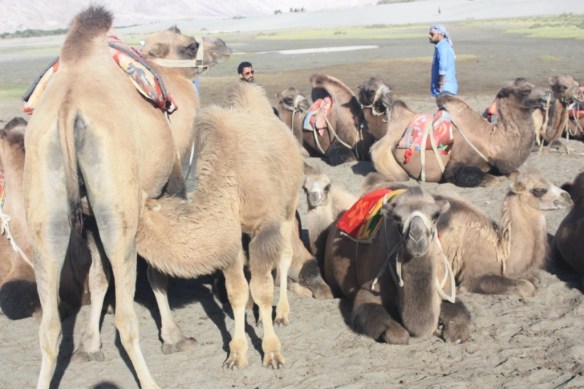
DAILY PHOTO: Bactrian Camels in Shyok Valley

Taken in the Nubra Valley (Shyok Valley) in August of 2016

Taken in the Nubra Valley (Shyok Valley) in August of 2016

IMG_2315 IMG_2267 IMG_2272


It’s the question everybody is always asking, “Do you prefer your camels with one hump, or two?”

Until our visit to Ladakh, our only experience was with single-humped camels, in places like Rajasthan and the UAE.

I have to say that I, personally, found the handling characteristics and ride of the two-humped (i.e. bactrian) camel to be marginally superior.

Of course, the bactrian is like a Porsche. It’s not at all practical as a family sedan. The two humps don’t allow room for passengers or cargo.

My main complaint,  however, is that (as you may note from the last picture) I got a camel with a flaccid hump. It was just flopped to the side. How do you think that made me feel?