PROMPT: 10 Things

List 10 things you know to be absolutely certain.

1.) Nothing is permanent.

2.) The world is not what it seems.

3.) One’s subjective experience is not determined by the state of the world.

4.) Nobody grasps enough truth to be intolerant.

5.) Uncertainty is the root of all fear.

6.) Fear is the root of all hatred.

7.) Hatred is a subjective experience (See #3.) Also, uncertainty is the root of all hatred (by the transitive property,) hence the benefit of travel.

8.) Any who: a.) has suffered a string of hardships; b.) allows themselves to believe that some “other” is wholly responsible for said hardships; and c.) who lacks a sufficient sense of self-empowerment to avoid surrendering entirely to a group identity can (and likely will) become a Nazi (or the equivalent of their day.)

9.) No one can predict the future. [Regardless of how much we all love to try. (See #5.)]

10.) Entropy increases (ultimately, in a closed system.)

NOTE: I remain ready to abandon any certainty in the face of better information.

PROMPT: For a Day

Daily writing prompt
If you could be someone else for a day, who would you be, and why?

A Buddha / Bodhisattva (if there’s one about these days.) Why? To feel how his (or her) subjective experience compares to my own.

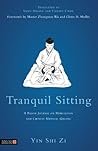
BOOKS: “Tranquil Sitting” by Yin Shi Zi

Tranquil Sitting: A Taoist Journal on Meditation and Chinese Medical QigongTranquil Sitting: A Taoist Journal on Meditation and Chinese Medical Qigong by Yin Shih Tzu
My rating: 4 of 5 stars

Publisher’s Site

This manual is an English translation of a work earlier published in Chinese. It is nominally on Taoist meditation and is written by a Taoist author, but it does include discussion of Buddhist practices as well (specifically Mahamudra.) Also, part of the author’s declared intent with this text is to write in a manner approachable to a wider audience, and because of this sect is rendered less important. So, for example, the book employs more scientific and physiological modes of explanation as opposed to meridians and other conceptual approaches from Traditional Chinese Medicine.

The book is presented in two parts. I found the first part much more beneficial and productive. Said first part is a general guide to meditation. It discusses fundamentals, theory, physiology, and how to align one’s living with a meditative practice (i.e. how diet, breathwork, sleep, etc. influence one’s practice.)

The second part consists of long and fairly detailed descriptions of the author’s experiences with both Taoist and Mahamudra meditation. I didn’t find this part useful, and I believe it may be counterproductive. Discussion of the author’s subjective experience may lead readers to get hung up on chasing identical experiences to the detriment of just practicing. It may give false ideas about “correct” and “incorrect” experiences of the meditation.

Overall, it’s a fine guide to meditation, particularly the first (i.e. larger) part. I can’t say that it breaks a lot of ground. A reader well-versed in meditation may not gain much insight from this book, but it’s as good as any to get started.

View all my reviews