BOOKS: “John Brown” by W.E.B. Du Bois

John BrownJohn Brown by W.E.B. Du Bois
My rating: 5 of 5 stars

Available free online at Project Gutenberg

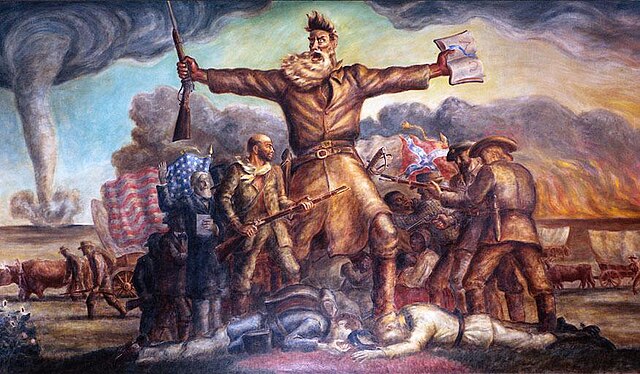
“John Brown’s Raid on Harpers Ferry” is one of those historic events like the “Teapot Dome Scandal” that American kids have to memorize a rote fact about to regurgitate on an American History test a couple times during their scholastic lives, never to be thought of much again, forever a familiar name lacking all depth of understanding. (At least that’s how it was in my day.) Unlike the Teapot Dome Scandal, which I suspect is not learned about in detail because it was somewhat complex and boring, I think the minimalist coverage of John Brown might reflect a bit of national embarrassment. For Brown’s tale is not complicated, and it’s certainly not boring. Brown thought slavery was an abomination, and he devoted his life to freeing slaves by whatever means he could, which culminated in a raid on an arsenal at Harper’s Ferry, West Virgina, at the convergence of the Potomac and Shenandoah Rivers, a raid intended to liberate weapons to the cause of arming freed slaves and other abolitionist fighters.

It’s a shame that more is not learned about John Brown because he was such a fascinating and principled individual, and in a sense his story isn’t just an embarrassing tale of a sparse few virtuous people against a mainstream that was — at best — indifferent to slavery. But there is a potential for pride in the fact that Brown and those who fought with him were able to see slavery for what it was and to stand strong against that mainstream, to make the fight of the oppressed their fight and — in the case of Brown and others — to pay the ultimate price in the conduct of that fight.

W.E.B. Du Bois’ biography of John Brown came out in 1909 and may not be written in the novel-esque style that a writer today would write it, but it is well-written and readable. Du Bois’ book is a full biography of Brown, if focused on his abolitionist aspect. Du Bois tells a little of Brown’s backstory and of his work life and then explores his experiences fighting in Kansas. However, this book does really shine in its account of the Harpers Ferry Raid and its aftermath.

Readers interested in American History or the biographies of virtuous individuals are urged to read this account of the life of John Brown.

View all my reviews

“The Portent” by Herman Melville [w/ Audio]

Hanging from the beam,
Slowly swaying (such the law),
Gaunt the shadow on your green,
Shenandoah!
The cut is on the crown
(Lo, John Brown),
And the stabs shall heal no more.

Hidden in the cap
Is the anguish none can draw;
So your future veils its face,
Shenandoah!
But the streaming beard is shown
(Weird John Brown),
The meteor of the war.

“I Sing the Body Electric” [7 of 9] by Walt Whitman [w/ Audio]

A man's body at auction,
(For before the war I often go to the slave-
mart and watch the sale,)
I help the auctioneer, the sloven does not
half know his business.

Gentlemen look on this wonder,
Whatever the bids of the bidders they
cannot be high enough for it,
For it the globe lay preparing quintillions of
years without one animal or plant,
For it the revolving cycles truly and steadily
roll'd.

In this head the all-baffling brain,
In it and below it the makings of heroes.

Examine these limbs, red, black, or white,
they are cunning in tendon and nerve,
They shall be stript that you may see them.

Exquisite senses, life-lit eyes, pluck, volition,
Flakes of breast-muscle, pliant backbone
and neck, flesh not flabby, good-sized
arms and legs,
And wonders within there yet.

Within there runs blood,
The same old blood! the same red-running
blood!
There swells and jets a heart, there all
passions, desires, reachings, aspirations,
(Do you think they are not there because
they are not express'd in parlors and
lecture-rooms?)

This is not only one man, this the father of
those who shall be fathers in their turns,
In him the start of populous states and rich
republics,
Of him countless immortal lives with
countless embodiments and enjoyments.

How do you know who shall come from the
offspring of his offspring through the
centuries?
(Who might you find you have come from
yourself, if you could trace back through
the centuries?)

“Sympathy” by Paul Laurence Dunbar [w/ Audio]

I know what the caged bird feels, alas!
When the sun is bright on the upland slopes;
When the wind stirs soft through the springing grass,
And the river flows like a stream of glass;
When the first bird sings and the first bud opes,
And the faint perfume from its chalice steals --
I know what the caged bird feels!

I know why the caged bird beats his wing
Till its blood is red on the cruel bars;
For he must fly back to his perch and cling
When he fain would be on the bough a-swing;
And a pain still throbs in the old, old scars
And they pulse again with a keener sting --
I know why he beats his wing!

I know why the caged bird sings, ah me,
When his wing is bruised and his bosom sore, --
When he beats his bars and he would be free;
It is not a carol of joy or glee,
But a prayer that he sends from his heart's deep core,
But a plea, that upward to Heaven he flings --
I know why the caged bird sings!

BOOK REVIEW: Anarcha Speaks by Dominique Christina

Anarcha Speaks: A History in PoemsAnarcha Speaks: A History in Poems by Dominique Christina
My rating: 5 of 5 stars

Amazon page


This collection of poems, written by Dominique Christina and selected / arranged into a story by Tyehimba Jess, tells the story of a slave woman who was used for medical experimentation. Most of the poems are in the voice of this woman, Anarcha, and are conveyed in a slave dialect. However, a few are from the perspective of Dr. Marion Sims, the doctor who used Anarcha (and other slave women) for research and experimental procedures. Even without the cues in the poem titles, it’s easy to tell when these switches in voice occur because the doctor’s poems are in “proper” English, as opposed to Anarcha’s dialect. I should point out, while I can’t tell you how accurate the slave dialect is, I can say it presents no challenge to the reader’s understanding of the story or of the imagery or metaphor of the poetry.

The events described in these poems are based on a true story. Anarcha developed a fistula (a hole in bodily tissues that’s not supposed to be there) as a complication of carrying a child, and as a result suffered persistent bleeding. Anarcha’s owner handed her over to Dr. Sims to repair the fistula and stop the bleeding, which would require the development of a new procedure. Sims is often called the father of modern gynaecology, and was lauded with statues and honors. However, in recent years, his image has been tarnished by the fact that many of his advancements were only possible through the non-consensual examination of, and experimentation upon, slave women.

I should point out that, while reading this book has made me interested in learning more about the details of the story, I can’t really comment on the degree to which the poems accurately convey history. From the little I was able to garner from quick internet research, there are wide-ranging views on Dr. Sims and his research. Some think Sims belongs in Josef Mengele’s corner of hell. (Note for non-history buffs: Mengele is the Nazi doctor who experimented on Jews and other prisoners during the Second World War.) Others believe Sims was genuinely working to heal the slave women and wasn’t solely motivated to find a treatment for paying patients, and that — in the context of his times — he should be considered a fine, if fallible, doctor. I don’t know how much is know about what was in Sim’s mind or how it matched his behavior, but at a minimum he seems to have been much less delicate with his slave subjects than he would have been with his patients in terms of subjecting them to pain and humiliation.

I will say that the poems in Anarcha’s voice feel authentic, i.e. they feel like they convey truth about what would go through a person’s mind when put in her position. Her humanity is felt. In a few cases in the Dr. Sims poems, that authenticity feels like it breaks down, and one thinks, “no one sees themselves that way” – an instance of self-deification springs to mind. That said, perhaps it’s an accurate depiction. More than one doctor has been known to be colossally narcissistic on occasion.

That said, this is a poetical work and not a historical account, and so the beautiful language, clever metaphors, and emotional resonance of the work are what serve to make it a book that should be read. I would highly recommend this book for all readers. Even if you aren’t typically a poetry reader, you’ll find this free verse collection readable because of its story and the insightful view into the mind of Anarcha it presents.

View all my reviews