BOOK REVIEW: Sleights of Mind by Stephen Macknik and Susana Martinez-Conde

Sleights of Mind: What the Neuroscience of Magic Reveals about Our Everyday DeceptionsSleights of Mind: What the Neuroscience of Magic Reveals about Our Everyday Deceptions by Stephen L. Macknik
My rating: 4 of 5 stars

Amazon page

Sleights of Mind explains magic tricks by telling one about the shortcuts, limits, and programming of brain (and attendant sensory systems) that facilitate such tricks. The reader needn’t be concerned that the book will spoil all the illusionists’ secrets for one. The authors carefully demarcate the beginnings and endings of spoiler sections that explicitly explain tricks. This allows a reader to skip over such sections if one doesn’t want to know the trick. I suspect few readers do skip the spoiler sections because that’s where the rubber meets the road in terms of the neuroscientific concepts being discussed. The spoiler sections are an attempt to comply with the magician’s code (the neuroscientist authors became magicians themselves) and to maintain a good relationships with the many magicians (some, like Teller or the Amaz!ng Randi, quite famous) who cooperated in the writing of the book.

Over 12 chapters, the authors explain the neuroscience of how various classes of illusion work. Most of the chapters address a specific class or subclass of illusion. The first few chapters deal with visual illusions. We look at the world in what seems like crystal clarity (at least with glasses on or contacts in), but there are many limitations and gaps in our visual processing system. While it seems like we are directly seeing the world around us, in point of fact, our visual experience is a product of the brain reconstructing information that the eyes take in—and it doesn’t do it as perfectly as our brain tricks us into believing. As the authors state it, “The spooky truth is that your brain constructs reality, visual and otherwise.” Chapter 3, deals with illusion in art, which is little outside the theme of the book, but it offers an opportunity to explain some intriguing facts about how the brain and eyes work in concert.

The next couple chapters (Ch. 4 and 5) deal with cognitive illusions. Just like our visual system, our conscious minds save energy by engaging in short-cuts that disguise the mind’s limits while offering the possibility of manipulation. The brain also works hard to reconcile what appear to be inconsistencies, and often this reconciliation leads us astray. Misdirection is discussed in detail. Our minds are primed to let certain actions and sensory inputs draw its attention, and humans are awful at paying attention to more than one input stream at a time. Teller explains that, “Action is motion with a purpose.” So, if one can give one’s movement a purpose (even scratching one’s chin) it will be ignored while movements seemingly without purpose are anomalous and draw attention. The authors introduce the reader to mirror neurons—the part of our brains that take observations of another’s actions and makes forecasts about that person’s intent. This system is highly hackable by magicians.

Chapter 5 informs us that we aren’t as good at multitasking as we think—which is to say we completely stink at it but tend to think we are awesome multi-taskers. The gorilla experiment is offered as a prime example of this situation. In the gorilla experiment, about half-a-dozen people, moving around randomly, pass a ball / balls among themselves. The subject is asked to count the number of passes. In the middle of this activity a man in a gorilla suit walks through the middle of the rapidly moving passers. When asked whether they saw the gorilla, most people say they didn’t (and those who do see the gorilla invariably offer a count of passes that is vastly off the mark.) [If this is either unclear or unbelievable, you can YouTube it.]

Chapter 6 examines multi-sensory illusions. The quintessential example is how our brains lead us believe that the sound of a ventriloquist’s voice is coming from the moving lips of a dummy. (Also, it seems like voices are coming from the lips of actors on-screen in the movies, even though the speakers are probably off to the side in the walls or ceiling.) Synesthesia (cross-wiring between senses and brain such that some people may always see the number 5 in red or hear a C-sharp in green) is introduced to the reader.

Chapter 7 explores the illusions of memory. Just as with our vision and attention, our memories aren’t as indelible as they seem to be. We think we’re calling up a transcription of the events of our lives, but really we’re remembering the last remembrance of said event. This can lead to a migration / distortion of events in the same manner as the kid’s experiment whereby one whispers a phrase into the ear of the kid in the next chair and it traverses the classroom. The original sentence “The cat is on the windowsill” invariably becomes something like “Lenny Kravitz steals puppies from the till.” (Have you ever experienced a situation in which a person remembers the details of an event substantially differently from yourself even if the broad brushstrokes are the same?) Some entertainers use pneumonic tricks to convince audiences that they have supernatural mental abilities when—in fact—they have merely turned understanding of memory to their advantage.

Chapter 8 considers how in-built expectations and assumptions are exploited by magicians and mentalists. Again, these methods work because our brains employ all sorts of energy-saving shortcuts. For example, our brains often do the same thing as Google’s search engine—filling in the blanks by taking advantage of one’s experience to avoid the need for costly cognitive processing.

Chapter 9 explains that our “free choices” are often not so “free” as we think. One of the most disconcerting, yet intriguing, facts to come from the onslaught of brain imaging studies since the 1990’s is that our decisions are made on a subconscious level before our conscious minds are even aware the decision has been made. Prior to this, we’d always been under the misapprehension that we are consciously making all these decisions–big and small–because the conscious mind is just a big credit stealer (to be fair, the conscious mind doesn’t recognize that it’s so out of the loop in decision-making.) So many of our decisions are made in predictable ways by emotional / automated responses, and mentalists use that fact to their advantage.

Chapter 10 is a catchall for topics that didn’t fit into earlier chapters, including hypnosis, superstitions, and the gambler’s fallacy (i.e. the idea that a roulette number that hasn’t come up in a while [or slot machine that hasn’t paid off recently] is bound to pay soon—regardless of the probability distribution that actually rules the outcome.)

The remainder of the book tells the story of the author’s try-out for a magic society and discusses the question of whether knowing the neurological and psychological roots of magic tricks will kill magic as a source of entertainment. I found the latter to be the more interesting discussion. The authors are optimistic about magic’s survival, and offer good reasons. After all, almost nobody believes that magicians are conducting supernatural activities [not even people who take some wildly unsubstantiated beliefs as givens.] Even knowing how the tricks work doesn’t create the ability to see through the tricks because so many of the factors that magicians exploit operate on a subconsciously programmed level, and such proclivities would have to be trained away. People who want to enjoy the spectacle of magic aren’t likely to go to the trouble of training themselves in that way.

I enjoyed this book even though I’m not particularly a fan of magic—though I did find myself watching quite a few YouTube clips of the magicians mentioned in the book. If you’re interested in how one’s mind and sensory systems work, and the limitations of those systems, you’ll find this book worthwhile. If you’re into magic, you’ll like it all the more so.

View all my reviews

BOOK REVIEW: Buddha’s Brain by Rick Hanson

Buddha's Brain: The Practical Neuroscience of Happiness, Love, and WisdomBuddha’s Brain: The Practical Neuroscience of Happiness, Love, and Wisdom by Rick Hanson
My rating: 4 of 5 stars

Amazon page

This is one of those books whose title leaves one unclear as to the book’s nature. The title has religious connotations, but its subtitle, The Practical Neuroscience of Happiness, Love, and Wisdom suggests a secular and rationalist work. The subtitle might clear things up if it weren’t for the fact that there are so many New Agey, spiritualist types who like to glom onto scientific terminology—presumably in an attempt to lend credibility to ideas that are “out there.” Thus, one may reasonably wonder whether this is just another Biomechanics of Chakra Fluffing style book—actually, I made that one up, but if you can see why such a title would be oxymoronic you know where I’m coming from. Without further ado, let me state that this book is rooted in the science of the brain, and, while it uses its fair share of concepts from Eastern religion as pedagogic devices, it doesn’t presuppose need to believe in anything [or anybody] for which there is no evidence. [What remains less clear is whether this book is properly considered self-help or pop science?] This issue with the title may be why Hanson came out with the more secularly-titled Hardwiring Happiness book a few years later that seems to cover similar territory (though, I’ve not yet read the latter.)

The central premise of Buddha’s Brain is that the brain’s neuroplasticity allows one to change the way one experiences life by changing the way one perceives and responds to life’s little trials and tribulations. Over time, one can become happier, more loving, and wiser—i.e. one can have a brain more like the Buddha’s. “Spiritual” matters are always at the periphery of what Hanson is discussing because this type of practice has historically been in the bailiwick of religious traditions—specifically Eastern (and other mystic) traditions that focus on looking inward to be a more virtuous person. However, where said traditions have often relied on assumptions unsupported by current science—such as the existence of a unitary (i.e. universally interconnected) consciousness, Hanson considers the issue from the perspective of our current understanding of the brain. In particular, he focuses on the fact that we are capable of training our brain to respond more positively to events.

Evolution, beautiful and elegant as it may be, has made us pessimistic and prone to disproportionately focus on the negative. This is because survival depended on being ready for worst case scenarios. So we imagine what that worst case is, and endlessly replay scenarios to prepare ourselves for how to deal with said worst cases. While this approach may have enhanced our ancestor’s survival probability, it can easily get out of hand and for far too many people it has. In the book, Hanson proposes three evolutionary strategies (i.e. creating separations [us / them, I / you, etc.], maintaining stability, and threat avoidance / opportunity seizure) that often end up tainting our worldview, raising our stress levels, and causing declining health and well-being. The book does get into the mechanics of stress reduction as well as how to change the way one experiences the world so as to be exposed to less stress.

Rick Hanson is a psychologist who holds a Senior Fellowship at a center at the University of California at Berkeley. He also founded his own center called The Wellspring Institute for Neuroscience and Contemplative Wisdom.

The book is organized into 13 chapters arranged in four parts. The four parts are: I.) The Causes of Suffering, II.) Happiness, III.) Love, and IV.) Wisdom. These parts are preceded by front matter which includes the first chapter which lays out the basics of the brain in layman’s terms as well as discussing the evolutionary survival strategies that sometimes fail to serve us well in modern living. More detailed discussion of the brain is introduced throughout the book at is relevant to the discussion at hand, but the level of this discussion should be approachable to all readers. Each chapter is divided into many subsections to make the reading easily digestible. One of the nice features of this book is that each chapter has a bullet point summary at the end. Actually, the author uses bullet points prominently throughout the book. There is one appendix which explores questions of nutrition for brain health. There is an extensive reference section containing largely scholarly references, as one would expect of a science book.

I mentioned earlier that I wasn’t certain whether to classify this as a self-help or popular science book. In many ways it’s both. It does give a great deal of practical advice about what one can do to change one’s life. On the other hand, it offers more background into the science than your average self-help book—though always at a layman’s level.

I’d recommend this book if you are interested in self-improvement, the science of the mind, or both.

View all my reviews

7 Stress Fighting Tips with Relevant Monty Python Song Interludes and Book Recommendations

In writing this post, I realized that Monty Python provides the I-Ching of life wisdom. If they don’t say it, it may not need being said. So I’ve let them expound upon my points wherever possible.


1.) Always  Usually look on the bright side: Our brains are programmed to constantly be on the look for potential problems and ruminate over solutions. This isn’t without its advantages. However, as your brain takes flight with this problem anticipation mode, it can begin to taint how one sees the world.

My high school psychology teacher told us a story of what he called the “gestalt of expectations.” The story goes like this: One is driving across southwestern America and there’s a gas station coming up, but one still has half a tank. Being from the East, one doesn’t realize how rare service stations can be in the desert, so one passes it by. Of course one runs out of gas (it wouldn’t be much of a story otherwise.) As one is walking back toward the service station, one begins to obsess over how the service station attendant is going to screw one over. After all, the unknown individual knows one is in a desperate situation. The more one walks under a burning sun, the more one inflates the gas station attendant’s ill-intentions, and one suitably escalates one’s mentally rehearsed response. Finally, disheveled and weary, one reaches the service station. A concerned-looking attendant bursts out of the station to meet one, saying, “Geez, you look beat, what can I do for you?” And that’s when one punches him right in the nose.

BuddhaBrainThe good news is that one can gradually train one’s brain to take a more positive perspective. A neuroscientist, Rick Hanson, has written a few books on how one can go about this cognitive rewiring. Buddha’s Brain is probably the most well-known of these books. The book lays out the science behind the brain and negative thinking in particular, and then goes on to present suggestions as to how one can change this cycle and yield the benefits of a more positive outlook. While the title of this book makes it seems like a religious tract, it’s really secular and scientific. If you’re still concerned, you might check out the more secularly titled Hardwiring Happiness.


2.) Make rest part of the process–and an essential one at that: Duh?  Yeah, it sounds self-evident, but  too many people think of rest as the slacking off that one does between doing “useful stuff.” What isn’t valued is given short shrift. Don’t think of rest as a necessary evil. Equating rest with goofing off results in two problems. First, the obvious one, people don’t get as much rest as they should. Second, while one thinks he or she is resting, one may be under chronic stress (the bad kind) as one’s minds churns over what they should be doing and the adverse impacts of not doing it. Just as one should have rests built into one’s workout for maximal effect, one should have rest times built into the day, week, and year.


3.) Find your bliss, and just do “it”: You probably think that by “it” I’m referring to sex. Actually, sex isn’t a bad “it,”  as its go, but it’s not the only it. Exercise, work the heavy bag, do a vinyasa (yoga flow sequence), go to work solving the problem at hand, or practice your Silly Walk. This also sounds like a “duh!” kind of statement, but far too many people wallow when they feel overwhelmed. What do they wallow in? Negative feelings. They worry that they can’t possibly hit the deadline or find the perfect solution. They worry that they’ll let someone down. They get angry at other people, the world, or a god or gods for putting them in their present predicament. They bristle at the unfairness of the universe. All of this snowballs into a stress monster–to mix my metaphors up nicely. If one can’t meditate or keep one’s mind on one’s breath, one may find relaxation in exhaustion. It’s all about inertia. It’s hard to get moving when one thinks one’s world has gone to shit, but that movement will make one feel much better–even if it doesn’t seem it can solve the problem at hand. One might need to change one’s life’s course altogether and become a lumberjack.


4.) Don’t create false monsters:  Remember what Michel de Montaigne said, “My life has been full of terrible misfortunes most of which never happened.” As this is really just expanding on a point in item #1, instead of elaborating, I will offer you this Monty Python skit to consider.


5.) Exhale: Each exhalation trips the “rest & digest” circuit (i.e. the Parasympathetic Nervous System [PNS])  just a little. Granted, this subtle relaxation effect is easily overwhelmed by the countervailing forces of stressors and even the antagonistic effect of inhalation with its–also minute–fight or flight mode (of the Sympathetic Nervous System [SNS.]) Still, if you don’t know what to do, controlling your breath while elongating each exhalation is a good start. This will help in two regards. First, it helps the PNS gain a little ground. Second, it’ll break your conscious mind’s obsession with the problem (or potential problem) at hand. One’s mind will wander and one will lose track of the breath, but the more one practices quietly returning one’s attention to the breath the better off one will be. Becoming frustrated with these diversions only strengthens the stress monster–so don’t do it.

Relaxation ResponseThe bible of the rest and digest mode is Herbert Benson’s Relaxation ResponseThis book was first written over a quarter of a century ago, but it remains readily available. It’s telling that Walter B. Cannon’s work on “fight or flight” mode predates Benson’s work by such a long time. In other words, the medical and scientific community were researching the body under stress for decades before it ever occurred to anyone to think in terms of rest mode as a state that could be studied and advanced–as opposed to just being the normal state of affairs. This should give one an insight into how the human mind goes about considering problems.


6.) Recognize that stress is like cholesterol–there’s a good kind as well as the bad: Acute stress can serve one well during instances of danger. We have this response for good reason. The problem is chronic stress. When one’s body is in a stressed state, it’s not taking care of general maintenance tasks like healing itself. That’s fine in a short term, but problems compound over time. Chronic stress brings a high likelihood of illness because the body isn’t dealing with its run of the mill chores as it should be.

ZebrasUlcers_SapolskyThere are a number of books that expand upon this issue and which offer advice for keeping one’s stress of a healthy type. Robert Sapolsky’s Why Zebras Don’t Get Ulcers is among the best. It’s a long book and goes into great detail, but Sapolsky’s sense of humor helps to continue reading when the scientific minutiae might seem overwhelming. Another book on this topic that I found to be quite informative was Lissa Rankin’s Mind Over Medicine.  Rankin is a medical doctor, and so she offers a little different perspective from that of Sapolsky. (The latter is a biologist / neurologist.)


7.) Realize that you are a speck in a vast universe and, so, how big or long-lasting can your problem be?: Yeah, it’s a double-edged sword because it’s–in a way–a demoralizing thought as well as a comforting one. Therefore, one should first watch this bit of Monty Python wisdom:


But then one can keep things in perspective through the realization that one is not yet dead.

BOOK REVIEW: Extreme Fear by Jeff Wise

Extreme Fear: The Science of Your Mind in DangerExtreme Fear: The Science of Your Mind in Danger by Jeff Wise
My rating: 4 of 5 stars

Amazon page

Extreme Fear examines the science behind fear—particularly the fear of life and death situations. In doing so, the author presents findings from scientific research as well as cases that demonstrate the concepts behind those findings. People are often so close to their fears that they take them for granted, and feel that there’s nothing to be done about them. However, there’s a great deal to be learned about how fear operates and how one can improve one’s performance in fearful situations. By replacing the lens of shame with one of science, one can see what fear is objectively, and make the emotion more of a help and less of a hindrance.

A central idea in the book is that fear evolved to maximize one’s chance of survival against the age-old threats facing mankind. These pre-historic threats were relatively straightforward: saber-tooth tiger attacks, clubbing by members of warring tribes, fire, famine, flood, etc. Ancient threats often called for hauling ass, freezing in place, or getting stabby. The problem is that our present-day threats often call less for gross motor skills (run, kick, or throw) and more for creative or nuanced solutions to technological problems (i.e. sliding cars, falling planes, or malfunctioning assault rifles.)

Motor learning is one means by which this mismatch between what our brain tells our body to do in a stressful situation and what is called for in our modern world. Take the case of the infantryman with the jammed rifle. Without training, he might pick up the rifle like a club, intending to use it to unleash blunt force trauma. That is, if he’s still alive then the enemy gets into cudgeling range. Alternatively, the soldier may drop the rifle and run for his life. However, because he had a drill sergeant who made him practice clearing his weapon over and over, his body can go to that behavior while his conscious mind is blinking out.

Still, motor learning only takes us so far. Sometimes creativity is called for, and that’s a tall order in the face of where our body / brain want to put limited resources. In fact, Wise begins the book with the story of a pilot who was flying an old plane when the wing support broke and the wing flipped up, threatening to rip off. Somehow the pilot figured out—based on a vague memory and lots of experience—that he could flip the plane over and fly it upside-down and the wing would snap back into place. Then he had to figure out how to land: a.) upside-down crash, or b.) try to flip the plane over at the last second. The brain systems that this pilot smoothly accessed are among those that one doesn’t expect to be operating in life or death situations—e.g. those involved with long-term conscious memory and abstract problem solving.

The question of how some people can keep their wits about them, as the above pilot did, while others crash and die is the one that Wise really wants to answer. It turns out that it’s not such and easy question. During World War II, the military conducted studies to try to determine which soldiers could be counted on under life and death stress. The answer didn’t readily present itself. Among the problems in finding an answer is that courage and fearfulness aren’t as unitary or straightforward characteristics as one might think. Wise presents the case of Audie Murphy as a prime example. Murphy was at once one of the most decorated American soldiers in World War II—a man who’d taken on a company of Germans single-handedly—and a man of great social anxiety.

The book’s 13 chapters are divided into three parts. The first part presents fear and its effects. The middle section deals with various forms, aspects, and facets of fear, including: social v. life-and-death fear, choking behavior in sports, and fear of fear v. fear of an outcome. In the last part of the book, Wise suggests how one might achieve better performance in the face of fear.

I found this book to be informative and interesting. Wise did a good job of picking cases to illustrate the concepts discussed in the scientific literature. I’d recommend this book for individuals who are interested in the science of the brain and the ways to achieve ultimate human performance.

View all my reviews

What Are Your Thoughts on “Dick Move Mondays” in a Dojo?

Going rogue with attacks

Gone rogue

So, the whole “dick move Mondays” concept may require clarification. First of all, some readers may be saying, “Every day is dick move Monday at our dojo.” However, readers who train at more orthodox schools may be wondering how such an apparently ludicrous idea would even come up. The idea’s origins are the result of seeking a martial art’s correlate to the “bad pass Fridays” that have been instituted in many basketball practices in recent years. On “bad pass Fridays” coaches give players passes that are catchable–but just barely. I’ll get into the scientific argument for this kind of training below, but for now suffice it to say that the idea is to have regularly scheduled instances in which the individual is taxed to his or her limits and forced to try to cope with worst case scenarios. While there needs to be some limitations for safety’s sake, I’ll argue that there’s some advantage to applying this concept from the sports science and motor learning literature to martial arts training. [Note: if your objective in practicing martial arts has nothing to do with being able to succeed in the context of a sporting match, an actual combat situation, or both (i.e. a situation in which an opponent is trying to clobber you and vice versa) then this isn’t really relevant to you. But feel free to read it any way.]


Here’s some low-down on the science. Historically, it’s been popular to teach / coach sports (and non-sport martial arts) using a “partial and blocked” approach. This method is extremely popular because: a.) it’s simple to organize and conduct practice sessions, b.) short-term growth is rapidly visible, and c.) it looks neat and tidy. “Partial” means that a particular skill (or even sub-skill) is extracted from the overall skill set of the activity at hand and practiced in isolation. This could be a throw, a strike, or a means of receiving or defending. “Blocked” practice means that one skill or sub-skill is practiced over and over again under the exact same conditions until it’s deemed time to move onto the next. “Whole and random” practice represents the opposites of “partial and blocked.” “Random” means that one drills a skill under an ever-changing situational context (e.g. one may still be drilling hip throws repetitively, but not against a static partner who’s standing in the same place–there’s movement and pushing and pulling, and possibly a few dick moves.) “Whole” practice simulates the actual event that one is practicing for–whether it’s a Muay Thai match or a parking deck brawl.


For a good explanation of the problems associated with blocked practice, watch the video by Trevor Ragan of “Train Ugly” that’s linked below. (fyi: “Train Ugly” is an apropos name for an approach that involves more “whole and random” practice because there will be more short-term failure and one won’t look masterful at what one is doing by the end of a practice session. However, long-term skill retention and the ability to integrate those skills and sub-skills into a more realistic environment is higher.)

As Ragan points out, the random approach requires one read the situation and environment and respond in a way that won’t leave one worse off. (I don’t like the word “planning” applied to martial arts because there’s never time to do any planning in the sense of using one’s conscious mind. However, I’d say reading is a very apropos concept, and there is a need to adjust to one’s context.)

So what would “whole and random” training look like in a martial art? First of all, one should realize that one doesn’t need to make every training session “whole and random” from the very beginning. In the beginning a lot of “partial and / or blocked” practice is necessary. The problem is that if one doesn’t ever move beyond that, one’s performance will be hindered. Second, all practice doesn’t have to be both whole and random; one can spend a lot of time with random drilling of a particular skill. One can drill a particular skill while moving around freely, applying counters, making timing more random, and making the approach less regimented. “Whole and random” practice in the martial arts involve sparring or randori. Jigoro Kano did a brilliant thing in making the techniques and practice environment safe enough that randori (free form) training became possible. For many years, I would have said that Kano Sensei made a system that was less “realistic” by paring out the dangerous elements of jujutsu. However, today I don’t see it that way. I’ve come to realize that the ability to train randori keiko actually added back in a great deal of realism. Who’s to say what the net effect on realism is. I certainly see the advantage over the old way in which one trained in a regimented fashion devoid free form components for years and then one day one went out on musha shugyō (warrior’s errantry) and may be the day you learned of a deficiency in your technique was the day you died.

So “dick move Mondays” is really a way to add randomness into training. One can’t ignore the reading portion of the attack because one never knows what whacky ass attack one’s opponent is going to come up with.

If you do implement “dick move Mondays” in your school or gym, you may want to review this instructional video by Master Ken because the “bitch slap” is sure to enter into your training.

[Disclaimer: Master Ken video included as farce. Readers are advised not perform any techniques suggested by Master Ken or his Amer-i-do-te practitioners.]

BOOK REVIEW: Faster, Higher, Stronger by Mark McClusky

Faster, Higher, Stronger: How Sports Science Is Creating a New Generation of Superathletes—and What We Can Learn from ThemFaster, Higher, Stronger: How Sports Science Is Creating a New Generation of Superathletes—and What We Can Learn from Them by Mark McClusky

My rating: 4 of 5 stars

Amazon page

McClusky’s book tells us how advances in sports science and technology are producing a new class of elite athlete. More usefully, it discusses which practices of high-level athletes can reasonably be emulated by amateurs. One may think that what’s good for the goose is good for the gander. In this case, not so much. If shaving a hundredth of a second off your time isn’t going to affect your life’s course, there are many activities of elite athletes that simply aren’t worth the cost (in whatever terms.) For example, the loss of friendships due to rampant flatulence resulting from consuming large quantities of baking soda isn’t worth it if you just want a little bit stronger Sunday cycling ride. (Baking soda [sodium bicarbonate] counteracts blood and muscle acidification during exercise and makes it possible to keep moving strongly when fatigued would normally degrade performance. Incidentally, this practice has been shown to be effective only for events that last between one and seven minutes.) On the other hand, some of the lessons of sports science are relatively low-cost and high benefit, and might be just what one is looking for to improve one’s performance. (e.g. Replacing a pre-workout stretching routine with one of rolling out the muscles.)

Faster, Higher, Stronger consists of twelve chapters, each addressing a different aspect of the application of science and technology to sport, including: training methods, genetics, nutrition, recruitment, practice, performance enhancing substances (legal and illegal), elevation training, and the limits of performance.

One question that has always been of great interest is how much of a top athlete comes from his or her genes? In other words, can anyone can do it–given a willingness to work like a maniac of course. As with many other questions about heredity, it was once thought that there would be a precise answer to this question in the wake of the decoding of the human genome. However, the success of the human genome project showed only that the situation was vastly more complex than we’d imagined. It turns out that having certain genes isn’t the end of the story because there are many factors that influence which genes are expressed. Attempts have been made to put numbers to the influence of genetics. For example, one scientist is quoted as claiming that 50% of oxygen processing capability (i.e. VO2 max) is heritable. This translates to the fact that, while the average Joe has a reasonable chance of engaging in athletics at some level, only a 0.1 to 0.3 % can summit the pinnacle of elite level athletics.

In many ways, science has encouraged coaches, trainers, and recruiters to think outside the box—and to look beyond the traditionally engrained approaches. One fascinating story was that of how the British national rowing team held tryouts based only on height, with experience with the sport being not required. They ended up with a champion rower who’d first entered a boat only four years before. This is part of the evidence that controverts the once popular 10,000 hour rule that was popularized by Malcolm Gladwell–though Anders Ericsson is more properly considered the father of the idea. It turns out that 10,000 hours of practice aren’t required for most activities if one goes about it right.

McClusky spends a considerable amount of space on the questions of what athletes should and shouldn’t consume. In emulating elite athletes many amateurs are working at cross purposes. This is readily seen with the issue of sports drinks. If you’re guzzling down a Gatorade or snacking on Cliff Bars after your run, you may only be ensuring that you continue to gain weight despite working out. On the other hand, you may decide that chocolate milk or beet juice are good choices for you.

I’d recommend this book for those interested in the heights of human performance.

View all my reviews

BOOK REVIEW: What If? by Randall Munroe

What If?: Serious Scientific Answers to Absurd Hypothetical QuestionsWhat If?: Serious Scientific Answers to Absurd Hypothetical Questions by Randall Munroe

My rating: 5 of 5 stars

Amazon page

If you like the tv show Mythbusters and snarky and / or silly humor, you’ll love Randall Munroe’s What If?: Serious Scientific Answers to Absurd Hypothetical Questions. Munroe gained internet fame (still not the same as real fame) drawing the popular webcomic xkcd. The book’s subtitle says it all. Munroe solicited questions from his web-legion (not the same as a real legion) of fans, selected a collection that he found intriguing, and answers them with a mix of science and humor. Munroe’s bona fides to answer questions of a technical nature include a degree in physics from Christopher Newport University and a brief career as a roboticist for NASA—though he’s fond of pointing out that he’s just a web-cartoonist whenever his answers might be wrong.

Each chapter presents a detailed answer to one of the absurd hypothetical questions. Most of the chapters are just a few pages long and feature the same variety of stick-figure cartoon that grace the xkcd website. He covers 60-ish questions in the book. Scattered throughout the book are sections called “Weird (and Worrying) Questions” which usually don’t receive answers but merely cartoons that mock the demented mind that came up with said question. (If that seems harsh, keep in mind that many of the questions he does answer are pretty warped (e.g. setting off a nuke in a hurricane or whether steady rising would result in death by freezing or suffocation).)

Like the Mythbusters, Munroe does an excellent job of selecting questions that have unexpected answers. For example, the author addresses the question of what would happen if one went swimming in a spent fuel pool (nuclear fuel rods are stored underwater for a long time after they come out of the reactor before they can go to dry storage.) The answer: Nothing if one swam near the surface, but if you swam down and touched the casks, you’d die in minutes. Munroe also takes liberty to find the more interesting unintended consequences embedded in some of the questions. For example, he dismissively answers the old question about whether every human on the planet standing as close together as possible and jumping so as to land simultaneously would have any effect on the planet. Instead, he takes on the questions of the logistics of getting everyone to one place, how much space humanity would take up, and how / whether people could get out of this state of shoulder-to-shoulder proximity alive.

Some of the questions are impossible to answer with certainty but Munroe takes them on when he can offer reasonable, scientifically-based speculation. For example, what will the area that is currently New York City look like in a million years? His answer is more or less: Who cares? Humans will be long gone and veins of plastic in past landfills will be the only evidence that we ever existed. Another such question is how much power can Yoda achieve through application of the Force?

Besides the many physics question (e.g. What’s the fastest speed at which one can hit a speed bump and live?), there are others that involve mathematics, chemistry, and biology. Mathematics questions include calculations of the likelihood that one would find his or her soulmate if each person really only had one soul mate. (My Indian friends might be pleased to know that we’d all be screwed if that were the case.) There are actually many questions that hinge on mathematical calculations.

One of my favorite chapters is in the domain of chemistry, and it answers what would happen if one tried to make a wall by collecting together blocks of all of the elements in the periodic table in the relative position in which they exist on the table? Answer: Nothing good. There are a few biologically centered questions as well. Munroe takes on the question of how much computing power human brains collectively have—and the more interesting unasked question of how human “computing” is different from that of machines.

I’d highly recommend this book for science lovers. In fact, even people who don’t care for science may find this book palatable because of its humor and the fascinating questions it addresses.

View all my reviews

The 4% Rule, Yerkes-Dodson, and Finding the Sweet Spot in Martial Arts Training

I was watching one of Michio Kaku’s Big Think videos recently that addressed American science education. The question of interest was how America continues to do so well in science and technology given that the American (primary and secondary) educational system isn’t up to par in science and mathematics with its technological competitors. The bulk of his talk (re: the H-1B visa and importation of brain power) isn’t germane to this post. It’s Kaku’s mention of a second secret weapon that caught my attention, and that’s how America is able to do a better job than many of its competitors in identifying and nurturing top talent. While math and science education is better in many Asian countries, those countries (e.g. Japan, Korea, or China) don’t excel at skimming off the cream of the crop. Dr. Kaku explains that this is because Confucian values teach students to conform, and students are loathe to stand out–even for exceptional performance. Even if a student wanted to show their talent in hopes of having it fostered, the large classes, lecture-centric teaching, and testing of memorization and standardized processes doesn’t offer much opportunity to grow one’s individual strengths.


Kaku’s statement resonated with me because I’ve been thinking about the pros and cons of traditional approaches to martial arts instruction. I’m particularly interested in the gulf between the traditional approach and what martial arts teaching would look like if one took advantage of the wealth of scientific knowledge about mind and body development. Most of the martial arts instruction I’ve received over the years is consistent with Confucian thinking. All the students are doing the same practice (or faking it to the best of each’s abilities if it’s beyond one’s current capacities), and each is trying to closely emulate the teacher-presented ideal as much as possible. There’s not much consideration of the individual student’s weaknesses or strengths. Emphasis is on trying to convey as high-fidelity a replica of the techniques that have been handed down through the ages. (While this may be a laudable goal, I’ll later offer explanations as to why I think it’s both death for retention of students and ultimately counterproductive.)


Let me first say that there are a number of advantages to the traditional approach to martial arts instruction. First, it’s easy to teach many students at once. This was probably a huge advantage when there were armies of men having to learn these skills. Second, [theoretically] it helps students reduce their egotism through discipline and conformity. The highly hierarchical nature of this approach means students spend years in a lowly position, with the hope that some humility may stick. (NOTE: I’m not certain that this works out in practice.) Third, it creates a disciplined learning environment that is conducive to helping a student keep his or her head in the game.


What the traditional approach isn’t so good at is producing students who all perform at the best of their abilities. I suspect that the traditional approach doesn’t do so well for student retention either. It’s a system in which new students are forced to drink through the fire-hose; while students who’ve been around for a while often feel like they’re stagnating.  As I’ll get to below, there’s good reason to believe that a proper match between the challenge of a task and the performer’s skill level is critical to creating an intrinsically rewarding activity and to helping students perform at their best.


My thoughts on this topic have been heavily influenced by learning and teaching yoga. While one’s vision of a yoga class may be rows of students doing the exact same posture (and huge classes and / or poor instructors may result in that condition),  but there’s often a degree of variation in a class. This variation results from two concepts that I’ve been thinking about quite a bit lately, namely modifications and capacity building.


Modifications are a two-way street. If the task at hand is beyond the student’s current abilities, he or she may be given an easier variant that allows him or her to work toward the fundamental form. On the other hand, if the task of the moment is old hat, a student might be offered a more challenging version on occasion. I’m not suggesting that one shouldn’t drill the basics throughout one’s martial arts career. Repetition of fundamentals is key to drilling them down into one’s nervous system. However, the brain loves novelty and hates drudgery, and it will become harder and harder to remain engaged if the overall challenge level doesn’t rise. The science suggests that one needs to keep upping one’s game if one wants to perform at one’s best.


The nature of modifications in martial arts may not seem as clear as it is with respect to yoga postures. For randori, sparring, and other free-form training, it’s easy to envision how one can adapt the practice to reduce or increase the challenge to a level more apropos of the student’s skill level. One can practice a restricted form. For example, one may work only on sparring with boxing rules to kicks or grappling out of the equation until a student builds up his or her confidence and abilities with recognizing and responding to punches. Alternatively, an advanced student might be presented with armed or multiple attackers. There are some practices, such as specific techniques, for which modifications may not be an option, but that doesn’t necessarily let a teacher off the hook for helping a student who’s challenged by the technique. That may be where capacity building exercises come into play.


Capacity building goes beyond offering an easier modification to suggesting exercises to help the student build the physical capacity to do the technique repetitively WITHOUT INJURY. I emphasized those last two words for a reason. In some martial arts, the need for capacity building exercises maybe clear because of the acrobatic insanity involved. However, practitioners of more pragmatic martial arts may say, “We don’t do all those fancy spinning back kicks, so we don’t need capacity building. Anybody can do our techniques because they’re simple and direct.” Maybe that’s true, but if multiple members of your school have the same (or similar) repetitive stress injuries, it’s not true at all.


What kind of capacity building are we talking about?  If the technique involves jumping or leaping and the individual is gravitationally-challenged, then plyometrics might be the prescription. On the other hand, if the problem is the inability of the student’s joints to withstand the technique, there might be need for exercises that build up stabilizing muscles, help him / her to cut weight, or both. If a student can’t do a throw without risk of injury, maybe that individual needs to spend time practicing with elastic bands or inner tubes or working on their balance.
 

RiseOfSupermanWhat is this 4% rule? I read about it in Steven Kotler’s The Rise of Superman. As background, there’s a state of mind called “Flow” that’s associated with performing at one’s best. In this state of mind, which some call “the zone” and others probably once called satori or samadhi, one’s concentration on the task at hand is at its greatest, unnecessary features like sense of time and sense of self fall away, one’s inner critic shuts the hell up, and–at least afterwards–there’s a blissful state. Flow can be described as the shutting down of specific elements of the pre-frontal cortex (PFC)–largely involved with the consciousness mind. It can also be defined neuro-chemically by the hormones released (i.e. Serotonin, Endorphins, Dopamine, Anandamide, and Norepinephrine) and neuro-electrically in terms of one’s brainwaves (around 8 Hz.)


There are conditions that favor achievement of Flow, notably: 1.) clear goals, 2.) immediate feedback, and 3.) a good match between the level of the challenge and the level of one’s skill. Flow is a key factor in why some activities are intrinsically rewarding (whether or not they are rewarding in other ways) and why almost any activity can be intrinsically rewarding if it’s sufficiently challenging relative to one’s abilities. What’s sufficiently challenging? That’s where 4% comes into the picture. While it’s by no means an exact or universal value, it turns out that when a task presents a challenge that is roughly 4% above one’s present skill-level is when this state of mind is most accessible. This is why one may see students drop out if they find the level of challenge stagnant. On the other hand, one may not keep new students either if the challenge is constantly beyond their abilities.


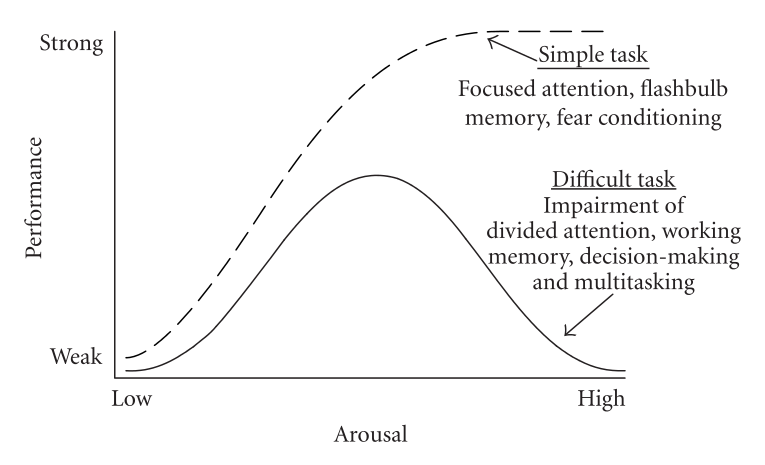
How about that Yerkes-Dodson? The two early 20th century scientists for whom the Yerkes-Dodson Law are named discovered that performance increases with arousal (one might do best to think of this as anxiety level rather than the colloquial use of that word) up to a certain point, beyond which performance either levels off or plummets–depending upon the nature of the objective.  The point is that keeping the training environment too sterile has it’s disadvantages. In free-form practices like sparring, a little nerves can be a good thing, but being overwhelmed can be detrimental.

Yerkes-Dodson Curves. Source: Wikipedia

Yerkes-Dodson Curves. Source: Wikipedia

Adjusting one’s instruction to the abilities of one’s students is challenging. Traditionalists may hold that it’s far more important to keep the tradition intact than it is to cater to the individual needs of students.  That is, said teachers may prefer to focus on the aforementioned high-fidelity transmission of the teachings of the lineage. There was a time during which I probably would have echoed that sentiment. However, it increasingly occurs to me that producing the best and most engaged students is the best way to keep a tradition alive.

The Jujutsu Murders, Plus Some Brain Science

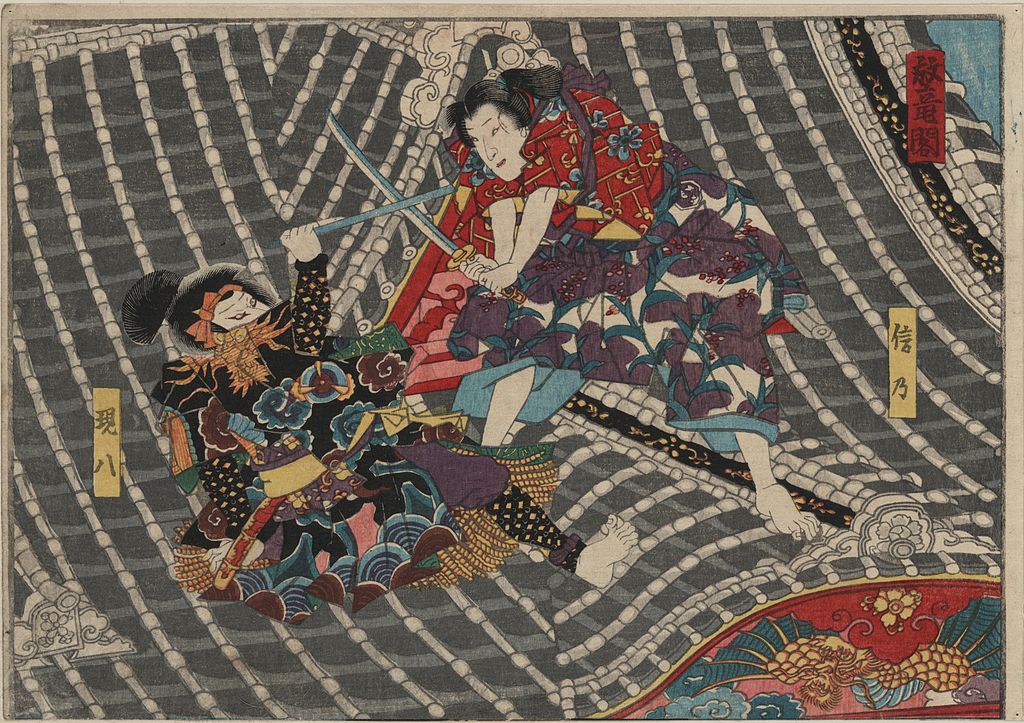
Jujutsu

Imagine you’re a detective in Edo Period Japan (1603-1868), and you’re told to investigate a case in which three highly-trained practitioners of one of the most well-respected jujutsu schools have been stabbed to death. Each of the three bodies has only one mark on it–the lethal stab wound. The wound is on the right side of the abdomen in all three cases. There are no signs of a prolonged struggle, despite the fact that each of the three had many years of training and none of the men was an easy victim. The stabbings happened independently, and there were no witnesses to any of the killings. So, who or what killed these three experts in jujutsu?


Nobody knows who killed them, but a rigid approach to training contributed to what killed them. As you may have guessed, the killer took advantage of knowledge of the school’s techniques, i.e. their “go-to” defense / counter-attack for a given attack. It’s believed that the attacker held his scabbard overhead in his right hand, and his weapon point forward in a subdued manner in his left. All three of the defenders must have instinctively responded to the feigned downward attack as the killer stabbed upward from below with the unseen blade.


It’s a true story. I read this account first in Jeffrey Mann’s When Buddhists Attack. That book offers insight into the question of what drew some of the world’s deadliest warriors (specifically, Japan’s samurai) to one of the world’s most pacifistic religions (i.e. Buddhism–specifically Zen Buddhism.)  Mann cites Trevor Leggett’s Zen and the Ways as the source of the story, and Leggett’s account is slightly more detailed.


This story intrigues because it turns the usual cautionary tale on its head. Normally, the moral of the story would be: “drill, drill, drill…”


Allow me to drop some brain science. First, there’s no time for the conscious mind to react to a surprise attack. The conscious mind may later believe it was instrumental, but that’s because it put together what happened after the fact and was ignorant of the subconscious actors involved. (If you’re interested in the science of the conscious mind’s stealing credit ex post facto [like a thieving co-worker], I refer you to David Eagleman’s Incognito.)  Second, our evolutionary hardwired response to surprise is extremely swift, but lacks the sophistication to deal with something as challenging as a premeditated attack by a scheming human. Our “fight or flight” mechanism (more properly, the “freeze, flight, fight, or fright” mechanism) can be outsmarted because it was designed to help us survive encounters with predatory animals who were themselves operating at an instinctual level. (If you’re interested in the science of how our fearful reactions sometimes lead us astray when we have to deal with more complex modern-day threats, I refer you to Jeff Wise’s Extreme Fear. Incidentally, if you’re like, “Dude, I don’t have time to read all these books about science and the martial arts, I just need one book on science as it pertains to martial arts,” I just so happen to be writing said book… but you’ll have to wait for it.)


So where do the two points of the preceding paragraph leave one?  They leave one with the traditional advice to train responses to a range of attacks into one’s body through intense repetition. Drill defenses and attacks over and over again until the action is habitual. This is what most martial artists spend most of their training effort doing. A martial art gives one a set of pre-established attacks or defenses, and it facilitates drilling them into one’s nervous system.


Of course, the astute reader will point out that the three jujutsu practitioners who were killed had done just what was suggested in the preceding paragraph, and not only didn’t it help them but–arguably–it got them killed. I should first point out that the story of the three murder victims shouldn’t be taken as a warning against drilling the fundamentals. As far as their training went, it served them well.  However, there’s a benefit to going beyond the kata approach to martial arts. One would like to be able to achieve a state of mind that once would have been called Zen mind, but–in keeping with our theme of modern science–we’ll call transient hypo-frontality, or just “the flow.” This state of mind is associated with heightened creativity at the speed of instinct. (If you’re interested in the science of how extreme athletes have used the flow to make great breakthroughs in their sports, I’d highly recommend Steven Kotler’s The Rise of Superman.) Practicing kata won’t help you in this domain, but I believe randori (free-form or sparring practice) can–if the approach is right.

BOOK REVIEW: Wired for Story by Lisa Cron

Wired for Story: The Writer's Guide to Using Brain Science to Hook Readers from the Very First SentenceWired for Story: The Writer’s Guide to Using Brain Science to Hook Readers from the Very First Sentence by Lisa Cron

My rating: 5 of 5 stars

Amazon page

There are countless books offering advice to writers. Some are good. Some are not. Good, bad, or ugly, few of these books offer anything new beyond particularly artful (e.g. humorous or poetic) explanations or superior examples. In other words, if you’ve read five writer’s guides you’ve read five thousand. Cron’s book is the rare guide worth a read even if you’ve read a hundred other such books. It’s not that Wired for Story offers radical or novel advice on story building (its writer’s tips are orthodox.) It’s the way this book couches the arguments for what can admittedly be hackneyed advice. As the title suggests, Cron’s book is about how our brains are wired to love stories–as long as said stories contain certain attributes that the brain finds appealing. (Conversely, there’s a reason why books that go wildly off the reservation with “experimentalism” are doomed.)

While I’ve read many a book on writing, I picked up Wired for Story more out of an interest in the subject of the neuroscience of story. The book doesn’t delve deeply into the science, but it does cite leading thinkers in the field as well as providing a good layman’s overview of the neuroscientific principles that inform the book’s tips. Cron’s background is in publishing and her bona fides to write this book are as someone who came from a career reading and rejecting / accepting manuscripts. However, I believe she did a good job of laying out science.

The central idea is that humans love stories because the narrative structure allows people to simulate a nasty chain of problems without suffering the real world consequences. The brain loathes uncertainty and randomness, and loves whenever it can learn about how to face a problem or make sense of the world. This is why we love conflict, tension, and an unrelenting unfolding of worst case scenarios in our stories even though we tend to hate those characteristics in our own lives. This results in both the tried advice to keep putting the protagonist through the wringer, and the qualifications that a writer should do so in a way that is believable (our brain’s BS-detector is ever on) and which will eventually force the protagonist to change. Cron offers a definition of story that has the usual elements: “A story is how what happens affects someone who is trying to achieve what turns out to be a difficult goal, and how he or she changes as a result.” As with many guides, the definitions of plot, the protagonist’s issue / goal, theme, and tone are elaborated at length—as well as being differentiated because these topics tend to be confused by neophytes—often resulting in a failure to clarify one or more of them.

Stories also give us an opportunity to anticipate what others will do, and forecasting the behavior of others gives one a nice little dopamine dump. The ability to foresee what others will do has always been a powerful evolutionary advantage, and those who did it better passed on their genes more than their oblivious counterparts. Owing to this idea, there is a great deal of advice about what should be in the book (only what is relevant), and how it should be revealed (in a way that eschews attempts to play “gotcha” with your readers.)

One may wonder why I’m so pleased with a writer’s guide that gives common advice about writing–just because it explains said tips in terms of evolutionary biology. The answer is that it’s far easier to keep these lessons in mind when they’re held together by a logic rooted in what all readers have in common (e.g. conscious and unconscious minds, emotions, instinctual drives, etc.) For example, knowing why readers hate an overly simple resolution for a problem that’s presented as insoluble (i.e. robbing them of dopamine reward for figuring it out) helps one better recognize this pitfall in all its forms and to avoid it. Such an approach allows for a deductive approach and is far more useful than having memorized “avoid deus ex machina” as a disparate tip that’s attached to a specific example. In short, it’s both easier to remember and broadly implement these ideas when one understands the rationale from the ground up.

Beyond the reason in the last paragraph, I enjoyed this book for reasons that have little to do with its advice to writers. While I now know that there are other books on the evolutionary biology of story that deal with the subject more from a scientific perspective (while I haven’t read it yet, you might try this book), this was the first book that I stumbled across on that topic. And, it’s a topic that’s well worth understanding whether you’re a writer or not. No matter what one does, understanding the universal appeal of a story can be beneficial, whether it’s in the context of teaching, parenting, or business.

I’d recommend this book for writers—particularly those who think about the world in scientific terms. Beyond writers, if you have cause to construct or use stories in your life—or suspect you should—you can benefit from this book.

View all my reviews