BOOK REVIEW: The Wit and Wisdom of Master Yoda by Yoda

The Wit and Wisdom of Master Yoda: Master Yoda QuotesThe Wit and Wisdom of Master Yoda: Master Yoda Quotes by Yoda
My rating: 1 of 5 stars

[I normally put a link here to the books I review, but wouldn’t want anyone to accidentally buy this one by mistake.]

This review is the same rant I put in my weekly reading review today. If you saw it there, don’t bother reading onward.

This book was a stinker, and I can’t recommend it for anyone–though its saving grace is that it’s slim and thus only wastes a tiny bit of one’s time. What the author apparently did was to watch a Star Wars movie marathon and pull every Yoda line out and collect them together. This is a sad effort in two ways. First, while Yoda isn’t a lead in the movies (and, therefore, has a limited number of lines), there’s a vast canon of Star Wars books, and it doesn’t look like the author trolled any of them for quotes. Second, some of the lines are neither witty nor wise. Occasionally, Yoda has a line equivalent to, “take a left at the second light,” and the author includes such banal quotes. Furthermore, some of the quotes appear a second time in either reduced or extended form. Beyond all these complaints, the author doesn’t even take the time to put together meaningful front matter to tell the reader something interesting that they don’t already know, and thus doesn’t establish his worth in producing such a book. (Also, he doesn’t seem to know accepted protocol for writing quotes inside quotes–i.e. use of single quotes. Which I guess means he probably didn’t just cut and paste all the quotes because then they would have been grammatically correct.) He also could have at least provided told us which movie each quote was from. It’s a lazy effort. It succeeds spectacularly in being lazy. If you’ve seen the movies (or have basic cable so that you can readily do so by way of one of the frequent Star Wars marathons) you’ll gain nothing from this book.

View all my reviews

TODAY’S RANDOM THOUGHT: Be the Change

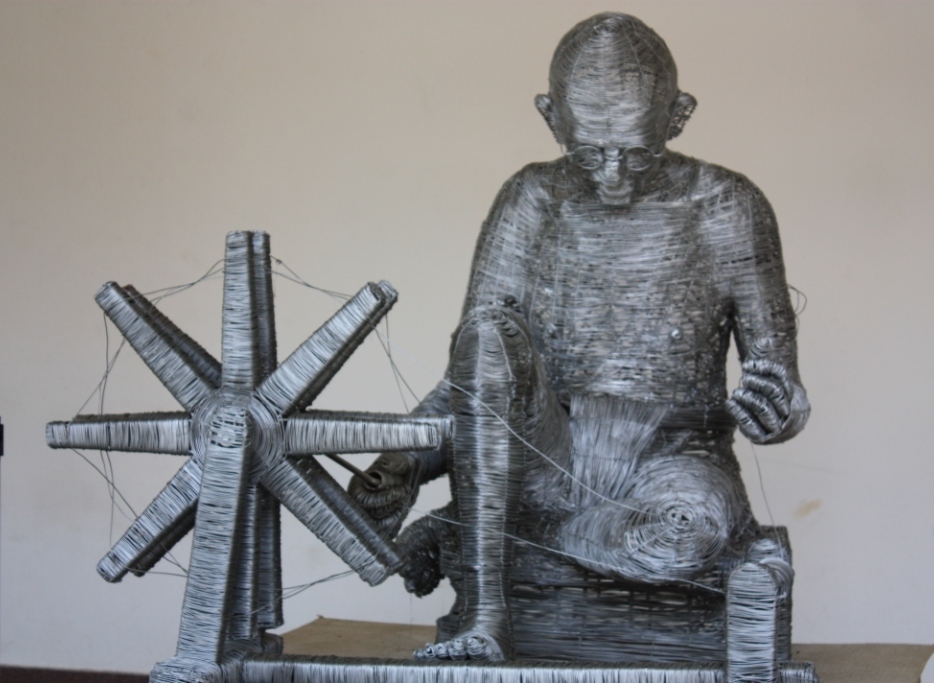
IMG_1501Gandhi is credited with saying, “Be the change you wish to see in the world.”

That’s powerful phrasing. It’s much more effective than, say: “Nag your friends until they’re the change you desire.” It’s also far more potent than: “Write your legislator to draft a new bill so that we all have to be the change you wish to see.”

It’s powerful because it acknowledges that–whatever else you do–you have to set a good example by doing what you think is right. Even if that”s painful and lonely. It’s powerful because it’s bold.

That’s why it sticks in the mind. I once read an entire book by a well-known billionaire who made his fortune in foreign currency arbitrage. I was underwhelmed by the book and the character of the author, and don’t even remember the title because I remember thinking the title should have been: “Why It Should Be Illegal to do What I Did.” This individual came to believe it was morally repugnant to upset the economies of entire nations to make a quick buck, but the lure of making that buck was too great for him to stop without the threat that someone would put him in jail for it. In other words, instead of living by the motto of “be the change,” he lived  by the motto of “If I don’t do it, someone else will.”

BOOK CHAT: Walking by H.D. Thoreau

WalkingWalking by Henry David Thoreau

My rating: 5 of 5 stars

Amazon page

Thoreau paints a portrait of walking in such grandiose terms that one will cease to think of putting one foot in front of the other as one of life’s mundane tasks. He’s not talking about just any walking, however. He’s not talking about the mall walkers who briskly exercise in temples of consumerism. He’s not talking about those who walk through the park with top 40 hits blaring from their iPod ear buds.

Thoreau is talking about those individuals he calls saunterers. To saunter, as to stroll, is to walk in a leisurely and aimless fashion. Thoreau’s walking is that which:
-takes place in nature.
-leaves worldly worries behind.
-is not a trivial time commitment.
-is more an exercise of the mind and spirit than of the body.

To the mall walker, Thoreau would point out the error of a missed opportunity to get away from mankind’s chaos and enjoy nature. As he puts it, “The most alive is the wildest.” and “…all good things are wild and free.” He’s also clear in that walking for exercise misses the point by injecting hurriedness into a time that should be about slowing down.

On those with iPods, cellphones, or other contrivances that distract one from the environs, Thoreau is equally clear, “What business have I in the woods if I am thinking of something outside the woods?”

Thoreau’s essay broadens as it progresses. From a commentary on the virtues of sauntering, the essay turns to the glories of nature, the character of America, and the state of thought in his contemporary society. These may seem like unrelated concepts, but there is a string of logic that connects them.

The connection to nature and the virtue of wildness should be clear. It’s nature that is the optimal backdrop of sauntering. It’s in nature that one can be set free from the troubles of the world of man and obtain a glimpse of god. It’s in nature where creativity breeds with chaos turned down and native brilliance turned up.

Thoreau’s discussion of America is tied to the theme of walking in a couple of ways. The first is as a land made for walkers. For example, he points out that a man could pitch a tent almost anywhere in North America without great risk of becoming a meal. The same couldn’t be said of India or Africa or Siberia, where man isn’t the sole predatory creature. The second is America as a place with room to venture out into uncharted territory. Thoreau points out that we may look to the East for the lessons of our predecessors, but a person should look West for opportunities to grow in one’s own right. Of course, Thoreau’s America was different from today’s America.

The end of the essay broadens out even further. Thoreau comments upon mankind and the state of ideas and thought. He echoes Socrates when he talks about that age-old question of whether it’s better to be ignorant (to know one knows little) or deluded (to think one knows a lot, but be drowning in false knowledge.) A reader may suggest that this is a false dichotomy. Why can’t one know most everything and not have a one’s body of knowledge rife with false knowledge? I can’t say, but all of the evidence suggests that if such a state exists, it’s the domain of God or gods (if such entities exist.)

Thoreau also bemoans what he sees as the decline of thinking man. What does this have to do with walking? I think Thoreau answers in the following quote:
“So it would seem few and fewer thoughts visit each growing man from year to year, for the grove in our minds is laid waste—sold to feed unnecessary fires of ambition, or sent to mill—and there is scarcely a twig left for them to perch on.”

I think that everyone should read this thin book–really an essay and not a full-scale book. The problems Thoreau notes have only gotten worse in our modern age. Far too few take the time to walk, and to acquire the benefits of sauntering.

View all my reviews

BOOK REVIEW: Vagabonding by Rolf Potts

Vagabonding: An Uncommon Guide to the Art of Long-Term World TravelVagabonding: An Uncommon Guide to the Art of Long-Term World Travel by Rolf Potts

My rating: 5 of 5 stars

Vagabonding is a book about how to make the leap from a cubicle-dwelling company-man (or woman) to a wandering free-spirit.

This book serves two functions. The first is to answer questions about how one goes about seeing the world if one is not independently wealthy or a recent lotto winner. In this role it provides information such as how one can fund one’s travel time, and, perhaps more importantly, how one can get a job after one has an 18 month void in one’s resume.

The second function is to psyche one up to take the leap. In this role it is more persuasive than informative. In both roles it succeeds, but it is in this second role that it is most useful. The Introduction title is “How to Win and Influence Yourself” and Chapter 1 is entitled “Declare your Independence.”

Each chapter has a list of tips and/or references, quotes from those who have done it, and a profile of a famous person associated with the lifestyle, including: Thoreau, Whitman, Muir, and Annie Dillard. The quotes show you that mere mortals have made this leap. The profiles show that you that you will be in excellent company if you do it.

One of the most important themes in this book is simplified living. If one isn’t independently wealthy, one will have to make “sacrifices” to adopt this lifestyle. However, if one learns to live lean, one will be able to make do with much less. One must also live lean during one’s travels. Potts’s advice is to travel light, and leave the electronics at home. (The latter may seem impossible these days, but as a person who recently lost a laptop in a travel accident, I respect the logic.)

I highly recommend this book for anyone who is ready to take the leap, but only if you’re serious.

View all my reviews

10 of My Favorite Quotes on Writing

Do not use semicolons. They are transvestite hermaphrodites representing absolutely nothing. All they do is show you’ve been to college. –Kurt Vonnegut


Write without pay until somebody offers pay. If nobody offers within three years, the candidate may look upon this circumstance with the most implicit confidence as the sign that sawing wood is what he was intended for. –Mark Twain


The faster you blurt, the more swiftly you write, the more honest you are.  –Ray Bradbury


Try to leave out the part that readers tend to skip. –Elmore Leonard


The first draft of anything is shit.—Ernest Hemingway.


Omit needless words. –William Strunk


The only rule for writing I have is to leave it while I’m still hot… –William Faulkner


Whoever wants to tell a story of a sainted grandmother, unless you can find some old love letters, and get a new grandfather?  –Robert Penn Warren


When you write the thing through once, you find out what the end is. Then you can go back to the first chapter and put in a lot of those foreshadowings. –Flannery O’Connor


As far as I’m concerned the entire reason for becoming a writer is not having to get up in the morning.  –Neil Gaiman

Wisdom in 5 Simple Lessons

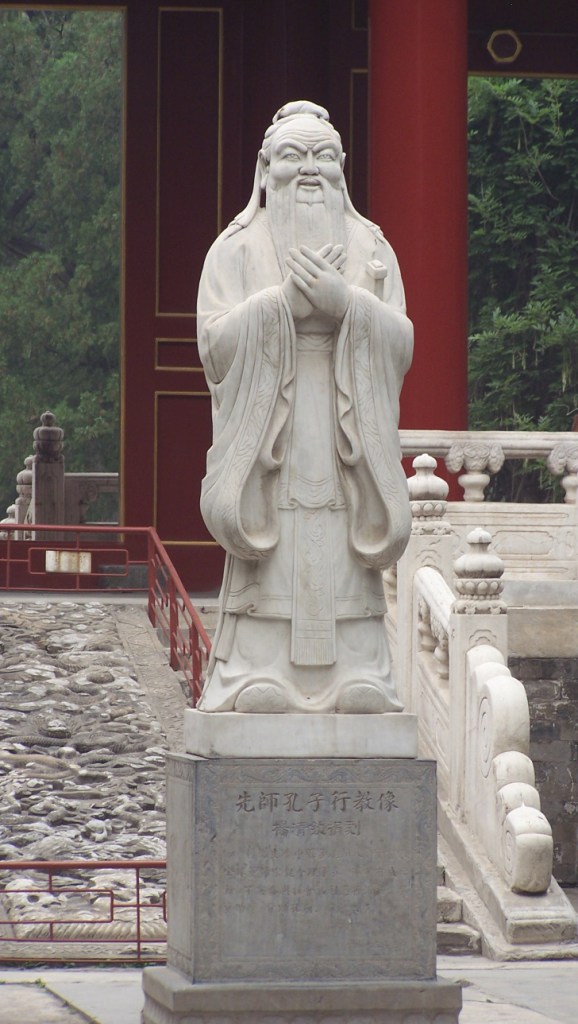
Confucius statue at the Confucian Temple, Beijing

Confucius statue at the Confucian Temple, Beijing

1.) Be kind, everyone you meet is fighting a hard battle –Plato

2.) If you choose, you are free; if you choose, you need blame no man.  –Epictetus

3.) …the greatest carver does the least cutting.  –Lao Tzu

4.) If it falls to your lot to be a street sweeper, sweep streets like Michelangelo painted pictures.  –Martin Luther King Jr

5.) A gentleman wishes to be slow to speak and quick to do.  –Confucius